


 🖨️ Print post
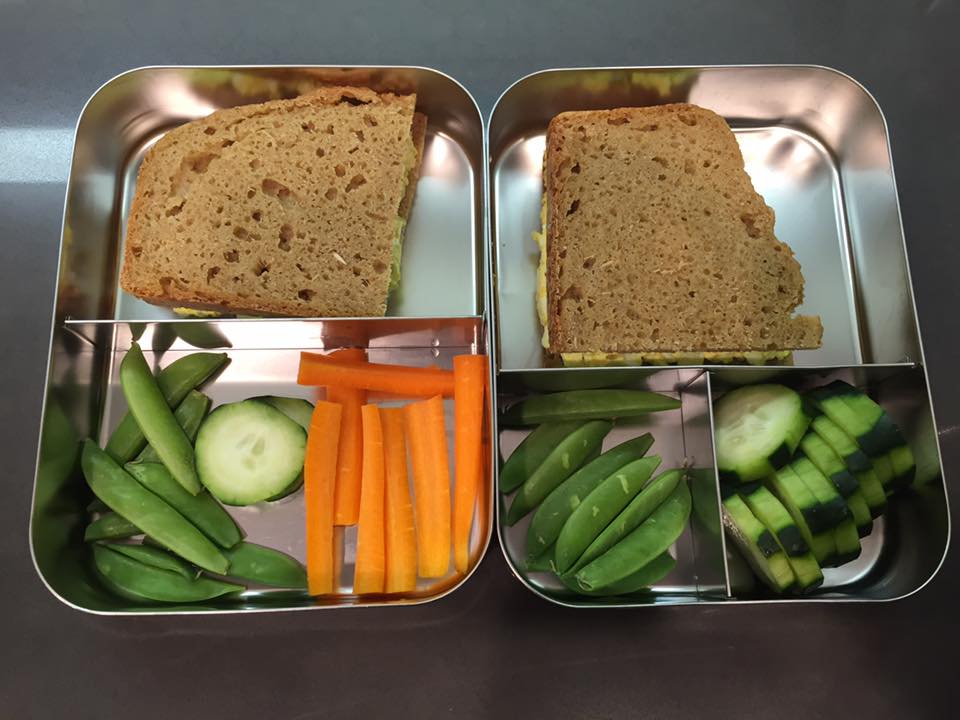
Pictured above is lunch made by Lora Brady for her children that she shared with the Nourishing Our Children community: “Egg salad sandwiches made with local pastured eggs and homemade mayo on homemade einkorn sourdough bread with fresh organic veggies. This is my boys’ favorite lunch.”
A Growing Wise Kids Column
Whether at work, school or just out-and-about at play, packing food “for the road” is a must-have skill. The lure of fast food to fill the tummy tank is unavoidable, stationed at every street corner, not to mention within the schools themselves. Don’t forget villainous vending machine temptations strategically placed down every corridor. As traditional food enthusiasts, we know it is vital to make every meal count.
Cafeteria lunches and vending machine snacks are laden with sugars and preservatives—ingredients that set a child up for poor performance on an afternoon pop quiz and for mid-class catnaps. Thus, a sack lunch becomes mandatory for those wanting to stay on top of their game nutritionally and mentally, at school and at the office. The nice part is, with a little forethought, packing lunches based on the principles of nourishing traditional diets can be easy and cost effective.
Hang Loose, Mom!
The opinion of peers can have a strong influence on a child’s feelings about belonging, especially given the impact of commercialism around eating. Some children with strong convictions about their food may not bat an eye at what other children say about their unconventional lunch items. In fact, certain situations may even lend to strengthening a child’s character about “being different.” Yet some children may consider it important to “belong” and when foods make them stand out or feel “different,” your lunch-making efforts may go to waste. If your child(ren) fall into the latter category, it’s important to indulge their “cool” needs. Are hoagie-like sandwiches the “in” thing? Well, break down and purchase the best hoagie-style bread you can find (or make your own if you are so inclined) and fill it with pastured sliced meats, homemade condiments and nourishing veggies (those they will eat). Making small allowances could mean the difference between eating your homemade lunch or trading for the junk!
Another strategy: get the kids involved! They can help with choosing lunchbox items at the store and even in the packing process. Little Susie will feel vested being a part of the lunch packing process and have more pride in consuming what she helped to create.
That extra touch may make all the difference. Try including an encouraging note, a comic, or a funny photo in your child’s lunch.
Main Lunchbox Items
Get creative with the main lunch item, it can make or break a lunch!
Dinner Leftovers: This is often the easiest food to add to a lunch, especially if you plan ahead. Try one of these Nourishing Traditions recipes in your next lunchbox meal: Maria’s Empanadas, Spicy Meat Loaf, Sesame Buffalo Wings, Spicy Lamb Pastries (Samosas) or Breaded Chicken Breast.
Sandwiches, Roll Ups and Pitas: Sandwich filling “holders” can come in many shapes and sizes, from the mess-containing pita pocket, tortilla or spongy English muffin, to the good ol’ standby multi-grain bread (preferably sprouted or slow rising sourdough). While purchasing a properly prepared loaf of bread is the simplest method of obtaining bread, homemade varieties can’t be beat. Sandwich filling options are endless; stand aside PB&J, these hipper sandwiches are moving in!
- Turkey meat slices with pesto and tomato
- Good quality salami with mustard and lettuce
- Homemade chicken liver pâté with pickles
- Apple slices, bacon, Dijon mustard, and cheddar cheese
- Grilled cheese embellished with bacon bits, shredded meat or chopped veggies
- Chicken, bacon, lettuce, tomato and mayo
- Nut butter (peanut, almond, cashew) with sliced banana
- Meat or turkey loaf with mayo and lettuce or sprouts
- Cream cheese with salmon, capers and red onion
- Chicken salad made with crispy pecans, grapes, celery and mayo
- Mashed avocado mixed with a drop of lemon juice in a pita stuffed with spinach, grated carrots, tomatoes slices, cucumber slices and provolone cheese.
Roll-ups: The great thing about roll-ups is that the “roll” can be so many different things. While the most obvious is a tortilla (preferably whole wheat and sprouted), other choices include toasted nori seaweed sheets, crepes, pancakes, or a large leaf of lettuce. Here are some easy creative inspirations:
- Raw cream cheese sprinkled with grated carrots, grated zucchini, grated apple and topped with a lettuce leaf
- Cream cheese, wild salmon, arugula or other lettuce and sliced green onion
- Mix cream cheese, chopped apple, nuts, vanilla, cinnamon and raw honey
- Refried beans (seasoned with cumin, garlic and salt), lettuce, cheese and salsa
- Hummus with shredded carrots, cucumber strips and sliced avocado
- Use a slice of deli meat to roll up a stick of cheese and add in some pickles or sauerkraut (preferably fermented and homemade), onions, a little squirt of mustard and mayo.
For more inspiration, check out the Sandwich Suggestions section of Nourishing Traditions.
Soups: Soups and chili offer the ultimate nutritional bang for your lunchbox buck. They fill the belly and warm the soul, especially on those cold winter days. These lunch items are particularly nourishing when made with a homemade bone broth base, which is bursting with vitamins and minerals, including calcium, magnesium, collagen and much more. Freeze leftover soup in meal-sized portions (glass Pyrex or small plastic yogurt-size containers work well). Thaw the needed portion overnight and warm it up on the stovetop (stay clear of the microwave) for the thermos.
“Snacky” Lunchbox Ideas
Crispy nuts and seeds (see Nourishing Traditions for how and why) – the ultimate snack item packed with fats and protein in an easy-to-digest package.
Trail mix made with crispy nuts, coconut flakes, dried fruit and just a splash of carob or chocolate chips to make it extra special.
Nutty Snack Bar (see recipe below).
Fruit salad made with chopped fruit with a dab of sour cream or crème fraiche with a touch of maple syrup and a sprinkle of dried coconut.
Apple fruit salad made with mayo, crispy walnuts, a little coconut and a dab of raw honey.
Homemade fruit leather.
Dates stuffed with crispy almond, pecan, or walnut.
Olives, green or black, from a can, drained.
Date logs/balls (available for purchase or make your own by grinding dates or raisins, add coconut or finely chopped nuts and roll into balls).
Jerky is yummy and filling. Try the Salmon Jerky in Nourishing Tradition for something a little different. For the traditional meat jerky, thinly slice a grass-fed beef or buffalo roast and sprinkle with sea salt or soak in naturally brewed soy sauce. Put it into a dehydrator or a 150 degree oven for up to 24 hours and enjoy.
Pemmican is a traditional Native North American “cake” typically used for emergency rations for adventures that may take one on long-term travels. It is make with strips of dried meat pounded into a paste, mixed with melted fat (usually tallow rendered from cow fat) and dried berries or fruit. See the recipe in Nourishing Traditions.
Hard boiled eggs with a dash of sea salt or herbed salt.
Cheese, preferably raw, cut into fun shapes with small cookie cutters.
Popcorn topped with melted organic butter, sea salt and a dash of nutritional yeast and/or parmesan cheese.
Yogurt Dough Crackers. Use the Yogurt Dough recipe in Nourishing Traditions. Add a few tablespoons of honey, roll out thin, sprinkle with salt, and puncture with a fork. Place on a cookie sheet and cook on 350°F for about 12 to 15 minutes.
Waffle squares. Use your favorite waffle recipe and add a little extra sweetener to the batter and send them off as a nice sweet bready treat.
Muffins offer an excellent way to sneak in veggies like shredded zucchini or carrot and sweet potatoes or even beets.
Baked tortilla chips with bean dip or homemade lacto-fermented salsa.
Avocado “pudding” made with mashed avocado, whole raw milk or cream with a dash of a favorite sweetener.
Raw veggies (carrots, celery, turnip sticks, pepper slices, daikon radish, etc.) or crackers make great dippers for hummus, guacamole, onion dip, or peanut sauce. Salmon dip can be made from canned salmon (drained), mixed with sour cream, kefir cheese, crème fraiche or mayo with capers and diced red onions.
Fermented veggies, especially pickles or any other choice enjoyed.
Nutty Snack Bar
1 cup nut butter of choice (preferably homemade from crispy nuts—see Nourishing Traditions for recipe)
1/4 to 1/2 cup brown rice syrup
1 cup crispy almonds, chopped into small or large pieces
1 cup dried coconut
1/2 cup crispy sunflower seeds
1 cup carob or chocolate chips or dried fruit of choice (such as dried cherries or raisins)
Mix everything together and press into a baking dish. You can leave this recipe raw and place it into the refrigerator as is or allow the flavors to meld and the chips to melt by baking it for approximately 20 minutes at 350 degrees F—either way it is yummy.
Beverages
Competing with the temptations of the soda machine or coffee station may be a challenge for some family members, so go the extra mile with beverages if this is a weakness. A homemade lacto-fermented beverage with a little whole food sweetener is far better than anything that can be found outside the home. Also, drinks can be put in the freezer overnight and by lunchtime, they are cool and frosty! Try these on for size:
- Raw whole milk!
- Kombucha with a touch of blueberry juice concentrate (not frozen juice “concentrate”, this is a bottled more nutrient-dense variety)
- Iced herb tea, such as Fruity Options, with stevia to taste
- Lemonade made with stevia or honey
- Seltzer water with cherry juice concentrate*
- Hot cocoa made with almond or coconut milk in a thermos for those cold days
- Water kefir (see recipes in Eat Fat Lose Fat by Mary Enig and Sally Fallon)
- Beet kvass with a touch of grape juice to add that extra zing of taste
- Homemade lacto-fermented ginger beer*
- Homemade lacto-fermented apple cider*
*Caution: these can be highly carbonated, be careful when transporting.
Sweet Treats
The trick to sweet treats for the lunch box is to find your family’s best compromise between health and “living in the real world” pleasure meter. Although the family may eat your famous no-sugar quinoa and barley cookies at home, that doesn’t mean they won’t be tempted to toss them for something more appealing in the vending machines or hit their buddies up for a trade at school. The first option is to try to see whether a sweet tasting whole food will satisfy this sweet treat category—especially if your lunch-toting family member is highly sensitive to sugar. This could be raw milk, a stevia-sweetened beverage, berries with a little sour cream and maple syrup mixed in or candy-ripe cherry tomatoes.
While whole foods certainly are ideal, they may not be practical in the “real world” of kid lunches. If that is the case for your little ones, any number of homemade desserty sweet treats fit the lunchbox bill—brownies, cookies, macaroons, honey nut balls or cookies made with a crispy nut base—almost any work. When choosing your lunchbox treats, the most important thing is to make them as nourishing as possible. Yes there will be a sweetener of some sort, whether it is evaporated cane juice, honey, brown rice syrup or stevia, but realize that what you are making will be off-the-charts more nutritious than anything the cafeteria or vending machines have to offer.
These “tote-able” foods will help keep you and yours nutritionally charged. The only requirements are thinking ahead, a lunch pail, preparation time and a little organization, which is no sweat once you have the basic ideas under your belt.
Sidebars
Four Tools of the Lunchbox Trade
Having the right “equipment” on hand is the first step in packing the perfect lunch for anyone. Below are the items to have ready.
1. Lunch “box.” Reusable lunch boxes or sacks come in all shapes, sizes, fabrics and colors. They are not only functional, but can fit anyone’s style. Have the kids pick out something that they consider “hip”—whether that is a hard-sided Cinderella box or the classic black collapsible cooler.
2. Freezie ice packs. Within the lunch pail aisle sit ice packs that fit nicely into lunch boxes to help the contents stay cool. Frozen lunch items can also be used in place of these packs, such as a frozen sandwich, yogurt or beverage.
3. Stainless steel thermos. This is an indispensable item to keep cold foods cold and hot foods hot. In fact, hot foods will stay so piping hot that caution should be taken when opening the thermos and taking the first swig! Not only will stainless steel thermoses retain temperatures for long periods of time, but, more important, they will not leach unwanted chemicals as do the more reactive plastic varieties.
4. Waxed paper or plastic baggies and small containers. Separating foods keeps them from getting discombobulated on a bumpy drive and prevents “mushiness.” Also, small glass bottles are great for packing drinks (if they are allowed in the cafeteria and if they won’t come back broken). Although plastic is not preferable, it may be necessary for younger children.
Time-Saving Packing Tips
1. Do what you can the night before. Mornings tend to be hectic and if all you have to do is pull a pre-made lunch out of the fridge or toss everything into the lunch pail, you can focus more on the morning meal and sending everyone off with a smile.
2. Make large batches of lunch items and freeze. For instance, make a large batch of chicken balls, serve a few for dinner, but save the rest in a plastic baggie and throw them in the freezer.
3. Freeze drinks. Pull these out the night before and put them in the fridge. By the time lunch rolls around, the drinks will still be nice and cold. It helps keep the other foods cool to boot! If the drink has milk or coconut milk in it, such as a smoothie-like mix, a little shaking distributes the remaining ice and makes the beverage refreshingly slushy.
Let’s Pack Lunchbox Samples
For simplicity, consider making one of these samples several days in a row, using this much variety on a day-to-day basis may be exhausting!
SAMPLE 1: Almond butter and banana slices between two whole grain soaked pancakes, a tangerine, trail mix, date balls/logs and raw milk.
SAMPLE 2: Pastured turkey meat slices, cheese cut into fun shapes with cookie cutters, homemade Yogurt Dough Crackers (to eat with the meat and cheese), yogurt with fresh or frozen raspberries with a dollop of unheated honey, salted cucumber slices and some kombucha.
SAMPLE 3: Nitrate-free pastured meat hot dogs with homemade ketchup for dipping, a handful of olives, carrot and turnip sticks with an onion dip mix, almond cookies and some lemonade.
SAMPLE 4: A thermos filled with meaty chili and veggies, cornbread muffins, fruit salad and apple cider.
SAMPLE 5: Salmon salad sandwich on sprouted whole grain bread, hardboiled egg with sea salt to taste, cherry tomatoes, brown rice pudding and ginger beer.
This article appeared in Wise Traditions in Food, Farming and the Healing Arts, the quarterly magazine of the Weston A. Price Foundation, Summer 2007.
🖨️ Print post
It is very difficult to find peanuts these days that havent been stored for long periods of time resulting in high levels of mold(afflotoxin) . Maybe that is the reason for alergic reactions. I would stay away from peanuts.
Why would you say stay away from the microwave?
Multiple studies have shown that heating food in a microwave does not affect the nutrition in food. Water, so boiling or steaming food by any heat method draws nutritional elements out of the food and into the water. Therefore unless you are planning on using that water, such as in stews or soups, that is the method that should be avoided. Simply reheated food in a microwave does not require a warning.
This is a very old myth that has long since been debunked by multiple scientific studies.
I’ve been making my kid’s school lunches since the early’80s. You could say I was one of the original granola moms. I always made lots of home made soups and chili which they loved. Home made cookies sweetened with honey,carob chips and pecans, raisins, fresh fruit. Now I prepare for my granddaughter, or rather, she makes her own. She’s been doing so since she could reach the counter. I’m raising her and have taught her good nutrition just like my own kids. Her favorite sandwich is whole grain bread, cucumbers, tomato, and lettuce with mayo. She loves fresh veggies and her friends sit around her begging for some. She has several other friends whose mothers are like me and send yummy healthy lunches. They trade among themselves and I am fine with that. It’s not that hard to come up with easy good lunches. And I’m a working grandma.
Hi, Our schools in Australia don’t have cafeterias like the U.S. so parents are constantly making or buying food for their kids to take for their recess and lunch breaks everyday. Our schools have a “no nut” policy meaning no food that has or may have nuts is allowed to be brought to school. This is in place so the children with nut allergies are safe. I am really struggling to find recipes to make quality snacks (for recess break) that are tasty and healthy but most importantly without nuts. Any suggestions?
Use seeds in lieu of nuts in recipes. Sunflower seeds work well generally speaking. 🙂 Meat sticks (https://traditionalcookingschool.com/food-preparation/not-so-tough-jerky/), hard boiled eggs, fruit with a seed butter, soaked crackers (Jovial has premade sourdough Einkorn crackers if you are able to spend the money) or bread, soaked pancakes rolled around a sausage or hot dog, olives, fruit and veggie slices. <3
Thank you Adrianne! It just takes another person’s suggestions to jolt some new ideas.
You’re very welcome <3 I know that feeling. If I remember, I ask myself how I would answer a person asking my same question… sometimes it works, sometimes not so much 😉
I’m having a hard time making sense of the conflicting information about cocoa. In some places cocoa is banned but here brownies and hot cocoa are suggested. What is so terrible about cocoa especially in combination with stevia or monk fruit (no sugar alcohols) when used with while grain soaked flours or raw milk? And why the conflicting instructions?
We generally do not recommend chocolate/cocoa products (as well as coffee and black tea) as they can be problematic for some; this must have slipped by, unnoticed! But as in all things, make choices based on what works for you and your family, while avoiding obvious problematic foods. An occasional chocolate treat may not be harmful for many, and it doesn’t hurt to allow ourselves an imperfect, but relatively harmless yet enjoyable, treat now and then! I make brownies a few times a year using sprouted whole grains, cocoa powder & chocolate, and honey or unrefined sugar. But again, this is not a regular “thing”, and my family enjoys this special indulgence while it helps keep them from feeling deprived.