


Page 56 - Summer2018
P. 56
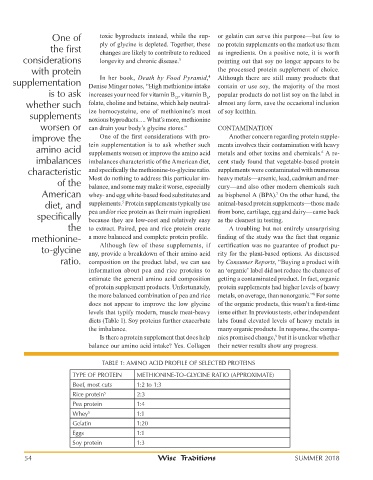
One of         toxic byproducts instead, while the sup-  or gelatin can serve this purpose—but few to

                 the first       ply of glycine is depleted. Together, these  no protein supplements on the market use them
                                 changes are likely to contribute to reduced  as ingredients. On a positive note, it is worth
        considerations           longevity and chronic disease.        pointing out that soy no longer appears to be
                                                           3
           with protein                                                the processed protein supplement of choice.
                                 In her book, Death by Food Pyramid,   Although there are still many products that
                                                                    4
     supplementation          Denise Minger notes, “High methionine intake  contain or use soy, the majority of the most
                 is to ask    increases your need for vitamin B , vitamin B ,  popular products do not list soy on the label in
                                                                    6
                                                         12
         whether such         folate, choline and betaine, which help neutral-  almost any form, save the occasional inclusion
           supplements        ize homocysteine, one of methionine’s most  of soy lecithin.
                              noxious byproducts…. What’s more, methionine
              worsen or       can drain your body’s glycine stores.”   CONTAMINATION

           improve the           One of the first considerations with pro-  Another concern regarding protein supple-
             amino acid       tein supplementation is to ask whether such  ments involves their contamination with heavy
                              supplements worsen or improve the amino acid  metals and other toxins and chemicals.  A re-
                                                                                                         6
             imbalances       imbalances characteristic of the American diet,  cent study found that vegetable-based protein
          characteristic      and specifically the methionine-to-glycine ratio.  supplements were contaminated with numerous

                    of the    Most do nothing to address this particular im-  heavy metals—arsenic, lead, cadmium and mer-
                              balance, and some may make it worse, especially  cury—and also other modern chemicals such
               American       whey- and egg white-based food substitutes and  as bisphenol A (BPA).  On the other hand, the
                                                                                          7
                diet, and     supplements.  Protein supplements typically use  animal-based protein supplements—those made
                                         5
             specifically     pea and/or rice protein as their main ingredient  from bone, cartilage, egg and dairy—came back
                              because they are low-cost and relatively easy  as the cleanest in testing.
                       the    to extract. Paired, pea and rice protein create   A troubling but not entirely unsurprising
           methionine-        a more balanced and complete protein profile.   finding of the study was the fact that organic
                                 Although few of these supplements, if  certification was no guarantee of product pu-
              to-glycine      any, provide a breakdown of their amino acid  rity for the plant-based options. As discussed
                     ratio.   composition on the product label, we can use  by Consumer Reports, “Buying a product with

                              information about pea and rice proteins to  an ‘organic’ label did not reduce the chances of
                              estimate the general amino acid composition  getting a contaminated product. In fact, organic
                              of protein supplement products. Unfortunately,  protein supplements had higher levels of heavy
                              the more balanced combination of pea and rice  metals, on average, than nonorganic.”  For some
                                                                                                      8
                              does not appear to improve the low glycine  of the organic products, this wasn’t a first-time
                              levels that typify modern, muscle meat-heavy  issue either. In previous tests, other independent
                              diets (Table 1). Soy proteins further exacerbate  labs found elevated levels of heavy metals in
                              the imbalance.                           many organic products. In response, the compa-
                                 Is there a protein supplement that does help  nies promised change,  but it is unclear whether
                                                                                          9
                              balance our amino acid intake? Yes. Collagen  their newer results show any progress.

                                  TABLE 1: AMINO ACID PROFILE OF SELECTED PROTEINS

                        TYPE OF PROTEIN      METHIONINE-TO-GLYCINE RATIO (APPROXIMATE)
                        Beef, most cuts      1:2 to 1:3
                        Rice protein 5       2:3
                        Pea protein          1:4
                        Whey 5               1:1
                        Gelatin              1:20
                        Eggs                 1:1
                        Soy protein          1:3


         54                                         Wise Traditions                             SUMMER 2018

