


Page 66 - Spring2020
P. 66
per person for moderate-quality food. For us, most of our day-to-day  GREENWASHING AND CLAIMS
         meals average around $2.50 to $4 per person, with the added bonus that   As is the case with the entire modern food
         our meal prep generally creates two to three meals’ worth of food. In  economy, meal kit companies seek to entice
         contrast, most of the meal kits run about eight to ten dollars per person  consumers through claims that their meals
         per meal. The paleo meals were the most expensive meals per person,  are “natural,” “fresh,” “healthy” and “whole.”
         partly because their contents were the closest to being fully ready-to-eat  However, many meal kit companies’ actual
         straight out of the box.                                      procurement practices don’t come close to any
             If you are a family of four wanting meal kits to cover three meals a  of these claims. Again, this is true across the
         week, you are looking at ninety-six to one hundred twenty dollars per  U.S. food system, where “greenwashing” is
         week to cover less than 15 percent of your meals! This represents an an-  rampant. For example, companies that produce
         nual cost of around five to six thousand dollars. By way of comparison,  eggs from chickens housed in confined animal
         the average U.S. family of four spends approximately seven hundred to  feeding operations (CAFOs) may festoon their
         one thousand dollars per month—or eight to twelve thousand dollars per  egg cartons with pictures of outdoor hens. Or
         year—on their entire grocery budget. Thus meal kit services definitely  products containing genetically-modified or
         target people and families on the higher side of the income spectrum.   other suspect ingredients may state that they
             One benefit of the meal services is that they arrive with premeasured  are “all-natural,” and no one will be the wiser.
         portions; a number of people I interviewed mentioned this feature favor-  It is probably prudent to be skeptical of meal
         ably. These individuals pointed out that it is not possible to eat more if  kit companies’ ubiquitous claims that their meat
         there isn’t any more food, and in addition they appreciated the reduced  and dairy are “hormone and antibiotic-free.”
         food waste. However, even if this was one up side, the benefits did not  Few companies are using pasture-raised meats
         seem to compensate for the meal kit services’ many drawbacks.   either, with the exception of some of the paleo


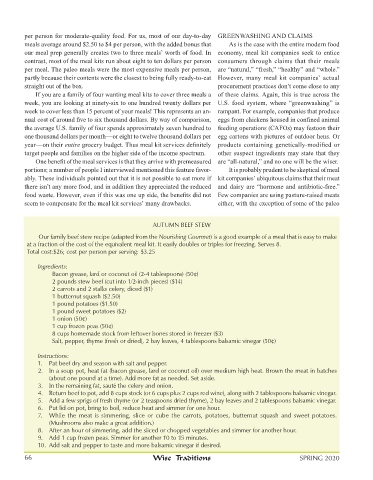
                                                  AUTUMN BEEF STEW

             Our family beef stew recipe (adapted from the Nourishing Gourmet) is a good example of a meal that is easy to make
          at a fraction of the cost of the equivalent meal kit. It easily doubles or triples for freezing. Serves 8.
          Total cost:$26; cost per person per serving: $3.25

             Ingredients:
                  Bacon grease, lard or coconut oil (2-4 tablespoons) (50¢)
                  2 pounds stew beef (cut into 1/2-inch pieces) ($14)
                  2 carrots and 2 stalks celery, diced ($1)
                  1 butternut squash ($2.50)
                  1 pound potatoes ($1.50)
                  1 pound sweet potatoes ($2)
                  1 onion (50¢)
                  1 cup frozen peas (50¢)
                  8 cups homemade stock from leftover bones stored in freezer ($3)
                  Salt, pepper, thyme (fresh or dried), 2 bay leaves, 4 tablespoons balsamic vinegar (50¢)

             Instructions:
             1.  Pat beef dry and season with salt and pepper.
             2.  In a soup pot, heat fat (bacon grease, lard or coconut oil) over medium high heat. Brown the meat in batches
                 (about one pound at a time). Add more fat as needed. Set aside.
             3.  In the remaining fat, sauté the celery and onion.
             4.  Return beef to pot, add 8 cups stock (or 6 cups plus 2 cups red wine), along with 2 tablespoons balsamic vinegar.
             5.  Add a few sprigs of fresh thyme (or 2 teaspoons dried thyme), 2 bay leaves and 2 tablespoons balsamic vinegar.
             6.  Put lid on pot, bring to boil, reduce heat and simmer for one hour.
             7.  While the meat is simmering, slice or cube the carrots, potatoes, butternut squash and sweet potatoes.
                 (Mushrooms also make a great addition.)
             8.  After an hour of simmering, add the sliced or chopped vegetables and simmer for another hour.
             9.  Add 1 cup frozen peas. Simmer for another 10 to 15 minutes.
             10.  Add salt and pepper to taste and more balsamic vinegar if desired.
         66                                       Wise Traditions                                 SPRING 2020

