


Page 87 - Summer2018
P. 87
organic movement clearly had this on their minds when they created the  production prices. Several years  ago,  most
            pasture rule in the first place.                              organic dairies received thirty-five to forty
                It appears that the USDA pasture rules must be followed by everyone  dollars or more per hundredweight for their
            except for big CAFOs, resulting in a devastating and drastic loss of many  milk. Now that price is dropping and in many
            small organic dairy farms across the United States. The added eighty  places is twenty-two dollars per hundredweight
            thousand cows from the non-compliant CAFO operations have become  with some areas left with no market or buyers
            the cheap “one-stop shopping source” for Group Danone, which owns  at all. Then the milk goes into the conventional
            Horizon Organic Milk, Stonyfield and other big box brands. These eighty  markets at less than fifteen dollars per hundred-
            thousand CAFO cows are roughly equivalent to most of the California  weight. The break-even cost for production of
            organic dairies put together! It is no wonder that organic dairies are be-  organic milk is roughly twenty-eight to thirty
            ing shut down. There is a massive national oversupply of organic milk  dollars per hundredweight if organic inputs are
            and there are no supply limitations now that nature’s natural pasture rule  used.
            limits have been removed.
                When the founders of the organic movement originally designed the  REAL ORGANIC PROJECT
            organic rules, the pasture rule ensured many benefits. Cows on green   As a consumer of organic dairy products,
            pastures made better milk with high CLA and good omega-3 fatty acid  you are left wondering what to do and whom to
            ratios. Cows on pastures sequester carbon and save our air from the  support? Organics should be about fair rules and
            ever-increasing burdens of carbon dioxide. Cows in CAFOs with their  evenly enforced regulations. As it stands today,
            huge manure lagoons are part of the problem, while cows on pastures  it’s not fair and it’s not evenly enforced. When
            are part of the solution.                                     you have no enforcement of standards, you have
                 The pasture rule is also critical because of sustainable supply man-  no organic market.
            agement. If there are no limits to production of organic milk, then it will   There is now a movement to place an
            become over-supplied and prices will drop, just like in the conventional  add-on label on organic products. One of the
            dairy system with its chronic oversupply problem and below-cost-of-  most popular is the Real Organic Project (re-


                                 OUR GOAL: RAW MILK DISTRIBUTION LEGAL IN ALL FIFTY STATES
                A long-term goal of the Weston A. Price Foundation has been the establishment of legal access to raw milk in all fifty
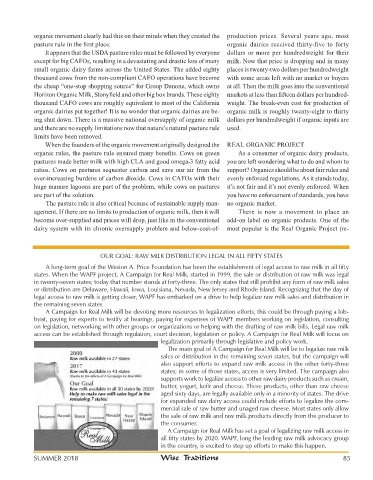
            states. When the WAPF project, A Campaign for Real Milk, started in 1999, the sale or distribution of raw milk was legal
            in twenty-seven states; today that number stands at forty-three. The only states that still prohibit any form of raw milk sales
            or distribution are Delaware, Hawaii, Iowa, Louisiana, Nevada, New Jersey and Rhode Island. Recognizing that the day of
            legal access to raw milk is getting closer, WAPF has embarked on a drive to help legalize raw milk sales and distribution in
            the remaining seven states.
                A Campaign for Real Milk will be devoting more resources to legalization efforts; this could be through paying a lob-
            byist, paying for experts to testify at hearings, paying for expenses of WAPF members working on legislation, consulting
            on legislation, networking with other groups or organizations or helping with the drafting of raw milk bills. Legal raw milk
            access can be established through regulation, court decision, legislation or policy. A Campaign for Real Milk will focus on
                                                     legalization primarily through legislative and policy work.
                                                       The main goal of A Campaign for Real Milk will be to legalize raw milk
                                                     sales or distribution in the remaining seven states, but the campaign will
                                                     also support efforts to expand raw milk access in the other forty-three
                                                     states; in some of those states, access is very limited. The campaign also
                                                     supports work to legalize access to other raw dairy products such as cream,
                                                     butter, yogurt, kefir and cheese. These products, other than raw cheese
                                                     aged sixty days, are legally available only in a minority of states. The drive
                                                     for expanded raw dairy access could include efforts to legalize the com-
                                                     mercial sale of raw butter and unaged raw cheese. Most states only allow
                                                     the sale of raw milk and raw milk products directly from the producer to
                                                     the consumer.
                                                       A Campaign for Real Milk has set a goal of legalizing raw milk access in
                                                     all fifty states by 2020. WAPF, long the leading raw milk advocacy group
                                                     in the country, is excited to step up efforts to make this happen.

            SUMMER 2018                              Wise Traditions                                                   85

