


Page 24 - Fall2013
P. 24
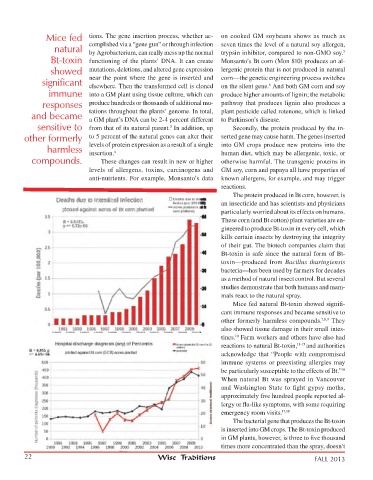
Mice fed      tions. The gene insertion process, whether ac-  on cooked GM soybeans shows as much as

                   natural    complished via a “gene gun” or through infection  seven times the level of a natural soy allergen,
                              by Agrobacterium, can really mess up the normal  trypsin inhibitor, compared to non-GMO soy.
                                                                                                                5
                 Bt-toxin     functioning of the plants’ DNA. It can create  Monsanto’s Bt corn (Mon 810) produces an al-
                 showed       mutations, deletions, and altered gene expression  lergenic protein that is not produced in natural
               significant    near the point where the gene is inserted and  corn—the genetic engineering process switches
                              elsewhere. Then the transformed cell is cloned  on the silent gene.  And both GM corn and soy
                                                                                        6
                 immune       into a GM plant using tissue culture, which can  produce higher amounts of lignin; the metabolic
               responses      produce hundreds or thousands of additional mu-  pathway that produces lignin also produces a
           and became         tations throughout the plants’ genome. In total,  plant pesticide called rotenone, which is linked
                              a GM plant’s DNA can be 2-4 percent different  to Parkinson’s disease.
             sensitive to     from that of its natural parent.  In addition, up     Secondly, the protein produced by the in-
                                                        3
         other formerly       to 5 percent of the natural genes can alter their  serted gene may cause harm. The genes inserted
                harmless      levels of protein expression as a result of a single  into GM crops produce new proteins into the
                                                                         human diet, which may be allergenic, toxic, or
                                      4
                              insertion.
           compounds.             These changes can result in new or higher  otherwise harmful. The transgenic proteins in
                              levels of allergens, toxins, carcinogens and  GM soy, corn and papaya all have properties of
                              anti-nutrients. For example, Monsanto’s data  known allergens, for example, and may trigger
                                                                         reactions.
                                                                            The protein produced in Bt corn, however, is
                                                                         an insecticide and has scientists and physicians
                                                                         particularly worried about its effects on humans.
                                                                         These corn (and Bt cotton) plant varieties are en-
                                                                         gineered to produce Bt-toxin in every cell, which
                                                                         kills certain insects by destroying the integrity
                                                                         of their gut. The biotech companies claim that
                                                                         Bt-toxin is safe since the natural form of Bt-
                                                                         toxin—produced from Bacillus thuringiensis
                                                                         bacteria—has been used by farmers for decades
                                                                         as a method of natural insect control. But several
                                                                         studies demonstrate that both humans and mam-
                                                                         mals react to the natural spray.
                                                                            Mice fed natural Bt-toxin showed signifi-
                                                                         cant immune responses and became sensitive to
                                                                         other formerly harmless compounds. 7,8,9  They
                                                                         also showed tissue damage in their small intes-
                                                                         tines.  Farm workers and others have also had
                                                                             10
                                                                         reactions to natural Bt-toxin, 11-15  and authorities
                                                                         acknowledge that “People with compromised
                                                                         immune systems or preexisting allergies may
                                                                         be particularly susceptible to the effects of Bt.”
                                                                                                               16
                                                                         When natural Bt was sprayed in Vancouver
                                                                         and Washington State to fight gypsy moths,
                                                                         approximately five hundred people reported al-
                                                                         lergy or flu-like symptoms, with some requiring
                                                                         emergency room visits. 17,18
                                                                            The bacterial gene that produces the Bt-toxin
                                                                         is inserted into GM crops. The Bt-toxin produced
                                                                         in GM plants, however, is three to five thousand
                                                                         times more concentrated than the spray, doesn’t
         22                                         Wise Traditions                                    FALL 2013                   FALL 2013                                  Wise Traditions


   123816_text.indd   22                                                                                       9/20/13   1:21 AM

