


Page 45 - Summer2018
P. 45
“modulated through several separate systems,  four years old have the second highest rate of   Many central
            including neural, endocrine and [intestinal]  total neurological deaths across twenty Western
            luminal factors” —and a disturbance in any  countries, and the death rate increased by 82   nervous
                          15
            of these systems can contribute to constipation.  percent from 1989 to 2010.  Parkinson’s dis-  system
                                                                             18
            So-called “secondary” constipation is the result  ease (PD), for example, is not only the second   disorders are
            of organic or systemic disease—including neu-  most common neurodegenerative disease in
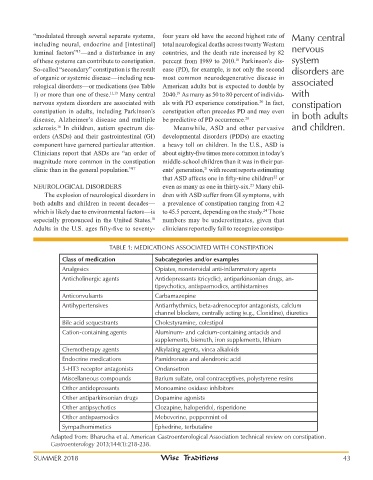
            rological disorders—or medications (see Table  American adults but is expected to double by   associated
            1) or more than one of these. 11,13  Many central  2040.  As many as 50 to 80 percent of individu-  with
                                                          19
            nervous system disorders are associated with  als with PD experience constipation.  In fact,   constipation
                                                                                     20
            constipation in adults, including Parkinson’s  constipation often precedes PD and may even
            disease, Alzheimer’s disease and multiple  be predictive of PD occurrence.         in both adults
                                                                                20
            sclerosis.  In children, autism spectrum dis-  Meanwhile, ASD and other pervasive   and children.
                    16
            orders (ASDs) and their gastrointestinal (GI)  developmental disorders (PDDs) are exacting
            component have garnered particular attention.  a heavy toll on children. In the U.S., ASD is
            Clinicians report that ASDs are “an order of  about eighty-five times more common in today’s
            magnitude more common in the constipation  middle-school children than it was in their par-
            clinic than in the general population.” 17  ents’ generation,  with recent reports estimating
                                                                   21
                                                      that ASD affects one in fifty-nine children  or
                                                                                         22
            NEUROLOGICAL DISORDERS                    even as many as one in thirty-six.  Many chil-
                                                                                  23
               The explosion of neurological disorders in  dren with ASD suffer from GI symptoms, with
            both adults and children in recent decades—  a prevalence of constipation ranging from 4.2
            which is likely due to environmental factors—is  to 45.5 percent, depending on the study.  Those
                                                                                      24
            especially pronounced in the United States.   numbers may be underestimates, given that
                                                  18
            Adults in the U.S. ages fifty-five to seventy-  clinicians reportedly fail to recognize constipa-

                                    TABLE 1: MEDICATIONS ASSOCIATED WITH CONSTIPATION

                     Class of medication           Subcategories and/or examples
                     Analgesics                    Opiates, nonsteroidal anti-inflammatory agents
                     Anticholinergic agents        Antidepressants (tricyclic), antiparkinsonian drugs, an-
                                                   tipsychotics, antispasmodics, antihistamines
                     Anticonvulsants               Carbamazepine
                     Antihypertensives             Antiarrhythmics, beta-adrenoceptor antagonists, calcium
                                                   channel blockers, centrally acting (e.g., Clonidine), diuretics
                     Bile acid sequestrants        Cholestyramine, colestipol
                     Cation-containing agents      Aluminum- and calcium-containing antacids and
                                                   supplements, bismuth, iron supplements, lithium
                     Chemotherapy agents           Alkylating agents, vinca alkaloids
                     Endocrine medications         Pamidronate and alendronic acid
                     5-HT3 receptor antagonists    Ondansetron
                     Miscellaneous compounds       Barium sulfate, oral contraceptives, polystyrene resins
                     Other antidepressants         Monoamine oxidase inhibitors
                     Other antiparkinsonian drugs  Dopamine agonists
                     Other antipsychotics          Clozapine, haloperidol, risperidone
                     Other antispasmodics          Mebeverine, peppermint oil
                     Sympathomimetics              Ephedrine, terbutaline
                 Adapted from: Bharucha et al. American Gastroenterological Association technical review on constipation.
                 Gastroenterology 2013;144(1):218-238.

            SUMMER 2018                              Wise Traditions                                                   43

