


MAKING THE MOST OF BREAKFAST
Breaking one’s fast from a restful night of sleep with nourishing foods charges all body cylinders. In fact, our mood and performance for the entire day is dependent on a good breakfast, as it sets the stage for balanced body chemistry and hormones. Compared to breakfast-skippers, children and adults alike who adequately fuel up in the morning have more energy and better emotional stability and find it easier to maintain their body weight. If you seek motivation to eat a good breakfast, keep reading; if you are stuck in a rut and in need of creative recipes, keep reading. Breakfast should be relaxed and nourishing. . . and non-negotiable.
BREAKFAST EATERS THINK BETTER
One study following a group of students found that they had better mental performance, including attention and memory, after eating breakfast compared to when the same group didn’t eat anything. The researchers also compared sugary ready-to-eat cereal to oatmeal and found oatmeal’s nutritional advantage (more nourishing whole food meal) made it a better choice at improving brain power and encouraging better test scores.1 Additional stats show higher test grades and better school attendance in breakfast eaters than in non-breakfast eaters too.2 Bottom line: to excel in whatever we do, whether it be school, work, play or relationships, we need breakfast to be at the top of our mental game.
Well-nourished students in Madrid who consumed an adequate breakfast (more than 20 percent of their daily energy) achieved better reasoning scores in the scholastic aptitude test (SAT) than did breakfast-skippers.3 What a good motivator for your profession-aspiring teen: “If you are college-bound, eat breakfast!” Same goes for more mature folks: a group of adults aged sixty-one to seventy-nine years who consumed a nourishing breakfast of such whole foods as whole grains and eggs fared better on memory tests in the morning than when that same group ate sweetened cereals or doughnuts.4 So a nourishing breakfast is important for the mental health of both young whippersnappers and those with a few miles on their tires.
BREAKFAST EATERS CONTROL WEIGHT BETTER
Those who skip breakfast tend to eat more calories throughout the day, ultimately leading to weight gain.5 Here’s one reason: skipping breakfast eventually results in insulin becoming less sensitive, that is, insulin resistance. Insulin is a hormone that carts sugar around in the blood, taking it either to be used as cell energy or to be converted to fat and stored. If body cell receptors (acting like miniature doors) are “less sensitive” or resistant to insulin, when sugar-loaded insulin comes to deliver its cargo to a cell, the cell refuses entry. This results in excess sugars floating around the bloodstream. The body then tries to produce more insulin to get the sugar into the resistant cells, and a cycle begins. This precarious scenario causes not only weight gain, hypoglycemic symptoms (light-headedness, low energy, brain-fog), but contributes to obesity and heart disease as well. Eventually the body may become unable to make insulin, which allows blood sugar to rage out of control, causing type- 2 diabetes (simply an extreme case of insulin resistance).6
Not surprisingly, obesity and insulin resistance syndrome rates are 50 percent lower in breakfast-eaters compared to those who frequently skip breakfast.7 Breakfast-eaters also tend to make overall better food choices throughout the day. Skipping meals encourages overeating at later meals and “the munchies” for more snacks. A study at Brown Medical School evaluating approximately four thousand people who have kept weight off successfully found that 78 percent ate breakfast daily.8 On the flip side, an earlier study from the University of Massachusetts found that people who habitually missed the morning meal were four times more likely to be obese.9 Simply put, breakfast gets one’s metabolism off to a good start and keeps the body more balanced all day long.
WHAT NOT TO EAT
A typical, politically correct, fat-phobic breakfast might include a refined-flour muffin, a glass of OJ, non-fat sweetened yogurt and, worst of all, an egg white omelet. Oh, and don’t forget the cup of caffeinated Joe. Even if these continental- style breakfast choices are low in sugar, the scarcity of nourishing proteins and healing fats makes them miserable choices for nourishing a healthy body. Even worse is Americans’ reliance on boxed cold cereals involving some menagerie of machine-generated crunchy puffs of brightly colored shapes and candy-like creations.
Let’s review four compelling reasons to opt out of these concoctions. First, the sugar content of many breakfast cereals rivals that found in a chocolate glazed donut!10 (For more info on the damaging effects of excess sugar consumption, see “Zapping Sugar Cravings” in the Fall 2010 Wise Traditions.) Second, the process necessary to achieve these kid-enticing flakes, shapes and crunch is called extrusion. This process combines high temperatures and high pressure, ultimately rendering many nutrients useless as well as damaging the residing proteins (or amino acids) within the grain and making them toxic to ingest.11
A third reason boxed cereals are a poor choice for breakfast is inadequate preparation, making the grains difficult to digest. To get the best nourishment and digestibility out of grains, it is best to prepare them in such a way that inactivates such compounds as enzyme inhibitors, 12 which would otherwise hamper digestion, and phytic acid, a compound that combines with minerals and prevents their absorption.13,14 The traditional practices of soaking and sprouting grains accomplishes this through pre-digestion of the food. This explains why sprouted foods are less likely to produce allergic reactions in those who are sensitive.15 And gluten-containing flours, especially wheat, are the main ingredient in most cereals and happen to be one of the most troublesome allergy-causing foods.
Dr. Braly, co-author of Dangerous Grains, believes that undiagnosed sensitivities to gluten and other grain proteins contribute to many autoimmune and neurological conditions, bone loss, chronic pain, learning problems, fatigue, intestinal complaints and more.16 The wide use and acceptance of wheat may be why many folks who have trouble with gluten fail to consider it as an underlying contributor. Moreover, there is evidence that high-gluten diets alter the normal lining of the small intestine in healthy people,17 which opens up the possibility that gluten, particularly in large amounts, is not ideal for many of us.
Finally, even if you avoid sugary cereals and opt for the “healthier” choices, fiber is typically a focal point, often with the promise of promoting “regularity.” In fact, just one cup of some fiber-fortified cereals dishes up more fiber than the highest recommended dose for fiber laxatives. However, recent research shows that overdoing fiber—from foods or supplements—can have detrimental effects on the body. Konstantin Monastyrsky, author of Fiber Menace, offers compelling arguments and research that proves that high-fiber diets contribute to a whole host of conditions—the very conditions believed to be improved by more fiber—including hemorrhoids, constipation, irritable bowel syndrome, and even colon cancer.
Monastyrsky explains that too much fiber creates large stools that over-stretch the intestinal tract, eventually causing damage. Also, bacteria in the intestinal tract ferment fiber and when too much fermentation occurs with excess fiber, the acidity that results causes intestinal inflammation, bloating and gas. Furthermore, fiber interferes with food’s digestion in the stomach, resulting in heartburn and indigestion.18 Ultimately, fiber isn’t the super-nutrient it’s blindly believed to be, especially the form found in hard-to-digest, highly-processed cereals. The small amount of fiber humans are designed to consume should come from whole, unprocessed foods that are properly prepared, such as cooked vegetables and soaked grains and legumes or sour leavened flours. Once again, whole, unprocessed foods prepared in the wise ways of our ancestors win in the end!
| SIDEBARS: PLANNED BREAKFASTSCertain children, or adults for that matter, thrive on having a plan. Here is when a weekly breakfast schedule might come in handy, especially for those hectic school days when there is no time for dilly dallying with decisions. Why not make a set breakfast for each day of the week? Involve everyone who will be partaking in the meal in the decision-making process. Monday and Wednesday could be oatmeal with a pool of butter and frozen berries swirled in, Tuesday and Thursday one-pot egg and veggie scramble, Friday a yogurt- or kefir-based smoothie along with a hard-boiled egg. Saturdays could be pancake day and Sunday could be celebrated with an omelet.
Breakfast Favorites from Fellow WAPF-Foodies Sally Fallon Morell , President of the Weston A. Price Foundation: “Our favorite is to bake no-nitrate bacon in a pan with fruit, such as pineapple slices, apple slices, banana, even apricots, peaches or nectarines, or with cherry tomatoes and mushrooms. This is served with eggs any style—scrambled, fried, omelet.” She enjoys this with a glass of raw whole milk. Her breakfast tonics include Swedish bitters, beet kvass and cod liver oil and high-vitamin butter oil mixed with warm water. Summer Waters , LAc, NTP, WAPF Chapter Leader: “My favorite breakfast is homemade soup. I enjoy chicken soup with chicken broth, sautéed veggies, chicken and a spoonful of bacon fat, ghee or butter. I then add a scoop of miso to each bowl as I prepare it to keep the miso alive. That way I have all my most cherished food groups in one meal: meat, veggies, broth, fat, and ferment! Adding different herbs is another way to add variation and even more nutrition. A dollop of sour cream or crème fraîche or maybe some smoked salmon or bacon pieces crumbled on top of different soups are excellent too.” Ramiel Nagel, author of Cure Tooth Decay, children and spouse: “Baked sweet potatoes fried in tallow, lard or ghee with breakfast sausage or bacon, and sauerkraut or kim chee, with cod liver oil and/or butter oil as supplement.” Chris Masterjohn , author and creator of www.cholesterol-and-health.com: “Three raw egg yolks (I crack the egg into my hand and let the white slip through my fingers and fall into the trash, and pop the yolk into my mouth). Large bowl of yogurt made from raw milk and fermented for twenty-four hours, full of frozen mixed berries. A large spoonful of raw sauerkraut and a raw orange. If I’m being a good boy, I’ll add one-eighth to one-fourth pound of liver, lightly pan-fried for about one minute in coconut oil. A larger breakfast, say after a workout, may look more like a lunch: grass-fed hamburger topped with melted cheddar cheese and sliced bell peppers sautéed in coconut oil on two pieces of toast made from French Meadows European Style 100% rye sourdough bread with butter, topped with some tomato sauce and a raw orange. Two quarts of salad made from romaine lettuce, strawberries, unpasteurized olives, green onions, carrots, celery, bell peppers, and feta cheese, topped with macadamia nut oil and raw apple cider vinegar. Raw sauerkraut or pickles.” Anne Fischer Silva , Clinical Nutritionist: “I came up with a recipe for breakfast that is a nice alternative to eggs and a very wholesome switch from pancakes or French toast.” See Breakfast Bar recipe (see on page 67). Jill Cruz , WAPF chapter leader in Chicago: “Our favorite is a berry smoothie: three tablespoons of raw yogurt, two tablespoons of raw cream, one-half cup fresh berries, two to three raw egg yolks. Blend and drink. If you leave out the yogurt, increase the cream to three or four tablespoons and only add two egg yolks; it turns into a lovely mousse you can eat with a spoon out of a parfait glass.” Jen Allbritton, CN: “There are two breakfasts that make me feel well-nourished and ready to take on the day. One is a bowl of homemade, twenty-four-hour-cultured yogurt made from pastured raw milk, combined with fresh or frozen raspberries, a raw egg yolk, a dribble of raw honey and handful of coconut granola (recipe on page 67) or ground almonds or walnuts. Second is a one-skillet veggie egg scramble. Sauté veggies, whatever is handy (for me it is usually a mix of onion, cabbage, carrots, zucchini and peppers), in plenty of butter, ghee or coconut oil and once the veggies are soft, drop in two eggs (or leftover meat and one egg works great too) and mix them into the veggie mix. Flip the mixture until the eggs are cooked through. Accompany with feta cheese, raw cherry tomatoes and a clump of raw sauerkraut.” Allbritton boys: “My two young kiddos adore oatmeal. I soak oat groats overnight (or all day if I am going to cook them in the crock pot overnight) often with another grain, like amaranth or brown rice, with a dollop of yogurt to jumpstart those enzymes. When ready to cook I usually include a can of coconut milk in the cooking water to add extra nourishing fats. To the final product, I add a pastured egg, gobs of butter and coconut oil, a dash of salt, coconut flakes and a sweetener. I stir in a small amount of frozen fruit to cool it off right before serving. Usually, I will make enough to last four of five days and simply re-heat each morning. On warmer days, Strawberry Breakfast Ice Cream (recipe on page 67) is a hit, as well as yummy, kefir-based, fat-loaded smoothies with several egg yolks and coconut oil.” |
To drive these anti-boxed cereal points home, Sally Fallon Morell tells us in Nourishing Traditions about an unpublished experiment performed at the University of Michigan in 1960. The experiment was actually in jest; however, the results are no laughing matter.
Three groups of six rats were observed: group one was fed cornflakes and water; group two the cardboard box that the cornflakes came in and water; and the control group received rat chow and water. The control group remained in good health through the testing period. However, the rats fed cornflakes and water died before those fed the cardboard box. From apparent outward behavior and autopsies, the cornflake-eating rats showed signs of severe insulin instability caused by dramatic insults to blood sugar and damage to the nervous system. Who knew that those consuming boxed cereals would be better off choking down the thirty-cent box instead!19
THE RULES OF A GOOD BREAKFAST
Breakfast can be as simple or involved as you like, but there are four rules that should be followed:
1. Fat and protein should be the featured nutrients. For most people, a carbohydrate-loaded breakfast based on vegetable juices, fruits, grains, flour and sugar doesn’t offer enough nutritional bang to get the day off to a good start. Breakfast-candidate foods (preferably produced through non-toxic, pastured-based agriculture) well-endowed with protein and fat include eggs, meats, fish, full-fat dairy foods such as yogurt or kefir, nuts and seeds, coconut oil, lard, butter and avocados. Once these fats and proteins are decided on, fruits, vegetables, tubers and whole grains make a wonderful side note.
2. Make at least a portion of breakfast food easily digestible through soaking grains, sour leavening of flours for breads, culturing dairy products, or fermenting fruits and vegetables. In Nourishing Traditions, Sally Fallon Morell reminds us that, “Almost everywhere in the world people ate fermented foods on a daily basis. They often ate them for breakfast, no doubt because after a night of sleep the body needs something that is rapidly and easily digested.”20
3. Don’t rush! Get yourself in the habit of going to sleep early enough to allow time in the morning to relax through your morning meal.
4. Plan ahead. Know what you will have tomorrow, whether it is going to be a beautifully laid out fare with flowers and a table cloth or something you throw together in under two minutes.
| SIDEBAR: SAMPLE BREAKFASTS FROM AROUND THE WORLDWhile many cultures have moved away from their native food roots, there are certain nourishing traditional breakfasts still served around the world.• Cambodia : Rice congee (a type of rice porridge soup) is a popular breakfast food usually accompanied with salted eggs, pickled vegetables or dried fish. Chicken congee, pig’s blood congee, and seafood congee are other favorites.• South Korea: Breakfast typically involves a bowl of rice along with stock made from simmered meats, bones, shell fish, anchovies with vegetables (radish, onion, seaweed, cucumber, squash, etc.) and an oil or fat. Kimchi (fermented vegetables and seasonings) is often served on the side.
• Japan : A traditional Japanese breakfast contains miso soup, rice with nori or other garnishes, natto (a type of fermented soybeans), rice porridge, grilled fish, raw egg and a pickled vegetable. • Scandinavia : A fat and protein-rich fare is common, including fish, cheese, eggs, bacon, whole-grain porridges, breads, potatoes, and fruits, along with juices, coffee, and tea or kulturmelk (Norway), a cultured milk similar to buttermilk or yogurt. |
One reason protein and fat are so essential for breakfast is that they are critical for overall brain chemistry balance. And one of the best sources of protein and fat is the incredible, edible egg! Eggs, laid by sun-bathing, bug-munching chickens, provide an especially brainy breakfast, being the richest source of the nutrient choline. This brain-loving vitamin is a key constituent of cell membranes, giving them flexibility and structure. It also provides a large portion of two fat-like brain molecules that account for a high percentage of the brain’s total mass, meaning choline supports optimal brain function.21
INCREDIBLE EGGS
Talking about eggs, an interesting study funded by the American Egg Board found that choosing two eggs for breakfast over a bagel resulted in more weight loss and higher energy levels, even though both breakfasts consisted of the same number of calories. Now, there are three take-home points from this study. One, protein is the body’s metabolism controller, creating balance and stabilizing appetite and hunger. Two, grains, especially refined varieties and definitely without the accompaniment of protein and fat, typically send one’s body chemistry into a frenzy while trying to recover and compensate. Three, calories are not just calories; their source makes a big difference in how they work in the body and on our metabolism.
A tip from Sally Fallon Morell on fried eggs: cook them sunny side up with a lid on the pan. This keeps the yolk soft and ensures the white congeals. Nothing puts children off eggs like runny whites. Also with scrambled eggs, they need to be really well beaten so no white appears in the cooked eggs—some children can’t stand to see the whites in scrambled eggs.
BREAKFAST BASICS
Keeping to a basic, old-fashioned breakfast menu is fine and dandy—eggs (prepared any way: scrambled, poached, boiled, fried, omelet) with a side of sausage or bacon from pastured animals; soaked porridge loaded with butter, coconut oil, nuts, seeds and berries; or French toast (made with properly prepared sour dough or sprouted bread) served with sausage, butter and a maple syrup-sweetened fruit sauce with a side of berries and cream. However, there are days when it is fun to step outside the box, and when that day comes, consider these inspirational ideas:
• Breakfast soup: “For many cultures, soup is a breakfast food. The Japanese begin their day with a bowl of fish broth and rice. French children traditionally consumed leftover soup before they started off to school.”23 See Summer Waters’ breakfast account on page 64.
• Meat and egg muffins (Meffins!): The variations for scrumptious morning breakfast muffins are endless with different meats, sausages, vegetables and cheese. Make a big batch and freeze your favorite. See recipe on page 67.
• Scrapple or liverwurst (pâté-like foods made from organ meats): sliced and fried until the outside is crispy along with scrambled eggs or stuffed in a breakfast burrito.
• Fruit and cheese sundae: Cottage cheese or ricotta with berries, nuts and seeds piled high in a fun fluted glass.
• Homemade cold cereal or granola: There are properly prepared cereal and granola recipes in Eat Fat Lose Fat by Mary Enig, PhD. Serve with cream or cultured dairy product.
• Dinner leftovers: Salmon patties, roast with gravy and fixings, shrimp stir-fry, egg or chicken salad, simple buffalo patties with fixings.
• Smoked salmon: Include with cream cheese or butter on properly prepared crackers or sourdough bread.
EGG BEATERS: CANNOT SUPPORT LIFE
Egg Beaters appeared on the market in the early 1970s. Fabricated with egg whites, corn oil, nonfat dry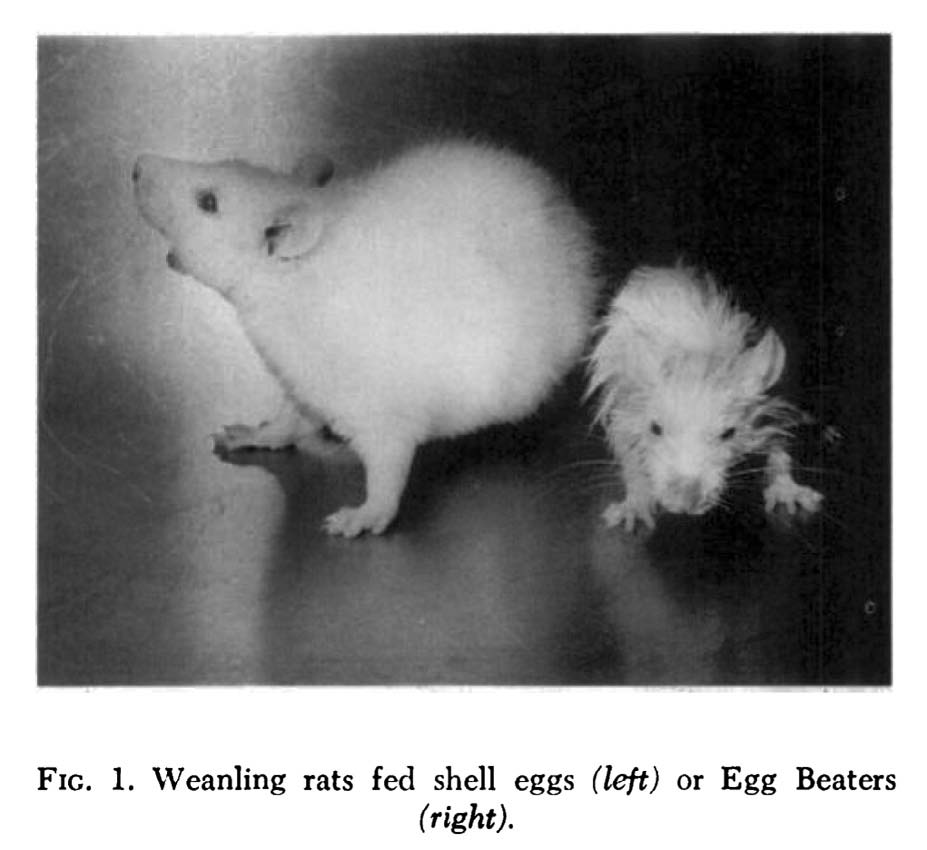 milk, emulsifiers, additives, artificial flavor and synthetic nutrients, the product contains the same levels of protein, fat, calories, macrominerals and vitamins as real eggs. But Egg Beaters are devoid of cholesterol as well as saturated fat and important unsaturated fatty acids, such as arachidonic acid. The weanling rats fed Egg Beaters did not grow well and lacked proper fur development. All those fed Egg Beaters developed diarrhea within one week and died within three to four weeks.
The authors of the paper, Meena Kasaii Navidi and Fred A. Kummerow, noted that Egg Beaters were not appropriate “as a substitute for egg yolk in infant feeding by pediatricians who may consider supplementation with cholesterol-free substitutes early in life in order to prevent the development of atherosclerosis” (Pediatrics Vol 53, No 4 April 1974). The dramatic results obtained in this study may have saved thousands of babies from the fate of being fed Egg Beaters; however the product is routinely served to the elderly in nursing homes.
| SIDEBAR: CREATIVE BREAKFAST IDEAS FOR THE WHOLE FAMILYCOCONUT GRANOLA4-5 tablespoons soft butter or coconut oil 4-5 tablespoons honey 3 cups large coconut flakes 1 cup halved crispy cashews 1 cup chopped or ground crispy almonds 1 to 2 cups halved crispy pecans or crispy walnutsPreheat oven to 250 degrees. Mix butter or coconut oil, honey and coconut flakes together in large bowl. Add crispy nuts and stir together until well coated. Spread evenly on cookie sheet in one layer. Bake in oven for approximately 20 minutes, stirring occasionally to prevent burning. Beware of overcooking! When the granola is a golden brown, pull out and allow it to cool completely, which is when it will get crispy. Good snack or on yogurt or fruit. This is a variation of a recipe created by Deb Millard. (Note: See Nourishing Traditions on how to make crispy nuts.)STRAWBERRY BREAKFAST ICE CREAM 1 1/2 cups frozen strawberries Blend all together in a food processor or blender and serve immediately. BREAKFAST BARS 1 1/4 cup almond flour (soaked, dehydrated nuts ground to a flour) In a large bowl, combine almond flour, salt and baking soda. Add coconut oil, maple syrup, water, and vanilla. Stir dry ingredients into wet. Mix in shredded coconut, seeds, and dried fruit. Grease an 8×8 baking dish with coconut oil. Press the dough into the baking dish, wetting your hands with water to help pat the dough down evenly. Bake at 350 degrees for 20 minutes. Cut and serve. Cool before cutting; these bars are crumbly. Very tasty topped with a dollop of yogurt or crème fraîche. *Option: For another variation of grain-free granola, leave out the water and prepare as usual. Once the bars have cooled, break into small pieces and place on a baking sheet. Bake at 350 degrees for 10-15 minutes, or until crisp and golden. Recipe created by Anne Fischer Silva, Clinical Nutritionist. Meffins Makes about 1 dozen 1 pound ground pastured pork (other ground meats work too) Preheat oven to 350 degrees. Grease 12 muffin cups. Brown sausage in skillet on medium heat and transfer to bowl. Use the leftover grease to sauté chopped veggies (adding extra fat if necessary; butter, ghee, coconut oil, lard or tallow). In a large bowl, beat eggs then add sausage, cottage cheese, sautéed veggies, onion, garlic powder, salt, pepper and other herbs or spices of your choosing. Spoon approximately 1/4 cup of egg/sausage/veggie mixture into each muffin cup, sprinkle with cheese and cook between 15 to 20 minutes, until egg has set. |
NO-TIME-FOR-BREAKFAST BREAKFASTS
Being rushed for time is still no excuse to bypass this all important meal; keep this list of last-minute grab-and-go ideas on the fridge. Note, many of these ideas must be made beforehand to have available for those rushed mornings (e.g. hardboiled eggs and muffins). Also, eating while in a hurry is never ideal for digestion and assimilation of your lovingly prepared food, so do your best to make these rushed meals occasional.
• Yogurt pops: A simple mix of yogurt, frozen berries, vanilla or almond extract and egg yolks blended and frozen in popsicle molds or paper cups with wooden popsicle sticks.
• Smoothies in a thermos: Pour your favorite smoothie into a thermos to take along on your way to school, work, or play-date.
• Granola breakfast bars: Pre-made batch of your favorite (see Breakfast Bars recipe on page 67 as one option).
• Apple donuts: Cored apple, sliced into thin rounds. Slather one apple slice with nut-butter and sprinkle with anything else you desire: dried fruit, crumbled dried banana chips, cinnamon. Top with another apple slice and enjoy (thanks to my friend Julia for this fun and simple idea!).
• Cheese and crispy nuts: What could be simpler! You can include a few dates for some natural sweetness.
• Hard boiled eggs: Have them on hand for grab and go.
IN CONCLUSION
You can’t beat the feeling of starting your day off with a breakfast that settles well, gets your brain cells firing, and keeps you feeling vibrant and energetic all morning. For some, fueling one’s family with nourishing foods is routine, yet for others, it may be a habit you need to start; either way, with the tools now at your disposal, there are no excuses not to make breakfast-time easier, yummier and more interesting in your household.
| SIDEBAR: GERMINATED GRAINS EQUAL MORE NUTRITIONSprouted foods of all kinds—nuts and seeds, along with grains—are more digestible and also offer better nutrition. Researchers at the University of Minnesota discovered that sprouted whole wheat has 28 percent more thiamin (B1), 315 percent more riboflavin (B2), 66 percent more niacin (B3), 65 percent more pantothenic acid (B5), 111 percent more biotin, 278 percent more folic acid, and 300 percent more vitamin C than non-sprouted whole wheat. Reference? |
REFERENCES
1. Mahoney CR, Taylor HA, Kanarek RB, Samuel P. Effect of breakfast composition on cognitive processes in elementary school children. Physiol Behav. 2005 Aug 7;85(5):635-45.
2. Rampersaud GC, Pereira MA, Girard BL, Adams J, Metzl JD. Breakfast habits, nutritional status, body weight, and academic performance in children and adolescents. J Am Diet Assoc. 2005 May;105(5):743-60; quiz 761-2.
3. Lopez-Sobaler AM, Ortega RM, Quintas ME, Navia B, Requejo AM. Relationship between habitual breakfast and intellectual performance (logical reasoning) in well-nourished schoolchildren of Madrid (Spain). Eur J Clin Nutr. 2003 Sep;57 Suppl 1:S49-53.
4. Randall J Kaplan, Carol E Greenwood, Gordon Winocur and Thomas MS Wolever. Dietary protein, carbohydrate, and fat enhance memory performance in the healthy elderly. Am J Clin Nutr, Vol. 74, No. 5, 687-693, November 2001.
5. Hamid R Farshchi, Moira A Taylor and Ian A Macdonald. Deleterious effects of omitting breakfast on insulin sensitivity and fasting lipid profiles in healthy lean women. Am J Clin Nutr, Vol. 81, No. 2, 388-396, February 2005.
6. Pizzorno, Joseph, and Murray, Michael, N.D. Textbook of Natural Medicine 2nd Ed. Churchill Livingstone 1999.
7. Eating breakfast may reduce risk of obesity, diabetes, heart disease. March 2003. Science Blog. http://scienceblog. com/1192/eating-breakfast-may-reduce-risk-of-obesity-diabetes-heart-disease/ 8. Wing RR, Phelan S. “Long-term weight loss maintenance,” Am J Clin Nutr, July 2005, pp. 22S-5S
9. Ma Y, et al. “Association between eating patterns and obesity in a free-living U.S. adult population.” Am J Epidem, July 2003, pp. 85-92
10. Better cereal choices for kids? Some child-focused products are 50 percent sugar. Consumer Reports. November 2008. Found at http://www.consumerreports.org/health/healthy-living/diet-nutrition/healthy-foods/breakfast-cereals/overview/breakfast-cerealsov.htm.
11. Fallon, Sally, Enig, Mary Ph.D. Nourishing Traditions. The Cookbook That Challenges Politically Correct Nutrition and the Diet Dictocrats. New Trends Publishing. Washington, DC. 2005 (Deluxe ed), pp 25 and 486.
12. Ibid., p 25.
13. Pitchford, Paul. 1993. Healing with Whole Foods. North Atlantic Books. Berkeley, California, p. 184.
14. Morris ER. Phytate and dietary mineral bioavailability. Phytic Acid Chemistry and Applications, Graf E (ed). Minneapolis: Pilatus Press, 1986, pp. 57–76.
15. Pitchford, Paul. 1993. Healing with Whole Foods. North Atlantic Books. Berkeley, California, p. 233.
16. Braly, James. M.D. and Hoggan, Ron. M.A. Dangerous Grains. Avery 2002.
17. M. Doherty and R.E. Barry. Gluten induced mucosal changes in subjects without over small-bowel disease. Lancet. 7. 1981. 517-20.
18. Monastyrsky, Konstantin. Fiber Menace. The Truth About Fiber’s Role in Diet Failure, Constipation, Hemorrhoids, Irritable Bowel Syndrome, Ulcerative Colitis, Crohn’s Disease and Colon Cancer. Ageless Press, 2005, pp. 15-16 & 42.
19. Fallon, Sally, Enig, Mary Ph.D. Nourishing Traditions. The Cookbook That Challenges Politically Correct Nutrition and the Diet Dictocrats. New Trends Publishing. Washington, DC. 2005 (Deluxe ed), pp. 468-469.
20. Ibid., p. 478.
21. Mateljan, George. The World’s Healthiest Foods, 2007 Choline, p. 745.
22. Vander Wal JS. Egg breakfast enhances weight loss. Int J Obes (Lond). 2008 Oct;32(10):1545-51. Epub 2008 Aug 5.
23. Fallon, Sally, Enig, Mary Ph.D. Nourishing Traditions. The Cookbook That Challenges Politically Correct Nutrition and the Diet Dictocrats. New Trends Publishing. Washington, DC. 2005 (Deluxe ed), p. 197.
24. Crisafi, Daniel, ND, MH, Ph.D. Alive Magazine 1995.
This article appeared in Wise Traditions in Food, Farming and the Healing Arts, the quarterly magazine of the Weston A. Price Foundation, Spring 2011.
🖨️ Print post
Yogurt pops
When I got to the suggestions for a quick breakfast, I was about to suggest smoothie cubes, but they were already listed! smilies/smiley.gif I made a smoothie in the blender with raw yogurt, water, organic strawberries and blueberries, an organic banana, and some raw honey. Poured it into two ice cube trays, froze the cubes, and keep them in a ziploc in the freezer. (Next to my ice cubes of chicken stock!) I put a few smoothie cubes with a few more generous scoops of raw yogurt in a cup, and then hit my commute. It’s so slow going, I feel like I am taking a leisurely time eating my breakfast. Haha. This is only when I can’t have a poached pastured egg with a piece of freshly milled homemade whole wheat toast (also stored in the freezer for convenience).
I’ve never tried raw egg yolk in a smoothie. Can you taste it?
I agree 100% that breakfast is the most important meal of the day. I wonder how much better my grades would’ve been in high school and college if every day I’d eaten an egg and a tsp of cod liver oil…
I love the idea of adding raw egg yolks to the yogurt pops. My kids LOVE yogurt pops, but my eldest is a picky eater and it’s hard to get him to eat eggs unless it’s in french toast (and even then he refuses at times)… I know he would love it in a yogurt pop though! I’ve been making pops with greek yogurt (full-fat) , orange juice, wild frozen blueberries, and grass-fed whey protein powder.
Sidebar – My favorite breakfast
Butterfly Eggs
Two chicken eggs – from my family’s own bantees
Buttered toast
Half a grapefruit
Your choice of the day’s beverage
Eggs fried in lard left over from bacon
— over easy with black pepper to taste
Prepare toast
— use toast to scoop the yolk …. (ecstasy)
— fork for the whites, four strips of bacon.
Scoop grapefruit “triangles” with a spoon
I have added egg yolks to smoothies and I cannot even tell its in there and neither can the kids. Its good stuff.
my name is mike and i would like to get a daily meal plan so can you help me with that ? if you could i would be grateful.
According to several recent articles by Dr. Mercola, the notion that skipping breakfast is bad is a myth. In fact, skipping breakfast can be a way to promote weight gain.
Oops, I meant “a way to promote weight loss.” 🙂
So are Ezekial bread products ok? =)
Some have soy, some don’t. We would recommend avoiding the ones with soy or soy byproducts. The others are probably OK.
Studies and researchers are said, skipping breakfast causes memory loss as well as taking full of breakfast causes laziness so take breakfast and nutrition with less quantity.
Where is page 67 or to what book? I’d love to get these recipes that are mentioned above. Thanks! Elizabeth
Clicking on the “receive replies to comments” tab after leaving a comment will automatically notify you of such. Subscribing, via email, to our news feed will send new information and updates to your inbox. Becoming a member is always the best way, though, to receive the most recent and up-to-date information including our quarterly journals with all of the beneficial content they contain! Consider becoming a member today to support our worthwhile work, and to receive the Wise Traditions Journal as they come off the press!
https://secure.westonaprice.org/CVWEB_WESTON/cgi-bin/memberdll.dll/OpenPage?WRP=MembershipApp.htm
We are glad you found this useful!
My grandmother kept a tube of Oscar Mayer Braunschweiger Liver Sausage & I developed a taste for it in the sandwiches she prepared with it.
Is this an acceptable product for WAP?
My son is allergic to eggs, nuts and seafood! I struggle to find healthy breakfast options. Do you have some allergy friendly recommendations?