



 🖨️ Print post
My father Vasilii was diagnosed with celiac disease, or gluten intolerance, three years ago after nearly 30 years of suffering from chronic digestive and absorption problems that no one could explain or help relieve. Although complications from the disease had brought him to a very precarious state of health, he made steady improvement the moment all sources of gluten were banned from his diet and nutrient-dense foods–including plenty of gelatin-rich broth–were introduced instead.
So dramatic was his recovery, in fact, that about a year and a half later, my father was feeling so good that he believed himself “cured,” and so when a local farm implement dealership sponsored a pancake breakfast which would be an opportunity to socialize with many neighbors, my father wanted to participate. My mother strongly advised against this move, but they ultimately compromised: Dad could have one pancake. Dad kept to the bargain, but less than 48 hours later, unpleasant symptoms of an allergic reaction began and did not fully disappear for almost 2 weeks. A bitter lesson, but one not likely to be soon forgotten.
Bread – A Modern Curse?
According to recent news articles, celiac disease–the inability to digest certain proteins in gluten-containing grains such as wheat, rye, barley and oats–afflicts at least one in 30 people. So common and so debilitating is this malady that many popular nutrition doctors and nutrition writers forbid the consumption of grains as a matter of course. In The Paleo Diet, for example, author Loren Cordain blames the consumption of grains for our modern deficiency diseases, and the narrowing of the jaw so prevalent in modern humans. According to Barry Sears, PhD, author of The Zone Diet, the switch to a grain-based diet in Egypt was a chief factor in the emergence of the diseases of modern civilization. Dr. Joe Mercola tells his patients to avoid grain, period.
Yet Weston Price studied several societies that enjoyed remarkable good health even though they consumed grains as a principle foodstuff. The primitive Swiss of the Loetschental Valley baked a sourdough bread in communal ovens, made of locally grown rye ground fresh in a stone mill. Rye bread plus rich dairy products–milk, butter and cheese–were the chief articles of the diet. Likewise, the primitive Gaelic peoples subsisted on seafood and oats. Both these groups exhibited beautiful facial structure and were free of deficiency diseases.
Price also found healthy groups in Africa and South America that consumed large quantities of grain, usually as a sour fermented porridge or beverage.
Bread –The Staff of Life?
Back to Dad: during his recovery, my husband Garrick, originally from Russia, took an interest in genuine Russian sourdough breads. Eventually he perfected his sourdough bread recipe and had baked and frozen many loaves of bread for my mother, who had stopped baking bread at home in deference to my father’s inability to eat it. I might add here that the gluten-free breads commercially available are mostly pretty wretched. All sorts of odd things are thrown together in a sad attempt to mimic the real thing: rice flour, bean flour, xantham gum, potato starch, and so on. The taste and texture of them bring to mind siege conditions. As we sat around my parents’ dining table discussing the mechanism of sourdough culture–yeast that is the leavener, and bacteria that develop the gluten and thereby the taste–we all had the same thought: perhaps the long, slow fermentation somehow digests the gluten? Perhaps it would be safe for my father to eat? Of course after his nasty pancake experience no one could expect him to become a guinea pig again, but in the interests of science, Dad decided he would try a piece of Garrick’s bread.
To our great relief and cautious excitement, after a couple of days there was no reaction, so he ate the bread again. And again there was no reaction. He has continued to enjoy the bread, although he does not eat it every day, for the last year and a half. He has never had any adverse reaction. In fact, he is now able to tolerate oats and corn and spelt (which he had been unable to do initially) and eats them in moderation as he does Garrick’s bread. He is also able to enjoy French and Belgian unpasteurized bitters and ale (made from barley malt and hops).
Of course each person with celiac disease has a unique response to the condition and recovery varies greatly. I don’t know that every person with celiac disease could tolerate this bread, and in fact, several people to whom I told this story were horrified that my father would eat it. But he is strong and energetic and agile: last fall at age 75 he re-shingled their garage alone, and he and my mother baled hay which he stacked in their barn. He fells dry trees in their woods and chops them to heat their house. I only hope I have as much energy at the same age and can take the same pleasure in life.
According to a recent article in Science Magazine (September 27, 2002), gluten in grain is not fully broken down, even by all the digestive enzymes normally present in the digestive track. What does break down gluten, according to the article, is a bacterial enzyme … just what the bacteria in a sour dough culture are likely to produce! The Science article stated sadly that it would be years before medicine would have a pill available for celiac sufferers–but why not just apply a little logic to the problem and go back to preparing bread with a long fermentation. This ancient method not only seems to digest or completely break down the gluten (as my father’s experience proves), but also neutralizes enzyme inhibitors (that interfere with digestion) and phytic acid (that block mineral absorption). Bread prepared in this old-fashioned way is truly the staff of life–a highly nutritious storage food that provides many nutrients in a form that is delicious and easy to digest.
F.B.I. (Friendly But Important) Warning:
In our house, the daily bread is made weekly. Garrick has perfected the method and now it is routine. Before giving all the particulars, let me provide Garrick’s F.B.I., friendly but important, warning. I’ll let him put it in his own words: “When making the starter, do not use on yourself perfumes and be sure your kitchen is free of chemical cleaners. Also it is a good idea to use a wooden bowl and spoon. Keep fur of cats and dogs out of your bread-making area and avoid major fightings between spouses. Remember: the dough has a better memory than you. All sins of omission or commission will be revealed later in the bread. This is true karma essence.”
Tools You Will Need
- Kitchen scale calibrated in grams
- Covered clay pot, such as a Romertopf baker, about 7 1/2 inches high by 10 1/2 inches wide by 14 1/2 inches long
- Oval basket or banneton, about 12 inches by 9 inches by 4 inches deep, in which dough will proof. These can be obtained from the Baker’s Catalog (800) 827-6836, BakersCatalogue.com
- Baker’s mittens
- Room thermometer
- Probe-type thermometer (as for poultry)
- Grain mill, hand-operated or electric
- Large mixing bowl, preferably wooden
Making Your Starter
You will need 200 grams of organic hard red winter wheat berries and 200 grams organic rye berries.
Day One: Grind all the grain together and take from this flour mixture 120 grams and place in a clean vessel. Pour over 120 grams spring water and mix well. Cover loosely with a piece of unbleached parchment paper and a damp towel and allow to stand for 48 hours at 60-65 degrees.
Day Three: You now have 240 grams of not very active starter. Discard half of it and to the remaining portion add 60 grams of the wheat/rye flour and 60 grams spring water. Mix well, cover as before and allow to stand another 24 hours.
Day Four: Repeat the same process as the day before.
Day Five: By now, one hopes to have a visibly active starter: bubbling and with a good smell–something like a wine-y smell. (If it smells bad at this point, discard and start all over again.) Let the starter stand, covered, for another 2 or 3 days to ferment further. It should become light, airy and fragrant. At this point you have approximately 240 grams of starter ready to use for baking your first loaf. Note that for each subsequent loaf you will use a piece of the previous bread’s dough as your starter; this piece of dough is called the chef.
Making Your Bread
The following recipe is for one loaf of wheat bread of approximately 4 pounds, leavened over 4 days.
The ideal room temperature for fermentation is about 65-70º F. At temperatures above or below this ideal, the timing of procedures will vary. Experience will teach you to adjust according to the conditions of your own kitchen. The following times and hours of fermentation are given as examples and are approximate.
We use all organic grains which we grind ourselves, spring water and Celtic sea salt. The technique of baking in the covered clay pot may seem at first cumbersome, but I highly recommend it for producing a loaf that most closely replicates one baked in a wood-fired brick oven in both beauty and flavor.
The day before you begin, grind all your flour together: 800 grams of hard red winter wheat berries, 600 grams of hard red spring wheat berries, and 200 grams of rye berries for a total of 1600 grams of flour. Keep the flour in a covered bowl at room temperature until used.
Day One, 10 am: Place your starter in a large mixing bowl and add 300 grams water. Stir until you have a milky, homogenous mixture. Add 300 grams of your flour mixture and stir very well. Shape into a ball, dust with flour and loosely cover the bowl with parchment paper and a kitchen towel. Let it ferment about 20-24 hours.
Day Two, Morning: Add 400 grams of water to your dough and mix very thoroughly, until it has the consistency of soft butter. Now add 600 grams of your flour mix, stir very well and knead with a wooden spoon or spatula right in the bowl. Again shape into a ball, dust with flour and cover loosely with parchment paper and kitchen towel for another 20-24 hours.
Day Three, 9 am: Dissolve completely 20 grams of sea salt in 260 grams of water. Crush to powder 2 teaspoons of coriander seeds in a mortar with pestle. Add this to the salty water and pour all together over your dough. Stir very well until you have a homogenous mass again. Now add the remaining flour to this mass, stirring, and then kneading first in the bowl, then on a floured surface for approximately 30-50 turns of dough. You are now making the final dough, but not yet the final shaped loaf. The dough should be slightly sticky and not dryish. Form into a ball and let it rest, covered by parchment paper and towel, on the table for about a half hour. Next, knead again briefly for 1-2 minutes, form into a ball, return to original bowl, dust with flour and cover with parchemnt paper and a towel. Let the dough ferment for 10-12 hours.
Day Three, Evening: Prepare your banneton (oval basket) for proofing the loaf: line it with a thin kitchen towel and then parchment paper. The size of the banneton and your clay pot should accommodate your loaf without crowding. A little experimenting will show you what works. Now comes a step you mustn’t forget! Cut off a piece of your dough of approximately 280 grams. This is your chef which you want to save and use for starting your next bread. Dust it with flour, wrap in a piece of parchment paper secured with masking tape, place it in a covered container and refrigerate. You can use it tomorrow or next week or even next month as the starter of your next bread.
Now you have the major part of your dough remaining in the bowl. If the temperature in your kitchen is 70 degrees or more, you can shape your loaf and proof it overnight and bake it the next morning: take your dough out of the bowl and place on a floured surface. Knead for several minutes, using a bit of flour, but do not allow the dough to become dry. Shape the dough into an oval close to the shape of the inside of the clay baker. Dust lightly with flour and place in the banneton. Cover with parchment paper and light towel and let proof overnight.
However, if your kitchen is 62 degrees or less, as ours is in winter, you will proceed a little differently: cover the bowl with parchment paper and a towel and leave until the morning.
Day Four, Morning: The cool-kitchen loaf needs a boost: shape the loaf as described above and place, uncovered, into the oven with an electric pan of steaming water that raises the temperature to about 95 degrees. In the case of both rising methods, the dough is proofed when you press it with your finger and the indentation does not rise, and the dough is soft and there are slight cracks in the surface–usually this takes about 3 hours with the oven-steam technique.
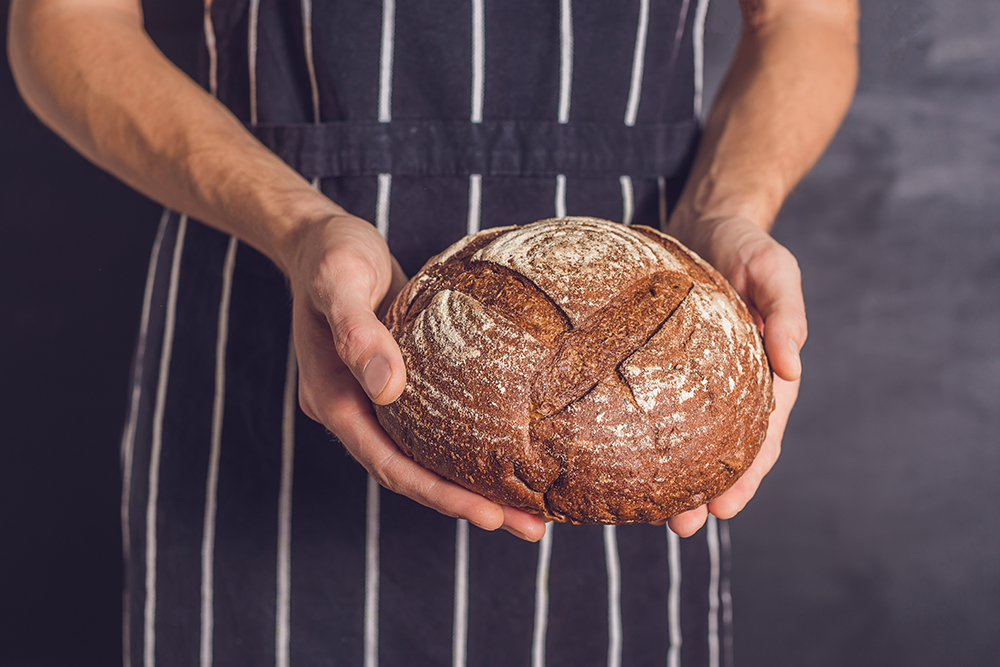
Now prepare your clay pot for baking: follow manufacturer’s instructions regarding soaking the pot about a half hour before baking time. Wipe dry, and place covered pot in cold oven and set temperature to 450 degrees. When temperature is reached, use baker’s mittens to take out clay pot, open and wipe up any drops of water–areas where the bread would stick! Strew coarsely ground grain on pot’s bottom and then take banneton and carefully but decisively overturn the loaf into the hot pot. Slash the loaf’s top in several places, cover pot and place in oven. Immediately raise the temperature to 500 degrees F. When oven reaches 500 degrees hold it here for 5 minutes then lower temperature to 450 degrees and bake for one hour. Now prepare a shallow pan with about an inch of hot water. Open oven, place pan on bottom of oven and remove the top of the clay baker. Reset oven temperature to 425 degrees and bake 25 minutes more. Remove bread from oven and use your thermometer to check the inner temperature of the bread. It should be close to 205 degrees (plus or minus 5 degrees). Remove bread from clay baker. Thumping the bottom of the bread should elicit a hollow sound. Place on rack, dab hot water on top and sides to help soften the crust, and cover with several kitchen towels. Let your bread cool at least 3 or 4 hours before tasting–the bread will still be warm and your house will smell absolutely wonderful! The crust will be more pliant the next day.
This bread is dense, but has a very nice crumb and can be sliced thinly for open-faced sandwiches. It keeps a long time (more than a week) if well-covered, and freezes beautifully. And nothing else comes close to the well-developed flavor of the grains in this bread.
Nostalgia
Virtually everybody who has had Garrick’s bread, and is from Eastern Europe, Lithuania or Germany, is immediately plunged into a nostalgia for the last time they had such bread, usually in a village, often before World War II. One woman remembered that her grandfather had been a village baker and made such bread before the War–she hadn’t thought of any of this for decades.
For Garrick, too, who is 68, baking this bread has significance on many levels, and it has been, unpredictably, a healing avocation. Unpredictable and unlikely too: Garrick can boil potatoes and make tea, but that about covers his culinary experience. Until this bread!! Who knew he had this talent lying hidden for so long. But now he gains so much satisfaction from baking bread and giving it to others to enjoy. Needless to say, he’s so pleased to share the recipe.
Sidebars
Sourdough Blini
The same starter that goes on to become bread can be used in a diluted form to make pancakes, or better still, blini, which we find the most delicious. Blini are crepes or thin pancakes found in traditional Russian cuisine and are raised by yeast, in this case, by wild yeast. Blini batter is a very useful resource in your pantry when unexpected guests come. In a few moments you can serve an elegant snack of tender blini filled with grated Gruyere cheese and scallions with a glass of white wine, or sweet blini filled with sour cream and fruit preserves with tea–or even filled with cream cheese, onions and caviar. Versatile and delicious and quite easy!
Once you have an active starter, you will use soft winter wheat berries that you grind as you need. (Sometimes I add some buckwheat flour to the batter for a different taste.) The basic formula is to “feed” your culture at least 8 hours before you plan to use it. You can make the batter rather thick at this stage, adding only flour and water; exact quantities are not important. When you are ready to use the batter you will thin it with a beaten egg and enough milk or cream to produce the consistency of thin cream.
Prepare the blin in a 10-inch skillet or sauté pan–I use a well-seasoned cast iron pan. Let the pan become very hot on the stove and grease with a nub of coconut butter or ghee or swipe pan with a piece of pork fatback (butter will burn). Quickly add about 3½ tablespoons of batter and swirl in the pan to cover the entire surface. The blin will cook quickly and is ready to turn when the top surface becomes dry. Flip over and cook for about 45 seconds more. Serve immediately and allow diner to add fillings: caviar and minced scallion, mushroom ragout, curried chicken–you get the idea! To serve with cheese, add grated cheese directly to the blin in the pan right before you would normally flip it. Fold blin in half and allow to cook for 30 seconds more (just enough to barely melt the cheese) and serve–this is like a Russian quesadilla!
If you do not plan to use the batter every day, feed the batter modestly and refrigerate. Remember to feed it a few tablespoons of flour and water when needed every 2-3 days while refrigerated and not in use. The batter will still ferment, although slowly, in the refrigerator. You can use it directly out of the fridge, but it behaves better if you allow it to return to room temperature overnight. About the only thing that will harm this batter is high temperature, so plan to keep your culture cool during the summer. With a little care, your culture should last a very long time. Our culture has been in the same bowl for 2 years now!
My Weekly Bread Routine
By Tom Cowan, MD
Most people say they don’t have time to make bread. Yet with my full-time, busy medical practice, I still make sourdough bread every week. Here is the routine I have developed, along with a couple of tricks to ensure the bread turns out well every time. One is to let the bread rise in a “tupelo bread bowl,” available from Lehman’s (888) 342-2387. The bowl keeps the dough warm and ensures a good rise. Also, I add 1/8 teaspoon yeast plus 1 teaspoon rapadura to the dough on the morning of baking–this ensures a good rise every time.
The routine goes like this:
- Every day grind about 1 cup biodynamic rye berries. On the first day, place the flour into a bowl, add enough water to make a soupy consistency and cover with a cloth. On each subsequent day, add another 1 cup flour plus water to the mixture. This is your starter. Keep at room temperature, but if you won’t be using the starter for a while, store in the refrigerator.
- The night before baking grind about 8 cups flour–I like organic spelt berries or biodynamic nonhybrid wheat the best, but any flour will work. In a large bowl place 1 cup starter, 1 3/4 cup cool water and 2 cups freshly ground flour. Cover and allow to sit overnight.
- In the morning, soak 1/8 teaspoon baker’s yeast in 1/4 cup water. Stir in 2 teaspoons Celtic sea salt and 1 teaspoon Rapadura (dehydrated cane sugar juice). Add this mixture to the flour mixture, stir and begin adding the rest of the flour.
- Once it forms into a ball, place the ball onto the counter, cover with a damp cloth and allow to rest for 10 minutes. Then knead the dough for 10 minutes, adding new flour to keep from sticking.
- Oil the tupelo bread bowl, shape the dough into a ball and place in the bread bowl. Cover with a damp cloth and allow to sit between 2 and 4 hours, until about double in size.
- Remove the dough, punch it once, knead again briefly, and put it back in the bread bowl for another 2-4 hours.
- Remove from bowl, cut in half, allow to sit for about 10 minutes, then shape into oiled bread pans (I use butter to grease the pans).
- Allow to sit for about 1 hour, then preheat the oven to 350 degrees, slash the tops of the bread with a knife, beat an egg and coat the top of the bread with the egg wash, sprinkle poppy seeds on top and bake for 55 minutes.The bread should sound hollow when you tap on the bottom.
- Place on wire rack to cool for about 1-2 hours.
That’s all!
Healthy Yeasted Bread
Genuine sourdough bread required dedication and time (although our own Dr. Cowan finds time in his busy schedule to make sourdough bread every week). A compromise, quicker bread–and one that may be more acceptable to western palates–is soaked yeasted bread. The following recipe has been developed by Sonja Kepford, head of our Des Moines, Iowa chapter. The total fermentation time–rising and proofing–is 7 hours, which is the magic number for deactivation of phytic acid.
To prepare the bread, you will need to have on hand 1 cup kefir “starter” and 3 cups “sponge.” Starter is some soaked, fermented flour that you keep on hand. Sponge is freshly rejuvenated starter. The ingredients are the same for both. The only difference is that the “starter” has been sitting around for a while and is really sour whereas the “sponge” is very fresh and active and has not become as sour.
How to make the kefir starter? Mix 1 cup flour with 1 cup kefir and enough water to make a mixture the consistency of pancake batter. Keep in a covered container where air can get to it, such as a bowl with a plate on top. Stir it once in a while if you remember. You can probably use it after one day, but wait three or four days the first time if you can.
The night before you want to bake, mix 2 cups flour, 2 cups water to 1 cup starter to make about 3 cups sponge in a big bowl. Leave covered on kitchen counter overnight to get bubbly.
Soaked Yeasted Bread
Makes three 9-inch by 5-inch loaves or one 9-inch by 5-inch loaf, two 8-inch pizza crusts and 8 rolls or hamburger buns
3 cups sponge
1 cup water or 3-4 eggs plus enough water to make 1 cup
2 teaspoons baker’s yeast
1/2 cup honey
1/4 cup warm water
1/2 cup softened butter
1 1/3 tablespoons sea salt
6 cups plus 4-6 tablespoons whole wheat flour, preferably freshly ground
Mix 2 teaspoons yeast into 1/4 cup warm water and let soften for 15 minutes. Remove 1/4 cup sponge to keep for future starter. (Feed the starter with 1/2 cup flour and 1/2 cup water and put in covered container in the cupboard. The starter will keep for one week, until the next bread making, without anything being added, but it should be stirred occasionally.)
Place 6 cups flour in a big bowl. Add 1 1/3 tablespoon sea salt and stir in. To the bowl containing the sponge, add the honey, egg-water mixture and yeast-water. Beat and stir into the flour. Add a small amount of additional water or several tablespoons additional flour until the dough feels right–it should be somewhat flabby. Knead in the bowl for 10 minutes, using water on your hands to keep from sticking. Toward the end of the kneading, smear 1/2 cup soft butter in your kneading bowl and work this in. Cover with a damp cloth and let rise for 3 hours. Deflate, round and let rise another 3 hours.
Grease your pans–loaf pans, pizza rounds and a pie pan for the rolls–and divide, round, relax and shape the dough. You may use unbleached white flour to help with the forming. (If you are making hamburger buns, make balls of the dough, flatten and place on a greased cookie sheet.) Proof in warm place 45 minutes to 1 hour, covered with a damp cloth. Don’t overproof. Preheat oven halfway through the proofing. Bake at 415 degrees for 15 minutes, then at 315 degrees for 15-20 more minutes.
To make cinnamon rolls, make a rectangle of dough, flattened to about 1/2 inch thick. Smear with soft butter and sprinkle with Rapadura or maple sugar, raisins, walnuts and lemon zest. Roll up from the side and cut into individual rolls by tightening a string around the roll at 1-inch intervals. If you want a VERY light loaf, follow the above recipe, except use part unbleached white flour, add the butter (melted) to the liquid ingredients, and use white flour to keep the dough from sticking during kneading.
Tortillas: Mix 2 cups sponge, 1 teaspoon salt, 1 tablespoon honey and 1/2 cup melted butter or lard. Add about 3 cups fresh whole wheat flour. The dough should be soft but not too sticky to work with. Let proof 7 hours. Deflate and form into about 15 balls. Roll to about 1/8 inch thickness, using unbleached white flour to prevent sticking. Cook tortillas about 1-2 minutes per side on a dry, medium-hot cast iron skillet.
Note: For meanings of terms such as “proof,” “feels right,” “round,” “deflate,” etc., and for many other tips on baking with whole wheat, such as why to smear butter in rather than melt it, please refer to the excellent book, Laurel’s Bread Book by Laurel Robertson.
Bread Machine Bread
Thank you for your article on bread, Spring 2003. I have been working on a recipe for soaked bread for a breadmaker and think I have finally achieved it.
The first couple of times you try the recipe, don’t leave it unattended. You may need to make some slight adjustments to get it right for your particular breadmaker, climate, type of flour, etc.
This recipe has been tested on a Panasonic SC-2000. It requires that the yeast, then the dry ingredients are put in first. If your machine has different instructions, alter the order given in the recipe.
This has been tested using spelt flour. Wheat flour may give slightly different results and require slight adjustments. If you can’t tolerate any dairy products, try replacing the butter with olive oil and the yoghurt with some lemon juice or cider vinegar (but keep the total liquid the same). This has not been tested.
150 ml (1/2 cup plus 2 tablespoons) yoghurt
200 ml (scant 3/4 cup) water
450 g (1 pound) wholemeal flour, less 3 tablespoons
1 3/4 teaspoons yeast granules
3 T arrowrood
1 t Celtic sea salt (fine)
1 T molasses
2 T butter
Weigh out 450 g (1 pound) flour, then take 3 tablespoons back out again. Mix together with yoghurt and water and add to the flour. Mix to form a dough. Cover and leave in a warmish place for 18-24 hours.
Put the yeast, arrowroot, salt, dough, molasses and butter in the breadmaker. Set it to a wholemeal setting and begin. When it’s partway through the kneading section, check that all the ingredients have mixed together and check the consistency. If it is slimy, add some more arrowroot, if it’s too dry, add a few more drops of water, drop by drop. Proceed as directed and enjoy the bread!
Deb Gully, Kilbirnie, New Zealand
Q&A:
Question: I made a loaf of sourdough rye bread which turned out wonderful and I’m very pleased with it. However, the last stage of the bread-making calls for adding 360g of flour to the dough, and then letting the bread rise for about one hour before cooking it. Based on the principles of Nourishing Traditions, I found the short time surprising. Do you think the phytates and other stuff in the grains would have time to be deactivated in so short a rising time?
Answer: First, you are right to question the short period of time that those final 360 grams of flour are processed before baking. My husband, Garrick Ginzburg-Voskov, and the baker/originator of this recipe, had corrected the timing in his recipe (which will be up at the website soon) to extend the resting period after the addition of the 360 grams to three hours, and the proofing time to two hours. But beyond this, the topic is an interesting one to think about for a moment.
We have read a study that shows that all phytates in wheat and rye flour can be neutralized in 2 hours in conditions of 4.5 pH and 45 degrees C (about 113 degrees F). Now that’s rapid! These are lab conditions, though, and not baking conditions, but they illustrate two important factors at work. Endogenous phytase (that is, resident in the wheat and rye flours) is activated in acidic conditions (such as a sourdough culture) and works at maximum speed when the temperature is close to the point when the phytase would be inactivated (which is about 115 degrees F). So we see that the phytates in these two grains can be pretty easily neutralized as long as we include the right acidity and enough time. At room temperature or a little warmer (as in the dough proofing stage) the phytase still works, just a little more slowly.
We also have to remember–and this is important–that the dough to which those final 360 grams of flour is added is teeming with active phytase from the preceding additions of flour to the sourdough. All the phytase acts cumulatively, and this increases its combined efficiency. (As an aside, one method to greatly boost phytase activity with oat flour, which is very high in phytates but low in phytase, is to culture it with wheat sourdough.)
Another question might regard the gluten development in the flour added in the last stages of dough preparation. We’ve read a lot about this, yet nothing (that we’ve seen, at any rate) that is absolutely definitive. Evidence does suggest that as the proliferative activity of the culture increases in an exponential fashion (and its consumption of nutrients in the flour as well, which can be measured) then it might be transforming the gluten at a similar rate; that is, faster at the end than at the beginning of the recipe when the first flour and starter are introduced to each other.
This leads us to one final “trick” in baking sourdough bread. Garrick was forced to do this when he was baking in warm weather, and the heat sped the culture along too fast, threatening to over-sour the dough. (This would result in a flattened, overly-sour, overly-dense loaf.) To forestall that outcome, he refrigerated the dough before the baking stage for about 16 hours in order to bake it in the cool of the next morning. (Bakers call this “retarding the dough.”) He was pleasantly surprised to note that the flavor of the resulting loaf was extremely good–obviously the culture kept working even in 40-50 degree temps. It seems natural to suppose that this extra time would also aid in further gluten development–no doubt the starches and sugars were transformed, too, as shown in the complex flavor.
My long discourse is to say that almost always, extra time works to your advantage! The only trick is to know under what conditions to extend the timing so that you are happy with the results of your labor. Thank you for your letter! Kind regards, Katherine Czapp
This article appeared in Wise Traditions in Food, Farming and the Healing Arts, the quarterly magazine of the Weston A. Price Foundation, Spring 2003.
🖨️ Print post
I am interested in making your bread but don’t have a romertopf what can I substitute thanks
I used extreme ware.
Then got a romertopf on Amazon!
I’m always amazed at what can be found used at thrift stores, garage sales and estate sales. I’ve purchased a Romertopf for a few dollars at a thrift store and my Zojirushi bread maker came from an estate sale for $10, both in mint condition.
Hi,
What a wonderful article and recipes – thank you for sharing!!
I have a quick question – I have been making my own bread for the last couple of years. However, I don’t use a starter culture, just yeast. This is the recipe: http://www.3aw.com.au/blogs/neil-mitchell-blog/adrian-richardsons-sourdough-bread/20120925-26ifz.html.
Basically it’s just flour mixed with yeast, salt and water and left to prove for 10-18 hours. Would the yeast in this recipe break down the gluten given the 10-18 hour proving period?
Thank you very much!
Looks like sourdough & yeast can be used together :
Healthy Yeasted Bread
Genuine sourdough bread required dedication and time (although our own Dr. Cowan finds time in his busy schedule to make sourdough bread every week). A compromise, quicker bread–and one that may be more acceptable to western palates–is soaked yeasted bread. The following recipe has been developed by Sonja Kepford, head of our Des Moines, Iowa chapter. The total fermentation time–rising and proofing–is 7 hours, which is the magic number for deactivation of phytic acid.
To prepare the bread, you will need to have on hand 1 cup kefir “starter” and 3 cups “sponge.” Starter is some soaked, fermented flour that you keep on hand. Sponge is freshly rejuvenated starter. The ingredients are the same for both. The only difference is that the “starter” has been sitting around for a while and is really sour whereas the “sponge” is very fresh and active and has not become as sour.
How to make the kefir starter? Mix 1 cup flour with 1 cup kefir and enough water to make a mixture the consistency of pancake batter. Keep in a covered container where air can get to it, such as a bowl with a plate on top. Stir it once in a while if you remember. You can probably use it after one day, but wait three or four days the first time if you can.
The night before you want to bake, mix 2 cups flour, 2 cups water to 1 cup starter to make about 3 cups sponge in a big bowl. Leave covered on kitchen counter overnight to get bubbly.
Soaked Yeasted Bread
Makes three 9-inch by 5-inch loaves or one 9-inch by 5-inch loaf, two 8-inch pizza crusts and 8 rolls or hamburger buns
3 cups sponge
1 cup water or 3-4 eggs plus enough water to make 1 cup
2 teaspoons baker’s yeast
1/2 cup honey
1/4 cup warm water
1/2 cup softened butter
1 1/3 tablespoons sea salt
6 cups plus 4-6 tablespoons whole wheat flour, preferably freshly ground
Mix 2 teaspoons yeast into 1/4 cup warm water and let soften for 15 minutes. Remove 1/4 cup sponge to keep for future starter. (Feed the starter with 1/2 cup flour and 1/2 cup water and put in covered container in the cupboard. The starter will keep for one week, until the next bread making, without anything being added, but it should be stirred occasionally.)
Place 6 cups flour in a big bowl. Add 1 1/3 tablespoon sea salt and stir in. To the bowl containing the sponge, add the honey, egg-water mixture and yeast-water. Beat and stir into the flour. Add a small amount of additional water or several tablespoons additional flour until the dough feels right–it should be somewhat flabby. Knead in the bowl for 10 minutes, using water on your hands to keep from sticking. Toward the end of the kneading, smear 1/2 cup soft butter in your kneading bowl and work this in. Cover with a damp cloth and let rise for 3 hours. Deflate, round and let rise another 3 hours.
Grease your pans–loaf pans, pizza rounds and a pie pan for the rolls–and divide, round, relax and shape the dough. You may use unbleached white flour to help with the forming. (If you are making hamburger buns, make balls of the dough, flatten and place on a greased cookie sheet.) Proof in warm place 45 minutes to 1 hour, covered with a damp cloth. Don’t overproof. Preheat oven halfway through the proofing. Bake at 415 degrees for 15 minutes, then at 315 degrees for 15-20 more minutes.
To make cinnamon rolls, make a rectangle of dough, flattened to about 1/2 inch thick. Smear with soft butter and sprinkle with Rapadura or maple sugar, raisins, walnuts and lemon zest. Roll up from the side and cut into individual rolls by tightening a string around the roll at 1-inch intervals. If you want a VERY light loaf, follow the above recipe, except use part unbleached white flour, add the butter (melted) to the liquid ingredients, and use white flour to keep the dough from sticking during kneading.
Tortillas: Mix 2 cups sponge, 1 teaspoon salt, 1 tablespoon honey and 1/2 cup melted butter or lard. Add about 3 cups fresh whole wheat flour. The dough should be soft but not too sticky to work with. Let proof 7 hours. Deflate and form into about 15 balls. Roll to about 1/8 inch thickness, using unbleached white flour to prevent sticking. Cook tortillas about 1-2 minutes per side on a dry, medium-hot cast iron skillet.
Note: For meanings of terms such as “proof,” “feels right,” “round,” “deflate,” etc., and for many other tips on baking with whole wheat, such as why to smear butter in rather than melt it, please refer to the excellent book, Laurel’s Bread Book by Laurel Robertson.
Well, Monika, it doesn’t look as if anyone with authority is answering your question. And I don’t know, either. I myself make a simple bread, though not quite like Richardson’s recipe. I use less yeast – 1/2 a teaspoon for a two-loaf recipe. And I knead. And after the first rising, I don’t expose the dough to any more flour; instead, I spread oil on the counter where I knead again. It would defeat the purpose of long-raised bread to add more flour. It is highly digestible is all I know. Best to you. – Wyandotte.
Thank you, Wyandotte 🙂
Is the sourdough bread recipe available anywhere in imperial units (cups) instead of metric (grams)? The water/flour weight conversation is tricky.
What about Essene bread? Made with sprouted wheat grains.
Real Essene bread should be nothing but sprouted wheat ‘baked’ in the sun.
And Ezekiel bread – look at the label. Is the flour also made from sprouted grain?
Can this recipe and process be used with spelt flour?
Hi Katherine,
I’m a bit confused with your husband’s bacterial fermentation compared to the brewers yeast fermentation. I know that if you add yeast, you get an alcoholic fermentation with a predictable rise and nice results. However, the gluten is not broken thus causing the gastric distress that so many people complain about. Your husband’s version has no added yeast resulting in a much healthier bread! With the bacterial fermentation, does it still create yeasts in the starter? Is this detrimental to our gut? I see many people on line that use pineapple juice in their starter but I would think that the sugars would create an alcoholic fermentation. They all like pineapple juice due to the acidity and making a better starter. What’s your take? Thanks!
Why do you discard half of the starter on days 3 and 4? Seems like a major waste.
I really enjoyed the process of making the bread and starter, it has been something I was looking forward during these days of lockdown. 🙂
I am gluten sensitive and I am have gone with a proper ancestors diet for already a couple of years. After reading the book from Dr. Price, I thought I could handle this amazing bread. Unfortunately even after following the whole process of the recipe, still an inflammatory reaction was triggered in my body. I noticed that since my body healed I react so quickly to inflammatory foods. It is such a bummer I really hoped to integrate this bread in my other fermentation routines 🙁
I have some questions… First, what if it never bubbles by day five, in making the starter? It never looked “light, airy and fragrant.” But it doesn’t smell bad, either. What might be off? Also, on Day One of the starter, you say the temp should be 60-65. When fermenting the bread, however, you need 65-70. Is that right?
I can’t do all of this. I just don’t have the time or the resources. Could you tell me the kind of bread that would do the least damage to my teeth that I can just buy? Is sprouted better or worse than normal grains? Is white bread better than whole grains and sprouted?
What about this “Super Sprouts” (Lindley Mills) flour that’s supposed to have reduced phytic acid?
Has anybody tried “Izzio Sourdough Bread?” They seem to be high quality for store bought bread, with long fermentation (more than 72 hours), traceable non-GMO seeds, only 3 ingredients, small batch.
It’s in my local store in Colorado. I would love some, hope someone here has some experience with it. I live in a super small studio, no kitchen, so making my own is out of the question. Thanks!