


 🖨️ Print post
Raymond Seidel, MD, HMD, said that he decided to become a homeopathic doctor during the Spanish flu epidemic of 1918 when he was working as a delivery boy for a homeopath in New Jersey. As he delivered remedies from homeopaths to their patients, he noticed that those taking homeopathy were all doing well while those taking aspirin were not. Seidel later stated, “I saw that the people who were taking aspirin were dying. . . and those that received homeopathic remedies were living.”
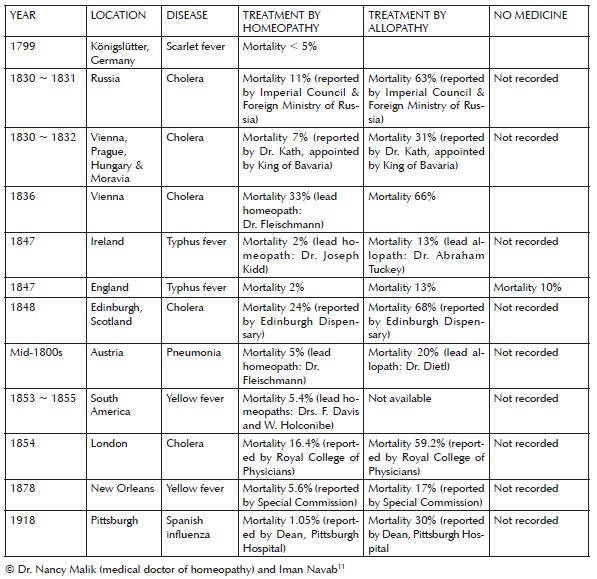
The mortality rate of people treated with orthodox medicine and drugs for the Spanish flu was 28 percent. In comparison, those treated by homeopathic physicians had a mortality rate of only 1 percent.1 Nor is the Spanish flu an isolated example—the use of homeopathy in epidemics has stood the test of time (see Table 1). In 2018, after conducting an extensive literature search, Dr. Jennifer Jacobs concluded that several different homeopathic methods can be employed during epidemics.2
SCARLET FEVER AND CHOLERA
Dr. Samuel Hahnemann (1755-1843) was a linguist, chemist, physician and founder of homeopathy. In 1799, Hahnemann made the accidental discovery that homeopathic Belladonna could be used as both a treatment and preventive for scarlet fever (also known as scarlatina).
Hahnemann wrote: “I reasoned thus, a remedy that is capable of quickly checking a disease in its onset, must be its best preventive; and the following occurrence strengthened me in the correctness of this conclusion: Some weeks previously three children of another family lay ill of a very bad scarlet fever; the eldest daughter alone, who, up to that period, had been taking Belladonna internally for an external affection on the joints of her fingers, to my great astonishment did not catch the fever, although during the prevalence of other epidemics she had always been the first to take them.”3
Hahnemann continued: “This circumstance completely confirmed my idea. I now hesitated not to administer to the other five children of this numerous family this divine remedy, as a preservative, in very small doses, and, as the particular action of this plant does not last above three days, I repeated the dose every seventy-two hours, and they all remained perfectly well without the slightest symptoms throughout the whole course of the epidemic, and amid the most virulent scarlatina emanations from the sisters who lay ill with the disease.”3
In 1831, the Russian community enlisted Hahnemann to assist in treating cases of so-called Asian cholera. Mortality was as high as 66 percent with the conventional care of the day. According to modern accounts of this period, “a murderous epidemic came over Europe from Russia (about 2,000,000 [sic] victims) with tremendous speed and mortality. The Baltic countries, Poland (1100 deaths in Warsaw alone) and Galicia were already affected. In Prussia and Austria frontiers were closed and quarantine facilities were constructed. Nonetheless, the Asian Cholera could not be halted.”4
Applying sound homeopathic theory, Hahnemann collected common symptoms of the disease and prescribed appropriate homeopathic remedies in an effective method that is now known as “genus epidemicus.” His treatment was highly successful and even came to be recommended by conventional physicians of the day.4
Genus epidemicus is derived from identifying the characteristic symptoms expressed during an epidemic, such as a wet or tickling cough, high fever, chills, sweating and so forth. These symptoms will point to a few remedies in most of the cases. Homeopaths can then quickly deduce which remedy to give by identifying the outstanding symptoms in a particular case and choosing among these remedies.
U.S. HOMEOPATHY BOOMS
Homeopathy found its way to the U.S. in the early 1800s as physicians immigrated from Europe. The public embraced it as a safe and gentle form of medicine—in direct contrast to methods of the day such as bloodletting, purging and the widespread use of mercury, arsenic and lead.
Many physicians of the time were apprentice-trained and were able to become a doctor with the equivalent of a high school education. They earned very low salaries and had relatively low social status. The New York Journal of Medicine (in 1845) described the requirements for conventional medical education at that time as follows: “All the young man has to do is gain admittance in the office of some physician, where he can have access to a series of ordinary medical text-books, and see a patient perhaps once a month, with perhaps a hasty post-mortem examination once a year; and in the course of three years thus spent, one or two courses of lectures in the medical colleges, where the whole science of medicine, including anatomy, physiology, chemistry, materia medica, pathology, practice of medicine, medical jurisprudence, surgery, and midwivery are all crowded upon his mind in the short space of sixteen weeks. . . and his education, both primary and medical, is deemed complete” [italics in original].5

Homeopaths, in comparison, were highly educated and to this day are required to have ongoing postgraduate education within the field.
As a result of homeopathy’s effectiveness and popularity, the first homeopathic hospital—the Cleveland Protestant Homeopathic Hospital—was established in Ohio by the mid-1850s. By 1900, over one hundred homeopathic hospitals had sprung up in the U.S., with twenty-two homeopathic medical schools and over one thousand homeopathic pharmacies.6,7 Included among the schools were Boston University; the Universities of Michigan, Minnesota and Iowa; and Hahnemann Medical College.
HOMEOPATHIC SUCCESSES
Interest in homeopathy continued to grow as it became obvious that it could treat epidemic disease safely and gently. Dr. Adam Miller, a homeopathic physician in Quincy, Illinois treating patients with cholera, wrote of his successes during an 1851 cholera outbreak: “The cholera had broken out in a fearful form the week before I arrived there. The people and the doctors were alarmed. It was in June, 1851. The word was soon spread through the city that a new doctor had arrived and that he knew how to treat cholera. The first day after my arrival I had three patients, the second six, and in two weeks had all I could attend to. I cured several that the Catholic priest had anointed and prepared for death. He was so vexed about it that he denounced me from his pulpit and warned people against employing me as their physician, and said it must be some black art or work of the devil that allowed people to get well after he had prepared them for death.”8
In Cincinnati, Ohio, homeopathy was booming, and homeopaths actually published names and addresses of patients cured of cholera compared to those who died. Of one thousand one hundred sixteen homeopathic patients, only 3 percent died, while between 48 and 60 percent of those under orthodox medical treatment died.9,10
In 1852, around the same time that homeopathy was flourishing in the U.S., a British medical doctor, Dr. Routh, was enlisted to complete a statistical account of mortality for all diseases in England, Austria and Germany. Routh reviewed over thirty-two thousand homeopathic cases and over one hundred thousand allopathic cases. Homeopathic treatment resulted in a 4.4 percent mortality rate while allopathic treatment reflected overall mortality of 10.5 percent.11 This pattern emerged repeatedly, whether the illness was typhus, cholera, yellow fever or other epidemic illnesses (Table 2).
HOMEOPATHY AND POLIO
Amid the growing acceptance of homeopathy as a successful response to epidemic disease, disgruntled allopathic physicians decided to form an organization to stem the tide of popularity of this form of medicine, which was eclipsing their incomes. They called this group the American Medical Association (AMA).12 The AMA’s rabid efforts to extinguish homeopathy included disallowing membership by anyone practicing homeopathy and even forbidding consultation with homeopaths.13 Despite the AMA’s efforts, homeopathy continued to gain support due in large part to its unprecedented success in addressing polio, diphtheria and smallpox.
In 1950, a polio outbreak was met by the closing of public facilities, “social distancing” and the use of menacing chemicals such as DDT, all of which failed to eradicate the presumed virus. In 1953, Dr. Morton Biskind tried—largely unsuccessfully—to draw attention to what he viewed as a more logical explanation for polio epidemics, proposing that polio and other central nervous system diseases were “actually the physiological and symptomatic manifestations of the ongoing government- and industry-sponsored inundation of the world’s populace with central nervous system poisons”—such as DDT.14 Author Forrest Maready has written in his book The Moth in the Iron Lung: A Biography of Polio, “The irony these very applications [of DDT] were very often being used in a desperate attempt to stave off poliomyelitis in children is unfortunately lost on most.”15
Several physicians desperately turned to homeopathy, using an approach that has come to be known as homeoprophylaxis (the use of homeopathy prior to exposure to the disease). Dr. Grimmer of Chicago prophylactically treated five thousand young children16 with a homeopathic remedy called Lathyrus sativus generally indicated for “paralytic affections of lower extremities,” “spastic paralysis,” “infantile paralysis” and situations involving “much weakness and heaviness” and “slow recovery of nerve power.”17 None developed polio.18 That same year, during an epidemic of poliomyelitis in Johannesburg, South Africa, Dr. A. Taylor-Smith protected eighty-two adults and children with homoeopathic Lathyrus sativus administered as a prophylactic measure. Dr. Taylor-Smith (an adherent to the viral theory) observed that while twelve children “were exposed to infection by direct contact,” all remained polio-free.16 In 1956, Dr. H.W. Eisfelder administered Lathyrus sativus to over six thousand children and observed no side effects or cases of polio.19
DIPHTHERIA AND SMALLPOX
In the late 1930s, diphtheria was the second leading cause of death in children in England and Wales.20 Many countries considered it a major child health threat. A laboratory experiment in 1932, published by a Dr. P. Chavanon, found that one to two months after administering homeopathic Diphtherinum in the 4M and 8M potencies, diphtheria antitoxins were measured in the blood.21 Diphtherinum is an example of a homeopathic “nosode,” a type of harmless homeopathic remedy safely made from inactivated microorganisms or products of the disease itself.22
The Chavanon study used the Schick test, a method involving the intradermal injection of a tiny amount of diphtheria toxin into the forearm, developed in 1913 by Austrian pediatrician Bela Schick to measure diphtheria antibodies.23 According to Dr. Chavanon’s report, a total of forty-five children changed from Schick-test-positive (no antibodies against diphtheria) to Schick-test-negative (antibodies present).21
In 1941, Drs. Patterson and Boyd repeated the same test with thirty-three children. All had a Schick-negative result within nine weeks of receiving Diphtherinum, and some as early as three weeks afterward.24 Another health professional named Dr. Roux repeated the Chavanon experiment in 1946 and again confirmed that the Diphtherinum nosode provided immunity lasting for up to five years.25
Another example of homeopathy’s successful use was recorded by Charles Woodhull Eaton, MD of Iowa during his trials of homeoprophylaxis for smallpox. During the trials, he treated almost three thousand patients prophylactically with the smallpox nosode Variolinum 30.26 Eaton recorded five hundred forty-seven “definite” exposures to smallpox in this group, but only fourteen participants went on to develop the disease—amounting to an efficacy (protection) rate of over 97 percent.
STILL FLOURISHING
Cuba provides a powerful modern example of a setting where homeoprophylaxis has flourished (Table 3).27 The country’s Finlay Institute (dedicated to vaccine research and development) has even utilized homeopathy within its department of natural remedies. Because the government distributes medicines to the population, homeoprophylaxis has been easy to implement as well as cost-efficient and highly effective. Between 2004 and the present, trials carried out in Cuba for cholera, dengue fever, swine flu, pneumonia, hepatitis A, leptospirosis,28 and the current coronavirus29-31 have produced stunning effects, showing disease prevention rates between 85 percent and 97 percent.
If we stop for a moment and consider the benefits of homeopathy, its track record in epidemics, the ease of distribution (no needles or cold chain required), plus the absolute safety of this natural method, it seems a rational and obvious choice during epidemics. Considering our ever-expanding awareness of our relationship with bacteria and viruses and the role they play in health and evolution, we would be well served to interface with microbes in the gentle manner that homeopathy allows.
REFERENCES
- Bradford TL. The Logic of Figures, or Comparative Results of Homoeopathic and Other Treatments. Philadelphia: Boericke & Tafel, 1900.
- Jacobs J. Homeopathic prevention and management of epidemic diseases. Homeopathy. 2018;107(3):157-160.
- Bradford TL. The Life and Letters of Dr Samuel Hahnemann (Chapter 17). Presented by Dr. Robert Séror, 2001. http://www.homeoint.org/books4/bradford/chapter17.htm.
- Scheuren C. Dr. Hahnemann and the cholera epidemic of 1831. Apr. 18, 2020. https://www.hahnemann-torgau.de/dr-hahnemann-and-the-cholera-epidemic-of-1831/.
- The New York State Medical Society and a National Medical Convention. New York Journal of Medicine. 1845;5:418. https://archive.org/details/newyorkjournalof5184forr/page/418/mode/2up.
- Coulter HL. Divided Legacy (Vol. III). Berkeley: North Atlantic Books, 1975, pp. 304, 460.
- History of AIH – Our Heritage – Our Future. https://homeopathyusa.org/about-aih-2/our-heritage-our-future.html.
- Bradford TL. Homoeopathy in Illinois. Chapter 27 in WH King, History of Homoeopathy and Its Institutions in America. Presented by Sylvain Cazalet, 2003. http://www.homeoint.org/history/king/1-27.htm.
- See reference #1, Bradford, 1900, pp. 68, 113-146.
- See reference #6, Coulter, 1975, p. 268.
- Malik N, Navab I. Lives saved by homeopathy in epidemics and pandemics. http://www.similia.lv/interesanti/par-homeopatiju/lives-saved-by-homeopathy/.
- Kaufman M. Homoeopathy in America. Baltimore: Johns Hopkins, 1971, p. 53.
- Homeopathy timeline: 1850–1874. http://www.wholehealthnow.com/homeopathy_pro/homeopathy_1850_1874.html.
- West J. Pesticides and polio: a critique of scientific literature. Wise Traditions, February 8, 2003. https://www.westonaprice.org/health-topics/environmental-toxins/pesticides-and-polio-a-critique-of-scientific-literature/.
- Maready F. The Moth in the Iron Lung: A Biography of Polio. Feels Like Fire, 2018, p. 232.
- Taylor-Smith A. Poliomyelitis and prophylaxis. Br Homeopath J. 1950;40(2):65-77.
- Lathyrus Sativus. https://abchomeopathy.com/r.php/Lath.
- Grimmer AH. The Collected Works of Arthur Hill Grimmer, M.D. (Ed. AM Currim). Norwalk, CT & Greifenberg, Germany: Hahnemann International Institute for Homeopathic Documentation, 1996.
- Eisfelder HW. Poliomyelitis immunization: A final report. Journal of the American Institute of Homeopathy. 1961;54:166-167.
- Vitek CR, Wharton M. Diphtheria in the former Soviet Union: reemergence of a pandemic disease. Emerg Infect Dis. 1998;4(4):539-550.
- Chavanon P. La Dipterie, 4th edition. St. Denis, Niort: Imprimerie, 1932.
- What is a nosode? https://homeopathyplus.com/q-what-is-a-nosode/.
- Schick test. https://www.britannica.com/science/Schick-test.
- Patterson J, Boyd WE. Potency action: a preliminary study of the alteration of the Schick test by a homeopathic potency. British Homoeopathic Journal. 1941;31:301-309.
- Eizayaga F. Tratamiento homeopatico de las enfermedades agudas y su prevension. Homeopatia. 1985;51(342):352-362.
- Eaton CW. The facts about Variolinum. Presented by Julian Winston. Source: Transactions of the American Institute of Homeopathy, 1907, pp. 547-567. http://homeoint.org/winston/variolinum.htm.
- Golden I. Use of homoeoprophylaxis in three countries. Similia. 2018;30(1):23-27.
- Bracho G, Varela E, Fernandez R, et al. Large-scale application of highly-diluted bacteria for Leptospirosis epidemic control. Homeopathy. 2010;99(3):156-166.
- Department of Natural and Traditional Medicine, Ministry of Public Health, Republic of Cuba. Homeoprophylaxis safety study with PrevengHo®-Vir in the context of the COVID-19 pandemic in Cuba. Quasi-experimental study post-registration (COVID-19); 2020. https://rpcec.sld.cu/en/trials/RPCEC00000312-En.
- Cadalso M. Prevention at the senior homes of the COVID-19. Apr. 2, 2020. https://www.cmhw.icrt.cu/en/villa-clara/25254-prevention-at-the-senior-homes-of-the-covid-20.
- Torres NG. Cuba promotes homeopathy as effective “weapon” against the coronavirus. Miami Herald, Apr. 7, 2020.
This article appeared in Wise Traditions in Food, Farming and the Healing Arts, the quarterly journal of the Weston A. Price Foundation, Summer 2021
🖨️ Print post
Leave a Reply