

 🖨️ Print post
I took a deep breath and stepped on the scale. The glass chilled my bare feet as I anxiously waited for the numbers to load. I sighed. “Ugh.” Up a pound and a half from yesterday. As I stepped off the scale, the racing thoughts began. “I should have run another mile this morning. Looks like no carbs today. Sticking to rice cakes and protein bars should do the trick. Maybe I won’t go to that party tonight.”
This is a peek into the brain of someone trapped within diet culture. Just how would I know these things? Because I was that teenage girl sucked into the world of dieting, gripped by a desire to be as lean and thin as possible.
The phrase “diet culture” has risen in popularity in recent years. But what does it really mean?
First of all, diet culture is not synonymous with diet. According to the Merriam-Webster dictionary, a diet is the “food and drink regularly provided and consumed,” or “habitual nourishment.”1 At base level, it is the food that one consumes, whether nutritious or not. Yet, a quick scroll below these definitions will reveal yet another: “a regimen of eating and drinking sparingly so as to reduce one’s weight.” This is the definition that most Western minds will populate when speaking of a diet.
In this article, I argue that an ancestral way of eating, inspired by Weston A. Price, can break the bondage of diet culture, revive broken metabolisms and restore joy to nourishment. But to show why an ancestral diet is a better approach to food and weight management, we first must answer the question: what is diet culture, anyway?
DIET CULTURE
In 2023, researchers defined present-day diet culture as “a societal norm that ranks thin bodies as superior to other body types,” noting that it “has been associated with negative outcomes, such as eating disorders.”2 The definition found at Medical News Today is a “set of myths and expectations around food and weight, which typically equate thinness to health and categorize foods into ‘good’ or ‘bad’ types.”3 The National Alliance for Eating Disorders agrees, stating that “diet culture is the pervasive belief that certain body types are better than others.”4
While the definitions vary slightly, the overarching characteristics are similar: thin bodies are morally better and thinness is the end goal, true health always means a lower number on the bathroom scale and food restriction is the primary means of weight loss. Those trapped in this mentality, particularly women, are susceptible to body image struggles, disordered eating and mental health battles.3
It’s not difficult to see dieting behavior interwoven throughout the fabric of our society. The American nation is obsessed with weight and physical appearance, and will choose less nutrient-dense foods in the name of calorie reduction—for example, egg whites over a whole egg, or rice cakes over brown rice simmered in bone broth. Every house and gym contains a scale, which has the power to form identities and crush confidence. Restaurants and prepackaged foods draw customers in with marketing schemes such as “this only has X calories!” For many people, the goal of working out is not overall health and longevity, but a free ticket to eat more Ben & Jerry’s after dinner. Additionally, how many people starve themselves all day in preparation for gorging themselves that evening?
In short, a fixation on thinness, calories and weight has permeated our society. But how did we get here?
TRACING THE ROOTS OF DIET CULTURE
Ever since dieting was invented in the nineteenth century, America has had “dietary whiplash.”5 In a Smithsonian Magazine article titled “The Seesawing History of Fad Diets,”5 Lisa Kingsley provides a chronological overview of the nation’s dieting history, shown in Table 1 on the next page.

As becomes evident when looking at the list of diets recommended and undertaken over the past century, dieting for the purpose of weight management is nothing new. These “fad diets”—which did not even include the more recent entries of paleo, keto or Trim Healthy Mama—set the stage for a culture obsessed with dieting.
However, the plethora of diets is merely a symptom of a deeper issue: our society is extremely visual and body-centric where external appearance trumps internal health. For example, who cares if you have insulin resistance, as long you’re skinny? Who cares if you cannot lift weights, as long as you are thin? Who cares if you’re always hungry and never satisfied, as long as you look good in your dress?
This leads to a fundamental question: if the actual goal should be true nourishment from the inside out, and diet culture fails this, what are we to do? Enter the ancestral approach to food.
ANCESTRAL DIETS
How does a Weston A. Price-inspired diet—called the Wise Traditions diet—not fall under the umbrella of diet culture?
To pass the exam of diet culture, a specific way of eating must be characterized by the goal of weight loss, a fixation on morally “good” and “bad” foods, and an obsession with skinny bodies and the numbers on the bathroom scale. The Wise Traditions diet does not pass the test because the goal is not thinness or a certain weight. The goal is to purchase and properly prepare foods in such a way that they are nutrient-dense and truly nourish the body.
Additionally, do not be fooled by the word “diet.” Our culture has so skewed the meaning of the word that it probably would be more helpful to substitute “way of eating” or “lifestyle.” After all, an ancestral approach to food is not a strict diet—it is a framework and philosophy that informs the food choices one makes.
The Wise Traditions way of eating is further set apart from diet culture by a lack of obsession with calories and macronutrients. The Weston A. Price Foundation (WAPF) website states, “the Wise Traditions Diet does not dictate specific ratios of macronutrients—protein, fat and carbohydrates—nor does it mean we have to eat unfamiliar foods like insects, seal oil or fermented fish.”6 This means that there is freedom in the Wise Traditions food framework. While the Foundation does encourage proper cooking techniques, it does not advocate for the elimination of entire food groups, as do other diets such as paleo (no grains) or keto (no carbs). WAPF is far more focused on the quality of the foods we consume, in contrast to diet culture’s numeric obsession with quantity.
Does this mean that it is always a “toxic” habit to track macronutrients (“macros”) or calories? I believe the answer is no, with one caveat—I do not believe that tracking macros or calories is a prerequisite to nutritious eating or maintaining a healthy body weight. With that said, in a society that abounds with food (and especially processed foods), it is quite easy to exceed one’s caloric needs without even realizing it. Thus, paying attention to calories and macros can serve as a tool—if done correctly. If someone has no clue how much they eat in a day, and they are struggling with excess body fat, then keeping a food log for a week and tracking their protein intake may be useful. The goal is to develop caloric awareness that allows the person to better navigate toward building a healthy plate.
If you find it helpful to count calories and macros for a (brief) period of time, use it as an educational tool, not a way of life. But if the idea of counting calories makes you want to pull your hair out, just focus on cooking and consuming nutrient-dense foods. And remember—our ancestors never even heard of calories or macronutrients.
WHAT IS A WISE TRADITIONS DIET?
The Weston A. Price Foundation website spells out eleven clear principles6 that can become the food framework from which one operates:
- Avoid all refined and denatured foods.
- Include animal foods.
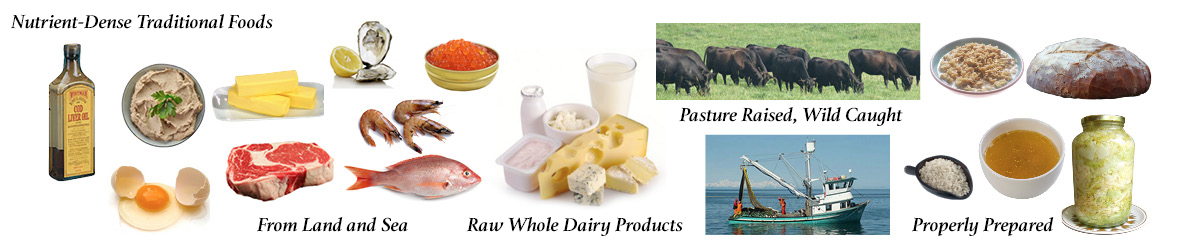
- Emphasize nutrient-dense foods (organ meats, animal fats, eggs, raw dairy, shellfish, fish liver oils and fish eggs).
- Eat some animal foods raw; cook most plants.
- Enjoy lactofermented condiments and beverages.
- Prepare seeds, grains and nuts properly to minimize antinutrients and increase digestibility.
- Enjoy saturated fats and avoid industrial seed oils.
- Consume animal foods from land and sea to balance omega-6 and omega-3.
- Use unrefined sea salt liberally.
- Include gelatinous bone broths.
- Emphasize nutrient-dense foods before and during pregnancy, and for growing babies.
In Nourishing Traditions, Sally Fallon Morell notes that the macronutrient proportions of traditional diets likely resembled the following: 40 percent of calories as carbs, 20 percent as protein and 40 percent as fat.7 However, Morell is careful to note that these proportions should “serve as guidelines only and not as rigid dogma that causes us to make a fetish of our eating habits.”7 For weight loss, she recommends about 20 percent as carbs and 60 percent as fat. (Her article titled “Thoughts on Weight Loss” provides four basic steps—Purge, Splurge, Fast and Last—that can help with permanent weight loss.8) Morell also makes an excellent point: diets that fixate on macronutrient numbers typically do so at the expense of food quality.7
This is the beauty of ancestral eating— nourishing foods are a far kinder master than the tyranny of calorie-counting regimens. If this piques your interest and you’d like to learn more, I encourage you to read Nourishing Traditions, explore the Weston A. Price Foundation website (westonaprice.org) and listen to the Wise Traditions podcast (westonaprice.org/podcast/).
NUTRIENT-DENSE FOODS, NOT CALORIE COUNTING
Although many people long to delete their calorie-counting app, throw out their scale and never look at a rice cake again, some may still be hesitant to embrace the ancestral approach to food with open arms. Why? Because an ancestral way of eating defies the rules and regulations of diet culture! Grass-fed steak with tallow? Freshly milled sourdough bread with butter? Raw milk that is full fat? Because these foods are not only nutrient-dense but higher in calories than kale chips and lowfat yogurt, many people ask the question: “Will I gain weight on an ancestral diet?”
Unless you are eating in excess and constantly ignoring your hunger cues, eating a whole-foods, ancestral diet is unlikely to make you gain weight. In fact, for many it will not only help you maintain a healthy weight but also shed the stubborn pounds you would like to lose. When we consume foods such as—pastured eggs, grass-fed meat or fermented sourdough— it helps regulate the body’s satiety hormones and metabolism which, in turn, makes it easier to not overeat and to maintain a healthy weight.
Weight is a big problem for many Americans. Today, although an estimated forty-five million Americans go on a diet every year,9 approximately three out of four adults are overweight or obese.10 Of the roughly 43 percent of adults who are obese, almost 10 percent are “seriously obese.”11 A study published in late 2025 suggested that if one measures obesity using not only body mass index (BMI) but also other anthropomorphic measures such as waist circumference, waist-to-height ratio or waist-to-hip ratio, the prevalence of adult obesity rises to a startling 69 percent.12
What’s the missing piece here? While there are many pieces in the obesity puzzle, processed foods may be one of the biggest culprits. These denatured foods wreck the body’s metabolism—and consequently lead to the need for calorie counting. The cycle never ends, and diet culture lives on.
How do processed foods destroy the body? First, most Americans are not having a processed treat merely once a year at Thanksgiving. Out of thirty-two countries, the U.S. consumes the most ultra-processed foods,13 with about 58 percent of daily caloric needs coming from them.14 Second, industrial seed oils account for 80 percent or more of the average American’s daily calories from fat.15 Third, researchers have found that people tend to consume more food on a processed diet. According to a small 2019 study,16 healthy individuals who volunteered to eat an ultra-processed diet for two weeks “ate about 500 calories more per day, ate at a faster rate and gained weight. On average, participants gained 0.9 kilograms, or 2 pounds while they were on the ultra-processed diet and lost an equivalent amount on the unprocessed diet.”17 Though processed foods lack nutrients, they have an abundance of calories.14 The combination of industrial seed oils, modified starches, refined sugar and addictive flavorings like MSG18 creates products that will hook consumers. Yet, after three Little Debbieʼs, the consumer will hardly feel full—and thus, the pounds begin to pack on.
What many people do not realize is that a fast-food diet will not only add to external body weight but will also wreak internal havoc. Because those captured by diet culture fixate on thinness, they often miss the significance of internal health. In her 2024 book Dark Calories, Dr. Catherine “Cate” Shanahan touches on the fact that people can have inflammatory body fat (generally referred to as visceral fat19), which typically builds up internally around the liver, pancreas and other organs.15 The problem is that this type of fat does not produce enough leptin to signal satiety to the brain, leading to overeating.15 Alarmingly, someone can be at a “normal” weight and still have visceral fat. Up to 45 percent of thin women and 60 percent of thin men actually have significant amounts of visceral fat, which Shanahan calls “skinny fat.”15 This kind of fat can lead to a dysregulated metabolism, hormone imbalance and, ultimately, disease.
Shanahan comments on modern metabolism:
“Just as the modern diet is profoundly unhealthy compared to the kind of diet humans historically ate, the modern metabolism is profoundly unhealthy too. The modern diet is nutrient-poor and toxin-packed. Therefore, the modern metabolism is constantly forced to generate oxidative stress and then adapt to it.”15
Fortunately, we can put the pieces of this puzzle together. If we swap the processed junk for whole foods, properly prepared, we can regulate our hormones and lose inflammatory fat. If we can regulate our hormones and lose inflammatory fat, we can restore a healthy metabolism. And if we can restore a healthy metabolism, we can maintain a healthy weight without joining the diet culture ranks.
FREEDOM FROM DIET CULTURE
In addition to the forty-five million Americans who go on a diet annually, thirty-three billion dollars is spent every year on weight loss products,9 due to the three-quarters of the adult population that is overweight.
It does not have to be this way. What if we focused instead on truly nourishing our bodies through properly raised and prepared foods, high-quality minerals, clean water, sunlight and movement? What if we sought to regulate our metabolism by feeding our starving bodies the nutrients we so desperately need?
I know that an ancestral way of eating can free someone from the chains of diet culture because I lived it. Diet culture was not kind to me. I achieved the skin-and-bones look I coveted—but at the price of my menstrual cycle, hormone vitality, energy and joy. As I yearned to break free from My Fitness Pal and the yoke of counting macros, I stumbled upon ancestral eating. I not only changed the food I consumed, but I also changed my mentality around food. I focused on nutrient density—through delicious foods, I might add. I traded my rice cakes for freshly milled sourdough bread, slathered with butter. I traded my extra-lean ground turkey for fatty grass-fed ground beef. I traded my egg white sandwiches for delicious yolks. And to my amazement, my health returned. I no longer felt like a shell of a person, nor was I gripped in the snares of the “way I must eat.”
Let’s make diet culture a thing of the past and embrace the wise dietary traditions of our ancestors.
REFERENCES
- “diet.” Merriam-Webster.com. https://www.merriam-webster.com/dictionary/diet (retrieved 1 Nov 2025).
- Fitterman-Harris HF, Davis GG, Bedard SP, et al. Digital mental health interventions: differences in diet culture intervention framing. Int J Environ Res Public Health. 2023 Dec 23;21(1):24.
- Sissons B. What to know about diet culture. Medical News Today, Nov. 30, 2023.
- The surprising history of diet culture. National Alliance for Eating Disorders, Jun. 27, 2023.
- Kingsley L. The seesawing history of fad diets. Smithsonian Magazine, Feb. 7, 2023.
- Wise Traditions Dietary Principles: Introduction. Weston A. Price Foundation, n.d. https://www.westonaprice.org/introduction-principle/
- Fallon S, Enig M. Nourishing Traditions: The Cookbook That Challenges Politically Correct Nutrition and the Diet Dictocrats, New Trends Publishing, 2003, p. 58.
- Morell SF. Thoughts on weight loss. Wise Traditions. Spring 2017;18(1):30-33. https://www.westonaprice.org/health-topics/thoughts-weight-loss/
- Medical weight management. Boston Medical Center, n.d. https://www.bmc.org/nutrition-and-weight-management/weight-management
- Henry Ford Health Staff. American obesity rates are increasing. Here’s how you can maintain a healthy weight. Henry Ford Health, Feb. 20, 2025.
- USAFacts Team. US obesity rates have tripled over the last 60 years. USAFacts, updated Nov. 5, 2025. https://usafacts.org/articles/obesity-rate-nearly-triples-united-states-over-last-50-years/
- Fourman LT, Awwad A, Gutiérrez-Sacristán A, et al. Implications of a new obesity definition among the All of Us cohort. JAMA Netw Open. 2025 Oct 1;8(10):e2537619.
- Stearn E. Revealed: Britain and US eat more ultra-procssed foods than anywhere else in world, with junk like cakes, sweets and biscuits making up almost 60 per cent of an adult’s average diet. Daily Mail, Feb. 29, 2024.
- Persellin K. Study: Consumption of ultra-processed foods may cause harmful ‘food addiction.’” EWG, Oct. 31, 2023.
- Shanahan C. Dark Calories: How Vegetable Oils Destroy Our Health and How We Can Get It Back. London: Hachette Books, 2024, pp. 58, 62, 63, 84.
- Hall KD, Ayuketah A, Brychta R, et al. Ultra-processed diets cause excess calorie intake and weight gain: an inpatient randomized controlled trial of ad libitum food intake. Cell Metab. 2019 Jul 2;30(1):67-77.e3.
- First randomized, controlled study finds ultra-processed diet leads to weight gain. National Institutes of Health, Clinical Center News, Jul. 1, 2019. https://www.cc.nih.gov/news/2019/summer/story-01
- Teller M. MSG: Three little letters that spell big fat trouble. Wise Traditions. Spring 2017;18(1):42-46. https://www.westonaprice.org/health-topics/modern-diseases/msg-three-little-letters-spell-big-fat-trouble/
- “Visceral fat.” Cleveland Clinic, last updated Aug. 22, 2025. https://my.clevelandclinic.org/health/diseases/24147-visceral-fat
I appreciate the promotion of the Wise Traditions diet, but I am not really sure why the author saw the need to bash beneficial diets, such as the Banting diet, the Atkins diet, and the ketogenic diet. It is really unfair to conflate them with other so-called “fad diets”, such as the Grapefruit Diet, or the original Weight Watchers approach. It is guilt by association.
In reality, diets such as Atkins, Keto, and Carnivore have greatly helped many people who have had serious health issues. Which is to not to say that they are optimal for everyone, but that they deserve respect, rather than the contempt conveyed in this article.
Sure, it would be great if we could worry less about what we do and do not eat, but the problems with our food supply and the numerous environmental challenges to our health that we now face demand that many people must take a strict approach to their diet in order to heal and thrive.