




 🖨️ Print post
If archaeologists are interpreting the evidence from mummies, stone carvings and other artifacts correctly, the relationship of human beings with the practice of tattooing may date at least as far back as 3300 BC.¹ However, the current Western fascination with tattooing as a no-holds-barred form of “self-expression”— what one might call a sort of “tattoo-palooza”— may be a practice without historical precedent. Beauty blogs openly celebrate the fact that tattoos are “everywhere these days,” happily noting, “it seems that everyone is getting inked.”²
Who is “everyone,” exactly? In the U.S., a 2023 Pew Research Center survey of adults found that one-third of respondents reported at least one tattoo, with the phenomenon trending more female than male (38 vs. 27 percent) and younger.³ Over half of women under age fifty reported tattoos—56 percent in the eighteen to twenty-nine age group and 53 percent of those thirty to forty-nine—and one-fifth of currently unadorned men and women under age thirty reported being “very” or “extremely” likely to get a tattoo in the future. By race and ethnicity, a third or more of Whites, Hispanics and Blacks had one or more tattoos, with Asians (14 percent) apparently being somewhat less tattoo-inclined. Those with a high school or less education and lower incomes reported tattooing themselves at roughly twice the rate (39 to 43 percent) of those with postgraduate degrees and higher incomes (21 percent).
The results of a Dalia Research survey conducted in 2018 suggest that the Pew study may even have underestimated U.S. tattoo prevalence.4 At 46 percent, Dalia ranked the U.S. third among countries whose residents have at least one tattoo, just behind top-ranked Italy (48 percent) and Sweden (47 percent). Other countries in the top twelve included (in descending order) Australia, Argentina, Spain, Denmark, United Kingdom—all at 40 percent or higher—and 35-37 percent of residents in Brazil, France, Germany and Greece.
SOME COLORFUL TATTOO HISTORY
Tattoo scholars (yes, there is such a thing) credit explorer Captain James Cook and British aristocrat Joseph Banks (Cook’s natural sciences partner on the voyage and later the decades-long president of the Royal Society), with introducing the word “tattoo” (as well as, ironically, the word “taboo”5) into the English language following their eighteenth-century travels (1768–1771), which included a sojourn in Polynesia.2,6 One account (likely apocryphal) suggests that the word tatau is onomatopoeic, composed of “tat” (referring to “tapping the tattooing instrument into the skin”) and “au” (“the cry of pain from the person being tattooed”)!7 Prior to the introduction of “tattoo,” other words used to refer to the practice included “pricked,” “marked,” “engraved,” “decorated,” “punctured,” “stained,” “embroidered” and the French piquer or piquage—but apparently “tattoo” caught on as none of these other terms had.7
Banks wrote in disbelief, “What can be sufficient inducement to suffer so much pain is difficult to say,” speculating that only “superstition” could be “a sufficient cause for so apparently absurd a custom.”7 He elaborated on the painful aspects of the procedure after observing the traumatic tattooing of a twelve-year-old girl’s buttocks:
“[I]t provd. . . a most painfull one. It was done with a large instrument about 2 inches long containing about 30 teeth, every stroke of this hundreds of which were made in a minute drew blood. The patient bore this for about one-fourth of an hour with most stoical resolution; by that time however the pain began to operate too stron[g]ly to be peacably endurd, she began to complain and soon burst out into loud lamentations and would fain have persuaded the operator to cease; she was however held down by two women who sometimes scolded, sometimes beat, and at others coaxd her.”8
The Cook voyage is reputed to have “changed the course of tattoo history” not just linguistically but in other ways as well. In addition to bringing back detailed records and drawings of the tattoo traditions encountered, Banks abducted a tattooed Polynesian to display him to the English court,9 and some members of the crew arrived tattooed themselves.7 Reportedly, this launched a new fashion trend among the royals and nobility.9 In the nineteenth century, the future King Edward VII and the future King George V both got tattoos, and, late that century, the first tattoo parlor opened on London’s famous high-fashion Jermyn Street.8,10
TATTOO SEMIOTICS OVER TIME
Historically, the rationale for tattoos and the meanings they communicate have varied widely. Historians believe that ancient Arctic and Egyptian peoples, for example, placed intricate tattoos on women’s thighs to safeguard mother and child during delivery11 and give newborns something pleasing to look at “as they slid from the womb.”12 However, many groups, such as the ancient Greeks and Romans, used tattooing for less uplifting purposes, viewing it as a method of “labeling”13 and penalizing society’s outcasts—the wide-ranging category of “outcasts” included “captives, slaves, criminals, deserters and prisoners of war.”14 In ancient China, too, engraving words on a person’s face became a widespread form of punishment from the Western Zhou period on (ca. 1056–771 BC).15
When we fast-forward to twentieth- and twenty-first-century Western society, it is obvious that tattooing has been undergoing significant sociocultural normalization, helped along by visible and incessant promotion on the part of athletes, celebrities and fashionistas. This prompted Forbes, in 2023, to write about the “more commonplace acceptance of tattoos in churches, schools and the workplace”:
“Companies including Disney, UPS and Bank of America have relaxed rules surrounding visible tattoos, and stigma around the permanent markings has largely faded in many industries. In 2020, the American Red Cross relaxed its donor eligibility criteria to make it easier for tattooed people to donate blood. The U.S. Army in 2022 eased its restrictions by cutting processing times for new recruits with tattoos and permitting current soldiers to have them in more places than previously allowed.”16
Among Pew’s survey respondents, the most common reasons named for getting one or more tattoos were far removed from criminality or outcast status, having more to do with remembrance, political signaling and, in our age of alleged narcissism,17 appearance. Nearly seven in ten respondents stated that their reason for being tattooed was “to remember or honor someone or something,” while the two other most common reasons were “to make a statement about what I believe” and “to improve my personal appearance.”3
As social acceptability takes ever greater hold and society elevates the most talented tattooists—one enthusiast, for example, describes “Top 10 Tattoo Artists That Make Me Want to Cover My Skin in Ink”18—tattoos have become so popular that the practice has even hit the halls of Congress.19 To bond with her eighteen-year-old granddaughter, Connecticut Rep. Rosa DeLauro, in 2024, had her arm tattooed with a rose at the ripe old age of eighty. That same year, Colorado Rep. Lauren Boebert unashamedly made headlines after posting on social media a bikini-clad picture of herself displaying a tattoo covering a major portion of her torso.20
“GENERALLY INVOLVES SOME PAIN”
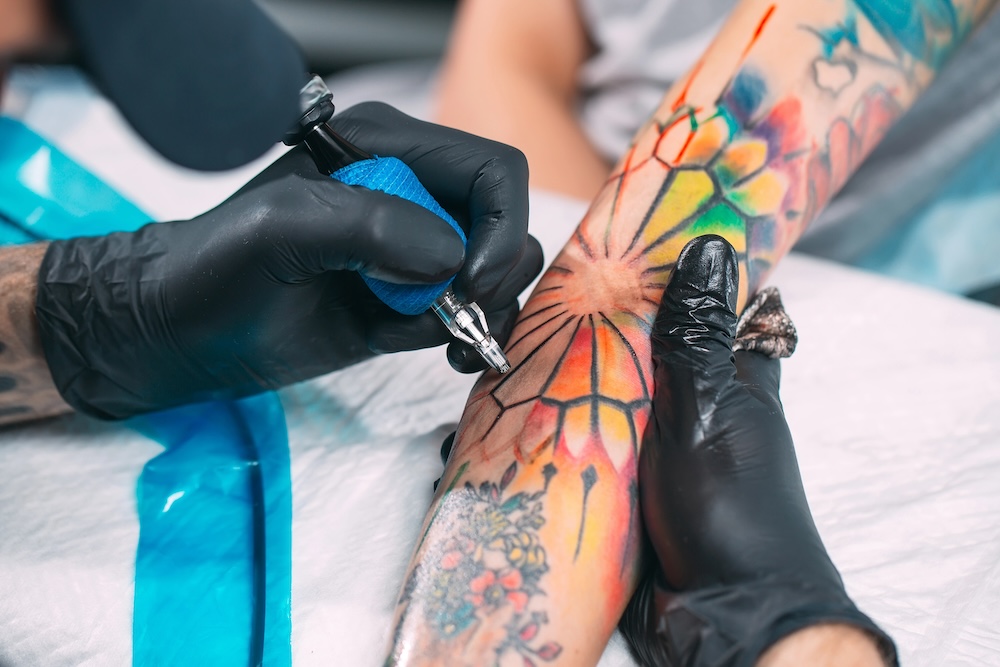
A New York tattooer patented the world’s first electric tattoo machine in 1891, a motorized device not majorly different in design from some of the “tattoo guns” in use nowadays.21 Today’s four-step process22 relies on different-size needles that attach to the hand-held “tattoo gun” (which can produce from fifty to three thousand up-and-down rotations per minute and regulates the flow of ink):
- The artist outlines the design on the skin with a stencil, sharpie or markers.
- Next comes “the fun part”: “The artist will dip the needle into the ink and start puncturing the skin.”22 The needle then “quickly goes in and out of the skin, leaving a trail of ink,” and the artist continues until the tattoo is complete.
- The third step is to add shadows and shading, using a thicker needle, “to create depth and dimension.”
- Finally, reverting to a thinner needle, the artist adds color, progressing from the lightest colors to darker ones.
Is “the fun part” actually “fun”? According to Healthline, which helpfully supplies a “tattoo pain chart,” getting a tattoo “generally involves some pain,” with pain levels varying by location on the body and “personal tolerance”; areas “with little fat, many nerve endings, or thin skin [are] more likely to hurt.”23 Areas where pain can be “high to severe” include the skull, neck and spine; rib cage; areola and nipple; armpit and inner bicep; inner or outer elbow; wrist, palm or fingers; stomach; groin and inner thighs; kneecap or behind the knees; shin; ankle, foot or toes.23 Healthline also explains that recipients may experience more than one type of pain:
- Dull or background pain (which can “periodically change or intensify”)
- Vibrating pain (“especially if the needle moves quickly”)
- Burning pain (caused by “the repeated trauma resulting from a tattoo needle piercing your skin in the same place”)
- Scratching pain (“like a cat dragging its claws across your skin”)
- Sharp or stinging pain (like “many tiny bee stings”)
The target zone for the ink is the second layer of skin, the dermis (about 1.5 to 2 millimeters beneath the skin’s surface), where collagen and elastin fibers are supposed to “help anchor the ink in place.”22 However, tattoo sites warn, if an inexpert tattooist mistakenly goes too deep into the next layer of skin, it “can lead to excessive bleeding, scarring, and prolonged healing times,” as well as a “blurry or ‘blown out’ appearance.”24 Mastering needle depth, apparently, is a skill that only comes with “time and experience.”24 (Tattoo websites do not discuss the guinea pig clients who unknowingly help tattooists acquire this expertise!)
THE INKS
Individuals who choose to get tattooed often justify their body art decision with the “people-have-always-done-it” argument.25 Few, however, appear to be paying attention to the risks of the newfangled inks and needles that make up the contemporary tattooist’s toolkit—materials strikingly different from those that nature supplied before the advent of the synthetic/ industrial era. Pacific Islanders’ traditional tools and pigments, for example, featured a “handled comb made of albatross, frigate bird, or bat-wing bone” (used to “etch lines and figures into the skin”), with the pigment created from a mixture of soot and a botanical oil.26 In the Philippines, needles made from “wood, horn, bone, ivory, metal, bamboo, or citrus thorns. . . created wounds on the skin that were then rubbed with the ink made from soot or ashes mixed with water, oil, plant extracts (like sugarcane juice), or even pig bile.”27 When tattooists moved beyond soot- and charcoal-derived black to other colors, they created reds, browns and yellows “using mostly minerals along with plants and animal parts.”28
The historical record seems to be mostly silent on whether and how often these nature-derived materials may have caused trauma to the skin or body. However, a commenter on Reddit hypothesizes that the freshly made charcoal used for most ancient pigments would have been “initially sterile” as well as “anti-bacterial and mildly antiseptic,” which could have helped “with both the cleanliness of the tools and the wounds themselves.”29
Nowadays, pigments are not only synthetic but manufactured by large corporations making colors that are not tattoo-industry-specific. As researcher Dr. John Swierk explains, “Surprisingly, no dye shop makes pigment specific for tattoo ink. Big companies manufacture pigments for everything, such as paint and textiles. These same pigments are used in tattoo inks.”30 This may be why some researchers have reported finding “exotic” contaminants in tattoo ink such as Texanol, a waterborne paint ingredient.31 In addition to the pigments, tattoo inks can contain “dispersants (polymers and surfactants), solvents (water and/or organic solvents), polymeric resins for binding, antifoaming agents (such as fatty oils), wetting agents (surfactants), rheological modifiers to control viscosity, pH modifiers, and biocides to prevent microbiological growth.”31
On the topic of contaminants, Swierk’s research team found that corporate manufacturers are consistently failing to disclose the presence of “potentially concerning additives” in their inks.32 In a study published in 2024,32,33 Swierk’s lab analyzed fifty-four tattoo inks from nine manufacturers and reported the following disturbing findings:
- Forty-five inks contained unlisted additives (“adulterants”) and/or unlisted pigments.
- Over half contained unlisted polyethylene glycol (PEG), a compound associated with severe allergic reactions as well as kidney failure.
- Fifteen inks contained unlisted propylene glycol, also linked to dangerous allergic reactions.
- Two of the unlisted preservatives were BHT (known to sometimes act as a tumor promoter) and 2-phenoxyethanol, a preservative with “conflicting” safety data.34
Swierk also expressed concern that twenty-three of the inks they analyzed featured an azo-containing dye.30 Azo pigments (used to create reds, yellows and oranges) are widely used synthetic colorants said to be benign when chemically “intact,” but which can degrade into suspected carcinogens. This phenomenon, called “reductive cleavage,” refers to the breaking of a chemical bond via a “reducing agent.” In organic chemistry experiments, the reducing agent might be a dissolving metal, an electric current or hydrogen gas.35 In the human gastrointestinal tract (following ingestion of azo dyes in food), the intestinal microbiota are the agent creating the carcinogenic metabolites.36 Inside human skin, the cleavage trigger is. . . ultraviolet light, including sunlight.30
A 2022 article in Toxicology and Industrial Health called attention to the cleavage problem:
“Tattooists. . . place tattoo ink inside the skin surface and unintentionally introduce a large number of unknown ingredients. These ingredients include polycyclic aromatic hydrocarbons (PAHs), heavy metals, and primary aromatic amines (PAAs), which are either unintentionally introduced along with the ink or produced inside the skin by different types of processes for example cleavage, metabolism and photodecomposition. . . . [T]he various ingredients of tattoo inks, their metabolic fate inside human skin and unintentionally added impurities. . . could pose toxicological risk to human health.”37
The heavy metals mentioned in the preceding quote are also a core component of tattoo inks. A 2022 study explains that “cobalt (Co), cadmium, and mercury are considered bases for the colors green, blue, yellow, and red,” and metals such as aluminum and cadmium are used “to obtain different tones and brightness.”38 The concerned authors of the study urge greater awareness of the risks of “lifetime exposure” to these and other ingredients, lamenting the fact that because “the different composition, chemical structures, and destiny of the inks in the body are not known exactly, it is difficult to evaluate their effects on health.”38
DESTINIES UNKNOWN
Tattoo inks suspend their pigment in a carrier solution,39 and this fact prompted the authors of a 2024 publication to explain the implications regarding the “destiny of inks in the body.” After injection of “about 14.36 mg of ink. . . per cm2 of skin, at a depth of 1-3 mm,” various cells (neutrophils, fibroblasts, macrophages, dendritic cells) “internalize” the pigment; however, tattoo recipients may not be aware that anywhere from 60 to 90 percent of the pigment is then “transported to the lymph nodes via the lymphatic system and to other organs, such as the liver, spleen, and lung, through blood.”40 The authors pointing out this little-known fact cite the need for longitudinal studies “to identify the cause-and-effect relationship between tattoo pigments and disorders in the lymph nodes and organs in which they are retained for life.”40 Stated another way, “tattoo inks are not as stable in the skin as one might think.”41
One reason for this instability is the growing technological reliance on nanoparticles. Black remains the most common tattoo color, but in a far cry from the long-ago use of soot, modern black inks can contain anywhere from five to more than fifty components,42 including carbon black nanoparticles. Because they are “ultramicroscopic,” these nanoparticles can “penetrate through skin layers into underlying blood vessels and then travel with the bloodstream,” entering organs and other tissues as well as possibly inducing toxic brain effects or nerve damage.43 Scientists suspect that nanomaterials are particularly likely to accumulate in the liver and spleen.41
Asking, “What Do People Really Know about the Medical Risks of Body Ink?” the authors of a 2018 article in the Journal of Clinical and Aesthetic Dermatology outlined other risks as well.43 Serious complications include allergic and hypersensitivity reactions to tattoo pigments, the formation of lumps that “can occur even years after obtaining the tattoo,” skin pigmentation disorders, inflammation and scarring.43 The FDA, which only started issuing guidance to the tattoo industry in late October 2024,44 acknowledges that it has received reports of adverse reactions to tattoo inks not just immediately after the procedure but also “years later.”45
Intentional or “unintentional” ingredients such as the PAHs, PAAs and heavy metals mentioned in the preceding section are all associated with “sensitizing reactions” as well as being potentially immunotoxic and carcinogenic.46 German researchers have found that when inks contain PAHs (which they warn “possibly stay lifelong in skin”), exposure to ultraviolet radiation decreases mitochondrial activity in the cells and compromises skin integrity.47
Nor is it just the inks that can cause problems. Even when tattooists are proficient at reaching the “just right” depth (neither too shallow nor too deep), dermatologists caution that the needles cause abrasion that comes with risks because “the needles contain large amounts of sensitizing elements such as nickel and chromium.”46 Tattoo sites also tell tattoo artists to avoid “overworking the skin,” which can cause scarring and “excessive” irritation.48 This apparently requires mastering other “just right” techniques such as applying the right amount of pressure, choosing the right needles and taking the time needed.
REGRET AND REMOVAL
In an article examining the tattoo market, Forbes reported, “The increasing popularity of tattoos has led to a boom in two industries— those who give them and those who remove them.”16 The 2023 Pew survey found that one-fourth of respondents regretted their tattoos.3 A study that looked at tattoo regret (titled “Think Before You Ink”), found that factors such as “getting one because of peer pressure” or “being impaired when getting” were predictors of later regret, as were experiencing an adverse event or having a tattoo on a visible location such as the face, neck, hands, wrists or fingers.49 Another study of tattoo regret found that two of the most common reasons for regret were making the decision on impulse or doing it to “look cool.”50
Unfortunately, for those whose regret spurs them to take action, tattoo “removal” turns out to be somewhat of a misnomer, masking a pulsed laser process “more painful than tattooing” that does not actually remove anything:
“Laser treatment does not remove the tattoo ink out of the body; rather, the relatively large pigments of the ink are broken down into much smaller particles, which are transported through the body and stored in the lymph nodes or other tissues. The ink does not ever really leave the body, though possibly a portion is excreted via the liver.”43
In an article titled “Tattoo Removal: 14 Things I Wish I Had Known Before Getting It,” a writer for Glamour notes that “complete tattoo removal takes a minimum of two and a half years on average”—because the body needs about three months between each session to recover from the laser assault.51 Describing the forty-five-minute sessions, the Glamour author writes, “[W]e take ‘before’ photos, clean the areas, inject them with lidocaine for freezing, laser them, ice them, and then bandage them. Oh, and sometimes a weird side effect happens where I taste metal when the laser hits my skin.” (The author explains that this is a common sensation when laser makes contact with lidocaine.) In addition, she comments, those contemplating removal should know that “the skin that is left might not be flawless.” Another person has more bluntly stated, “First thing to realize is that your tattooed skin will never, ever be able to look normal again, as though nothing was done to it.”52
THINKING CAREFULLY
One of the latest tattooing trends to hit the marketplace is “permanent makeup.” Just like it sounds, permanent makeup (also called micropigmentation) uses tattooing techniques to “replicate the appearance of traditional makeup, such as for eye liner, eyebrows, and lip color.”53 Cleveland Clinic’s webpage about micropigmentation notes that the procedure can be “especially helpful if you are a person who wants to look their best while avoiding the physical challenges of applying makeup” but includes a special caution to young people to “think carefully,” because “What’s ‘hot’ in beauty fashion today, may not be tomorrow’s trend and you don’t want to be stuck with an undesirable look.”54
Others advising young people to “think carefully” have approached the issue from a religious perspective. Offering a “Catholic perspective on body art,” a deacon in the Archdiocese of Portland, Oregon, considers tattoos a form of “physical graffitti”25 and cites St. Paul’s admonition in 1 Corinthians 6: “Do you not know that your body is a temple of the Holy Spirit within you, which you have from God?”
Regardless of one’s tattoo cosmology, the number of unknowns surrounding modern-day tattooing—whether pertaining to adverse events, undisclosed ingredients, sneaky nanoparticles or the phenomenon of regret—suggest that “thinking before you ink” is not such bad advice.
SIDEBARS
SHIFTING MEANINGS, USES AND POLITICS
Perhaps no country illustrates the shifting meanings, uses and politics of tattoos better than Japan. Historians believe that in ancient Japan, tattooing started off as a means of communicating social class or conferring spiritual protection.55 In some locations, islanders appear to have used hand tattoos to show that a woman was married.56 Around the seventh century, however, the practice seems to have entered into a centuries-long period of official disfavor,57 and written records started to document its punitive use to brand criminals with a “permanent mark of shame.”58
In the Edo period (1600–1868), Japanese tattooing experienced an interesting resurgence, evolving into what fans describe as a “vibrant, narrative-driven art form.”57 Branded individuals started transforming their markings into “body suit” tattoos called irezumi, and woodblock carvers began to lend their “engraving expertise,” becoming tattoo artists.58 Other subgroups, ranging from courtesans to men in certain trades to kabuki actors, took advantage of tattooistsʼ growing sophistication. For its part, however, the ruling warrior class consistently rejected tattooing due to Confucian prohibitions about “causing injury to oneʼs own body.”56
By 1872, Japanese rulers wanted to present a “civilized, strong appearance” to Western powers and decided to ban tattoos, but the yakuza organized crime syndicate kept the practice going, using tattoos to signify membership (not unlike gangland tattooing in the U.S. today), and in the process, cementing a strong cultural association in that country between tattoos and criminality. Ironically, when General MacArthurʼs occupying forces lifted Japanʼs tattoo ban in 1948, it reinforced the general publicʼs negative perceptions of tattoos: “Having the ban lifted by Americans led many Japanese to resent the practice even more.”55
TATTOO INKS OF YORE
An article titled “Tattoo Ink Throughout Time”11 describes how some populations and regions made tattoo inks in centuries past:
- Aetius, a Roman scholar and physician, recorded a recipe that used “Egyptian pine bark, corroded bronze mixed with vinegar, gall nut (a type of insect larvae) and vitriol.”
- Celtic and Pict warriors made a blue dye from the leaves of woad (isatis tinctoria) by drying and then boiling (twice) the leaves of the flowering plant to make a “thick viscous paste.”
- In the Japanese city of Nara, they burned pine branches with sesame oil, collected soot and kneaded the soot with “bone glue” to make a dough dried in small blocks for several months to years. To make the ink, they then shaved the blocks and mixed the shavings with water.
- Sailors—one of the most storied subgroups ever to engage in tattooing—reportedly have used whatever was at hand, including gunpowder and urine.
REFERENCES
- Tattoo. Britannica, updated Aug. 14, 2025. https://www.britannica.com/art/tattoo
- Michalak J. The history of tattoos and why they’ve become so popular. Byrdie, updated Dec. 3, 2023.
- Schaeffer K, Dinesh S. 32% of Americans have a tattoo, including 22% who have more than one. Pew Research Center, Aug. 15, 2023.
- Armstrong M. Where tattoos are most popular. Statista, May 23, 2018. https://www.statista.com/chart/13942/where-tattoos-are-most-popular/
- https://www.aieti.eu/enti/taboo_ENG/
- Sayce P. Captain Cook finds tattooing in the South Seas. Tattoo Club of Great Britain, Apr. 16, 2009.
- Saunders R. The etymology of “tattoo” in Western culture: how the word became the badge of an adventurous life. Medium, Oct. 2, 2021.
- Lenz P. A history of… tattoos (Part 2). Histories, Aug. 8, 2025. https://www.gethistories.com/p/a-history-of-tattoos-part-2
- We delve into the archives and appreciate the history of tattoos. Celebrity Ink, Aug. 9, 2020. https://celebrityink.com/blog/we-delve-into-the-archives-and-appreciate-the-history-of-tattoos/
- Shoemaker R, Alker Z. How tattoos became fashionable in Victorian England. The Conversation, Jan. 13, 2020.
- Tattoo ink throughout time. Trinity, Jul. 31, 2016. https://www.trinitybj.com/help-center/blog/tattoo-ink-throughout-time
- Saunders R. Canada’s tattooed tribes: what we know about the body art of the Haida and Inuit peoples. Medium, Oct. 25, 2021.
- Peter J. The painful reality of tattoos (& removal) in ancient Rome. Oct. 3, 2022. https://www.youtube.com/watch?v=cAXWy5AnkGA
- Kyriakou G, Kyriakou A, Foots Th. Dermatostiksia (tattooing): an act of stigmatization in ancient Greek culture. Actas Dermo-Sifiliograficas. 2021 Nov-Dec;112(10):907-909.
- Chapter 1: Introduction to tattoos (part 2) – the origin of tattoos in China. Dragoart Tattoo, Sep. 13, 2023. https://dragoarttattoo.com/blogs/blog/ the-origin-of-tattoos-in-china
- Roeloffs MW. Tattoo USA: One-third of Americans have ink as industry projected to hit $4 billion. Forbes, Aug. 15, 2023.
- McDonald C. Is narcissism really on the rise? Here’s what it is and how to recognize it. Deseret News, Jul. 12, 2024.
- Farnum P. Top 10 tattoo artists that make me want to cover my skin in ink. Cicada Creative Magazine, Jan. 29, 2021.
- Lippman D. Cory Mills has a dramatic new Capitol tattoo. Politico, Jun. 13, 2025.
- Peter R. 8 US politicians who have tattoos: from Sarah Palin to John Fetterman. MEAWW, Aug. 18, 2024.
- The rotary tattoo machine, then and now. Trinity, Sep. 11, 2016. https://www.trinitybj.com/help-center/blog/the-rotary-tattoo-machine-then-and-now
- Melvin J. How tattoos work: everything you need to know. The Fall Tattooing Blog, Sep. 14, 2022.
- Cirino E. Guide to tattoo pain by body part. Healthline, updated Dec. 23, 2024.
- How deep does tattoo ink go? Needle depth, explained. Kingpin Tattoo Supply, Jul. 19, 2024.
- Lukosh RS. Physical graffitti: a Catholic perspective on body art. PatrickMadrid.com, Oct. 1, 2011. https://patrickmadrid.com/wp-content/uploads/2011/10/bodyart.pdf
- Lindsay C. How was the ink collected and created for traditional tattoos? Quora, n.d. https://www.quora.com/How-was-the-ink-collected-and-created-for-traditional-tattoos
- History of tattooing: Philippines. Wikipedia (accessed Aug. 29, 2025).
- Tattoo ink throughout time. Trinity, Jul. 31, 2016. https://www.trinitybj.com/help-center/blog/tattoo-ink-throughout-time
- 7LeagueBoots. How did ancient people avoid tattoo infections, given the high risk? Reddit, n.d. https://www.reddit.com/r/AskHistorians/comments/1dpdn3t/how_did_ancient_people_avoid_tattoo_infections/
- Khaled F. What is azo dye? Tattoo ink shares possible link to cancer in new study. Newsweek, Aug. 26, 2022.
- Jacobsen NR, Clausen PA. Ingredients, chemical analysis and safety of marketed tattoo ink stock products: carbon black nanoparticles and other problematic constituents of black ink and their potential to harm tattooed humans. In J Serup, N Kluger, W Baumier (Eds.), Tattooed Skin and Health. Karger, 2015.
- Swierk J. What’s in tattoo ink? My team’s chemical analysis found ingredients that aren’t on the label and could cause allergies. The Conversation, Mar. 22, 2024.
- Moseman K, Ahmed A, Ruhren A, Swierk JR. What’s in my ink: an analysis of commercial tattoo ink on the US market. Anal Chem. 2024 Mar 5;96(9):3906-3913.
- Pedroja C. Is phenoxyethanol in cosmetics safe? Healthline, Nov. 27, 2018.
- Lee S. Mastering reductive cleavage in organic chemistry. Number Analytics, Jun. 9, 2025.
- Feng J, Cerniglia CE, Chen H. Toxicological significance of azo dye metabolism by human intestinal microbiota. Front Biosci (Elite Ed). 2012 Jan 1;4(2):568-586.
- Negi S, Bala L, Shukla S, Chopra D. Tattoo inks are toxicological risks to human health: a systematic review of their ingredients, fate inside skin, toxicity due to polycyclic aromatic hydrocarbons, primary aromatic amines, metals, and overview of regulatory frameworks. Toxicol Ind Health. 2022 Jul;38(7):417-434.
- Karadagli SS, Cansever I, Armagan G, Sogut O. Are some metals in tattoo inks harmful to health? An analytical approach. Chem Res Toxicol. 2023 Jan 16;36(1):104-111.
- ACS Newsroom. Exposing what’s in tattoo ink. ACS, Aug. 24, 2022.
- Dodig S, Čepelak-Dodig D, Gretić D, Čepelak I. Tattooing: immediate and long-term adverse reactions and complications. Arh Hig Rada Toksikol. 2024 Dec 29;75(4):219-227.
- Nanoparticles in tattoo ink could cause cancer. Friends of the Earth Emerging Tech Project, n.d. https://emergingtech.foe.org.au/nanoparticles-tattoo-ink-could-cause-cancer/
- Jacobsen NR, Clausen PA. Carbon black nanoparticles and other problematic constituents of black ink and their potential to harm tattooed humans. Curr Probl Dermatol. 2015;48:170-175.
- Rahimi IA, Eberhard I, Kasten E. Tattoos: What do people really know about the medical risks of body ink? J Clin Aesthet Dermatol. 2018 Mar;11(3):30-35.
- The ink is dry: FDA issues final guidance for tattoo industry. Crowell, Oct. 29, 2024.
- Think before you ink: tattoo safety. FDA, content current as of Dec. 17, 2024.
- Kurz B, Schreiver I, Siewert K, et al. Investigation of adverse reactions in tattooed skin through histological and chemical analysis. Dermatology. 2023;239(5):782-793.
- Regensburger J, Lehner K, Maisch T, et al. Tattoo inks contain polycyclic aromatic hydrocarbons that additionally generate deleterious singlet oxygen. Exp Dermatol. 2010 Aug;19(8):e275-e281.
- How to avoid overworking the skin with the right needle choice? Ascent Needles, Dec. 6, 2024.
- Morlock R, Morlock A. Think before you ink: perception, prevalence, and correlates of tattooing and tattoo regret in US adults. Cureus. 2023 Nov 2;15(11):e48167.
- The statistics surrounding tattoo regret and how to avoid it. Advanced Dermatology, n.d.
- Chan L. Tattoo removal: 14 things I wish I had known before getting it. Glamour, Sep. 7, 2022.
- Morton C. Can a laser remove a tattoo completely? Quora, n.d. https://www.quora.com/What-happens-to-the-ink-during-the-laser-tattoo-removal-process
- Permanent makeup. Wikipedia, n.d.
- Micropigmentation. Cleveland Clinic, last reviewed Jul. 2, 2020.
- Irezumi: Tradition and Criminality [exhibit]. Japanese Visual Culture, Fordham University, n.d. https://japanesevisualculture.ace.fordham.edu/exhibits/show/irezumi_tradition_and_criminal/irezumi_introduction
- Yoshimi Y. “Irezumi”: the Japanese tattoo unveiled. Nippon.com, Jan. 30, 2017.
- Swanston Z. A history of Japanese tattooing. ZealandTattoo, Jun. 30, 2025.
- Ximiao Z. The evolution of irezumi: from penal markings to masterpieces of art. Inksmith Journal, Mar. 19 [no year given].
This article appeared in Wise Traditions in Food, Farming and the Healing Arts, the quarterly journal of the Weston A. Price Foundation, Fall 2025
🖨️ Print post
Hello Merinda,
I organize a Make America Healthy Again (MAHA) group here in CO. where we meet virtually twice a month. Many of our members are also WAPF members who are fantastic supporters of MAHA. We are currently considering the theme of Mental Health, and in search of an expert presenter on SSRIs. Is this something you might consider on a Tuesday evening on Zoom from 7 – 8:30 MT? Thank you so much for your consideration!