

Demystifying Heart Attacks Stephen Hussey looks at true causes and prevention Play Audio
A New Look at Circulation: The Helical Heart & Microvascular Flow Dr. Manel Ballester-Rodés shows that the heart is a double helix Play Audio
Neurological and Chronic Disease: The Aluminum Connection Dr. Christopher Shaw reviews some of his aluminum discoveries Play Audio
Wireless Exposures Camilla Rees discusses the wireless radiation pervading our lives Play Audio
DEPARTMENTS
- President’s Message: How to Eat Meat (see below)
- Letters: Letters to the Editor of Wise Traditions
- Caustic Commentary: Sally Fallon Morell takes on the Diet Dictocrats Play Audio
- Reading Between the Lines Merinda Teller takes a look at tattoo toxicity Play Audio
- Homeopathy Journal Anke Zimmermann considers the homeopathic remedy Alumina
- The Wise Traditions Pantry Ron Bazar says, pay attention to antinutrients Play Audio
- WAPF Podcast Interview Nina Teicholz dissects the wrong-headed U.S. Dietary Guidelines
- All Thumbs Book Reviews
- Tim’s Video Reviews
- Thumbs Up
- Vaccination Updates Kendall Nelson on the meningitis narrative Play Audio
- A Campaign for Real Milk:
- Healthy Baby Gallery: More Wise Traditions babies!
President’s Message
Recently the Wall Street Journal ran an article that described the Weston A. Price Foundation as advocating a “carnivore” diet, that is a diet very heavy on meat with little in the way of plant foods. While the Weston A. Price Foundation certainly advocates a diet rich in animal foods, this description of our teachings really misses the mark.
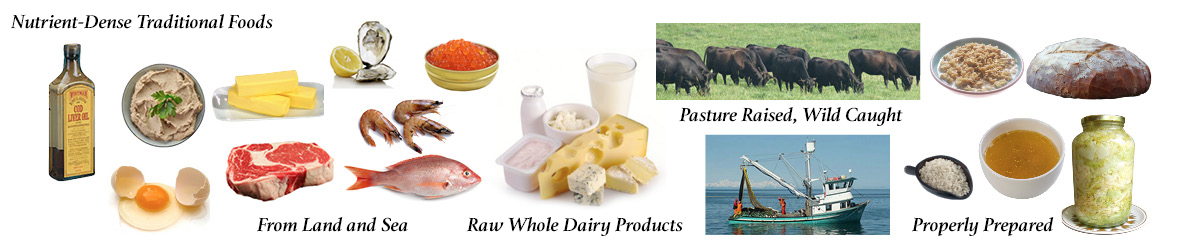
The main characteristic of the Wise Traditions diet teachings is that we advocate for nutrient-density, especially high levels of the “fat-soluble activators” found in animal fats, organ meats and certain seafoods like shellfish and fish eggs. In addition to choosing foods especially high in fat-soluble and other nutrients, we also advocate avoiding foods and dietary practices that block or reduce nutrients in our food.
The practice of eating a lot of meat, especially lean meat, can indeed be counterproductive to human nutrition. That’s because when we eat protein, the liver releases vitamin A to process that protein. And if the protein we are eating contains little or no fat, fat that provides vitamin A, we eventually become depleted of this critical nutrient on a high-meat diet. Traditional people never ate meat without the fat!
Another problem with the high-meat diet is that meat contains a lot of methionine. Some symptoms associated with high methionine levels include nausea, drowsiness and irritability. Long-term, too much methionine is associated with cardiovascular risk.
The solution is to eat meat with broth—a reduction sauce or broth-based gravy—or to eat long-cooked stewing meats, which have a lot of connective tissue, with their stewing juices. Collagen in connective tissue and bone broth is rich in glycine, and it is glycine that mitigates any detrimental effects of excess methionine.
So there’s a way to eat meat to ensure that it is nutrient-dense and not a nutrient drain: eat meat with the fat and eat it with a good source of glycine. That also means consuming good sources of vitamin A (with its co-factors vitamins D and K2), such as cod liver oil, liver, butter from grass-fed animals and egg yolks from pastured hens, and not just meat.
In a reply letter to the Wall Street Journal, honorary board member Pam Schoenfeld and I pointed out that traditional diets contained varying amounts of plant foods. With plant foods, as with animal foods, proper preparation is key. Bread that is sour leavened will be much richer in nutrients than unleavened or yeasted bread; and the antinutrients that block mineral assimilation and digestive enzymes will be largely neutralized. Cooked vegetables release their minerals for ease of digestion and are lower in irritating components and anti-nutrients. By contrast, milk products provide the best nutrition when they have not been heated.
Attention to these important details ensures a diet that is nutrient-dense and easy to digest.
🖨️ Print post
A good article but it fails to mention the importance of traditional food fermentation as a critical step in food preparation.
See Steinkraus.
(1) Handbook of Indigenous Fermented Foods, Second Edition, Revised and Expanded
Keith Steinkraus
November 14, 1995 by CRC Press Reference – 792 Pages
ISBN 9780824793524 – CAT# DK5116Series: Food Science and Technology