





 🖨️ Print post
In 2010, Apple launched its first iPad. The event made a big splash in the tech marketplace, almost instantly transforming tablets from “fictional gadgets from the future” into “essential everyday companions.”1 More significantly, the iPad and other tablet brands began reshaping consumer expectations,2 feeding an insatiable demand for kid-friendly hand-held devices3— and young children became some of the tablets’ most avid users. By 2017, almost four in five U.S. families with young children had a tablet in the home.4 In fact, as one reporter quipped, “If you are an adult in possession of both a tablet and children, the children are likely to take possession of the tablet.”5
Children’s ready adoption of these enticing accessories has drawn praise from some quarters and consternation from others. For example, after a research team in the UK conducted studies seeming to show that the devices accelerated certain developmental milestones,6 the investigators enthusiastically gushed that “tablets should be part of a baby’s world from birth.”7 On the other hand, a Harvard expert who has questioned the wisdom of tablet use by very young children reminds parents of the irreplaceable importance of experiential learning—the feeling of paint “squishing through…fingers.”8 Even the American Academy of Pediatrics (AAP)—a trade organization not otherwise known for adopting enlightened positions on child health—crafted a policy statement warning of the potential for harm from “excessive digital media use” and agreeing that what young children need most is “hands-on exploration and social interaction with trusted caregivers.”9
As some developmental experts inch toward branding young people’s diet of empty media “calories” as a public health issue,10 there is another set of dangers that has remained largely off the table in discussions about children’s screen time—namely, the risks associated with the radiofrequency (RF) electromagnetic radiation that tablets and other mobile devices produce.11 This concern should be paramount, however, because children and their developing nervous systems are uniquely vulnerable to RF radiation.12 Over a decade ago, a group of researchers was already cautioning that because exposure to manmade RF radiation is widespread, even the smallest effects “can have large public health consequences.”13
THE EVIDENCE IS IN
In 2014, a news report on young people’s use of tablets asserted that “the dangers of tablet use for children—if dangers exist—are as yet unidentified.”5 This disingenuous opinion ignored the game-changing pronouncement made a few years earlier (in 2011) by the World Health Organization’s International Agency for Research on Cancer (IARC), which classified the RF radiation from cell phones and comparable devices as a “possible human carcinogen.”14 IARC members clarified that this carcinogenic potential held for “all types of radiation within the radiofrequency part of the electromagnetic spectrum, including the radiation emitted by base-station antennas, radio/TV towers, radar and Wi-Fi.”15 And, in terms of radiation effects, all of the wireless devices commonly used by children—tablets, laptops and smartphones— “pack the same punch under the hood.”16
In 2018, the U.S. National Toxicology Program (NTP) reinforced IARC’s warnings by releasing findings from a rigorous twenty-five-million-dollar cell phone study that bumped the evidence of carcinogenicity up from “possible” to “conclusive.”17 The senior scientist who led the design of the study stated, “We can no longer assume any current or future wireless technology is safe.”18 Although many of the media outlets downplayed the significance of the NTP study, word has gotten out to many parents about the risks that cellular and wireless technologies pose for children. In a brief survey conducted by the Environmental Working Group (EWG), to which over twenty-one thousand people responded, over 95 percent of respondents were “extremely” or “very” concerned about young children using cell phones and wireless devices such as tablets.11
CONSTANT BURSTS
When people use tablets to connect to the Internet, they can go online in one of two ways: through Wi-Fi or by connecting to a cellular network. However, even when the user is offline, the radiation does not “automatically stop.” In fact, wireless tablets emit “constant bursts” of pulsed RF electromagnetic radiation—up to nine hundred times every hour.19 The same holds true for wireless-enabled laptops, which are “always ‛checking in’ and searching for a Wi-Fi connection.”20 Why is this the case? As the Environmental Health Trust (EHT)—an education and research organization focused on wireless technologies and other environmental health hazards—explains:19
Tablets “have up to five transmitter antennas emitting radiation as a beacon signal that transmits even when the internet is NOT being used…. The bursts continue because the tablet antennas ‛check in’ with what is called a ‛digital handshake’ to the base network which is usually a Wi-Fi router or hotspot, or a nearby cell tower. If the network signal strength is low, then the tablet’s radiation burst is higher. This digital handshake continuously repeats.”
As EHT and others point out, children do not usually heed the fine-print warnings that come with tablets and laptops. Tablet manufacturers tell users to avoid direct contact with the transmitting antenna or to place the antenna away from the body, but instead, “many children will lie down on the floor with a tablet very close to their face, exposing their eyes and brain.”19 With small children’s heads more directly in front of the antenna, “the radiation will more directly penetrate their head, neck and chest area.”20 Italian researchers who analyzed different tablet and laptop exposure conditions (that is, “antenna at different distances…, in different positions and orientations”) for male and female preteens and young adults found that young people tended to absorb the most RF energy “in more sensitive organs such as eye, genitals, and breast.”21
Children (and many parents) are also unlikely to be aware of the Federal Communications Commission’s (FCC’s) obsolete guidelines for human exposure to RF electromagnetic fields, which were last updated over twenty years ago, well before today’s more powerful devices had entered the marketplace. Even at that time, however, the FCC specified that mobile devices were “designed to be used… in such a way that a separation distance of at least 20 centimeters [about eight inches] is normally maintained between radiating structures and the body of the user or nearby persons.”22 Yet as a children’s advocacy organization has commented, for small children “it is almost impossible to follow FCC recommendations and keep 8 inches from the body.”20 The AAP has criticized the FCC regulations for not being strict enough to protect children.
THE DIGITAL INVASION OF SCHOOLS
With growing awareness of mobile devices’ powerful effects, discerning parents are taking steps to mitigate wireless risks at home. They have little control, however, over their children’s wireless exposure at school. Over an astonishingly short period of time, wireless tablets and lightweight laptops have inundated U.S. classrooms. Cheery news accounts herald tablets and laptops as a way to “sustain students’ interest,” “reward their achievements” and keep students up to date on “the latest events or research.”23 By 2014 (just four years after the introduction of the iPad and three years after Google’s introduction of its Chromebook laptop24), roughly three in five schoolchildren in grades three or higher had access to a tablet or laptop—as well as 41 percent of children in grades K-2.25 By early 2018, the Chromebook’s relative affordability and Google’s “robust partnership program” with schools had allowed the Chromebook to claim 60 percent of the school computer market.24,26
As these statistics suggest, the push to swap textbooks for tablets has been very good for business, particularly given the near-saturation of demand for mobile devices in other corners of the consumer market.27 According to a 2013 report in Bloomberg, “tech companies are falling back on the old adage: get ’em while they’re young”—and “if you’re looking for young people, there’s no better place to find them than in schools.”27
Common Core provides a clear example. The bold Bill & Melinda Gates Foundation-backed initiative is now acknowledged by no less than Bill Gates himself to have been an educational flop,28 and a disappointment to parents, students and teachers alike. Nonetheless, Common Core was a “huge boon” for the tech industry, inspiring a “gold rush” to supply the iPads and laptops on which the digital curriculum was meant to be delivered.29 The devices were also central to Common Core’s push for “individually adaptive computerized assessment”30 and the collection and cloud storage of troves of “Big Brother” data on schoolchildren.31 Although the initiative appears to have tanked (for now), Common Core encouraged a new level of “corporate encroachment in public education”32 that may be here to stay.
With such strong incentives to push the wireless revolution forward in schools, the technologies’ impact on schoolchildren’s health has, once again, been a nearly invisible topic of discussion. In some states, however, concerned citizens have nudged officials to take a closer look. In Maryland, for example, the Maryland Children’s Environmental Health and Protection Advisory Council (an advisory body to the state’s General Assembly and state agencies) undertook an “expansive” investigation after hearing from parents worried about schools’ increasing use of wireless tablets and laptops.33 Parents expressed concerns about health risks as well as frustration over their lack of any say over their children’s in-school exposure to Wi- Fi radiation.
Guided by a literature review, a medical presentation, public meetings and emails from citizens, the Maryland Council considered “chronic health effects such as cancer, as well as chronic and acute effects such as impacts on vision…, and non-health outcomes such as educational performance.” One of the critical insights produced by the review was that the FCC’s decades-old guidance on RF exposure does not reflect “current science and newer exposures, especially to children.” Thus, the Council recommended that Maryland’s Department of Health and Mental Hygiene ask the U.S. Department of Health and Human Services (HHS) “to formally petition the FCC to revisit the exposure limit to ensure it is protective of children’s health and that it relies on current science.”33 (For the council’s additional suggestions, see “Recommendations at School.”)
Ironically, schools’ uncritical rush to get a tablet or laptop into every student’s hand has given rise to some unanticipated problems. For example, after purchasing iPads for fifty thousand students at almost fifty schools, the Los Angeles Unified School District encountered challenges with keeping the devices “secured” overnight and on weekends.34 The district also discovered that students could easily breach the security measures that were supposed to keep them from visiting websites such as Facebook and YouTube.
More troubling than these hassles, however, are the indications that school performance (especially reading and mathematics) is deteriorating in the countries that have “invested the most in introducing computers in schools.”35 Children’s ability to store memories and knowledge is declining due to the rapid shifting of focus between tasks, and devices are pulling time and concentration away from schoolwork due to users’ constant access to messages and “digital amusements.”35,36
In Uruguay—which launched an ambitious One Laptop Per Child initiative in 2006 (called Plan Ceibal)—evaluations have repeatedly showed no improvement in students’ academic results at any socioeconomic level; the report describing the lack of improvement states that the findings are consistent “with most of the literature on the impact of the use of computers for learning, which found null or negative results.”37 However, this has not stopped Plan Ceibal’s proponents from pushing for a nationwide wireless network and a massive Internet of Things infrastructure, ostensibly to ensure efficient “device maintenance and replacement” and reduced “downtime” for users.38
IMPACTS COMING HOME TO ROOST
The twenty-first century has been marked by “aggressive development” of wireless communications, including not only the proliferation of mobile phones and Wi-Fi but also “exponentially increasing RF radiation from base stations and satellites”—translating into nonstop exposure, for “both biosphere and mankind,” to a “multitude of…RF signals.”39 Although these technological developments have brought social and economic benefits to some sectors of society, many experts are deeply concerned about our inability to assess, predict and manage the health consequences.13,39
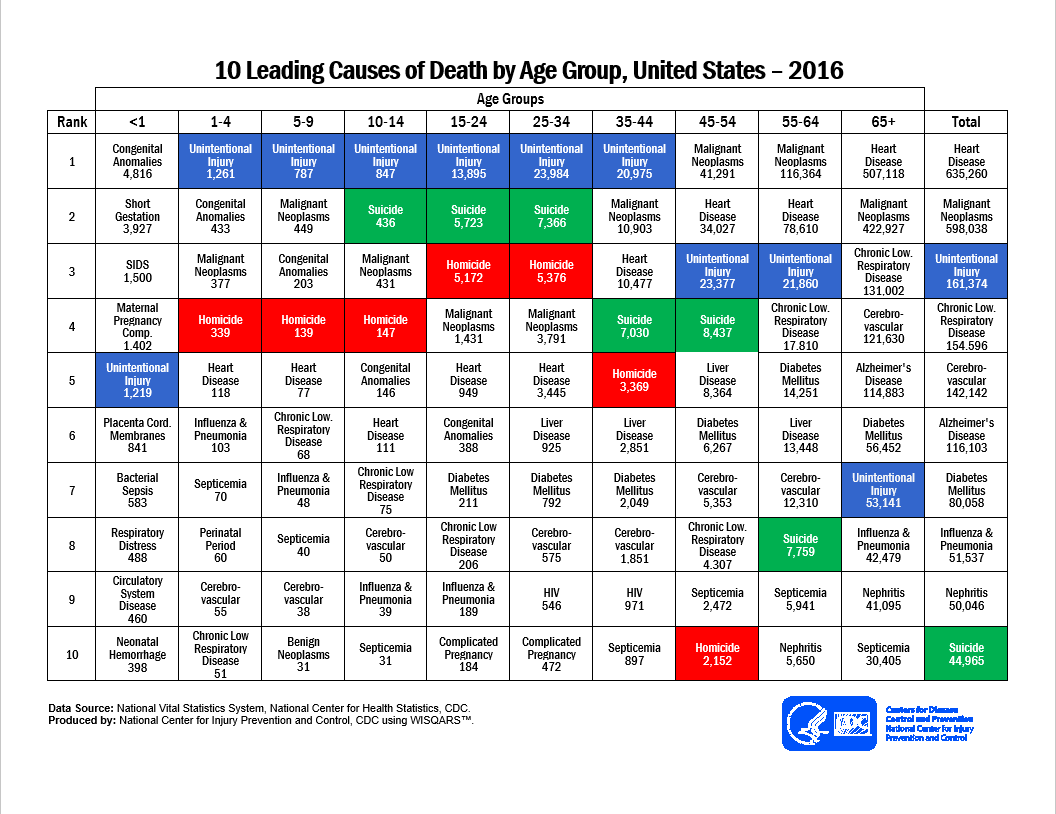
The literature already documents a number of troubling spillover effects on health, including ergonomic problems; increased risk of overweight and obesity; impaired development of mirror neurons; declining empathy; risk of depression and other mental health problems; sleep problems; and an increased risk of attention deficit hyperactivity and conduct disorders.35 Of even greater concern, cancer is now the second leading cause of death for five-to-nine-year-olds, the third leading cause of death for the very youngest children and preteens, and the fourth leading cause of death for young people between the ages of fifteen and thirty-four.40 Pediatric rates of brain cancer—as well as of liver, kidney and thyroid cancers—increased between 2001 and 2014 “across sex, age, race/ ethnicity, region, economic status, and rural/ urban status.”41 Similar childhood cancer trends are playing out in Europe.42
Although many aspects of modern life are undoubtedly contributing to these developments,43 few are as unrelenting or pervasive as RF electromagnetic radiation. In 2013, Swedish researchers found a fourfold increased brain tumor risk in children who began using mobile devices before age twenty. They pointed out that “no other environmental carcinogen has produced evidence of an increased risk in just one decade.”44 Because policy- and decision-makers seem disinclined to heed the warning signs, the burden continues to fall on parents to educate their children and control risks (see “Recommendations at Home”).
At the same time, it is important for all citizens to continue to pressure school administrators and legislators—at the local, state and federal levels—to do something about the growing risks outside the home (see “5G update”). The stakes are very high not just for children but for all of us.
SIDEBARS
RECOMMENDATIONS AT SCHOOL
An investigation on school-based Wi-Fi risks conducted by the Maryland Children’s Environmental Health and Protection Advisory Council resulted in a number of recommendations for local school systems:33
- Use wired instead of wireless devices wherever possible.
• Have children place devices on desks “to serve as barrier between the device and children’s bodies.”
• Locate laptops in a way that “keeps pupil heads as far away from the laptop screens (where the antennas are)
as practicable.”
• Use a switch to shut down Wi-Fi routers when not in use.
• Teach children to turn off Wi-Fi when not in use.
• Place routers as far away from students as possible.
• Fund research on the health effects of electromagnetic radiation in schools.
• Educate parents and the public on ways to reduce exposure.
RECOMMENDATIONS AT HOME
At home, the safest option is to eschew wireless connections entirely and use only wired (Ethernet) connections. Although this option may seem quaint to those who have grown accustomed to “anytime, anywhere” access, Ethernet connections offer greater peace of mind in terms of radiation exposure. The Environmental Health Trust (EHT) points out, for example, that “more data = higher radiation,” meaning that wireless streaming of music or videos will produce a higher radiation intensity.19 Instead of streaming, EHT recommends either pre-downloading or watching or listening using a wired connection. EHT offers the following additional recommendations for safer tablet (or laptop) use:19
- Set up wired Ethernet connections throughout the home.
• If you choose to stick with Wi-Fi rather than wired connections, turn off the router at night and keep the router away from bedrooms.
• Do not purchase a tablet unless it can be used non-wirelessly. Connect the tablet (or laptop) to Ethernet with an adapter and cord. The adapters will vary depending on the tablet’s make and model.
• Turn on airplane mode.
• Set the Wi-Fi, Bluetooth and other antennas to OFF (this requires careful checking).
• Always place the tablet on a table, not the body, even when wireless antennas are turned off.
• Do not use devices when there is a poor connection.
• Avoid using devices in cars, elevators, trains and buses.
Other recommendations pertinent to children include keeping electronic devices out of children’s bedrooms and turning off all screens at least thirty minutes before bedtime. Never allow children to sleep with a wireless device under their pillow (this also applies to college students)!
5G UPDATE
The global rollout of 5G networks and technology is unfolding at a fast and furious pace,45 despite intense opposition from citizens, scientists and medical professionals alarmed by the technology’s serious risks to human health and the environment. Ground-based 5G infrastructure involves placement of millions of small cell towers on virtually every street corner, but in addition, this infrastructure will soon be supplemented by thousands of low-Earth-orbit 5G communication satellites.46
Martin Pall, PhD, professor emeritus of biochemistry and basic medical sciences at Washington State University, recently declared that “Putting in tens of millions of 5G antennae without a single biological test of safety has got to be about the stupidest idea anyone has had in the history of the world.”47 Dr. Pall, who is “particularly expert in how wireless radiation impacts the electrical systems in our body,” also says that wireless technology hazards are creating a public health crisis that is “the worse one I’ve ever heard of.”48
Thus far, over forty-eight thousand signatories from around the world have signed on to the International Appeal to Stop 5G on Earth and in Space (still available for signing at 5gspaceappeal.org/the-appeal/), addressed to the United Nations, World Health Organization, European Union, Council of Europe and governments of all nations.49 The Appeal “urgently calls for a halt to the deployment of the 5G…wireless network, including 5G from space satellites,” describing 5G deployment as “a crime under international law.” The Appeal makes reference to a literature base of “well over 10,000 peer-reviewed studies” documenting that RF radiation is overwhelmingly harmful to all life on the planet. The planned 5G deployment “threaten[s] to provoke serious, irreversible effects on humans and permanent damage to all of the Earth’s ecosystems.”
REFERENCES
- Shopping guide for the best tablets. https://bestreviews.com/best-tablets.
- Statistics & facts on tablets. https://www.statista.com/topics/841/tablets/.
- U.S. tablet PC market—industry analysis, size, share, growth and forecast 2012-2018. https://www.transparencymarketresearch.com/tablet-pc.html.
- Robb M. Kids’ screen time shifts dramatically toward phones and tablets. Common Sense Media, Oct. 18, 2017.
- Cocozza P. Are iPads and tablets bad for young children? The Guardian, Jan. 8, 2014.
- Bedford R, Saez de Urabain IR, Cheung CH, Karmiloff-Smith A, Smith TJ. Toddlers’ fine motor milestone achievement is associated with early touchscreen scrolling. Front Psychol 2016;7:1108.
- Dawn R. How early should toddlers play with tablets? Study may surprise you. Today, June 15, 2015.
- Should young children use iPads? https://www.hsph.harvard.edu/news/hsph-in-the-news/michael-rich-tots-ipads/.
- Council on Communications and Media. Media and young minds. Pediatrics 2016;138(5).
- The mediatrician: alum frames kids’ media diet as public health issue. https://www.hsph.harvard.edu/news/hsph-in-the-news/kids-media-exposure-public-health/.
- Naidenko O. Yet another reason for your kids to unplug? Health risks from cellphone radiation. EWG’s Children’s Health Initiative, July 11, 2018.
- Redmayne M, Johansson O. Radiofrequency exposure in young and old: different sensitivities in light of age-relevant natural differences. Rev Environ Health 2015;30(4):323-35.
- Kheifets L, Repacholi M, Saunders R, van Deventer E. The sensitivity of children to electromagnetic fields. Pediatrics 2005;116(2):e303-13.
- http://electromagnetichealth.org/electromagnetic-health-blog/iarc-rf-carc/.
- Children and wireless FAQ’s. https://ehtrust.org/take-action/educate-yourself/children-and-wireless-faqs/.
- Table radiation: can a tablet computer affect your health? https://www.defendershield.com/tablet-radiation-can-tablet-computer-affect-health/.
- Cancer researcher states that $25 million NIH study confirms that cell phone radiation can cause cancer. https://ehtrust.org/cancer-researcher-states-25-nih-study-confirms-cellphone-radiation-can-cause-cancer/.
- “Clear evidence of cancer” from cell phone radiation: U.S. National Toxicology Program releases final report on animal study. https://ehtrust.org/clear-evidence-of-cancer-from-cellphone-radiation-u-s-national-toxicology-program-releases-final-report-on-animal-study/.
- iPads and tablets: health risks, safety risks, and practical solutions. https://ehtrust.org/take-action/educate-yourself/ipads-tablets-health-risks-safety-risks-practical-solutions/.
- Top ten facts about laptops. https://safetechforschoolsmaryland.blogspot.com/2015/07/top-ten-facts-about-laptops.html.
- Siervo B, Morelli MS, Landini L, Hartwig V. Numerical evaluation of human exposure to WiMax patch antenna in tablet or laptop. Bioelectromagnetics 2018;39(5):414-22.
- Cleveland RF Jr., Sylvar DM, Ulcek JL. Evaluating compliance with FCC guidelines for human exposure to radiofrequency electromagnetic fields. OET Bulletin 65, Edition 97-01. Washington, DC: Federal Communications Commission, Office of Engineering & Technology; August 1997.
- Schools shift from textbooks to tablets. CBS News, March 6, 2013.
- Chromebook. https://en.wikipedia.org/wiki/Chromebook.
- Nagel D. One-third of U.S. students use school-issued mobile devices. The Journal, Apr.8, 2014.
- Lacoma T. Chromebooks vs. laptops. https://www.digitaltrends.com/computing/chromebook-vs-laptop/.
- Brustein J. Tablets in schools: what could go wrong? Bloomberg, Oct. 11, 2013.
- Polet J. Gates admits Common Core failure, then doubles down on it. Philanthropy Daily, Nov. 1, 2017.
- Winterhalter B. A surprising benefit of the Common Core: really cool video games. The Atlantic, Sep. 12, 2014.
- Farrell JP. Common Core revealing its true colors. Giza Death Star, Nov. 10, 2015.
- McCambridge R. Why smart people (at the Gates Foundation) can’t learn. Nonprofit Quarterly, Oct. 10, 2018.
- Fenton W. Why I’m optimistic U.S. public schools can close the digital divide. PCMag, Feb. 19, 2016.
- Maryland Children’s Environmental Health and Protection Advisory Council. WiFi radiation in schools in Maryland: final report. Dec. 13, 2016.
- LAUSD’s iPad problems frustrate those involved in the $1 billion technology project. Huffpost, Oct. 2, 2013.
- Hedendahl LK, Carlberg M, Koppel T, Hardell L. Measurements of radiofrequency radiation with a body-borne exposimeter in Swedish schools with Wi-Fi. Front Public Health 2017;5:279.
- Freed R. Why phones don’t belong in school. Huffpost, Apr. 12, 2016.
- “One child-one laptop” program in Uruguay has failed to improve results in maths and reading. MercoPress, Sep. 19, 2013.
- Osimani F, Stecanella B, Capdehourat G, Etcheverry L, Grampin E. Managing devices of a one-to-one computing educational program using an IoT infrastructure. Sensors (Basel) 2018;19(1).
- Markov M, Grigoriev Y. Protect children from EMF. Electromagn Biol Med 2015;34(3):251-6.
- 10 leading causes of death by age group, United States—2016. https://www.cdc.gov/injury/images/lc-charts/leading_causes_of_death_age_group_2016_1056w814h.gif.
- Siegel D, Li J, Henley SJ, et al. Incidence rates and trends of pediatric cancer—United States, 2001-2014. 67th Annual EIS Conference, April 16-19, 2018, p. 108.
- Steliarova-Foucher E, Fidler MM, Colombet M, et al. Changing geographical patterns and trends in cancer incidence in children and adolescents in Europe, 1991-2010 (Automated Childhood Cancer Information System): a population-based study. Lancet Oncol 2018;19(9):1159-69.
- Knapton S. Modern life is killing our children: cancer rate in young people up 40 per cent in 16 years. The Telegraph, Sep. 3, 2016.
- Davis DL, Kesari S, Soskolne CL, Miller AB, Stein Y. Swedish review strengthens grounds for concluding that radiation from cellular and cordless phones is a probable human carcinogen. Pathophysiology 2013;20(2):123-9.
- Teller M. Microwave radiation coming to a lamppost near you. Wise Traditions 2017;18(3):46-50.
- Thomas JP. 20,000 satellites for 5G to be launched sending focused beams of intense microwave radiation over entire Earth. http://healthimpactnews.com/2019/20000-satellites-for-5g-to-be-launched-sending-focused-beams-of-intense-microwave-radiation-over-entire-earth/.
- Newton T. Prominent biochemistry professor warns—5G is the “stupidest idea in the history of the world.” DC Clothesline, Feb. 21, 2019.
- Dr. Martin Pall opposes SB. 649. http://scientists4wiredtech.com/2017/08/dr-martin-pall-opposes-sb649/.
- International Appeal: Stop 5G on Earth and in Space. https://www.5gspaceappeal.org/the-appeal/.
This article appeared in Wise Traditions in Food, Farming and the Healing Arts, the quarterly journal of the Weston A. Price Foundation, Spring 2019
🖨️ Print post
Leave a Reply