


 🖨️ Print post
On learning of reports showing high levels of lead in unrefined salt, the Weston A. Price Foundation sent samples of salt for testing to Brooks Laboratory in Seattle, Washington.
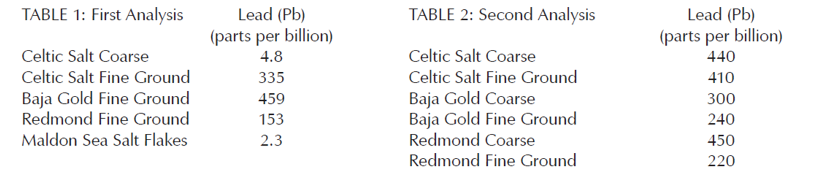
The results are shown in Table 1. Indeed, three of the five samples tested high, at 150 – 460 parts per billion. Maldon sea salt flakes tested low as advertised; however, the coarse Celtic sea salt also tested low.
This raised the question of whether the lead found in unrefined salt was caused by grinding. In fact, this is a possibility with cheap zinc alloy grinders, which put lead in the ground powder.1
So, we sent out more samples to the same laboratory to test this hypothesis—coarse and fine samples of three popular brands of unrefined salt (see Table 2). The results showed similar values for both coarse and fine ground salts; in fact, for each sample, the amount of lead was lower in the ground salt.

Some observations: ocean salt seems to accumulate more lead than other heavy metals, such as cadmium, arsenic and mercury. Both rounds of testing found levels of these metals lower by several orders of magnitude than the amounts for lead.
Secondly, itʼs hard to make the claim that the source of the lead is modern pollution. The highest level found was for Redmondʼs coarse salt—and Redmondʼs comes from ancient seas, buried under the ground for thousands of years. Natural sources of lead in the ocean include wind-borne dust, volcanic outgassing, runoff from streams and rivers, and from forest fires.2 Since lead has been a component of ocean salt (and, therefore, also of seafood) throughout manʼs history, it makes sense that we have some inbuilt mechanisms for protection, assuming that levels are not too high. The seafood-eating populations of the South Seas described by Dr. Weston Price did not show any sign of lead poisoning. (Those on the interior of the South Sea islands even drank seawater for salt.)
In fact, the body produces several lead-binding proteins that segregate lead into nontoxic forms, which we can then eliminate.3 For example, metallothionein (MT) is a family of cysteine-rich proteins made in the cells. Lead-binding proteins are formed in several organs (kidney, brain, lung and liver), and even appear in the red blood cells. Lead uptake is also blocked by certain strains of microorganisms in the gut.4 Assuming that the exposure to lead is not too high, these mechanisms would provide protection against the negative effects of lead.
Metallothionein is based on cysteine, a sulfur-containing amino acid that we get from meat, eggs and seafood; some of the other lead-binding proteins contain glycine, which we get from bone broth; and beneficial microorganisms can protect us when we have good gut flora by eating lacto-fermented foods and avoiding antibiotics. Likely vitamin A is also involved, as vitamin A is our number-one protection against toxins. In short, a nutrient-dense Wise Traditions diet is our best protection against lead in food, including in salt.
Moreover, both animal and human studies have shown that low calcium intake increases the risk of lead toxicity. In one rat study, researchers found that rats ingesting a low calcium diet had blood-lead concentrations four times higher than rats on a normal calcium diet, although the quantities of lead ingested were equal. So, raw dairy products, containing highly usable calcium, are another protective factor in the Wise Traditions diet.5
Of course, we donʼt want to overload these protective systems by ingesting too much lead. Processed foods that tend to be high in lead include commercial baby foods, fruit juices, dark chocolate and protein powders—foods that we donʼt recommend for many reasons.
But many natural foods also accumulate lead, including rice, leafy greens, root vegetables, spices and seafood. To minimize lead in vegetables and spices, buy organic, and always choose wild-caught—not farmed—seafood. To avoid lead in rice, use organic rice grown on the West Coast, such as Lundberg Family Farms.
Tests have found lead in bone broth at levels between seven and ten parts per billion6—less than the fifteen parts per billion which the U.S. Environmental Protection Agency (EPA) considers safe for water—and who is drinking chicken broth in the same amount as they are drinking water? Of course, for many reasons, we should be making broth with bones from pastured chickens or other animals using clean, filtered water.
Symptoms of lead poisoning in children include developmental delay, learning difficulties, irritability, fatigue, digestive disorders, hearing loss and seizures. In adults, symptoms usually manifest as brain fog, joint and muscle pain, headache, mood disorders, fertility problems and miscarriage. High levels of lead can be determined by a blood test.
Should symptoms or blood test indicate lead overdose, the solution is to avoid foods high in lead, including seafood, and opt for a salt low in lead such as the Maldon—all the while embracing a diet rich in animal foods, raw dairy foods and lacto-fermented condiments and beverages. But for most of us, lead in unrefined salt—which humans have been consuming for centuries, often in amounts much higher than currently consumed—should not be a concern.
REFERENCES
- tahoegrinderco.com/do-grinders-contain-lead-how-to-avoid-risk-what-to-look-for/.
- Lead cycle. Wikipedia, last edited Mar. 26, 2026. https://en.wikipedia.org/wiki/Lead_cycle
- Gonick HC. Lead-binding proteins: a review. J Toxicol. 2011;2011:686050.
- Xiao X, Zhang C, Liu D, et al. Prevention of gastrointestinal lead poisoning using recombinant Lactococcus lactis expressing human metallothionein-I fusion protein. Sci Rep. 2016 Apr 5;6:23716.
- Bruening K, Kemp FW, Simone N, et al. Dietary calcium intakes of urban children at risk of lead poisoning. Environ Health Perspect. 1999 Jun;107(6):431-435.
- Monro JA, Leon R, Puri BK. The risk of lead contamination in bone broth diets. Med Hypotheses. 2013 Apr;80(4):389-390.

Leave a Reply