


Interview With Elze Van Hamelen – Pharma Food
HILDA LABRADA GORE: Dutch researcher and journalist Elze van Hamelen covers the topic of “pharma food,” which is her term for the takeover of our food supply by the tech industry, resulting in pseudo foods like lab-grown meat and “milk without a cow.” Elze writes for publications that include the Solari Report, which sponsored Elze’s thorough research on this topic and in 2023 published her tour de force report for Solari subscribers, titled Pharma Food: Biotech on Your Plate: The Next Chapter in Big Money’s Battle to End Food Sovereignty.1,2 Here, Elze unveils what pharma food looks like, who’s backing it financially and why. She also offers insights into what we can do to defend our food freedom and what to watch out for when it comes to these problematic and toxic “novel foods,” which not only threaten our health but also the future of small farms.
Elze, what does “pharma food” mean?
ELZE VAN HAMELEN: That was an interesting discovery. Catherine Austin Fitts of the Solari Report had asked me to investigate lab-grown meat and I wanted to know how this is made. I started researching it and what I found out is that lab-grown meat uses the same production methods that are used to produce biotech pharmaceuticals.
Biopharma basically uses two processes. One is cell cultures. They say they grow meat in a petri dish. I thought that was weird because if I go to the supermarket and buy a piece of meat, I cannot grow a cow out of it. So, how do you “grow” meat? I thought that was so odd. I wanted to know how it was made and found out they use cell cultures. You culture it in some substance that is blood or resembles blood, and these cells proliferate. In biotech pharmaceuticals, they use these cell cultures to produce biotech medicines. In that setting, the cell culture itself is the waste product.
HG: Are you saying that the cell culture that they use—in which they try to make the cells proliferate to make something that looks like meat—is included in the end product, when in the biotech pharmaceutical industry, they discard it as waste?
EvH: Yes. Biotech pharmaceuticals use cell cultures to test their products on or to grow their products or for vaccines. But for lab-grown meat, they proliferate these cells, and they want to make more and more. That cell culture is the product that they eventually make the meat from. Reading this, you doubt that it can be real. You read it three times over because it’s so insane.
HG: Tell me about the second biopharmaceutical process.
EvH: This is called precision fermentation. In some ways, it’s a bigger concern because it’s already in the supermarkets. People don’t know that they’re eating it. If you’re eating “dairy” products where the manufacturers say, “This is milk without cow” or “This is butter without animals,” you’re probably eating precision-fermented products. In the 1980s, they found out how to produce insulin that’s very similar to human insulin. They take E. coli bacteria and they insert the human gene that codes for human insulin; then they ferment these genetically modified bacteria, and these bacteria then produce insulin. That’s a biotech pharmaceutical process that’s been on the market for decades.
HG: It’s insulin that is similar to what the body produces, but it’s been synthetically produced.
EvH: Exactly. Now, they believe that this same production process can replace most materials and foods—a lot of the foods in the supply chain. In 2020, McKinsey had a forecast that they called the “Bio Revolution.” They said, “We can make so many materials in this way. We can make wood fibers, for example, but also a lot of foods.” Let’s take the example of cow’s milk. They insert the gene that codes for some substance that is in cow’s milk, and these bacteria start to ferment, and they will produce a component of the cow’s milk. Because cow’s milk itself is a complex product, they cannot produce regular complex milk, so they synthesize something called human milk oligosaccarides (HMO), and they put this in infant formula. [Editors’ note: A group of German researchers stated in a 2022 publication, “We consider the use of terms such as ‘human milk oligosaccharides’ and corresponding abbreviations such as ‘HMO’ in any advertising of infant formula to be an inappropriate idealization of infant formula. Manufacturers should stop this practice [and] [p]ediatricians should inform families that infant formulas supplemented with synthetic oligosaccharides do not resemble the complex oligosaccharide composition of human milk.”³]
HG: It’s sneaky because we don’t expect these things to be in the food supply, and we’re not aware of the recent technologies that the industry has developed.
EvH: So why the term “pharma food”? The answer is that as I was reading about all these technologies and trying to understand how lab-grown meat works. I thought it’s not ‘lab-grown.’ These are pharmaceutical production processes. This is pharma food. That was my line of reasoning. That’s how I coined the term.
HG: Our readers are well-informed, and they’re already saying no to some synthetic meats and the pseudo foods. We avoid ultraprocessed foods, but is the pharma food that you’re describing already in our food supply, and we’re not aware of it?
EvH: The first lab-grown meat product had many difficulties in the production process and was approved in Singapore. Apparently, I just read, it’s not on the market anymore. In the U.S., the FDA has approved one type of lab-grown meat, but I believe the company is having so many issues that it’s not yet on the market. When you read their reports, you understand that there are so many difficulties—not just technical— that you don’t have to be too concerned that the market will be flooded with this any time soon. Right now, we should be more concerned with not just the plant-based and soy burgers, but the Impossible Foods products supported by Bill Gates, because those are made with precision fermentation.
HG: I’ve heard that a product that looks like chicken has been approved for the supermarket refrigerated section. It’s gone through the same process, and unless someone reads the fine print, they might not realize that it’s a biotech-driven food product.
EvH: The last time I looked, one type of lab-grown meat had been approved, but as far as I know, it’s not being sold yet. But there are a lot of precision-fermented foods on the market already. In the European Union (EU), it’s very tricky. They say, “We have this strict GMO regulation,” but with precision fermentation, they say, “The actual product is not genetically modified, it’s the bacteria,” and the EU calls the bacteria “processing agents.” It’s not approved under the GMO regulations, but it’s approved under the “novel food” legislation, which nobody knows about. “Novel food” is anything that people didn’t recognize as food before 1997. It’s all this weird synthetic stuff—even nanomaterials.
HG: Even the term “precision fermentation” sounds like a good thing. The Weston A. Price Foundation is all about fermented foods. It’s an ancient way of preserving and making the nutrients in food more bioavailable. But this is something different.
EvH: You see something very tricky here. They’re searching for the words to make something that is very technological sound natural. First, it was “lab-grown” meats, but people don’t like the term. Then it was “guilt-free” or “clean” meat. Then, in the Netherlands, “cellular agriculture.” Who can be against agriculture?
With fermentation, wine is fermented, and as you said, a lot of fermented foods are healthy. They’re testing out these types of words. Or they will say, “it’s a culture.” Yogurt is a “culture”—what’s wrong with a “culture”? But it’s a cell culture. They are trying to find these words that make it sound normal for us.
That’s interesting, too, because with all this wording, it’s tech venture-capital businesses that invest in this. These people are technocrats. They like certain types of wording and that gets them excited to put money into this. The type of wording that the consumer likes is very different. That’s very clear.
HG: Who is behind this? You have just mentioned the tech world, because it’s about technological advances, and I imagine there are some environmentalists who think this is better for the planet, and others who think it’s better for our health. Who are some of the main drivers?
EvH: There is a lot of money behind it—billions of dollars—which is very odd because there is not a market demand. The consumer is not interested in it, but a lot of money is pouring in. Why this is weird, too, is that when you think about the tech firms, they can have a hockey stick curve. Once a lot of people sign up for an app, and it harvests a lot of data, then you can make a lot of money. If you sell a product, though, you can never have this growth curve. So, it doesn’t make sense why they are investing this much money in it.
The other line of reasoning is the policy reasoning. They say at the UN level, “There’s a climate crisis, that’s what we need to solve. For the climate crisis, we need to change agriculture. We need a radical overhaul.” They are not referring to traditional agriculture, they say it’s industrial agriculture that needs to change—and we agree on that—but the way they want to do it is to put farmers out of business. They say, “If we change agriculture, people need to change their diets. They need to change their protein consumption.” That is another change in wording— “protein” is no longer meat.
HG: This hasn’t been studied. We don’t know how people would thrive or decline on these kinds of pseudo foods.
EvH: If you look at how this is made, it’s toxic. It’s artificial. They say, “There’s a lot of antibiotic resistance. This is ‘clean’ meat.’” However, look at the amount of disinfectants they need to keep a cell culture “clean” so that it won’t become a bacterial culture. In addition, they use fetal bovine serum—blood from cow fetuses—to get the cells to grow.
HG: It doesn’t sound appetizing.
EvH: That’s a problem for the so-called “clean” meat, so they need a synthetic alternative. But again, these synthetic alternatives are genetically modified; there are hormones, growth factors and all kinds of weird stuff in it. If you have the cells—like a piece of “meat” in your body—it’s part of a lot of tissue, and you have veins, and your blood drains, kind of like pulling garbage out of your cells. It becomes clean. But with the regular cell culture, if you grow it, there is no system to remove the waste products out of the cells. There’s a necessity there. They need to add all this stuff to make this stuff grow.
You also need to grow it in a structure, which is often nanomaterials that, again, are usually not edible. I even read one patent for a nylon that would disintegrate on your tongue.
HG: At least fetal bovine serum is natural; it’s from the cow and its offspring. Vegetarians or vegans or others would say, “We need to make something synthetic that’s similar.” This is where we get into trouble when we’re trying to improve upon what nature has to offer us. The case in point is this disintegrating nylon idea.
EvH: But even the fetal bovine serum—should you eat a cow fetus like a regular adult cow? They pump this blood from a living fetus. Interestingly, after studying all this, it made me eat meat again after being vegetarian for many years! I came to the point where I thought, “This is all so weird and artificial.” If I can speak to a farmer who takes care of his animals well, and I know he’s normal and doesn’t do weird stuff to his food, there’s a cycle of life and death. Death is part of it. There’s a lot of meat-eating in nature. I like that a lot better than all this insane, unnatural, non-food.
HG: Do you mean to say that before you dived into this, you thought it was healthier for you and maybe healthier for the planet to avoid meat altogether?
EvH: I was a vegetarian for a long time. Not purely for the environment. That was part of the story that I bought, but also because I thought, “I don’t know if I can kill an animal, so why should I eat it?” I came to a point where I saw that so many unnatural things were happening, and I was trying to eat everything clean, not processed, and without pesticides, so it seemed more natural for me to start eating meat again. All the insanity with the food was part of it; I wanted just “back to basics,” normal farming.
There is also another part of the story. The EU has asked all the member states to develop a “protein strategy.” The idea is that farmers need to grow more of their proteins on their land, and people need to eat less meat and more plant-based proteins. They basically want to take the animals off the land. What they don’t tell all the environmentalists—of which I was one before—is that regular vegetables won’t grow without manure! Also, a lot of land is not suitable for growing vegetables. The most perfect way is that you have cows or other animals on the land, they graze the land and plow it a bit, and you get a very good cycle of biodiversity. Land and animals go together. You cannot separate them. They are trying to replace animals and meat with all this plant-based stuff and weird synthetic stuff. It doesn’t add up. The land and nature will become very unhealthy and people as well.
HG: I want to go back to something you said earlier. Apparently, pharma food is coming at us from a lot of different directions. What are some of the terms on labels we should look for when we are shopping or that might be on the horizon? You said some things have been approved and haven’t shown up yet at the grocery store. How can we be on the lookout for these pharma foods?
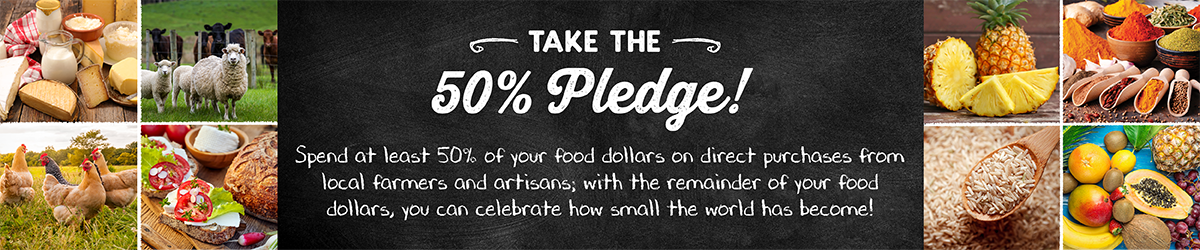
EvH: I’m thinking about the U.S. labels. Officially, they’re bioengineered labels, but they have made the labeling process so cumbersome, and different rules apply in different cases. In other words, you really don’t know. What I would recommend if you want to have good fresh food is to find a direct link to a farmer. Buy directly from a farmer or find an intermediary. In the Netherlands, we have people who buy from the local farmers in the region. You can order online, and they will deliver your groceries once a week. That can be a nice startup, too. If you are in the city and you see there is nothing nearby, that can be a great opportunity.
If you look at all the ways that they’re basically adulterating our food—in the EU, they approved insects. They can be used as ingredients in cupcakes or breads. It’s on the ingredient list, but who looks at that? Who knows? There’s not a large bug on the package.
HG: They know that wouldn’t be good for marketing. Recently I bought some sourdough bread. It looked like it had all the good things and I assumed it was really fermented. Unfortunately, after I served it, I saw in tiny print at the bottom, “This product includes bioengineered ingredients.” I was shocked because there was no big label. There was nothing that indicated to me that this product contained something that had been produced in a lab.
EvH: Exactly. They’re doing so much weird stuff with our food. You can try to learn about all the labels. In the U.S., it’s great that you have the Non-GMO Project.4 That’s a little bit more expensive, but they are on top of what are GMOs, and about precision fermentation—for them, that’s a GMO. In Europe, we are dependent on the EU legislation. People are eating GMOs and they think they are protected against this. They have no idea. The Non-GMO Project uses their own labeling scheme; you know it has gone through a good vetting process there.
For me, the best thing is not just reading the labels, but knowing a farmer. Speak to your farmer and know how they’re taking care of the land and how they deal with their animals. Here in the Netherlands, if you have “organic” cows, they still can have the mRNA vaccinations. You have to talk to your farmer to know how they think about what they do.
HG: All around the world, the Weston A. Price Foundation has volunteer chapter leaders, and their role is to help people find local sources of real food. But we are a small nonprofit; we can’t go through and vet every farm, so your advice is perfect for people to find out if their farmers are using vaccination on any level and if they are injecting their animals with mRNA. We have to be bold enough to ask. Hopefully, the farmer will be transparent enough to give us answers. I want to back up to ask about the cell culturing process. I believe the pharmaceutical industry uses human fetal cell cultures in vaccinations. Is that right?
EvH: Yes, in a lot of the vaccinations. There are a couple of pro-life organizations in the U.S. that have studied this and published about it. That’s described in my Pharma Food report published by Solari, which includes all the references. Sometimes, the vaccines are grown on these cultures, and sometimes they’re just tested on them. But that is very common. They manipulate cell lines that were made from human fetuses in a way that keeps on proliferating, and these are still in use.
HG: You mentioned earlier about the impetus behind some of these movements. Are there global policies in place that support this pharma-food agenda?
EvH: It’s a policy pyramid. They say that we need this for the climate and that’s why you have the farming policies. That’s why they’re pushing synthetic food. Then, you have the venture capitalists, and the big food corporations like Cargill and GBS, which have their own “alternative protein” departments. A lot of countries started but said they need an ecosystem to get this off the ground. They organized consortia to combine the startups with the corporations and the universities. They started this with government money to bring these parties together to get this off the ground.
You see what is happening in the investment world. You have the ESG—environment, social and governance—ratings. Basically, they say, that regular traditional agriculture uses too much land. It uses too much water, pesticides and antibiotics. We need to quit all this. They say these synthetic methods are “clean,” so you get a better ESG score. That’s a way to shift the investments.
HG: I saw a clip of Bill Gates celebrating some of this biotech or bioengineered food. He said, “All of this food has been made without photosynthesis.” The people in the room practically stood up and cheered. I thought, was this a good idea?
What do you say to the person who says, “You’re behind the times. You want to hold on to how things were a hundred years ago. Don’t you see that this is the way to feed the world and the way of the future?” What would you say to that naysayer?
EvH: The way to feed the world is the way we fed the world in the last couple of thousand years. We as humans are part of the environment and part of nature. We work best if we work together with the earth and with the animals. That’s how we fed the world all the time. The industrial agriculture experiment is pretty recent. It started after World War II, and it has failed. It has destroyed the soil. It’s bad for animal health and look at our health. You sometimes see old pictures of people on a beach in the ‘60s; compare those people to people on a beach now who are often obese and sick. This experiment with artificial food that they’re now pushing even further ahead has already failed. It’s clear that it has failed.
There’s also the important issue of the freedom to choose the food you eat. If you look at the direction in which all the policies are headed, it’s toward getting people off the land. The land and the capacity for food production will be in the hands of big corporations that have no allegiance to the people. You will have no oversight of food safety anymore. It should be a free choice. Do you want to eat that synthetic stuff? Fine, but we want to do it the proven way it’s been done all this time.
HG: It makes a lot of sense to realize what freedoms may be taken away, even subtly. We need to be on our toes! How can we be activists advocating for food freedom in this realm?
EvH: As consumers, the most important thing is to vote with your dollars. If you’re buying your food at the supermarket, you’re financing the people who are poisoning you. Buy from a farmer or buy from local people or from an intermediary, but try to boycott the supermarket. That’s very important. It’s very basic.
If you have money to invest, invest in your farmers. I had the thought that we should get some farmers’ investment funds that could buy up the land from farmers who are struggling— especially if it’s a piece of industrial agricultural land—and have a real long-term plan to make it viable again and have some smaller farmers on it. It should be like a transition. That’s the investor part.
Then, there is the political part. I’m in Europe, so I’m less aware of the situation in the U.S. The current situation is created by policy, and it can be changed by policy. You can advocate for better policies. Here, I would look at the website of Catherine Austin Fitts, the Solari Report,5 because she’s done a lot of work on this and you can find a lot of good information there.
HG: In your investigation, what surprised you the most as you were digging into this pharma food movement?
EvH: That is a difficult question because I went from one amazement to the next, even shaking my head thinking that this is not possible. The weirdest thing was that the first lab-grown meat project was a NASA project to investigate if they could grow meat in space. You cannot take a herd of cows on your spaceship. For a long time, a couple of researchers worldwide were trying to make something out of this, but it wouldn’t get off the ground.
The movement was basically kickstarted by an NGO, New Harvest, which was led by a man named Jason Matheny. They organized a conference where they secured funding for the researchers and connected the researchers. Because of this New Harvest work, it started to become a movement. If you look at the resume of Jason Matheny, he has degrees from Duke University and Johns Hopkins University. He has had a career at DARPA [Defense Advanced Research Projects Agency] and IARPA [Intelligence Advanced Research Projects Agency]. He is currently the CEO of the RAND Corporation. I looked at that list and wondered, why would creating a market for this product be a priority for the intelligence community? If you look at his resume, that’s an intelligence operation. Why would they want to kickstart lab-grown meat?
HG: That’s a great question. What do you suspect?
EvH: First, you have to recognize that it’s not just lab-grown meat, it is also precision fermentation and vertical farming. These are all cases where you have to grow food indoors. This was a pivotal moment in my research. I was reading all this insane stuff and thinking it cannot be possible. At some point, I asked myself, under what conditions would this be rational? I remembered that the same Jason Matheny had also been research director at the Future of Humanity Institute at Oxford University. He wrote a very long article about possible cataclysms that could wipe out humanity. He said, “If there is a cataclysm that endangers the earth, there are basically two ways that you can survive that. One is to build underground bunkers. The other one is to become a multiplanetary civilization.” That’s his article. I thought back to what I had read about NASA and lab-grown meat.
If you believe this, then you start thinking about circumstances where you cannot grow food outdoors—because there’s a nuclear holocaust or a Maunder Minimum or a comet hits the earth and you have to grow everything in underground bunkers—then I can understand that you would start to invest in processes and also have these insane investment streams for products. The business case doesn’t make sense, but if you think that it’s about survival, then I could understand it.
In the report, I also go into a few other scenarios. I don’t have the answer, but the official story is not right. What is the real story? I don’t know, but I have a couple of ideas. We presented that in the Solari Report.
HG: What you’ve revealed already helps us start to connect the dots. I have to say, I understand why when people hear you or read these reports, they get scared. You’ve told me that your objective is not for people to be afraid, but to be empowered.
EvH: I often do deep dives, and people will sometimes respond saying that they can’t read it anymore because it scares them and they just want to live their life. They ask, “How do you do it? Are you not becoming depressed?” I am not becoming depressed. All this stuff is going on as we speak. They’re herding us into a corner. If you don’t see it, it will happen to you—and you won’t have any choice. If you start looking and putting the pieces of the puzzle together, then you can make much more informed choices. These choices can save you. When you hear this type of information for the first time—and for myself, too, sometimes I hear pieces or read things—you’re shocked. You have to process your emotions. But in the end, it’s happening. It’s not something new. Now you see it, now you know, and now you can choose. It’s always better to have a choice. That’s empowerment.
HG: Sally calls it “survival of the wise,” and it will happen. This information that you’re bringing to the fore is helpful for us to be empowered in a profound way. Now, this is the question I always pose at the end: If readers could do one thing to improve their health, what would you recommend that they do?
EvH: The one thing I already said is to buy from your farmer. The other one, especially in the U.S., is to filter your water because there’s a lot of lead piping and other stuff in your water systems. Next to food, your water is one of the most important things that you ingest. There are other things, of course, but I would start with that. Your food and water, then you’re a long way ahead.
- https://home.solari.com/2022-annual-wrap-up-pharma-food-pdf-now-available/
- https://home.solari.com/pharma-food-with-elze-van-hamelen/
- Bührer C, Ensenauer R, Jochum F, et al. Infant formulas with synthetic oligosaccharides and respective marketing practices. Mol Cell Pediatr. 2022 Jul 13;9(1):14. Erratum in: Mol Cell Pediatr. 2022 Jul 23;9(1):15.
- https://www.nongmoproject.org/
- https://home.solari.com/
This article appeared in Wise Traditions in Food, Farming and the Healing Arts, the quarterly journal of the Weston A. Price Foundation, Summer 2024
🖨️ Print post
Leave a Reply