


 🖨️ Print post
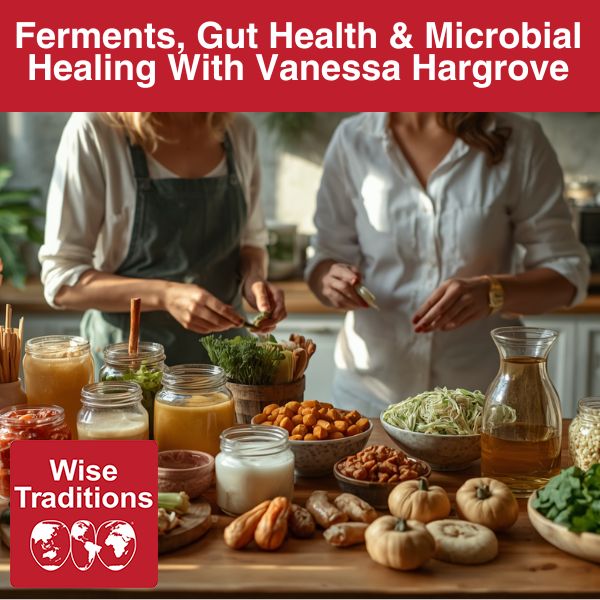
What if some of the most powerful medicines aren’t found in a prescription bottle – but in the microbes living inside traditional fermented foods?
Vanessa Hargrove joins the podcast to explain how foods like kefir, kombucha, yogurt, sauerkraut, and sourdough may help restore the microbiome, reduce inflammation, improve digestion, curb sugar cravings, and support overall health. Vanessa shares her own dramatic healing journey – from debilitating joint pain and severe food sensitivities to vibrant health through ancestral nutrition and fermentation.
The conversation explores how modern life may be damaging the microbiome through glyphosate, antibiotics, chlorinated water, and antimicrobial household products – and why rebuilding beneficial microbes may be one of the missing keys to better health. Vanessa also discusses the powerful role fermented foods may play in supporting digestion, mood, immunity, hormone balance, and even chronic gastrointestinal conditions.
She explains the science behind targeted microbes, why homemade ferments differ dramatically from many store-bought versions, and offers practical guidance for beginners who want to start incorporating ferments into daily life without feeling overwhelmed.
The episode also covers fermentation safety, sourdough, milk kefir, candida overgrowth, histamine intolerance, sugar addiction, and why Vanessa believes restoring the body’s microbial ecosystem can profoundly change health and vitality.
WAPF Ad- Go to www.westonaprice.org/journal-healthy-baby-issue to order yours now.
Visit Vanessa Hargrove’s website to learn more – hargrovegeneralgoods@gmail.com
Join the Nourishing Our Children closed Facebook group
Check out our sponsors:
Goddess Vitality From Optimal Carnivore “Discount code WESTON10 for 10% off.”
Four Visions “Discount code WISE for 15% off your order.”
—
Watch the episode here
Listen to the podcast here
Episode Transcript
Within the below transcript the bolded text is Kendall Nelson
What if the answer to so many of our modern health struggles isn’t something new, but something we’ve forgotten? We all want to feel well. We want steady energy, clear thinking, strong, resilient bodies and yet so many people are dealing with digestive issues, inflammation, cravings, and chronic discomfort that never quite goes away. What if part of the problem is that we’ve lost touch with something essential, the living world inside of us? This is episode 583 and our guest is Vanessa Hargrove.
Vanessa’s path into this work was deeply personal. After leaving home and shifting away from a nutrient-dense diet, she began experiencing severe joint pain and a cascade of health issues that no clear diagnosis could explain. When she began changing her food and eventually discovered the power fermentation, everything started to shift.
In this episode, we explore what the microbiome is. Why it plays such a central role in our health and how everyday factors like antibiotics, processed foods, and environmental exposures can disrupt it. Vanessa walks us through how fermented foods like kefir, sauerkraut, and kombucha can help rebuild that inner ecosystem supporting digestion, reducing inflammation, and even helping to regulate cravings and mood.
We also talked about how simple this can be. This isn’t about complicated protocols or expensive solutions. It’s about learning how to work with food in a more intentional way. It’s about rediscovering something foundational about nourishment and about giving the body what it needs to restore balance.
Before we get into the conversation, I want to tell you about the healthy baby journal. Looking for the perfect gift for parents-to-be? Grab a copy of the Wise Traditions Journal that is entirely dedicated to healthy babies. It has articles on healthy fetal development, how to avoid autism, homemade formula, and vaccinations. It’s only $12. It will set parents off on the right foot. This is Kendall Nelson, and you’re tuning in to Wise Traditions.
—
Vanessa, welcome to the show.
Thanks for having me on. This is so fun.
Vanessa Hargrove AKA The Microbiome Witch
I’m so happy you’re here. I was doing a little bit of research for this episode. I was going on your social media and I saw that you call yourself a microbiome witch. You have to tell us.
I have a couple different words for it, micro witch or microbiome witch. I say that I use microbes like magic to heal all my friends and family. That’s my thing. It’s like micro magic. It’s so powerful. Microbes are cool. Have you done my research into that into the microbiome?
A little bit, but I want you to tell us. What if I was to ask you what are five wonderful things about the microbiome?
You’re mostly microbe. A lot of people don’t know that our body is majority microbe. We have the in our nose, on our skin, and in our digestive tract. They are everywhere and they are more than ourselves. We are literally made of microbes. The microbiome could be on the inside and on the outside, but it’s basically the world we have created to cultivate and let microbes live in us. That’s our microbiome.
You are mostly microbes. They are everywhere, and they are more than ourselves.
We’re going to talk a little bit about food as medicine and specifically ferments. I’d love to hear how you got involved in that. What’s your story?
I’ve had quite the health journey. In my early twenties, I moved out of my parents’ house and I started eating just whatever. My mom was a Weston A. Price’s mom. She started in the 2000s when it first started. I went from a very nutrient-dense household in my eighteen years and then I moved out and I started eating like crap. That’s the only way to say it. I was eating 100% carbohydrates. I had a lot of stuff going on, and I started having horrible joint pain- my knees, my elbows, my wrists, like my whole body.
I went on a search and I was like, “What the heck is going on? Why am I hurting? I went to the doctor.” They’re like, “You don’t have arthritis. You don’t have this. You don’t have that.” My mom came to me and said, “You should try this GAPS diet.” All Weston A. Price people know the GAPS diet is no joke. That was my first foray into cutting foods out, bringing foods and trying to heal my body. A shocker, all my joint pain went away. What do you know? I was gluten-free for a number of years.
I thought I was never going to be able to eat gluten again. I thought I was just broken. A lot of people think, “That made my elbows hurt and my knees hurt. I can’t ever have gluten again.” That didn’t end up being in the case for me. It turns out I’m glyphosate and folic acid sensitive. It’s not the gluten. It’s the things they put on the gluten. Once I started to figure that out in 2020, I went down the rabbit hole for sourdough.
Sourdough was my gateway into microbes. That was a rabbit hole that I didn’t know was going to send me down a path that completely changed everything. From sourdough, I started brewing kombucha, and then I made water kefir. I then found out that they were putting gross stuff in our cheese, so I was like, “How can I make my own cheese?” and I found milk kefir. Milk kefir completely changed my life.
It got rid of everything. All my Candida cravings. Sugars craving is completely gone. It healed my gut. I got so much energy, so much vibrant, and so much health from one food. I was like, “This is crazy.” I had no idea that food could create so much vibrance, health, and wellness. I just went crazy. I had to try everything after that. That was it for me. I was hooked on the microbes.
You mentioned glyphosate and probably, a lot of us don’t have a real true wheat intolerance. We have a glyphosate intolerance. Can you explain why glyphosate is so classic to the microbiome?
Glyphosate, if you didn’t know, was originally patented as an antibiotic. It’s not the antibiotic that kills the bad microbes. It’s an antibiotic that kills your good microbes and leaves the bad microbes there. Every time you eat a regular burger bun from the restaurant or you have a handful of Goldfish crackers or a bowl of Cheerios, you are carpet bombing your microbiome. These people that have this glyphosate intolerance are these glyphosate issues. It’s not because they’re necessarily allergic to the glyphosate. It’s because they’re murder killing their microbiome on a daily basis and they’re never building it back up.

Increasing Fiber Content Or Fermented Food In Your Diet
That’s super important. I also want you to tell me about a study. I was watching a talk you were giving and you were talking about a study from Stanford University. Can you tell me about that?
It is such a cool study. There’s this couple at Stanford University, the Sonnenbergs. They worked together. They’re microbiome professors at Stanford. They did a study where they wanted to test the efficacy of increasing your fiber content or increasing fermented foods in your diet on reducing your body’s inflammation. They did this. I think it was an eight-week study. They put half of the people on increased fiber intake. They did five more servings a day of fiber and then they put the other group on five fermented foods a day. That could be kombucha, kefir, yogurt, or any fermented food.
The group that had the fermented foods had a dramatic decrease in the inflammation markers. The folks who were just on the fiber had no change. It’s very powerful stuff. That study was the thing that blew my mind. It made me start thinking about it super seriously. My husband was having issues with his knee. He has had water on his knee since he was a teenager and we’re in our 40s. When I saw that study, I was like, “Let’s try. Let’s do the thing. Let’s try it.” I had him eat fermented foods. He had sauerkraut. He would have a little yogurt a couple times a day. You don’t have to have very much.
We’re talking like a shot of Kombucha and kefir, a spoonful of yogurt and fermented veggies is enough to make this impact. It has a huge impact on your diet, on your health, on your life. Anyway, long story short, I put them on these fermented foods and within two weeks, that water on his knee went away and it was there since he was a teenager. It was pretty crazy. I was not expecting that. That was cool. Every time. I’ve experimented with these fermented foods, every person I’ve given them to had these amazing results. I’m like, “This is food. This isn’t like medicine. This isn’t something that you had to go get a prescription for.”
Tell me more about that. Let’s dive deep and tell me exactly how the ferments work.
Depending on the microbe, every microbe has its own job. Different foods, you’re going to cultivate different microbes in it. I do a thing that I called targeted microbial therapy. That’s my own coined term. I teach classes, and I have group, coaching, and things like that. We look at your symptoms and we target the microbe to what you need. Specifically, something like the lactobacillus planetarium. That one is found in fermented foods like fermented veggies and certain yogurts. You can get it in Kombucha. The kefir soda I make all has it.
Lactobacillus planetarium is a binder. It’s a gentle binder and it will grab onto toxins in your body and escort them out. Anytime someone has a stomach flu or throws up. They just exposed themselves to bad gluten. That’s something I give them and it helps to get it out of their body. Another example would be there’s a yogurt that I cultivate. It’s a single microbial yogurt called L. reuteri. L. reuteri is super powerful. It has an amazing strong bacteriocin, which is the security system of the microbes. They come in and they create their own security system to kick out other bad microbes that are taking up their space.
L. reuteri has the power where it increases your testosterone. It increases your skin thickness. Ladies who bang their hand on something and it splits open. They’re like, “I just have thin skin from aging.” L. reuteri fixes that. It’s very cool. It increases testosterone and oxytocin. Those things will increase your sex drive. They will increase your muscle growth and all of these things. L. reuteri is so sensitive to antibiotics. If your mom had antibiotics when she was giving birth to you, you probably don’t have it anymore. Repopulating your body with these powerful microbes can make an enormous impact on your health.
You Are The Microbe
How common is it for us not to have the good microbes that we were supposed to have? Are there things that are happening in this environment that are particularly making those go away?
Glyphosate is a big one. They chlorinate our water. If you’re drinking tap water, you’re killing your microbiome. Those are huge. If you take antibiotics, that kills it. A lot of times, your dish soap and your dishwasher detergent. If you’re using Cascade or Dawn, those have antimicrobials in them. They do not wash all the way off of your dishes. You’re eating your fork with the antibiotic. You’ve got to live in the microbes. You are a microbe.
They are everywhere. Killing off your microbes on a regular basis is going to make you feel bad. When you repopulate your microbes, guess what happens? It reverses a lot of these issues. I have a client who lives a couple states away. We did it over the phone and I helped her targeted microbial therapy. She was so incredibly sick.
She had IBS, Crohn’s disease, and gastroparesis. Literally, her stomach was frozen. She couldn’t digest meat. She was so sick. We put her on these targeted microbes and we have reversed every single thing on that laundry list. Her gastro doctor is completely shocked. She had Crohn’s disease. She was on a Humira on a monthly injection and she’s completely off of it. She got herself off of everything just using food.
What’s the likelihood of her getting well if she stays within just the regular Western medical system?
She just got worse and worse. That’s why she ended up on my page. That’s how she found me because she was on eight prescriptions a day to the tune of thousands of dollars. Guess how much it helped? It didn’t. It didn’t help at all. It just made her worse.
Understanding Fermentation Safety
Let’s talk a little bit about fermentation safety.
That’s a big one. Microbes are cool and all, but you have to give them a little assistance to help them along on their way. Say we’re making fermented vegetables. If you don’t add enough salt to those fermented vegetables, you’re not going to drop the pH slow enough to protect it from other bad microbes. Those salt environments drop that pH, and they only let the good microbes thrive. If you forget the salt, if you leave it out, if you don’t put enough, if there’s veggies floating on the top. You’re going to grow other stuff. It’s like a petri dish. They love it. They love anything that’s floating.
Microbes are cool and all, but you have to give them a little assistance to help them along their way.
You have to be very mindful of what you’re doing. A lot of times, you’ll see a recipe for sauerkraut and it’s like taking a head of cabbage. I heard the cabbage could be big or small. That is not a good control for how much cabbage you use. A head of cabbage and a tablespoon of salt, you don’t know if that’s going to be enough salt to drop the pH of the small or the big head of cabbage low enough. A lot of times, people will run into issues where they create a ferment and it ends up molding. They’re like, “I can’t do ferments because it’s moldy.”
I do recommend when I teach making fermented veggies to make sure that you are using a percentage of the weight in salt so that you know this is exactly how much I need and then you have the flexibility. You could take ten cabbages or two cabbages. It doesn’t matter when you have the weight to find the 3% of that weight. You’re good to go and you could put whatever you want in there.
Do you have any other tips that we should know about?
Kombucha is also an issue for a lot of people. If you’re a kombucha maker, you have to make sure that you save enough of that sour kombucha tea to lower the pH of your sugar tea to make sure that it doesn’t mold also. There’s just all these little tips, tricks, and hacks. I teach all of those on Instagram. I teach him in my classes, too. It’s pretty important. Those basic instructions are pretty basic. I am one of those simple ladies. I don’t like complicated directions. I try to simplify everything down so it’s easy-peasy. Once you know how to do it, you’re good to go. It helps a lot. It’s having systems in place.
We think that a lot of people are reading, thinking, “This sounds wonderful but I don’t have time or I don’t know how to do this. There’s too many different things. How am I going to make milk kefir, kombucha, and sourdough?” Where would you suggest that somebody starts?
Pick one that resonates with you, first of all, and start there. Once you have the hang of the one, you can add another one. A lot of these things are very hands-off. It’s almost like meal prepping. You’re going to make a big batch of something and then you’re going to let it sit. My kombucha sits on the counter for two weeks. It takes me ten minutes to mix it up and then it just sits. It’s not like you’re actively messing with it on a regular basis. When it’s ready, I pour it into my dispenser and we drink it. You don’t have to do anything crazy or fancy with kombucha.
A lot of people get daunted with the idea of flavoring the kombucha and bottling the kombucha, this and that. I’m like, “Choose your own adventure. If you want to make it super complicated, make it complicated, but it doesn’t have to be. My kids drink plain kombucha, uncarbonated out of a glass container. I don’t do anything fancy to it and they absolutely love it. It tastes like apple cider and they will drink it every single day. You decide how hard it’s going to be. That’s up to you.
What Vanessa Eats Fermenting-Wise On A Daily Basis
What does your daily routine look like? What do you eat fermenting-wise?
I drink kefir every morning. My breakfast is a quart of milk kefir. It’s a meal replacement at that point. In a quart of milk kefir, you’ve got 40 grams of protein. That is what you need for a meal. Ideally, you want 40 grams of protein. It has hundreds of billions of microbes. On top of that, there are so many nutrients when you ferment food. This is the cool, powerful thing about fermentation. When you add those microbes to the food, they go in and they eat that food.
When you add microbes to the food, they go in and eat it. In return, those microbes spit out vitamins for you.
Those microbes, after they eat, spit out vitamins for you. You’re going to take the basic nutrients in a milk that your body would have to digest and use its own microbes to break it down into vitamins and turn it into a pre-digested food that is already broken down by the microbes. The milk kefir doesn’t have any lactose. It has very little case in because those are the things that the microbes eat. You get rid of those two things that most people are like, “I can’t do lactose.” It’s gone now. You don’t have to worry about that. Milk kefir is good for anybody who thinks they can’t do lactose.
Especially the homemade kefir. The store-bought kefir is fake. It’s not the same. It’s yogurt. It’s not kefir. The one you make it home has 30 to 80 different strains of my probes in it. The one you buy from the store maybe has twelve. That is a big difference in diversity and that’s not all. In that kefir, you’ve got all your B vitamins. You’ve got calcium, phosphorus, magnesium, and trick the fan. There’s all of these amazing things in the kefir.
The only thing that it’s missing nutrition-wise would be a little bit of sodium. You could put some salt in there if you want and then it’s missing vitamin C. You can add in some vitamin C to your kefir. I like to add it’s called Baobab powder. It’s from a fruit from Africa, Baobab fruit. It’s very high in vitamin C. A very good prebiotic. I drink that every morning in my kefir so I get a well-rounded breakfast. That’s where my day starts every single day.
Different Fermented Products You Can Make
Give me a list of what are some of the different fermented products that people can make.
There’s a lot of them. You could ferment any vegetable. You can ferment any fruit. You can ferment fruits into sodas. You can ferment fruits like a chutney. There’s a billion different ways to do it. You’ve got those fruit and vegetable ferments and then there’s dairy ferments. You’re looking at yogurt and some kefir. Those are the main dairy ferments. You can ferment things like natto, which is a fermented soybean. It’s super powerful. It is a spore-based probiotic, which is something that you’re not getting in those dairy ferments. You’re not getting that in the vegetable ferments. It’s very special. Natto is cool. Have you heard of natto?
I have. I haven’t had it, though.
It’s very cool. It’s interesting stuff. If you’re a weird texture person, you can buy it as a powder or freeze-dried natto. It’s a yummy snack. After they ferment it, you can freeze and dry it. It’s very good but it’s very slimy. You stir it and those microbes create these strings. A lot of times, you could take a scoop of natto and you pull that string and it’ll just keep going. You can walk around your house and the string will just keep growing. It’s the weirdest thing.
You can add it to hot foods. In Japan and China, they have it for breakfast a lot of the time. They’ll have natto with rice. When you combine that natto with the rice, it breaks down that slime. The hear from the rice will break down the slime. Bacillus subtilis is the name of the microbe in natto. It is tolerant to heat. You can add it to soups and things like that, so you don’t have to necessarily eat it as a slimy bean.
For those people that are a little bit intimidated, maybe they don’t start with natto.
Natto is a special breed, but it’s worth it. The reason natto is so cool is because it has an enzyme called nattokinase. Have you heard of nattokinase?
I have, but tell us more.
Let’s talk about it. They are using nattokinase in the spike protein detox. You can make your own spike protein detox at home using natto. The other thing they use is curcumin. You can do turmeric. They all use bromelain, so you could do pineapple. Make your own detox. The nattokinase breaks down clots, lumps and bumps. If you’ve got any weird clotting issues or anything going on in your heart or your veins, very powerful.
If you’ve got cyst or fibroids, natto would be a good tool for you to consume. If you have digestive issues, natto has all of the digestive enzymes that you need. It has amylase, protease, and lipase. It has all of them. Instead of going and getting a vitamin, you could have a spoonful of natto before you eat and help break down all of your food. It’s very cool and powerful.
How Ferments Can Become A Form Of Medicine
Let’s talk a little bit more about how ferments are a form of medicine. Maybe we can pick a couple different examples of ailments and I’m not sure if this is an ailment. One thing I think is interesting is that they can help you with your sugar addiction. Can you tell me about your experience with that?
As I said, I moved out of my parents’ house and I was 100% carbohydrates. I was literally living on candy. Instead of eating a meal, I would eat like a handful of Skittles or something. It was really bad, so because of that, I had PCOS. PCOS is basically diabetes of your ovaries. When I stopped eating candy, I switched to other sugary things. I switched to sourdough. I switched to cookies or anything sweet I could get my hands on.
If I bought the Halloween candy more than a day in advance, I would eat all of it. It was really bad. I got on the milk kefir and the unexpected side effect is that all of my sugar cravings went away. Completely gone. I walk past the cake and the samples. I’m not interested in pizza. I literally have very little interest in any carbohydrates. I ate the majority of meat, if I’m being honest, and then fruit. That’s pretty much all my body is interested in eating anymore.
It has made a crazy impact for me because I was crazed. That was all I wanted and that’s the thing. These microbes will take control of your brain. They are running the show. They are telling me what to crave. They are telling you what your body wants. If you feel like you can’t get it in control of what you put in your face, that’s the microbes. That’s not you. They are driving and you need to get them under control.
What is specifically in the milk kefir that is causing the sugar cravings to go away?
It’s all of the microbes. When you drink a very full action packed micro-filled thing, those microbes will start to repopulate your body. When those microbes start repopulating, they use their bacteriocins to kill off bad things and they push the candida back into its little corner where it belongs. We all have candida, whether it’s overgrown or not. Usually, the candida will overgrow when you take an antibiotic and you didn’t do anything to repopulate afterward. Your candida is like, “There’s no microbes in here. Let me stretch out,” and it just takes over. It fills up any open space.
A lot of times when people are taking an antibiotic, I recommend drinking kombucha or kefir soda while you’re on that antibiotic to make sure that you’re filling in that space with microbes so that the candida can’t overgrow. In kombucha and kefir soda, there’s something called saccharomyces boulardii, which is a beneficially yeast. That’s the yeast you want in your body. They use it in hospitals to stop crazy cases of diarrhea and puking. It’s a very powerful yeast.
If you’re taking an antibiotic, that’s killing off all your good microbes and your bad microbes, but it’s not killing the yeast. If you drink kombucha, the good yeast and the kombucha will hold that space open. Once you’re done with the antibiotics, you can fill it back up with your good microbes and not have the ill effects that you would get like yeast infections, candida, and thrush. All of those things will happen when you’re used overgrowth.
I assume that a lot of what you see in your practice is that you have people with gastrointestinal problems.
Very often.
Talk to me a little bit about that.
This is a huge issue. People have it all the time. There’s so many people that are just bloated, constipated and can’t digest anything. They’re just low stomach acid and miserable sick people. Every time they eat, their tummy hurts and that’s not how it’s supposed to be. It’s not. In my practice, we work on fixing the nutrition. We obviously teach a Weston A. Price diet, nutrient density and then bringing in those good microbes to help your body adjust and bring your stomach acid back up.
We do a lot of lifestyle practice like this, too. Don’t drink water while you’re eating. People are like, “What? I have to swallow. I need water.” I’m like, “No you don’t. You need to chew your food. If you chew your food and you don’t drink water, there’s tons of enzymes in your mouth. That is your first line of digestion. You’re constantly diluting those. You’re drinking water, you’re diluting your stomach acid before you put the food in there, your body’s not going to digest your food well. We practice chewing.
I chew for a solid minute every bite. My husband gets so bored when I’m at the dinner table because I eat so slow but it’s important and it has changed my life. Sitting down, chewing my food, not drinking water and just relaxing when I eat changed everything. Completely everything. My bloating went away. These are the practices that I teach and there are things you do for free. It’s not something you have to take a pill for. These are all things you can make at home and do it home. They’re just about you. They’re not about taking something.
Do You Need Supplements If You Are Eating A Weston A. Price Diet?
Speaking of taking something. We’re in a culture that takes a lot of supplements. Do you need to be taking supplements if you’re eating a Weston A. Price diet and eating a lot of ferments?
I don’t think so. The only supplements that I will take on occasion is vitamin D3, K2 if I haven’t been outside enough that day. We try to work on our sun gazing or sunbathing. We want to get our circadian rhythm. That’s important. If I missed that, I’ll take that and then I will take magnesium. I do take black seed oil because the stuff in black seed oil, you can’t get from the Weston A. Price diet, and it’s very powerful. Those are the only couple things that I take
Other than that, I am full of ferments. You’re getting so many nutrients and so many vitamins. When you ferment a vegetable, you are multiplying the nutrients in that vegetable ten times. A lot of times you have impaired digestion and you can’t get the nutrients out of that vegetable anyway. If you ferment it, all of those nutrients are unlocked, so you can eat that and get all of the good things immediately into your body.
You’re not having to count on your digestion, your microbes and your ability to break things down. It’s already broken down for you. If you’re eating your sauerkraut, you’re getting your vitamin C and all your B vitamins. You’re getting so many good nutrients. You’re drinking your kefir, getting your magnesium, getting your phosphorus and all these amazing nutrients such Calcium and K2. In yogurt, the same thing, protein. You’re getting all those same nutrients from your yogurt that you wouldn’t necessarily be getting otherwise if you just drink the milk.
If your digestion can’t handle it and you drink the milk. Guess what happens? You have stomach issues. You have bloat and gas. All of those things happen when your microbes are not up to snuff. Adding all those things in makes your body better at digesting. They give you all of those nutrients and then if you’re doing Weston A. Price, you’re doing beef, liver, bone broth and all these amazing foods that are so nutrient-dense. You don’t need a vitamin.
You’re making me want to go home and ferment, that’s for sure.
You should.
I’m wondering. Is it possible to overdo it? It sounds like you’re getting so many vitamins and nutrients and stuff. Does your body just know what to do no matter how much of this you eat?
Yes, and honestly, there’s only so much sauerkraut you can eat. You’re not going to eat like bowls and bowls of sauerkraut. The ideal dose of sauerkraut is maybe two tablespoons. That’s what they recommend. My husband will eat a cup of sauerkraut and two cups of sauerkraut sometimes. That’s not something you’re going to eat in large quantities. It’s not like you can overdo it. Even with me drinking a quarter of kefir every day. You can’t overdo it.
The only way it would be an issue and this does happen sometimes, where people are so damaged from years of food trauma. They have created an ecosystem in their body where they have a lot of microbes that produce histamines. That is an issue that we run into occasionally in the fermented food space. People will have histamine intolerance, but this is something that we get rid of using fermented foods.
Ferments: When people are so damaged from years of food trauma, they have created an ecosystem in their body where they have a lot of microbes that produce histamines.
When someone has a reaction to fermented food it’s like fast and immediate. You go, “You’re having a histamine overload.” It’s pretty clear at that point. We will slow-roll those ferments. Starting off with kefir, I say dip the spoon and lick it off. If you have histamine issues, a drop of kefir to start and incrementally increase a little bit at a time until your body can tolerate it. By the time your body is tolerating half a cup of kefir, your histamine issues are pretty much gone.
How Long Does It Take Before Seeing The Results
When you’re working with clients. How long does it usually take to see results? Is it a whole span depending on what ailment they have?
It just depends on the person on how dedicated they are or how hard they go. Misha, the girl I was talking about earlier, who had all of those gastro issues. She was seeing real results within two months. Within a year, she was off of all of her meds.
At this point, is she completely healed?
Yes. She was 85 pounds when I met her. She’s up to 130 pounds. She’s off all her meds. She’s running around playing with her grandkids doing all the things. She has her life back. She was literally bedridden when we met.
I imagine all of these things are good for children, too. Do you have any specific tips for kids?
Absolutely. Kefir is great. In the GAPS diet, they recommend milk kefir and sauerkraut juice for kids. For my kids, they get at least a shot of kefir a day. I’ll just give him a little cup. Drink it if they don’t want to drink a whole cup. My daughter will also drink like me. She drinks half as much as I do of kefir in the morning social. She’ll drink two cups of kefir. Kefir is great and children love kefir. Children love kombucha and kefir soda.
They love yogurt. Put a couple berries on there and they’ll love it. It’s so good for them. This is the best way that you can get your kids to eat ferments. If they’re weird about it at first, I say sneak that stuff in. Sneak it in. Put it in their smoothie. Make kefir ice cream. Make kefir dip. I make ranch dip. I have snuck so many microbes into normies using dip. You have no idea. I will make a key for dip and I’ll put garlic, onions, dill, salt and pepper and make it taste like ranch. Put that out with a loaf of bread and you will watch people who thought they would never touch a microbial food devour a whole bunch of microbes.
Finding A Great Cookbook On Ferments
Is there anything that I haven’t asked you that’s on your mind that you think about when you usually talk about ferments?
Not necessarily. This pretty much covered all of the conversation part. There’s so much more we could dig into. This could be like a 10-hour episode. If we were messing around, we could do it. We could have an hour on each ferment and it would be deep. There are a lot. It is involved. If anyone needs deeper information and they want to go join my school community. I teach all this stuff in school. I teach it on Instagram and I have tons of classes. I have a bunch of live classes on YouTube that you could watch if you wanted to, if that’s not your thing. I had to start posting on YouTube because the Weston A. Price community is not all social media, but a lot of them will look on YouTube so I started posting on YouTube.
What about if somebody just wants to find a great cookbook on ferments or a great place to find recipes, where should they go?
I have a little book. It’s not like a super expansive book like Miss Sally Fallon. She has an amazing book. Her book is fantastic. Mine is not that crazy. Mine is the basics. I am not a flowery writer. I am, get the information into your hands so you know what you’re doing. In my book, there are all the homemade cleaning products you need. All of your homemade skin care products. I have all the ferments in there. I have all my favorite sourdough recipes. It’s like 140 Pages or something. It’s not a super huge book. It’s just a printable eBook.
You could print it out. You could print it out one page at a time if you want as you’re doing the recipes and stick them into a binder. I looked into getting it printed and they were like, “It’s going to be a million dollars.” I was like, “Let’s not.” I just decided to sell a printable eBook. You all can grab it and put it out yourself and save you like $68 or something crazy. They wanted me to sell the book for so much and I was like, “That’s stupid. That’s not accessible. I can’t handle that.”
I’m all about trying to make it accessible for people. All of those recipes I gave them for free. If you don’t want to buy the book and you’re like, “Vanessa, I would like to make sauerkraut.” You can message me on social media and I will send you each recipe individually. You could collect the whole book one at a time if you want. It’s not about making money. Everybody kept asking me, “Can I get this recipe? Can I get that recipe?” I just put it all in one place. Now, I can shoot the PDF off or people can go buy it if they want.
You’re so generous. I think I also saw that you give away kefir grains, too.
I do. I ship kefir grains all over the US for just the cost of shipping. It’s been awesome. There’s like three or four people shipping kefir grains as a business, and they charge so much. I’m like, “This is your waist product. I’m just going to ship them for free. You pay the shipping and I will ship you kefir grains.” I have that up on my website. If I get inundated from here, it might take me a while to ship out, but I will keep people posted if we do get orders from the show. I don’t know how long it’ll take to get them out because I am just working with the greens that I have left over from my kefir.
Pick A Ferment And Do It
That’s perfect. Vanessa, as we start to wrap up here. I want to ask you one question that I ask everybody at the end of the episode. That is, if the reader could do just one thing for their health. What would that one thing be that you would suggest?
Pick a ferment and do it. Whichever ferment resonates with you because your instincts are good. Your gut is smart and it will tell you what you need. I always recommend milk kefir as my number one because it is that potent and that powerful. If you don’t do milk or you’re still scared, start with the fermented vegetable and eat it. That is the best thing you could do for your health. Rebuild your microbial populations.
Pick a ferment that resonates with you and do it. Your gut is smart and will tell you what you need.
You’re also going to be speaking at the Weston A. Price Conference that is happening in October 2026 in Washington, DC. People can find you on their website, but they can also come to the conference and hear you speak in person.
Come hang out with me. Sit with me at meals. I love to chitchat. I’m always a very social person. I like the attention, so I’m like, “Let’s hang out.” I’ll be giving two talks at the conference. I’m doing my target in microbial therapy talk, where I break down all of these fermented foods, what you use them for, what microbe is in there that makes it so powerful. I’m also going to demystify sourdough.
It’s just getting rid of all those crazy terms that people add to these recipes that make them so unapproachable. I explain what everything means, how to do it and how to simplify it so it’s not so stressful. All these sourdough people on the internet make it seem so stressful and it’s not that bad. It’s not, I promise. It’s not that bad.
I’m definitely going to invite you back on the episode to specifically talk about sourdough and I’m going to come to your talks at the conference. I hope everybody else does, too.
It’s honestly one of the best talks of the conference. It is. I’m tooting my own horn here, but I’m good on a stage.
Perfect. Vanessa, thank you so much for being here with us. I appreciate it.
Thank you so much, Kendall. This was so fun.
—
Our guest was Vanessa Hargrove. You can learn more about her work, find her classes and access resources by connecting with her online and through her community at Hargrove General Goods. This conversation was a powerful reminder that the body is not separate from the living world. It is a living world. When that internal ecosystem is out of balance, we feel it in our digestion, our energy, our cravings, and our overall sense of well-being. We explored how modern life from antibiotics to processed foods to environmental toxins, can quietly disrupt that balance and how rebuilding it doesn’t have to be complicated.
Vanessa showed us that simple, consistent practices like incorporating fermented foods and supporting our microbiome can have profound effects over time. She also offered a new way of thinking about food. Not just as fuel, but is information, as a tool that can actively help restore and regulate the body. Perhaps most importantly, she reminded us that healing is often more accessible than we think when we return to these foundational principles. If you enjoyed this episode, please share it with a friend. Leave us a review and consider supporting the Weston A. Price Foundation. Thank you so much for reading. Be well, be nourished, and be free.
About Vanessa Hargrove
Vanessa Hargrove is a wife, mother of two, author, and microbiome coach who helps families restore health through fermented foods, low-tox living, and ancestral wellness practices. She is the founder of Hargrove General Goods and creator of Targeted Microbial Therapy (TMT), where she teaches practical ways to support gut health, digestion, and overall wellness through food, lifestyle, and beneficial microbes. Vanessa also shares her work through social media and her book Homestead to Homestead.
Important Links
- Vanessa Hargrove on LinkedIn
- Vanessa Hargrove on Instagram
- Hargrove General Goods
- Journal, Healthy Baby Issue
- Nourishing Our Children Facebook group
- Optimal Carnivore
- Four Visions
- Weston A. Price Foundation
Episode Sponsors
🖨️ Print post

Great podcast. I listened to it twice. Thank you Vanessa and Kendall.