
 🖨️ Print post
In nature, there is no lie. But in our society, culture, and even agriculture there are lies. Mollie Engelhart is the author of Debunked by Nature and today she explains how nature re-educated her, helping her to see through the lies we’ve been told related to climate change, gender, how to nourish ourselves, and more.
Mollie was once a vegan chef. Today, she’s a regenerative farmer who has learned a lot of lessons along the way. She shares some of the most important lessons on this podcast.
Visit Mollie’s websites: sovereigntyranch.com and debunkedbynature.com
Become a member of the Weston A. Price Foundation (and use code pod10)
Check out our sponsors: Optimal Carnivore and Bordeaux Kitchen
—
Watch the episode here
Listen to the podcast here
Episode Transcript
Within the below transcript the bolded text is Hilda
There are lots of lies floating around in our society, culture, and even in our agricultural systems. In nature, there is no lie. That is why nature is perfectly suited to point us in the direction of what is true. This is episode 570. Our guest is Mollie Engelhart. Mollie is the former vegan chef who is now a regenerative farmer. As you could expect, most of her paradigms were completely inverted by nature.
She challenges our views on societal and cultural suppositions about the environment, gender roles, and more. Because nature has debunked a lot of what she once considered true, she points us in the direction of a new way of thinking. Before we get into the conversation, I want to remind you that the Weston A. Price Foundation is a member-supported organization.
We can only do our education, research, and activism with your help. Please become a member. Go to Weston A. Price and click on the Become a Member button. It is only $30 for the year when you use the code Pod10. We would appreciate your support. It is the only way we can keep going. Thank you in advance. Welcome to the family.
—
Welcome to the show, Mollie.
Thank you so much for having me back.
Discomfort Is Essential For Growth
Your new book, Debunked by Nature, is out. There is so much in this book. I hardly know where to start. I want to start actually in the middle, because I think you had a chapter called Discomfort is Not Dangerous. Talk to us about that. What does that mean? Why did you write that part?
We are in a society where we do not know exactly where it started, but we started with trigger warnings, and you do not have to go to class in college because this might make you uncomfortable. It has gotten so extreme that now we think that discomfort is actually harm. We are training our youth to feel like, “If I feel uncomfortable, that means something is wrong.” If we look at human history, we are more comfortable right now than we have ever been.
To be alive and to be human is to be uncomfortable, to toil in the sun, to grow food, to be in the elements, to build your own shelter, to build infrastructure for water, or to haul water. We have never been this comfortable. Now we are at a place where people feel that if I feel uncomfortable, it is actually that it is violence, or that it is something against me. It is not that discomfort is not informing us of something, and it may be informing us that we need to make a change in our lives.
To be alive and to be human is to be uncomfortable.
It may be informing us that we need to get away from somebody, but the idea that discomfort means something is wrong is very antithetical. It is the opposite of what it is to be human because it is uncomfortable to be human. If you look at my hands, they are calloused. I work a physical job. I work with my hands. Now, the first time that I used a shovel to the point that it made my skin rub off and I had a blister, does that mean I should never shovel again? Is that shoveling bad?
No, I had to build up a tolerance to being able to do that kind of work. In exercise, you are doing squats, and then you are sore the next day. Should I never do squats again? No, discomfort is actually something to work through to become stronger. As a society, I think that we are becoming weaker and weaker because we have no ability to push through discomfort. We cannot say, “It does not feel good, and I am going to make these adjustments and keep going.”
I use an example in the book of an employee who walks out. She comes up to me in the restaurant, and she says, “I feel uncomfortable going back to this table.” She must mean they are hitting on her, or they are being inappropriate. I say, “What happened? I am so sorry.” She says, “I messed up their appetizer.
I got them the wrong drinks, their drinks came after their food, and they are still waiting for their food. They got the wrong food.” I said, “Let us just go fall on the sword.” Say, “I am sorry, this is not what we are committed to. My manager is going to come over and comp some stuff, but I just want you to know that I was distracted.
I made these mistakes, and it is not the experience that I want you to be left with.” She took that as I did not have her back. She was uncomfortable because they were upset. She did not want to go back to the table. I said, “You have to, you made a mistake. All there is to do is take responsibility and move past it. We are all going to make tons of mistakes in life, but we cannot run away from them.”
She said, “I cannot work for someone who does not have my back and walked out of the restaurant.” This is where we are at societally, and it is really dangerous because anything worth doing is hard, giving birth is hard, building a house is hard, farming is hard, everything is hard. This idea that I feel uncomfortable with, therefore I should not have to do it, is going to leave us very dependent on a system that does not care for us.
Anything worth doing is hard—giving birth is hard, building a house is hard, farming is hard.
Were you ever challenged, I imagine you were, on the farm, to also look stark-eyed at death, or let us say, processing animals. You do regenerative ranching now. Do you think this is one reason you are comfortable being uncomfortable?
My parents raised me way before that to have a personal responsibility mindset. I would come home from school, and I would be fighting with some girl at school, and I would be mad, and my dad would say, “Where can you take responsibility, and what happened?” Walk me through how I was being, even if I thought I was right, he would say, “What could you have done differently?”
He would say, “You do not have any idea what she is going through at home. You do not have any idea what her home life is like, what other things are going on, and you are personalizing this one moment of interaction.” He would always say that the most powerful place to stand is in personal responsibility. Also, not taking stuff personally.
He would say that you want to be balanced in not taking stuff personally and saying, “How could I have been better to not have this outcome?” I just feel like I was raised very much with that mindset. I do think farming, I am a restaurant owner and a farmer, those are two of the hardest ways to make a living. I have had to push through.
I do have that will, and that would be one of the greatest gifts that God has given me, which is my ability to just keep going in the face of no agreement or having it look scary. I have had to face death, being that I was a vegan chef turned cattle rancher. I have faced death a lot of facing death, and that has definitely formed me in many different ways. I am not sure specifically about this, but I am increasingly present that there is no life without death and that we want to have reverence in every day for the death that is happening for us to be alive. I do think that that is important.
I love the way your father raised you and the ways in which you were willing to tackle things head-on. This is why I am curious even about the title of your book, Mollie, Debunked by Nature. What was it that debunked you when it comes to nature?

During COVID, there were a lot of conversations about masks and the vaccines, and a lot of stuff was going on. I was spending a lot of time on the farm because there were limits, telling people they could be in the restaurant, etc. I just started thinking about these little lies in our society that are required to be in society.
COVID, there were so many of them that had no backing for anything, six feet apart. Quarantine healthy people. I started to think about what a truth seeker is. What is someone who is seeking the truth? I started to look at nature and say, “If it is not true in the divinity of nature, in God’s perfect design, in the ecosystem of nature, which I think is an expression of the highest intelligence, the most high intelligence, then it is probably not true, and we have used emotion and our egos to manipulate it.”
I go through in this book many things that we consider to be facts, that race is a real thing. I do not know if race is a real thing. We were all made in God’s image, and no other animals in nature are very concerned about what color the other animals are. A goat has no reaction to their other goats being different colors from them. We have made these different lies that cause division, that cause us to be more pliable and more in control.
I started to take these different lies, and it could be anything, like “Fed is best” is a lie that we tell in our culture. The formula is just as good as breast milk. Nature will show you everything that is not true. Weston A. Price showed us that it is not true or even that, it is better to have any nutrition than no nutrition.
I guess, yes, but the reality is that if we eat food in the way God made it, and Weston A. Price showed that cultures that are eating mostly carbohydrates like tubers and whale fat, thousands of miles apart, but they are eating coherent food, whole foods, the way God made them from their environment, they are totally healthy. While we are here arguing over this diet or that diet, really just going back to God’s design, nature’s design, divine intelligence, the creator’s design, we can see the lie that corn syrup is just the same as fruit sugar. Sugar that is in fruit. It is just not the same.
I love that you said in your book that even a seven-year-old child can see this.
Everybody’s saying that now boys can have babies. My daughter will tell you, there is no bull in the pasture, so nobody is going to get pregnant. The cows can jump on each other all they want, but without a bull, this is not going to create. We act like sex and gender are fluid and constructs, and we act like race is real, but nature shows us it is the other way around. Race is a construct that we have made up. Gender has an obvious design, and male and female are two sides of a beautiful coin that is made to create balance in this beautiful world.
Nature shows us that race is a construct that we’ve made up, and gender has a design that is obvious.
Do you encounter people in the farming community in regenerative ag circles who disagree with you on these things? I am curious.
Farming is right of center, I would say mostly. There are more consumers. Acres USA recently said that they had a realization prior to Taylor purchasing it that they tried to cancel Joel Salatin, or they did cancel Joel Salatin from their conference, and that the consumer of organic and regenerative food has a different view of the world than the farmer has. I do not like the idea of left and right, blue and red. To me, what is that saying, “Give them a fight and bread, and they will just not pay attention to everything else?” Bread and circuses.
When we identify with a blue jersey or a red jersey, it is the problem. I really am on a mission to bring people under the tent on both sides, to see the splinters of truth in each other’s ideas, and really try to create a coalition because I think there is more that makes us the same than makes us different. I do think it is more the consumer of organic food who will push up against these ideas rather than the farmers. Farmers have a tendency, or conventional farmers will push up against my ideas about agriculture more than my ideas about these things.
Consumer Vs. Farmer Perspective On Food & Agriculture
It is so fascinating. You are really bringing a lot of things to the fore that we do not always think about. I do think when you said it is the consumer that sees things differently than the farmer, that makes sense to me, because we do not see beyond the meat on the styrofoam plate covered with plastic. We just get that, or we see maybe a Petta movie, for example, and we think, “I want to eat in such a way that I have a light footprint on the planet.” As you said earlier, something has to die for us to live, and maybe I cannot see that clearly because I have had no experience processing a chicken or seeing that gophers are killed when my carrots are harvested.
I was a vegan for many years, and I have no judgment of people who want to cause less harm. I want to cause less harm. I just decided at some point that causing less harm is going to be doing regenerative agriculture. Does that mean that I do not kill anything? No, it is crazy. I barely eat any meat. I am mostly a vegetarian. I eat bone broth, raw milk, and all of these things.
What is crazy to me is that I am the one choosing, “That pig has to go. This cow has to go. I have a cow, Linda, and I like her very much, but she has not gotten pregnant. She is three and a half years old. She has to go. She cannot be a pet forever. I wanted her to have babies. She has a huge, beautiful frame.” A lot of times, when you have a very big female cow that looks just so majestic, she could be a free martin that we did not know had a twin.
I do not know if people know this, but when cows are born, if they are twins, if there is a boy cow and a girl cow in the twins, then the girl cow 93% of the time is sterile because the testosterone from the boy makes her fallopian tubes and uterus not form correctly. Sometimes you have these cows that you are like, “She is amazing looking. I definitely want to breed her.” She does not get pregnant. She does not get pregnant.
She was not a twin, but it could be that there were twins originally, and then one disintegrated or did not make it. She is a free martin that we did not know about. I do not know if that is true for Linda, but I have had other cows that that was true, and Linda fits that bill of being super big, super majestic, a little masculine. That is because of the testosterone that happens. A lot of people do not know that. Whenever a cow is having twins, I am always praying for two girls or two boys, but if a girl and a boy, the girl will be only good for me and not be able to be a milk cow or a breeding mama.
It sounds like you have to make tough decisions along the way.
All of us used to have to make tough decisions. Our food system is such that we are not present. Even people who want to be conscientious, for example, we are feeding a little grain right now, and people are saying, “I thought you were 100% grass fed.” I said, “We have had a really dry summer. We have very little forage for the winter.”
I want everybody to put on a little weight for the winter because it is going to be cold, and I do not want them shivering and using up so much energy just to stay warm. I am feeding some grain right now before the wintertime. Am I a purist who thinks grass-fed, grass-finished is great? Yes, but I think that in Florida, in places that have green grass all year round, in places that have ample water, that is possible. We want to bring up our grass herd. We want to bring in more regenerative agriculture.
That may mean context is one of the six principles of regenerative agriculture because you have to farm for your context. I also have to make tough decisions that the consumer may not agree with, like feeding my grass-fed cows some grain before winter, because that is what is best for them. It has to be that you are balancing the desires of the consumer and the well-being of your cows and your goats or pigs or whatever.
Most people have no idea because they have not lived on the farm. As we were saying, consumers live a different life from the farmers. What is needed when you are actually boots on the ground? Literally on the farm, trying to care for the animals, stewarding the land and their situation for good health, and then ultimately to serve the family on that homestead, but also surrounding folks who want to get real food. I did want to ask you, you said that you are committed to doing less harm, but I would say with regenerative ag, Mollie, you are actually not just doing less harm, you are doing good. Do you agree with that statement?
From Vegan Chef to Regenerative Farmer
I believe I was fully led by the Lord to do this. It is not easy. It is not the path of least resistance by any means. My husband sometimes rolls his eyes and says, “Baby, why do we have to do everything the way you think God wants us to?” He is like, “Lots of other people just go to church on Sunday and small group on Wednesday and be done with it and then make their money however.” I really do think that I am doing more good, and not just the land is being regenerated, but the ripple effect on the communications that I am having on podcasts by writing the book, by writing every day in Epoch Times, and then by having people come to the farm and learn and understand.
Many people do not even know they hear these buzzwords like organic and regenerative, but they do not really totally understand it when you can see the cows moving every day. You can see where they were and where they are going, and how that is different than just letting them eat everything and choose to eat one thing and let another thing overgrow. Being able to see that makes a huge difference for everybody. The ripple effect of that is huge.
Mollie, when you were a vegan chef, did you think that food was medicine?
I did not think that. I never had fake meat. We did have tempeh, and we did have tofu in our restaurants, organic sprouted tofu and organic sprouted tempeh. We always have those in our restaurants, but I never had anything that I did not consider a whole food until we did have pizzas, and then we did have a fake cheese, like a Follow Your Heart cheese. Other than that, I did not incorporate a lot of, or any of the fake meats, because I just did not think it was good food.
I always knew that. I did not know the seed oil thing for a long time. We did have like Earth Balance butter and stuff. I will tell you an interesting fact. When I was pregnant with my second daughter, I could not eat anything with Earth Balance. I just could not do it. It was so weird. I was like, “Ugh.” I started to do research about seed oils and Earth Balance through that experience, because I felt like when you are pregnant, your body has a heightened response to what is poison in quotation marks.
I really wanted to know why my body was having that reaction to not wanting anything that was having that Earth Balance, what is it, Earth? I saw these studies where animals would not eat it. They would put it out, and animals would not eat it. I have never seen that. I have given it to the pigs, and they will eat it.
Pigs eat everything. I do not eat anything. I do think that is interesting. I started to do more research, and that is really where I lost my passion for the vegan restaurants. I was always trying to serve whole foods, but it got very hard to serve whole foods without seed oils and without animal products. How do you do that economically? It was very hard, and there were not a lot of options. You cannot put olive oil in the fryer. You put coconut, which is like clarified coconut oil, you could put in the fryer, but it became impossible not to use seed oils.
That is really where I started to see, “I am not working for the highest good.” The seed oils were the downfall, but I did always think food was medicine, and I did always use local farms, and I did always only serve organic, and I did always prioritize whole foods. We would have a potato taco. We would have different things, but we were never trying. We had jackfruit tacos, but I never tried to have like meat crumble or any chicken or any type of thing. Just like that.
What motivated some of the chapters in your book about debunked by nature? You have already talked about race, you have talked about gender, and even your understanding of what really nourishes. I know that shifted. What else has shifted for you, Mollie?
A lot of things shifted, and I think a reverence for all of life came out of this transition, and more responsibility. With veganism, it is easy. Just do not eat meat, and then you are a better person. That is a terrible thing to say because it is not true, but that is, I think, an underlying theme. The bigger thing than veganism is just the environmental movement as a whole.
The underlying message in the environmental movement, and I think there are many movements out there around DEI, around environmentalism, around veganism, that were started with really good intentions and have been co-opted for separation, division, and evil. The environmental movement probably started with really pure intentions.
It has become a pathway to fund huge oligarchies of wind and solar that are not sustainable without government subsidies. The underlying message became that humanity is a scourge, a plague, a problem on the planet. When you are training children, and I mean, they are training children. My kids watch very limited TV, but you are even doing like a summer homeschool program, and you think it is like, “Okay.” All of a sudden, you are hearing these things.
Ideas and that humanity is ruining everything, and there are too many people on the planet, and I am like, “Where is that?” It is in our cartoons. It is in Jurassic Park. It is everywhere that basically we are a plague. We are a scourge. We are the problem on the planet. What happens is that mindset makes us okay with that. We have a very low sperm count, and men are going to be at a zero sperm count by 2040 because only a population that believes they are bad, wrong, and evil would be okay with being sterilized. What other reason would humanity be completely blind to the fact that we are being sterilized and not even interested in it?
That is a startling statistic. That by 2040, we will be at zero sperm count?
In the United States, at the current trajectory, if we do not change something. You can Google that. That is common. We are not doing anything to change it. We are not stopping the endocrine disrupters. We are ramping up whatever geoengineering, we are ramping up chemical liability, pesticide shield is trying to come in from every different angle.
We are largely not concerned about it at all. My son is five years old. By 2040, how old is he going to be in his childbearing years? I would like him to be able to have children. We scream about reproductive rights, but my question is, what about the rights of my children to reproduce? Only a society that believes they are a problem would be okay with being sterilized.
Reframing Reproductive Rights
I am taking notes because what you are saying is really powerful. You are right, we are like, “Reproductive rights, everyone should be able to not have a kid if they do not want to, but what about just the ability to have a child? What are we doing for that right?”
I always say reproductive rights should mean the right to have a child. If you choose not to have a child, okay, but we have to protect the rights of our children to have children. Those rights are not being protected. I actually want to shift the meaning of reproductive rights to the right to be able to have children, to not be sterilized by the endocrine interrupters, the plastics, the chemicals in our food, all of the things, the atrazine that is bringing our testosterone so low, we know atrazine turns girl frogs into boy frogs, or boy frogs into girl frogs, when there are no boy frogs, or the other way around.
What are we letting that be sprayed on our food for? There is no outrage and a revolution in the streets because we, on some level, think, “If humanity gets completely desecrated, I guess that that is okay, because we are the problem. We are ruining the oceans. There’s a lot of plastic.” Rather than saying, “Wait, the first thing asked of us by God was to tend to the garden.”
Maybe we just need to tend to the garden. My life and my purpose are to tend to the garden and inspire other people to tend to the garden, and also remind us that we all belong, you belong here. It is a fricking miracle that you are here. Thousands of people had to fight and toil and war and build and survive crazy circumstances for every one of us to be here. You are a miracle, and you belong here.
How are you going to be the best cell of the body that honors your ancestors and honors the divinity of this perfect place that we are in, rather than being apathetic, like, “I am a problem, and I guess it is fine, and I should not have any children because we are already overpopulated.” That is the programming we are in. We have forgotten that we belong here. We have forgotten that the first request of us was to tend to the garden.
To be fruitful and multiply. I want to back up for a second because I wonder if some of this thinking about protecting the environment by having a lighter footprint, and maybe not having kids or flying less or driving less, has been fueled by also saying there are too many cattle. First, we said there were too many animals, and now we are saying there are too many people, or maybe it was the other way around, but talk to us about how cows have also been judged and blamed for environmental woes.
Humans As Keystone Species & Sustainable Farming
They have. What is crazy is that there were way more bison hundreds of years ago than there are cows today. First of all, that cannot be the problem. Cows are not the problem. I have a chapter of my book that says, “Your solar panel versus my cow.” People want to talk about cows as the problem because we have been taught that. Let us just put aside everything. Just listen to what I am about to say, and I do not, nobody needs to own it.
Just try it on like a jacket, and you can take it off after I say, but do not start trying to disprove what I am saying. Just listen to what I am saying. If you have a solar panel and you have a cow, the solar panel needs to be mined. There is a battery that needs to mine lithium, cobalt, or whatever to make the battery work. It is heavy. There are all types of precious metals and all types of stuff in that solar panel, glass, all this stuff. Not to mention that there is slave labor with the Uyghurs in China, probably making it.
There is child labor in other countries getting those minerals and all that. That is before the solar panel gets here. The solar panel gets here, and it has a shelf life. It has a time that it can live. When it is done, it becomes something that is non-biodegradable, that has to be managed and dealt with, and the batteries that it is attached to also have to be managed and dealt with, and are detrimental to the environment. That is a solar panel.
My cow can be born on my field right there, can eat grass on my field its whole life, and then it can die on that field, and it will disappear to nothing. There was no slave labor, and there was no mining. There was no environmental impact. There was no water contamination. There was nothing about my cow. Are there ways that we can keep cows that do not cause water contamination?
Yes. Moving cows every day on grass in mob grazing, holistic pen grazing, has zero negative impact and a huge positive impact. When that cow dies, it is likely going to be nourishment for humans. Let us say it just died by accident, got black lead, and died on the field. I want to say that the cow will disappear within a few weeks. It would just be nothing.
It would nourish the earth.
We often think about windmills or solar panels as high-tech. I like to say that God’s tech is the most high-tech and that we have forgotten that your garden is always bringing down energy from the sun, turning it into energy for us. There is no waste. Any time that we try to reproduce that with our high-tech solutions, we are actually far less high-tech than the most high-tech. We are never going to be more high-tech than God.
God’s tech is the most high-tech. We’re never going to be more high-tech than God.
We can learn from him, and then we can work with Mother Nature, God, divine intelligence, or we can try to outdo science. That is never going to work. I request that we start to step into our role as the keystone species and work with God, work with nature, and fill our role. There is plenty of evidence that the rainforests are a co-creation with man and God, that the Native Americans were not chasing the bison, but the bison were coming after the Native Americans’ birds for the fresh grass, and then they were being harvested by the Native Americans.
We have always integrated ourselves into nature. The other big study-up of the environmental movement is that we are a scourge, a plague. We need to just go to the city, sequester ourselves, and make more solar panels. It is okay. We are just going to outsource that suffering to Africa. You do not see the babies digging out the cobalt.
Do not worry about it. You are super eco-friendly. Do not worry about it. Your Tesla is zero emissions. No, it is literally not. You just outsource the suffering to somewhere else, and that is virtue signaling. I am saying, “Why can’t we just step into our role, Keystone Species, beaver, wolf, elephant, man, we are a Keystone Species, and we have a job to do?”
People have no idea that the wind turbines, the solar panels, and even making an electric car require so much energy and then leave so much waste, as you have alluded to. It is really not as environmentally friendly as we think. That is why I love your phrase about how the most high-tech, we cannot surpass because we are trying to replicate it, but we are making a mess of it.
Here is the thing, I believe capitalism, and this is a very controversial thing to say, I do not think capitalism is a problem. Capitalism is the closest thing to nature. We have just stopped practicing capitalism. We have all of these oligarchy companies that are protected, too big to fail. We have these contracts and the friends of the friends, and they are getting this solar wind contract. Solar and wind do not work without government subsidies.
Our entire farming system does not work without government subsidies right now. It is a socialized system. We are not practicing capitalism anymore. We are screaming that capitalism does not work, and we need socialism. I am like, “No, literally we are practicing socialism, and it is not working.” You guys are calling it capitalism. Capitalism is. I live in a neighborhood, and I have opened a business that supports the neighborhood. If it supports the neighborhood, the neighborhood supports the business. This is a centrifugal relationship that continues to spin.
What we have now is not that we have an extractive system that is constantly extracting labor, extracting minerals, extracting all these things. That is subsidized by the government printing money, inevitably saddling our children with debt. They were like, “Capitalism s***.” We have not practiced capitalism in a long time.
Such a good point. Mollie, we are getting near the end of the episode. I am so sorry, because I know you have so much more to say. I wanted to ask you, what do you think of when it comes to solutions? You left some of your work to literally roll up your sleeves, get calluses on your hands, and start making a difference, not just doing less harm, but bringing good about on the planet. What are some solutions that can help the regular Joe to reconnect with the land and work in the harmony that you are describing with nature?
Supporting Local Farms & Practical Solutions For Food Security
There are many things that we can do to make a difference. People always say, “Besides supporting local farmers, what can I do?” I just want to say that there is nothing more important than supporting local farmers. We have lost 170,000 farms in the last eight years. That is fifteen percent of farms. We are going into agrarian collapse. If we want there to be nutrient-dense local food, everybody needs to be committing a percentage of their food budget to the local farms, buying directly from the local farmer.
I want to say the first thing is that all of us farmers are struggling. Eighty-five percent of farmers have off-farm jobs. That means that we are working for free to grow the food for people. That is not a win, but you could help take some of that off by volunteering at farms. There are tons of different programs like Woofer, but you could also just call a farm. I always tell people, “If you do not want to get your hands dirty, but you want to help a farm.”
I am terrible at spreadsheets and accounting. There is whatever your services is, I bet that there is a farmer who could use your help. Offer your help, understand that farmers are working a whole, 85% of us are working another job to have the privilege to work for free to feed you. That does not work. You can lift some of that burden by volunteering at farms. You can support local farms. You can order online if you live in a place that has a shorter season.
You can order online from many different farms, including my own. I am not trying to just sell my farm. This is about everybody supporting everybody in their local environment. Educating other people, just not in a didactic way where you are like, “If you do not do this,” but just, “Let us try to get a turkey this year from a local.” Your mom says, “Why? I do not like it. It is not as clean. There are still a few bits of feathers I have to pick when I get it from the local.”
Whatever the thing is. You can say why it matters, and you can explain, and then maybe your mother, who was resistant to the local turkey, goes to the farmer’s market on Saturday, and then maybe she tells her friends at Bridge Club, and then they do. It is really just about educating. If you have a platform and you have a big audience, just once a week remind people to shop at a local farm, and when you are doing it, make content about it, and I know it is so silly to say that, but just making content reminds other people that they too can make that difference that you are doing.
It is something that we need to constantly remind each other of, because conversations disappear. Your husband cannot tell you, I love you one time, and then you know that you are loved for the rest of your marriage. Conversations disappear, so we just need to keep reminding people of how important the agrarian society is, and that all of rural society is based on that agrarian society. If we have the collapse continue in the way that it is, it is going to reshape humanity in a way that is not good.
We need to keep reminding people of that. I know that sounds silly, but it is. We need to take action. However you spend your time, your money, and your energy is what you are committed to. If you are saying you are committed to one thing, but everything you eat comes from Instacart and Amazon and whatever, then you are not likely actually committed to that thing. We have to take the harder action. We have to give up our convenience and do the thing that is right for all of humanity.
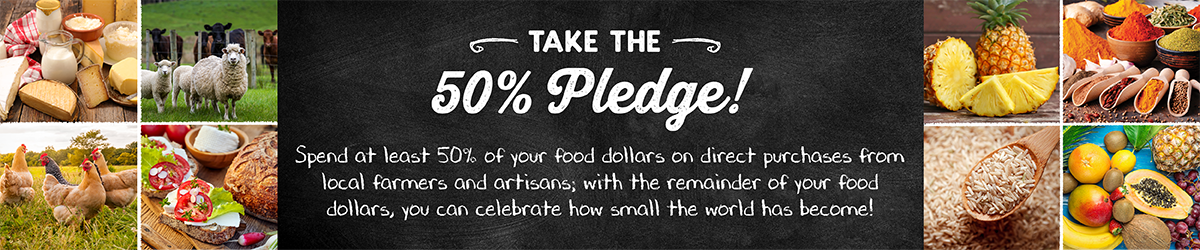
This is so critical. The Weston A. Price Foundation has a 50% pledge area on their website where they invite people to spend 50% of their food budget on local farms, which is exactly what you are talking about. Support the local farmer, invest in the economy, and keep an infrastructure going that eventually will be much more helpful than keeping the local Walmart going.
As we saw during COVID, the trucks shipping food across the country were all falling apart, and we needed the local farmer more than we ever realized. We do not want to hit that crisis point again to test that out. Let us invest in our local communities. Shake the hand that feeds us, as AJ Richard says. I just love that so much.
I love that too. Wait, one last thing I want to say about that is that during COVID, I had 500 boxes. We were delivering to people’s doors from my farm in California. I was like, “This is really working. For the first time, my CSA program was working, and we bought more vans, and we bought all this infrastructure and got online infrastructure we invested in.” As soon as people did not have to wear a mask in the grocery store anymore, they felt safe again.
They all canceled their subscriptions. It is important that we do not wait for there to be an emergency to support your local farm, but that we be the front line. There is no emergency that we are supporting. I wrote out one of those monkey surveys or whatever, and everybody said, “I like just choosing exactly what I want. You only have citrus in the wintertime for fruit, and I like strawberries.” It is like, “I understand that we have to care more about the local farm workers than that we want to eat broccoli 365 days a year because broccoli may not grow in your area 365 days a year.”
Of course, Dr. Price found that the healthiest people on the planet were eating locally and seasonally. It would do us well as it would do our bodies a favor as well. Now I want to ask you the question I like to pose at the end. Mollie, if the audience could just do one thing to improve their health given all that we have covered today, if they could just do one thing to improve their health, what would you recommend that they do?
Raw milk. Raw milk is the greatest healing thing on the planet. I had four children. We covered this when I was on the show last time, but I had four children late in life. I had my first child just before my 37th birthday, and then I had my most recent child at 45. Basically, I had four children in eight years, and I gained weight with each of them.
Even though I was eating really healthy and really clean and working out, working on the farm physically, I do not, I believe in using my muscles in real life, not in the gym, but I could not lose the weight. I had this download, doing some research for a friend who lost all their Bifidobacteria after taking the COVID vaccine.
I had this insight that if a baby, the highest levels of Bifida are right when a baby starts going from breastfeeding to eating food, and that it is not that the breast milk has the high levels of Bifida, but it sets up the perfect ground for the Bifidobacteria, that if you did a raw milk fast, that you would create that and then start integrating food against little by little, like a baby, that you could regrow your Bifidobacteria.
I tried it, and I did eighteen days on Raw Milk Fast the first time, and I did 46 days the second time. I just think it was life-changing. I look younger, healthier, skinnier than I did before I did it. Sometimes people post pictures from the show and stuff, and I am like, “This is not looking good there.” I really do think that it is a wealth of health and vitality that comes out of it, and it is God’s perfect food. There is just so much available.
I just saw this interview with Tom Cowan saying that the Mayo Clinic was originally a milk fasting clinic, and that is why it was in a rural area close to raw milk. This is not new information. This is old information. I always say jokingly, but that raw milk is the real white privilege. We need to make it available to everybody because it is white and it is a privilege, it is illegal everywhere, or twenty states or something. It really is deeply nutritious. I think that would be the best thing to add to our diet if you can.
I love it, Raw Milk for the win. Yes, when Sally set up the foundation, she also started the campaign for the real milk whole initiative. There is a website called RealMilk.com where people can find where they can find Raw Milk in their area. I just want to put in a little plug for that. Also, to say that I believe it is legal in some way, or form, in 47 of the 50 states. We are almost there. Mollie, thank you so much for all of your valuable information. It has been an absolute pleasure. On behalf of the Weston A. Price Foundation, thank you.
Thank you.
—
Our guest was Mollie Engelhart. Check out her websites, Sovereignty Ranch and Debunked by Nature, to learn more. For the transcript for this week’s episode, visit our website, Weston A. Price, and click on the podcast page. Now for a podcast review from midwife Melissa. She said, “Loving this show. Wise traditions enlighten with timeless health wisdom, blending traditional knowledge with modern insights. Each episode feels like a clarifying guide through the world of wellness, offering practical, life-enriching advice.
It is a must-listen for anyone seeking a balanced, informed lifestyle.” That review means so much. Thank you so much for putting it out there. If you also love the show, please tell the world. Go to Apple Podcasts, click on ratings and reviews, give us a bunch of stars, and tell us why you listen. It means a lot to us as we work hard on each episode, and of course, to prospective listeners. Thank you so much for tuning in, my friend. Stay well and remember to keep your feet on the ground and your face to the sun.
About Mollie Engelhart
Mollie is a regenerative farmer, chef, whole food restaurant owner, author, and mother. She is the author of “Debunked by Nature: How a Vegan-Chef-Turned-Regenerative-Farmer Discovered that Mother Nature is a Conservative”. She helps to run Sovereignty Ranch, a 200-acre ranch and farm in Texas, that features a restaurant with farm-to-table dining, a farm store, and space for retreats.
Important Links
- Mollie Engelhart
- Mollie Engelhart on YouTube
- Mollie Engelhart on Instagram
- Mollie Engelhart on Facebook
- Debunked by Nature
- Real Milk
- Wise Traditions on Apple Podcasts

Leave a Reply