



 🖨️ Print post
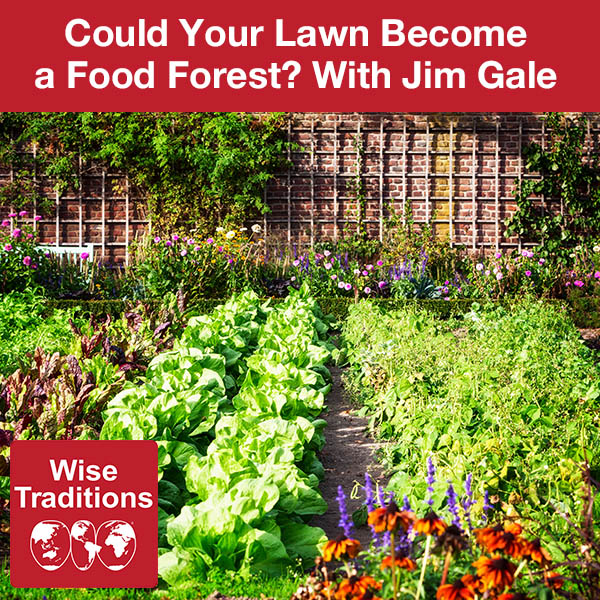
Most American lawns are lovely…but not exactly an efficient use of space. What if we made the most of the land, helping to turn it into a source of sustenance for our families and communities? We could use permacultural principles to understand the land and collaborate with current ecosystems to help bring about its full potential. So says guest Jim Gale of Food Forest Abundance.
On today’s episode, Jim talks about how to get started with small shifts: how to decide what to plant and where to get started exactly. He also covers the importance of protecting ourselves against food shortages through better land management. And how we might cross our own mental barriers to start to explore this somewhat alternative lifestyle.
Visit Jim’s website: foodforestabundance.com
Register for our Wise Traditions conference at wisetraditions.org
Check out our sponsors: Paleo Valley and Optimal Carnivore
—
Listen to the podcast here
Episode Transcript
Within the below transcript the bolded text is Hilda.
What if your lawn could be a food forest? Seriously, what if we could convert our lawns from a liability to an asset, a source of sustenance for our families and communities? This is episode 441. This is exactly what is on the mind of our guest, Jim Gale. Jim is the CEO of Food Forest Abundance. He covers a number of topics, including how to go about making this shift from lawn to food forest.
He gets practical covering where to start, how to decide what to plant, and how to propagate food from items purchased in the grocery store. He explains permaculture, the land management approach that collaborates with natural ecosystems. He also discusses how to protect ourselves from food shortages and overcome our own internal mental obstacles that might prevent us from adopting this alternative lifestyle.
Before we get into the conversation, I want to personally invite you to come to our Wise Traditions Conference in Kansas City, Missouri from October 20 to 22, 2023. It’s the conference that nourishes in every way. The food is wise traditions-friendly, the people are authentic and welcoming, and the speakers are stellar. This year, 2023, they include Sasha Latypova, a retired pharmaceutical industry research and development executive. As you might suspect, Sasha will offer important insights in her keynote speech about what she dubs weaponized healthcare. There will be lots of valuable information along with the amazing connections and other things I highlighted a moment ago. Join us. Go to Wise Traditions to sign up. I’ll see you there. You’re tuning in to Wise Traditions.
—
Coming up, Jim explains the simple beginnings of every permaculture food forest.
—
Go to Paleovalley to place your order and receive 15% off your first order with this particular link.
Optimal Carnivore. Go to Amazon and place your order. Use the code WESTON10 to save 10% on all products. Remember that Optimal Carnivore plants a tree for every product sold.
—
Register for our Wise Traditions Conference
Check out our sponsors: Paleovalley and Optimal Carnivore
—
Welcome to the show, Jim.
Thank you. It’s wonderful to be here.
You have lived such an interesting life. You’ve traveled the world. You’ve had a lot of insights. Now, you’ve started your Food Forest Abundance group. I’m so curious about so many things, but my first question has to do with you’re a-ha moment. When did you realize, “Something’s got to change, and it starts with me.”
It started out in about 2007. I had heard from some people who were crazy conspiracy theorists that there were people that are running our world. There are parasites that are poisoning and destroying our soil and creating fear, all in the effort of controlling the population and their asset, which are the slaves around the world. We are all part of that because we pay a percentage of our productive value to people. What do they use it for? They use it for war.
At the same time that I learned that, I learned the science of permaculture, which stands for permanent agriculture or permanent culture. It was developed by Bill Mollison and David Holmgren. Millions more around the world are proving this science to be the answer to all of the world’s biggest problems. When I say all the world’s biggest problems, I’m talking about mass extinction, deforestation, world hunger, cancer, diabetes, heart disease, and tyranny of all kinds. The solutions are embarrassingly simple, as Bill Mollison puts it.
Permaculture is the answer to all of the world’s biggest problems.
Here’s the biggest catalyst. I had. My first two daughters, Mia and Seila. When you have kids, and every parent knows this, then there’s something more important than you in this world. I started looking at the world through their lens, a more long-term perspective lens, and started asking the questions knowing what I knew about the problems, the mining, poisoning of soil, and all these other control methods. I started freaking out. I’m an optimist. I love solutions. I went through this period of cognitive dissonance and of pain.
I had sold the mortgage company that did about $1.3 billion in gross revenue. When I sold that, I had time, so I went down every rabbit hole and started researching. It took a while of playing around with different ways of doing it, but we figured it out. We cracked the code. What we are doing is emulating everything that the permaculture people around the world have been saying for generations.
This is fascinating stuff. I want to ask you, and not to go down this rabbit hole too much, but why do you think that there are parasites or people trying to control the planet? They’re pillaging the Earth. They’re making our life so difficult and stuff like that. Why wouldn’t you see that we’re all the part of the problem? Maybe we’re the parasites. We’re the ones wanting to dominate the Earth and subjugate it without a thought about the future. Why don’t you blame us instead of “them”?
We are part of the whole thing, but there’s an entity out there that is called mind control. It’s governed, which is manager control, and mente, which is mind. Those are the people. They’re the same families that have been in charge for hundreds of years that mandate and produce the poisons and narrative and create the fear. They’ve purchased and own all of the mainstream media narrative places, like newspapers. They purchased many years ago 75 of the most influential newspapers around the world.
People, in general, are good. We want to enjoy life. We want to share, have fun, and love each other. The ultimate selfishness is not to be loved but to be loving. That’s the best feeling in the world. There are different ways to look at it. Are they evil? Is there an evil basis? Maybe, but they’re psychopathic in the way that they’re controlled by fear. I am so positive and optimistic about the future because their system and way of thinking are radically unsustainable. All unsustainable systems fail. What we’re presenting here, thanks to the permaculture movement, is a solution to all of it, and it’s going global rapidly.
I’m so thankful for that. I first heard about permaculture when I was in Africa. I was in Kenya. A friend of mine said, “We should connect with these permaculturists outside of Nairobi here.” I was like, “What’s that?” She then started opening my mind to it. Talk to us a little bit more about the permaculture philosophy and how we can implement it in our own backyards.
For permaculture, the basic philosophy is to observe what nature does and emulate that to serve humanity in a way that also serves the whole system. In fact, if it doesn’t also serve the whole system, it doesn’t serve humanity. It’s regenerative capitalism. It’s capitalism that is transparent on every level, and everybody wins. We’re using that tool to bring these methods to the world as rapidly, strategically, and logically as possible. A permaculture-designed system is a system that mimics natural systems, but it produces the yield that we desire.

Doesn’t all agriculture do that?
No. There are some people out there who create GMO seeds or modified seeds to such a degree that the plants that grow out of those seeds do not produce new seeds. That’s the definition of unsustainable. You’re done. The only way to get the next round of seeds is to go buy the seeds from the same producer. It’s a control mechanism.
Real agriculture that serves people and the planet is a more sustainable model where there’s more life that comes from the life and the seeds that are planted.
It’s not only sustainable, but it’s regenerative, abundant, and expansive. One of my good friends and designer, his name is Chad Johnson, has a food forest in Northern Minnesota on the tip of Lake Superior. His food forest planted over the last couple of years is so abundant and expansive that he estimates that thousands of plants have been planted in the forest around his food forest by the birds, the wind, and the water that comes through his system.
It’s not stuff that he put there with his own hands.
The Garden of Eden ideal, not from a religious control perspective but from a spiritual possibility perspective, is the next logical step for our humanity.
I want to bring it home to my own backyard. Is my front yard or my backyard ae lawns a waste of space?
They can be turned from liabilities. The American lawn that is 40 to 50 million acres takes more poisons and more resources than any other crop. It’s monochromatic. It doesn’t provide a good smell, colors, or food, so it’s a liability. You can turn that same land with the same amount of resource input into an asset that provides you and your family not only healthy food for generations to come but as a result of that healthy food, the odds of getting cancer, diabetes, and heart disease go way down. You will save lots of money over time. You’ll have birds, butterflies, and bees in your backyard. It’s the ultimate stack of functionality.
When did we get the idea that a green lawn was an aesthetically pleasing and helpful idea right around the house? Where do you think that came from?
I know exactly where it came from. It came from mind control, govern and mente. Henry Kissinger many years ago said, “If you want to control nations, control oil. If you want to control people, control their food supply.” This is not the ramblings of a psychopath. This is the strategy of a slave master. If that’s the problem, then we use the permaculture principles to turn the problem, which is this ridiculous use of our resources, into the solution, which is nature’s way of using resources designed to serve people as well.
I’m convinced. What would I do if I wanted to put a food forest in my own yard?
Everything starts with design. The permaculture designers around the world are my favorite people. They’re the detailed people who have made a living and are making a living designing these food forests to serve whatever the customer’s goals are. Some customers want zero maintenance. They want to put a food forest on the ground and never think about it. Those systems have to have a certain amount of elements stacked in so that the watering occurs as needed and things are happening. Ninety-nine percent of food forests inspire an interaction with them because their beauty is so amazing. That’s the thing that we teach, too. It is to interact with the food forest. Start with design, and then go from there to the actual installation.
With design, from what I’ve studied of what you’ve put out there, it’s important to look at what’s already working in my backyard. I could be like, “What life is here? When does the sun hit it?” and so forth so that I can collaborate with nature as opposed to fighting it.
Exactly. We can’t compete with nature and win. There’s no winning that battle. Instead, we collaborate and work with those systems. We find out the wind patterns and the sun patterns. Most importantly, the zone, the rain, and then how much you want to interact. We advocate that there are two different types of plants from this perspective. One is perennials, which are plants that you plant once and they keep growing for, sometimes, thousands of years. There are annuals where you plant them, and once you harvest, then you have to replant.
Nowadays, the annuals will come to fruition much faster, usually 3 to 6 months, and you’ve got a crop whereas the perennials take a little bit more time. We like combining them. That solves two problems, the short-term food supply problem, which is right on our doorstep, and the long-term food supply problem. The Garden of Eden everywhere is how it will be here in the next 10 to 20 years.
When you talk about the Garden of Eden and even the term food forest, I picture this lush, vibrant area with all kinds of food. It must not look like that at first for the very reason you said. For the perennial, the crops won’t show up until later, and the annual depends on how many I plant. What is a food forest in the first place?
I’ll describe one. My partner, Dr. Ian Scott, who is our lead design team leader, has a tenth of an acre backyard. In his backyard, he’s got over 100 different perennial plants and over 70 different varieties of food. He’s got gingers, turmeric, yucca, avocados, mangoes, blackberries, mulberries, peaches, figs, and dragon fruit. I could go on 70-some different varieties. That’s a food forest. It’s a diversity of food grown in a small space stacked.
Underground, you’ve got your roots and tubers. You can have sweet potatoes, potatoes, ginger, turmeric, yucca, and taro. You’ve got your next layer, which is the herbaceous layer. You’ve got your mushrooms. A lot of medicinal plants grow well in this area. You can have your shorter shrubs, your taller shrubs, your shorter fruit trees, and your taller fruit trees, and then your grapevines and passion flowers going up them. It becomes a whole stack of food growing in a relatively small place.
Can anyone get that started without professional help?
Absolutely. You could go to your local nursery and buy a bunch of fruit trees of diversity. Sometimes, you need to get two of the same type of pollination and so on. You can go to YouTube and say, “How is the best way to plant this in my zone?” Usually, there’s an answer right there. In fact, for $20, you can go to the store, buy your favorite fruits and veggies that are non-GMO stuff and organic stuff, and take the seeds out. You can go to YouTube and say, “How do you propagate apple seeds?” You can start your own food forest for $20.
Isn’t it funny that we have to go to YouTube, Google, and DuckDuckGo to find these answers? In other words, these were wise traditions that our ancestors were well-acquainted with.
This was the norm. I lived for twelve years in Costa Rica. Every grandma I met in Costa Rica, especially the ones out in the country, knew more about healing the body and the mind than any doctor I met over there or in most places.
I’m not surprised. I’m glad you mentioned Costa Rica. I think it’s important to know our zone because we might get excited about growing pomegranates, let’s say, when maybe pomegranates don’t grow easily where we live. That’s why it’s important to know where you are and what can grow well there.
That would be one of the first considerations of the food forest designer when talking to the customer. It is, “What zone are you in? What other microclimates and different elements are related to your particular property?” Even within a particular property, there are several microclimates. There could be a pond, which creates a neat microclimate, and so on. The zone is job one. There are people like Sepp Holzer who are growing lemon trees in the Swiss Alps, where it’s impossible to grow lemon trees yet he’s growing lemons.
How so? Is it because of the richness of the soil and how he’s regenerated things there?
This is where it gets magical, and this is where people are starting to test the edges of what’s possible. A lot of it has to do with the movement of water. Water is some kind of magical lifeblood of the whole system with the nourishment and cleaning. It’s like the lymphatic fluid and the blood fluid of a human body. It’s really neat when you start playing with the movement of water.
I want to hear the story of somebody who started really simply and is enjoying what is maybe not quite a food forest but more like a food section of their backyard.
Those stories are everywhere where people start with a couple of little plants. They want to see if they can do it. A lot of times, they’ll start with annuals, which take a little bit more maintenance. We’ve got annual gardens out here, and it takes fifteen minutes a week or so. There’s no such thing as weeds in a permaculture system. There are plants that are competitors to the plants you want, and some of those plants you want to take out or suppress to allow the plants you want to grow.
There are so many ways to do it. Starting with little steps in permaculture, you make small changes, and then you learn and observe. You then interact and make changes according to what you learned and observed. Every permaculture food forest starts with the first tree in the ground, and then you start loving it. This is a magical experience of letting the plants be the teachers. It has been proven scientifically that the act of looking at or being in a food forest is going to raise your energy and your health.
Just the act of looking at or being in a food Forest is going to raise your energy and health.
Tell us how you got started. You had your two little kids. You had read up on the problems with control. You wanted to get going in this direction. You were starting to study permaculture. What was the first tree or plant that you put in your own area?
When I do something, no matter what, whether it’s wrestling, getting in the business world, or traveling, I go freaking nuts with it. The first thing we did after I started learning this was we bought a fruit tree nursery. We bought the whole thing. We planted thousands of fruit trees in Southern Costa Rica. We even built several fruit tree nurseries on our own properties. I didn’t start small. I said, “This makes sense. I’m going to start all the way.”
What fruit was it?
What fruit wasn’t it? I don’t think you can name a fruit that wasn’t in there. In Costa Rica, when I first got there, I could only probably name 15 or 20 fruits. We had 140 different species growing on one property. What we’ve learned over the last couple of years, thanks to the internet and people connecting like growers, is that the actual number of food-producing plants is infinite. There are so many more than anybody’s aware of. Most of the stuff, if you’re walking in a natural area, are edibles and medicinals all over the place that you don’t know about yet.
You walk right by them because maybe you don’t have that ancestral wisdom, the herbalista, or the herbalist who used to live in the village. Those traditions are long gone. It’s so sad.
They’re coming back though. That’s an opportunity. It is sad, but the beauty of it is that those are the most important traditions. That’s the foundation of our health and our wellness as a society. Being in the business of helping people with their real eyes see clearly about what’s possible, it’s the best opportunity in the history of the world.
I love that you’re an optimist, but I can’t help but think about people who are resistant to this idea. What are things that are blocking us from moving in this direction, do you think?
It’s BS. It’s Belief Systems, Bad Science, and Bulls*** that are put into our minds through programs like television, Hollywood, and all the mainstream media narratives that are controlled by the same two companies, which are controlled by the same families that have always controlled everything. If that’s the problem, then the solution on the other side of that is free thinking. It is enlightenment per se.
When we can meditate and allow our minds to relax, we start feeling our hands and heartbeat and going inside with our breath. That’s the foundation. As we release the programs from our minds, the gaps open up. That’s when divine intervention happens. That’s when magic happens. If this is a thought and this is a thought and that’s our brain, you can’t have any new ideas when you’ve got your thoughts back to back.
We self-limit, don’t we? We think, “That’s my Uncle Harvey. He’s really good in the garden. I could never do that.”
It’s all bad programming. Anything we say about ourselves that is disempowering is a program. Throw that out and replace it with the opposite of it.
You are enlightened and growing. You’re a person who’s pursuing truth and this empowering feeling. Have you been able to transmit that or help cultivate that in your own children?
Yes. One of my daughters is fairly shy. She’s a shy girl. She went to school and did not obey or comply with her own judgment and will. Everything we do is voluntary. Voluntarism is my favorite thing, the voluntary exchange of value. She said, “I haven’t worn a mask.” I said, “What?” She goes, “I’m the only kid in my class that’s not.” I know that people are looking at her funny. It’s emotionally beautiful.
Look at how that’s the result of your life, pursuits, and integrity. You are allowing your children the freedom to be empowered, express themselves, and grow like nature.
We provide the foundation, love, nourishment, and support. The seed has to grow. It knows what to do. It’s like kids and humans. We know what to do at our deep level. When we can use our emotions as our compass to feel which direction is right and we’re feeling fear, shame, rage, and all these things, then we know it’s time to settle down. It’s time to strategically, intentionally, and selfishly be thankful and be serving. When we can combine those things, then everybody wins, including us.
That thankful attitude helps us when we relate to nature as well. We’re not trying to fight the weeds, fight the ground, or go against what it’s doing. It’s rather something of a dance. Joel Salatin calls it the beautiful choreography when we want to join in the dance and not change the rhythm or what have you.
What would this world be like without the friction? We wouldn’t have babies without friction. We wouldn’t have anything without friction. We would probably be a buzz of the universe. That friction is what creates the desire to change. It’s what creates the catalyst for, “I don’t want that, but what do I want?” The more time we’re stuck in, “I don’t want,” the more we build up the desire to want what we don’t want, like the opposite of that. It’s time as a society to say, “What do we want?”
Is that why you said a moment ago that you feel like there is momentum in this permaculture movement and this movement of Food Forest Abundance?
It is epic, magical momentum. I’ll give you a few different foundational pieces that are happening. We had a TV show pilot done. It happened to be done by my favorite producer back in my 20s, The Crocodile Hunter producer, and one of my favorite actors back when I was in my mid-30s, Adrian or Vincent Chase from Entourage. We got together and did a pilot TV show. It’s called The Land of Plenty. That’s being put out to the networks. That’s magical.
I got off the phone with David Avocado Wolfe. We were on a call talking about supporting each other. We were talking about supporting his incredible foundation, which is putting millions of fruit trees in the ground all over the world. Also, our system is the system that’s scaling the cooperative business model of cooperative partners that are installing these food forests around the world. That’s one. We’ve got three Emmy award-winning producers and TV personalities all coming aboard. It’s the tip of the iceberg.
That’s really exciting. Congratulations.
Thank you.
I like this cooperative, collaborative mood that we do see in nature, too, right?
Yes, we do. One of the things I love to share is we are putting the vast majority of the net monthly profits back into the system strategically. Here’s how we’re designing and installing food forests in public areas, schools, food banks, and churches. For any community public area, we’ll design and put in a food forest. I like to share this. We’re doing this because it’s good for us on every level. It’s good for our bigger picture, the mission and vision of our company. It’s also good for our company to put all the profits back into a certain point. The point is when we win, we reverse these trends.
It’s making me think of the Gangsta Gardener. Have you heard of him?
I love the Gangsta Gardener.
It’s amazing. He’s like, “We should have roots that are hanging out that anybody can grab like the old days when you walk down the street. It shouldn’t be that you’re stealing from a neighbor. It’s there for anyone to eat.”
I love that guy. If anybody knows the Gangsta Gardener, I want to chat with that fellow. What we do is we shine a light on people that are doing it. Our mission internally is to serve the cooperative partner, which is anybody in the world who’s doing good work and creating regenerative solutions.
That’s fantastic. I’m sure that this episode will hit those who want to collaborate with you. I have a couple of more questions before we wrap up. One is, let’s say I’ve got my trees planted and so forth. I saw on your website that bees and other things can be added to take that food forest to the next level. Is that right?
Yeah. We are putting up our first beehive here at Galt’s Landing. We’re developing that off-grid community with the studio to demonstrate this every day from a place of, “This is awesome. This is how we do it.” Chickens, animals, and everything can be incorporated into a food forest system. In fact, we’re sending compost tea brewers. We’re sending these 50-gallon drums with all the different elements to make compost tea to all of our cooperative partners so they can add compost tea to all their food forest installations.
I’ve never heard of compost tea.
Compost tea is the nutrients that the plants love. We put some molasses in there, rock dust, worm castings, and all the compost. We create a bubbler in there to stir up the water for 24 hours, and then it creates hyper-nutrient-dense living water. We put that water on the soil, and that inoculates. It’s like a spark of life.
It sounds great. I bet, because of what you said earlier, that anybody reading who is like, “I want to start my food forest,” could start small. They could probably make up their own compost eventually if they want.
If you go online, you figure it’s easy to make up compost tea. We’re making it even easier.
I have one more question. Do you personally also work with people getting their food forest started?
My joyful obsession and duty to everything I hold dear is to do as best I can to affect, inspire, and empower the most possible people. We’ve got a whole design team and many layers of support systems within the system. I talk to almost every customer, but when it comes to the details, I thank God for detailed people. We have an abundance of detailed people who help with the very specifics.
It reminds me a little bit of my husband, who’s an athletic director. He used to coach the teams himself, and now he coaches the coaches. You’re doing a good deal of both of those probably.
I’m leaning toward coaching the coaches more. As the whole vision and mission grow globally, I’m going more into podcasts, TV shows, and speaking events.
That’s to inspire more people. Thank you for taking the time. I want to pose you the question I often pose at the end. I’m aware that you’re not a doctor or a health professional, but that might be even better. If the reader could do one thing to improve their health, what would you recommend that they do?
Relax and enjoy life.
That’s beautiful. Thank you so much for your time. It’s been a pleasure.
Thank you, Hilda.
—
Our guest was Jim Gale. Visit his website, Food Forest Abundance, for more resources. For a review from Apple Podcasts, “An Excellent Show with Empowering Information,” from Marlenethepug. She says, “Following or closely following the teachings of Weston A. Price offers an empowering lifestyle.” Marlene, thank you for this review. I’m so glad that this show has been beneficial for your journey on health and wellness.
If you’d like to leave us a review, please do so on Apple Podcasts. Another way to get the word out about the show and this life-giving and health-saving information is to simply share the episodes that have resonated the most with you with your family and friends. Thank you for partnering with us and getting the word out. Thanks also for tuning in. Stay well, and remember to keep your feet on the ground and your face to the sun.
About Jim Gale
At age 19, Jim Gale first learned about the power of writing his goals. From the practice of inspired visioning, he became a 4-time All-American and National Champion wrestler. After college, he moved to Hawaii, backpacked through 37 countries, lived with the Maasai, explored cultures, and searched for his next inspired vision.
He wrote his goals again at age 29, which included being retired in 3 years. Jim went on to create a mortgage company that reached $1.3B in sales in 3 years, leading him to early retirement and the achievement of another life goal.
He bought a boat, lived on the ocean for a year, and then moved to Costa Rica to build eco-villages where he discovered permaculture. It changed his life and he realized he needed to bring it to every household in the world. The idea whose time has come became Food Forest Abundance.
Important Links
- Food Forest Abundance
- Paleovalley
- Optimal Carnivore
- Apple Podcasts – Wise Traditions

Leave a Reply