


 🖨️ Print post
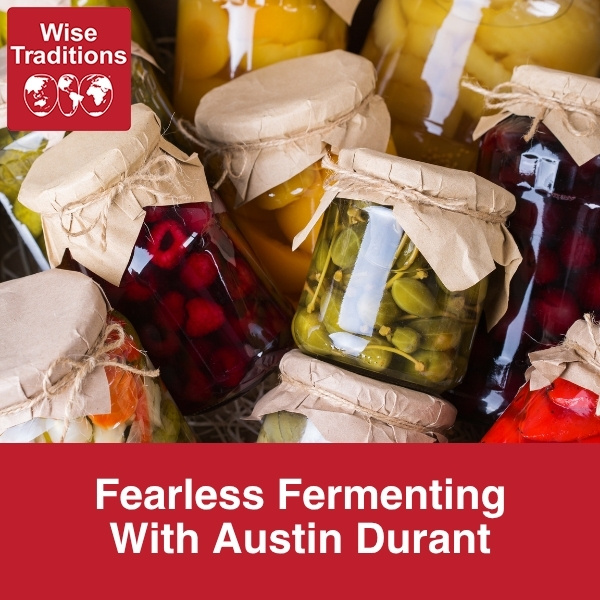
Are you afraid your kombucha scoby might kill you? Are you intimidated by the idea of making your own kraut? You may know that ferments are good for your gut and your overall health, but you still might be hesitant when it comes to making your own. Austin Durant, the author of “Fearless Fermenting,” hopes to ease your fears by showing you the fermenting “ropes”. He goes over how easy it is to get going, with tools and produce you might have on hand in your own kitchen right now. He also explains why you should even get started in the first place. From porridge to kraut to escabeche and more, Austin demystifies the process, inviting you to roll up your sleeves and to get fermenting for fun…and for your health!
Visit Austin’s websites: fearlessfermenting.com and fermentersclub.com
Become a member of the Weston A. Price Foundation (and use the code pod 10)
Check out our sponsors: New Biology Clinic and MASA Chips
—
Watch the episode here
Listen to the podcast here
Episode Transcript
Within the below transcript the bolded text is Hilda
You know ferments are good for your gut and your overall health, but you still buy your kraut, kombucha, and pickles at the farmers’ market or at a grocery store. That may be a thing of the past, as this episode demonstrates how easy it is to get rolling with fermenting food yourself. This is episode 554, and our guest is Austin Durant, the author of Fearless Fermenting and the Founder of the Fermenters Club.
From porridge to escabeche and more, Austin demystifies the fermentation process and helps us get a handle on how and why to get fermenting. He goes over how simple it is to get started, making it doable. He also explains the science behind fermented foods’ many benefits. Before we get into the conversation, I want to remind you that it is the Weston A. Price Foundation’s 25th anniversary. Join hands with us. If you have benefited from our work in any way, for example, if you’re a fan of this show, now is the time to give back.
You can become a member this year, in 2025, for only $30 for the year using the Code Pod10. Not only will you become a part of the Weston A. Price Foundation family, but you will be entered into a drawing to win a prize from some of our favorite Wise Traditions-friendly companies. Join now. Go to Weston A. Price Foundation and click on the Join Now button. Using the Code Pod10, it’s only $30 for the year. Thank you in advance for supporting the foundation’s important work of education, research, and activism. You might win a little something special from us as a thank you.
‐‐‐
Welcome to the show, Austin.
Thanks. It’s great to be here.
Austin Durant: The Forrest Gump Of Fermentation
Why do you consider yourself the Forrest Gump of fermentation?
At a time when I was getting into it, I felt like I was showing up at all these fun events. I got to meet Sandor Katz and Michael Pollan at the same event up in Northern California. I was like, “There’s something significant here.” It seemed like as I was getting more into it, I kept having these synchronicities, like in 2015, I met Joel Salatin in Oregon. It propelled me. It let me know that the universe was saying, “This is the right direction. Keep going with it.” Eventually, it led to me creating my own festivals and creating that momentum myself here, where I am in Southern California.
When you talk about synchronicities, I know you’re talking about these encounters with these people, but it’s a good parallel to what happens in fermentation. Things come together, and then the magic happens.
That’s a good point. I’ve been diving into esoterica myself. That’s true. There’s a steep symbiosis between organisms when you put the right ones into our bodies. It’s everywhere in nature, from between a soil and a plant, between a plant and a human, and between the microbes that are in our gut and us. It’s symbiotic layers everywhere.
Tell us a little bit about why fermentation is so special. I feel like fermentation is trending. I see people on TikTok and on Instagram chopping up their cabbage and are all about it. Why do you suppose?
It’s a remembering. Not to wear the tinfoil hats, but we’ve been led astray from natural ways of living. Fermentation was something that humans have done for thousands of years. The genie wants to get out of the box. It’s such a simple thing. It’s profound. There are flavors involved. It hits all the notes. It’s an easy way to give yourself medicine that is perfectly tuned to your body. It lets you take command of what you’re putting in your body, including how to source it. The layers go on and on.
I’m taking notes, and I want to write down what you said. You said it’s an easy way to put medicine into the body. With fermentation or fermented foods, how are they beneficial to us?
There are lots of reasons and things that these microbes do. I like to say they’re living their lives doing what they do, and they wind up creating these metabolites or postbiotics, if you want to get nerdy. There are substances that they create in the course of their living. For example, vitamin B, vitamin C, digestive enzymes, which help us digest other foods if we’re also eating fermented foods, and the probiotics themselves.
The microbes that are there digesting the sugars, carbohydrates, or proteins in the food source, most of them are still living when we ingest them. Those work in harmony with our own native gut flora. It’s so simple and profound. There are lots of nutrients we’re putting in our bodies that are not there. When you start the jar, let’s say, of sauerkraut, they’re there only after that fermentation process proceeds. It’s alchemy, for sure.
It’s so fascinating. When you were talking about the enzymes being alive, I thought, “I bet most of the food that we eat is dead food.” Do you know what I mean?
I do. We can enjoy blueberries in February if we’re in the Northern hemisphere, which is not super natural to do. We have long supply chains, freezing, and all that stuff, but a lot of that stuff either denatures, or we have to pick the food before it’s fully ripe. All the things that the Weston A. Price Foundation advocates in terms of that.
The living, the chi, and the energy of the food are somewhat restored when we ferment as well. It is always important to start with seasonal, organic, and local as much as possible. That’s called regenerative now. For the most part, it’s true. Having a flavor of food doesn’t mean its energetic quality or its nutritional quality is very high.
Just because a food has a flavor, doesn’t mean its energetic or nutritional quality is very high.
The Weston A. Price Principles & Fermentation’s True Nature
I’m also thinking of the first principle of the Wise Traditions principles that the foundation has put together. Dr. Price noted that the healthiest indigenous people had no refined or denatured foods. In other words, they weren’t eating things out of cans and packages. When we talk about fermentation, to clarify for the audience, we’re talking about making ingredients and putting them together as our ancestors would’ve done in a container that makes the goodness more bioavailable. It enhances what’s there and makes it even better. That’s a different process than what Dr. Price was referring to. When he said overly processed, refined, or denatured foods, he meant things that we’ve put into a container that makes them, in a way, no longer alive.
That’s a very good point. Fermentation is a process. I like to say it’s the process of transforming and/or preserving food. In a way, we’re replicating an environment of what would happen in nature. We take a bunch of cabbage, shred it up, put it into a jar, and then we add a little bit of salt. It’s not only to season it, but what it does is it allows us to regulate which microbes show up.
Through trial and error for thousands of years, our ancestors figured out, “If we put 2.5% salt into this cabbage, it’s going to keep the molds away, but it’s going to allow those “good guys” to proliferate,” like the lactobacillus, bifidobacteria, and all the hosts of different bacterial good guys. We call them the symbiotic ones.
I want you to speculate for a minute. How do you think our ancestors figured that out?
I think about this often. If you know what a kombucha SCOBY is, it’s this blobby-looking gel. I bet there was a dare involved with our ancestors, like, “What did this form on our tea here? I dare you to drink it.” I wonder about that. As I’m getting more into the woo, so to speak, I think that humans have had a much deeper relationship with our plant allies in previous cycles. I’m learning that everything moves in cycles. It’s not linear, as we’re taught.

We had this knowledge of plants. Where that came from is still somewhat mysterious to us. When we’re talking about plant medicines, the ones that bring us into altered states, they talk to shamans. They ask them, and they say, “How did you know that these 2 plants out of 30,000, when you combine them, would create this effect?” They simply said, “It’s because the plants told us.” There’s a wisdom. The threads are still with us, thankfully, with all of our ancestors.
You are a part of this remembering. This is what I love. You are calling us back. We might not be talking to the plants themselves, but we’re talking to someone who’s going to help us get back on track. I want to ask you about your book, Fearless Fermenting. What are we afraid of? What are most of us afraid of when it comes to fermenting?
The title came to me somewhat naturally before I started writing the manuscript. I’ve taught classes for almost fifteen years. People had trepidation. They were like, “If I’m purposely putting something on the counter and letting it sit for two weeks, that sounds funky.” Maybe I tried it once without proper instruction, and it did become a science project. That happens sometimes.
The truth is, fermentation is very safe. Especially when we’re talking about vegetables, it’s a very benign process because it’s what’s going on in nature. If all goes wrong, if you mess up, if you forgot to add salt or whatever, or if some bug got in there, worst-case scenario, you compost it and start over. With it being very safe, the corollary that I’d like to remind people is to trust your senses. We have a whole host of senses beyond the 5 or 6 that we’re told help us negotiate our environment and keep us safe.
The truth is, nature is benign. We’ve been taught it is this hostility paradigm. If we pay attention and listen, nature will be very kind and say, “We added some additional ingredients. Now, it’s pink, fuzzy, and gross-smelling. You don’t want to eat this.” To honor that is what I mean by trusting your senses. It’s a combination that we’ve been detached from trusting our senses and from connecting with nature. I’m an ambassador in that way to help people restore this tradition that our ancestors all did, which is very helpful.
The truth is, nature is actually benign—we’ve just been taught to see it through a hostile lens. When we slow down and pay attention, nature reveals its kindness.
I love that about trusting our senses. I was thinking, “How do we know if what’s been on the counter for two weeks is going to kill us?” We can open up that can or jar, and if we’re like, “This does not smell good,” then we’ll know this is probably not meant for human consumption. In contrast, if we open it up and we’re like, “Hey,” and we take a taste and we’re like, “That’s good,” then we’ll know, right?
That’s right. I’m not a medical doctor, but most of the poisons and things that are lurking, at least in this natural process, will be obvious. It’s not going to be hidden in there. It’s not like, “You didn’t taste the pickle, but it’s going to kill you.” Being a natural process, there will be some funky flavor. Your body will reject it because we have deep wisdom of thousands of years.
From Stranger To Fermentation Fanatic: Austin’s Journey
Speaking of wisdom, you didn’t grow up knowing how to ferment. You were a stranger to it yourself, right?
I was. I was on my own journey to understand where food comes from and explore. I don’t want to use the word health conscious because it’s so thrown around, but my parents were a little avant-garde. Embarrassingly, now, but my father used to do something when we did go to McDonald’s. I grew up in the ‘80s. As kids, that’s what we did.
He would especially say, “Can you make a batch with no salt?” He was on to things. As we know now, that’s not necessarily good advice, but the point is, there was an attitude to be somewhat discerning with what you’re putting in your body. That carried with me into adulthood, and then understanding and learning about food.
When I first left school, I moved to the San Francisco Bay area, which was a food mecca. It opened up my eyes to that. I wanted to be more curious. Along that journey, first of all, I discovered the Weston A. Price Foundation because they had already figured it out. They were way beyond me in terms of things like raw milk and fermented foods. That was probably one of my first exposures to fermentation. I was like, “This sounds interesting.” I made my first batch of sauerkraut. It hit all the things that I love. It was sour, spicy, salty, crunchy, and delicious. I was hooked ever since then.
There’s a reason we crave that. Didn’t you say in your book that your grandfather used to spoon-feed you something? You called it jet fuel. What was that?
I was only learning it secondhand from my mom. Apparently, it was a salt and vinegar solution that must be somehow an old-world tonic. I would lap it up like a baby sitting in my high chair. It would make my lips white. That developed my affinity for sour and salty.
Interestingly, we still crave those things, which is why people like salt and vinegar chips or pickles. Not all pickles are fermented. Somehow, we’ve come up with a sheep imitation of real ferments. Soda, even. Isn’t that an imitation of what a fermented beverage would be like?
I don’t know the deep history of soda other than Coca-Cola and the things they put in their first version. We won’t talk about that. There are different styles of pickling. I like to say all ferments are pickled, but not all pickles are fermented. It’s not purely accurate. Meaning, there are multiple ways to preserve foods, such as quick pickling. You take the vegetables, put vinegar in it, and then heat-seal it so that it’s shelf-stable. That’s okay. It still preserves the food, but it doesn’t provide all that alchemical transformation that the biology of microbes does. Those are 2 different ways to get to the same spot, but 1 has far more nutrients than the other.
I also think about more flavors because that alchemy that’s going on is a 7 to 10-day process. There’s a lot that can go on, and new flavors are getting created. With sodas, it’s probably something like that. There were naturally carbonated sodas like kombucha or water kefir that may have been an inspiration for the original soda shops.
Some of the things that we ferment naturally get these bubbles showing up, like kombucha, right?
Absolutely.
The effervescence is what I’m getting to.
We could probably do a two-hour episode on just kombucha. Kombucha creates this layer on top called pellicle or a SCOBY, which is a cellulose matrix of both bacteria and yeast. Believe it or not, that’s a strategy to help the inherent yeasts start to ferment and create alcohol. This is a geeky moment for fermenters. If you get natural carbonation on your first ferment of kombucha, you’re doing it right. It means the seal has formed well on the SCOBY layer, and then natural carbonation can come. What we typically do is we’ll take finished kombucha and put it into a bottle for a secondary fermentation or bottle conditioning. That’s where we can amp up the flavor as well as the carbonation. It is a natural process. Carbon dioxide is one of the things given off by these microbes.
The FerMatrix: Your Guide To Easy Home Fermentation
I know for me, I am always craving bubbly stuff. That has to do with this desire for something fermented, perhaps. I satiate that craving with kombucha, sometimes with sparkling water, but I’m like, “I want that playful stuff on my tongue.” Let’s dig in a little bit to what you call the fermatrix, which I loved in your book. It is a method by which you rate the difficulty of an undertaking. Talk to us about why you came up with that. What’s the easiest ferment for us to get started with?
The fermatrix is a scale that, more or less, takes a lot of different factors that go into making a fermented food. It gives each food a value, and then amalgamates that into a simple score. You can go to my book and flip open to a page. I’m going to go to cubed radish kimchi. The fermatrix score is a fourteen, which is relatively in the middle of the scale.
The scale is something like 0 to 20. The lower the number on the scale, the more it allows fermenters, new and experienced, to choose their own adventure. The recipes are roughly organized from lesser to more complex, but not necessarily. The simplest food is straight-up grain porridge, whether it’s oats, barley, or wheat. That has a fermatrix score of seven.
I have to stop you right there. Porridge as a ferment? Why has that never crossed my mind? Tell us more about that.
Cereal grains want to ferment on their own. That’s what sourdough is. If you take whole grains and put them into a jar with a little bit of water, it helps to inoculate if you’ve got whey, kefir, or kombucha. It will also proceed even if you don’t. After two days, you’re going to get that nice sour smell. What I noticed, especially with whole grains, is that they take almost no time to cook. Once they’re nice and soggy, after 1 or 2 days, you can throw them in a pan, and you’re just heating them up. It saves time. I used to make steel-cut oats or whole oats. That was a 30 or 60-minute process.
This is also in line with reducing some of the phytates. Those cereal grains do have phytates. I know that’s a Weston A. Price Foundation principle. Porridge is that simple. You can keep it going. You can make enough for three days’ worth, take off what you want, eat that for breakfast, and then replenish it with some new oats. You’ll have what I call a porridge pot that’ll keep going for a little while.
That’s fascinating. Good to know. If we were going to get started, would you suggest starting with porridge?
If you eat cereal grains, absolutely. If you want to go to something simple like vegetable ferment, carrot sticks in a little bit of brine, or chopped up vegetables, one of my favorites is escabeche. I call it taco bar veggies. You chop up a veg and put it into a brine. I have recipes for the ratio of salt to water. You pack it into a jar, and in a week or two, you’ll see that alchemical transformation happening. They’ll start to smell sour. It will start to soften the vegetables. Any way you want to start, it’s pretty straightforward.
What part of the world is escabeche from?
I believe it is Latin America. I want to say Central America. It had an origin in Spain. The word came from Northern Africa. It means pickled. It evolved over time. Now, it’s pickled veggies.
Low-Tech Fermentation: Clean, Not Sterile For Beginners
If we want to get started, do we have to sterilize the mason jars we’re going to put the stuff in? Sometimes, it seems so involved for the beginner. Talk to us about one way we can be less fearful and more ready to go with it.
I came at it from an approach of I like low-tech stuff as much as possible, and fermentation is one of the lowest techs you can imagine. With that, I wanted to develop a set of procedures that make it something that you can even start now. You probably don’t need to go buy anything to do this. If you’ve got a good mason jar, a cloth towel, and a rubber band, which we all have, and maybe a Ziploc baggie or something that you can weigh down the vegetables, then you’re ready to go.
I like to say you want to be clean, not sterile. It’s not reckless fermenting. It’s fearless fermenting. It’s hot, soapy water. I have an automatic dishwasher. That’s all you need to do. You would wash your dishes and put them in your cupboard. The same level of cleanliness is what’s required for fermentation. I have an elderly cat. He’s blind and deaf, so he calls out every once in a while.
That’s so cute.
He’s a nice guy.
Do you feed him ferments?
Occasionally, I’ll give him broth, but his stomach is so sensitive these days. I give him good-quality senior cat food.
Unveiling Fermentation’s Hidden Power
What is something that most of us don’t know about ferments, would you say? I’m not talking about necessarily Weston A. Price Foundation members. Generally, what do people not know about them?
It’s probably the nutrient density of it. Even I am learning new things. I didn’t realize that short-chain fatty acids were created during the process. The enhancement of this very simple process is probably the thing that I was like, “I didn’t realize that.” Also, it is probiotic-rich. I like to say that fermented foods are the original probiotics. We have it distilled into a pill. Honestly, that can be useful in certain applications, but you’re getting a wider variety of probiotics, especially if you’re making it in your house. You’re in your territory. Especially if you’re getting stuff from your garden, those microbes are almost custom-tailored to you, versus if you buy something from far away.
That’s so fascinating because I’ve been reading the Ringing Cedars series. Have you heard of that?
No.
It’s an account about a woman in a Siberian taiga. Without getting into it too much, she says that everything that we grow and cultivate ourselves is more nourishing than if we get it from the store, even if we get it from the farmers’ market. For example, I could go to the farmers’ market and buy some ferments, but if I make it myself, it is more tailored to me. It’s going to bring me even more benefits. That’s a little bit woo, but I wonder if there is something to that. Maybe you can also contrast for us the difference between wild fermentation and a different kind.
The woo is real with ferments. Especially when you are making sauerkraut and massaging, it is almost a spiritual experience because you are imbuing your magnetic energy into it. You’re informing it, like, “Here’s what my body is doing right now.” I do believe that communicates to the microbes, and they will tailor what they’re extracting from the vegetables to give it to you. I do believe that happens. I’ve heard of that metaphor with seeds as well. Have you ever heard of putting a seed in your mouth to get the saliva on it? Planting it means a similar process. What was the other half of the question?
The other half of the question is, I wanted to go from the woo to the science and ask you about the short-chain fatty acids. Tell me a little bit about what the benefits of those short-chain fatty acids are and why you were surprised by this information that they’re available in ferments.
My standard disclaimer is I’m not a doctor, and I’ve not been on TV. My understanding is fairly limited. Short-chain fatty acids are nutrients in our gut. It’s the butyrates and some other ones. It’s something that I thought maybe when we ate the food, our bodies would then create that from what we put in there. I learned that it happened in the actual jar itself. It predigests our food and makes it easier for us to get all the nutrients from it. In a way, it’s using its own energy, the ether, and then we’re getting to enjoy it. We can spend less energy doing that and more energy towards hugging your kids or going out into the garden. Sorry, I brought it back to woo there.
I love it. I was thinking about how some animals on the planet have multiple chambers in their digestive tract, which helps them digest the food or pre-digest it so they can easily absorb the nutrients. We are monogastric as human beings, so we need to have some help in that regard. That’s exactly what the fermentation process does. It predigests it. It’s making everything more bioavailable, so we can get the energy from it more easily.
I’d rather have one stomach. I have nothing against cows. I love cows. One of their first chambers is specifically like a fermenting stomach. They call it that, I believe. I’m no cattle rancher.
Probiotics And Gut Health: The Microbes In Charge
It’s great. You have your specialization in fermentation. We love it. You mentioned these short-chain fatty acids. You also talked about probiotics and enzymes. I know we’ve thrown that term around in this conversation quite a bit, but break it down for us. Why do they matter? Why do we need probiotics?
The definition of a probiotic is an organism that confers a health benefit on its host. It turns out that we have about 50 trillion cells that make up our bodies, and we have about 1 and a half times that number of microbial cells that live in and on our bodies. That’s in our mouth, under our arms, and on our skin. In our gut is the largest of those neighborhoods, so to speak. It’s about 90% of that. It’s a staggering number, like one trillion or something like that, that lives in our GI tract. These microbes are symbiotic with all plants and all animals. Every animal has that in their digestive system. That’s a given. We need to create a healthy environment in which this symbiosis occurs throughout our lifetimes.
Fermented foods, which contain these natural probiotics, are a surefire way to help keep those good guys, so to speak, in good quantity, as well as picking the right foods. If we start to eat foods that are not good for us, like processed sugars, processed flour, etc., then that can attract certain different types of microbes. It will still take up resonance in our gut, but we’ll start to have deleterious effects on us. I’m preaching to the choir a little bit here. Fermented foods and probiotics do help keep that ecosystem in our gut and all over our bodies humming and resonant with our environment.
I was listening to a podcast one time where they were saying, in essence, what you’re saying. It’s that we are more microbes than human cells. We’ve got all these microbes all over us and all in us. This podcast was saying, as a matter of fact, the microbes are in charge. If you think, “I’m weak-willed. I want ice cream every night,” it’s not you. It’s the microbes. If we have that imbalance, they are going to be craving more and more of the foods that feed, so to speak, the bad guys as opposed to having the proper balance where we’re not going to want to give into a sugar craving because we’ve got the right balance in our gut. Does that make sense?
It does. I can firsthand attest to it. I didn’t necessarily want to make this a top subject, but I completed a five-day dry fast with no food, no water. One of my purposes in going on this fast was to curb my sugar craving. I do have a bit of a sweet tooth, and I can eat all things, fortunately, but I could tell that it was influencing what I chose.
What I mindlessly chose was with my hand. It was like, “Why is my hand reaching for that pastry?” I’m on day three of the refeeding protocol. I haven’t even eaten solid foods yet. I have broth and kefir. There’s a profound change already. The benefits of a dry fast extend months after you do it. I can mentally think of a brownie, but my body has no desire. It’s a thought experiment.
Do you think you starved off those bad gut bacteria that we’re craving that stuff?
There’s a lot of research that has gone into this. It sounds hazardous, but there’s a lot of good research. Russia is where it came from as a protocol. That is one of the ideas. You shut down your digestive system completely, and then you go into ketosis, and then you start to go into autophagy, which is your body cleaning up all those cells. With that, all the unwelcome bacteria that took up yeast and took up resonance are dehydrated, for one, and then they’re sent away. It does what I would call a reset. I don’t want to be too flippant about it. One of the first things we’re taking is kefir, animal broth, and stuff to get the proteins back.
I remembered the second part of that question. I was asking you to contrast wild fermentation, maybe with cultured fermentation.
Those are two different major styles. The wild ferments would be your pickles, kimchi, or cabbage, where the microbes that you’re going to employ, so to speak, are already present on the food. It’s on the outer part of the cabbage, for example. That’s contrasted with something like kombucha or kefir. You could naturally take a glass of sweet tea, which is what kombucha is, set it on the counter, and say, “Become kombucha,” but it would probably take 18 or 19 years to get that many microbes. You don’t want to wait that long when you’re making kombucha. What do you do? You take a culture, which is a set we know does the work of that SCOBY. We drop it into the tea, and it does that. Cultured foods generally require that specific starter set that we know reliably does that work.
Is one superior to the other?
I don’t think so. They both have their merits. The cultured ferments are a little bit more complex. Kombucha is a symbiotic colony of bacteria and yeast that are working together. Nature wants to work together all the time anyway, so we’re recapitulating that when we put it into our jug or our container. Wild ferments both have tremendous amounts of benefits, both sets of them. There’s much overlap, too. Lactobacillus is the genus. That’s found on plants, like Lactobacillus Plantarum. It’s also in things like kefir, like Lactobacillus Reuteri, and all this stuff. I wouldn’t say one is not better than the other, but I use them both in symphony.
I see. It occurred to me that I believe the foundation has recommended making sure to have a ferment at every meal, but to use it more as a condiment as opposed to the main dish. Can we over-ferment ourselves? That’s what I’m wondering.
Yeah. Going back to the rule that fermentation is safe, it’s also very tonic. These are tonic foods. Meaning, in a small volume, they pack a lot of punch. You can overdo it with fermented foods. Typically speaking, you might get a little bloaty or gassy, but it’s fairly benign. What is happening is you’re creating a big party in your stomach because you’re adding a lot of probiotics. The ones that are already in there may start to get a little competitive. There’s off-gassing that happens.
I’ve heard many anecdotes of that happening, especially from my friends who have been ferment-deprived. When I say, “Here’s a bag of sauerkraut,” and they pound the whole thing in one sitting, I slowly back out of the room. You can overdo it. You usually get a little bloaty and stuff, but I would say otherwise it’s pretty benign.
The Ferment Skeptic: Taste, Trends, And True Nourishment
What would you say to the ferment skeptic who’s like, “This guy’s into it, but I don’t like the taste of that stuff. I’m going to stick with my usual diet.” What would you say?
That’s a good question because it’s a hard sell. Certain people understand intellectually the benefits, but they’re like, “I don’t like pickles.” It is happening all the time where it’s like, “So-and-so doesn’t like pickles, but she tried yours, and now, she’s turned around.” Pickles are an example where you can eat non-fermented pickles and have a bad experience.
If you get a little bit out of your comfort zone and try something either again or try something for the first time, and see the sensations, observe what’s going on, and see if you like it, then that will guide you. The skeptic is maybe lazy or busy. I love that it’s trending, but is clean water a trend? No. It’s something we need in our basic everyday life. If the trendiness is what gets people aware of it, then let’s get them aware of it. Maybe push through it a little bit. Don’t think of it as medicine, but know that it’s nourishment and medicine at the same time.
If trendiness is what gets people to pay attention, then so be it—but I’d encourage them to go deeper. Don’t think of it just as medicine; understand that it’s both nourishment and healing at the same time.
I like that. I’m going to write that down, too. We’re getting to the end here. I want to pose you the question I love to pose at the end of the show. If the reader could do one thing to improve their health, what would you recommend that they do?
I would say to eat a small amount of fermented food or beverages once a day. That could be 4 ounces if it’s sauerkraut or 8 ounces if it’s kombucha. Observe the difference in your health, well-being, demeanor, complexion, and how you digest food, and be witness to that.
I love it. Thank you so much. On behalf of the Weston A. Price Foundation, it has been a pleasure.
Thank you. I loved it.
‐‐‐
Our guest was Austin Durant. Visit his website, Fearless Fermenting, for more. You can also go to Fermenters Club to learn more. Here’s a review from Apple Podcasts. SSedai said this. “Great podcast. I enjoy this podcast. I highly recommend.” SSedai, that’s short and sweet. I love it. Thank you so much for taking the time to review the show. You, too, can go to Apple Podcasts. Click on Ratings & Reviews, give us a bunch of stars, and tell us what you like about the show. Thank you so much for tuning in. Stay well, and remember to keep your feet on the ground and your face to the sun.
About Austin Durant
Austin Durant has been fermenting food for over a dozen years. In 2011 he founded Fermenters Club, whose mission is to improve people’s lives by teaching them why and how to make and enjoy fermented foods; and to create communities that are connected through their guts. Austin has taught hundreds of classes on a wide variety of fermented foods and their traditions such as sauerkraut, pickles, kimchi, kombucha, miso, and sourdough bread. He writes and publishes recipes (mostly fermented) on his website, fermentersclub.com and hosts on-demand, self-paced food fermentation mastery courses through Fermenters Club Academy. He teaches live and virtual private team-building workshops to corporations and other organizations and hosts hands-on fermentation intensive workshops. Austin has produced annual day-long fermentation festivals in San Diego, California and Portland, Oregon, with over 1,000 attendees. Austin has also collaborated with some of the world’s leading researchers of the human gut microbiome at the University of California, San Diego, and has been featured in a research paper. Austin has given presentations at the Wise Traditions Conference in 2022 and 2024. In 2024, he published his first book, Fearless Fermenting. When not stuffing things into jars, Austin enjoys gardening, practicing permaculture, cooking, yoga, writing, and studying cosmology, new physics and the natural world.
Important Links
Episode Sponsors
🖨️ Print post

I much enjoyed Austin’s approach. A fermenter myself, I could identify w his enthusiasm. While listening, I was bottling a batch of beet kvass. Tho I’m a whiz at water kefir and medicinal quality kraut, it took me 5 years to do beet kvass. Austin has a “can do” approach. I wish he lived closer, I would Invite him to speak to our chapter.
I enjoyed the podcast with a fresh take on fizzy drinks and other fermented foods. I also did a five day dry fast earlier this year hoping to get out heavy metals like in the Phoenix Protocol. Maybe I would’ve gotten more out of it if I lasted longer, but because of being sensitive to emf’s, it did not go as well as planned. Dry fasting used to be easier for me, and after hearing the podcast Dan Stachofsky I ordered one of his products.