
 🖨️ Print post
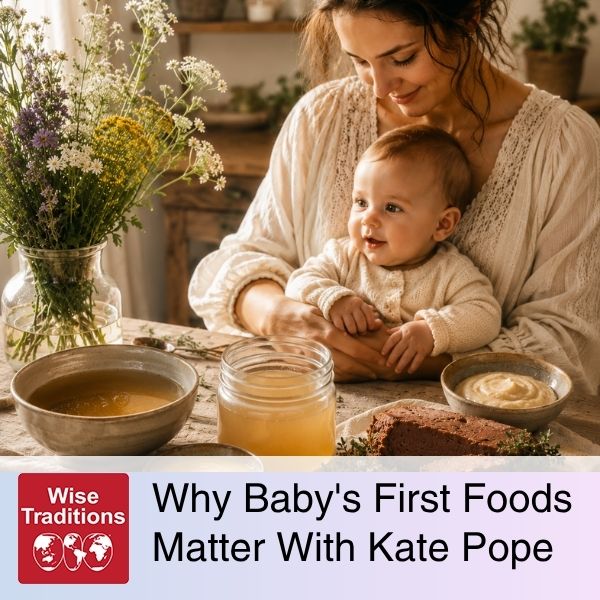
What if the foundation of your child’s lifelong health begins long before the first bite of solid food?
In this episode, Kate Pope, founder of the Mama Baby Biome, explains why preparing for pregnancy, nourishing the maternal microbiome, and protecting a baby’s earliest microbial exposures may be some of the most important investments parents can make. Drawing from both her professional training and her own birth experiences—including an unexpected cesarean followed by a successful home birth—Kate shares practical guidance for supporting both mother and baby through pregnancy, birth, postpartum, breastfeeding, and the introduction of first foods.
Kate explains why the microbiome influences everything from digestion and immunity to allergies, eczema, and even picky eating. She discusses the critical role of postpartum healing, why breast milk is far more than nutrition, and why she believes meat stock—not rice cereal or fruit—is the ideal first food for babies. She also offers hope for parents whose children are already struggling with food sensitivities or selective eating, showing that it’s never too late to rebuild health from the inside out.
Whether you’re planning a pregnancy, raising young children, or simply curious about how our earliest nutritional choices shape lifelong wellness, this conversation offers a fascinating look at how traditional foods can help build healthier families for generations to come.
WAPF Ad- Wise Traditions journal dedicated to healthy babies
Learn more about Kate Pope and the Mama-Baby Biome
Join the Nourishing Our Children closed Facebook group
Check out our sponsors:
Four Visions – “Use the code WISE for 15% off your order.”
Masa Chips – “Use code WISETRADITIONS for 25% off your first order.”
—
Watch the episode here
Listen to the podcast here
Episode Transcript
Within the below transcript the bolded text is Kendall Nelson
Most parents instinctively understand that the earliest years of life matter like the food we eat during pregnancy, the way babies enter the world, how they are nourished and cared for in those first months. All of these experiences helped shape the trajectory of Health for years to come. Only recently have we begun to appreciate the profound role the microbiome plays in that story. This is episode 589 and our guest is Kate Pope.
Kate is a functional nutritional therapy practitioner, certified GAPS practitioner, holistic chef and founder of the Regenerative Cooking School. She specializes in helping mothers nourish themselves and their children through what she calls the Mama-Baby Biome. The shared microbiome between mother and child that influences everything from digestion and immune function to allergies, eczema, and even food preferences later in life.
Through her courses and teachings, Kate guides families through pregnancy preparation, postpartum healing, breastfeeding, and introducing first foods in ways that support the developing gut, brain and immune system. In this episode, Kate shares how an unexpected cesarean birth with her first child deepened her understanding of just how critical the microbiome is in an early life. Already trained in nutrition and familiar with the importance of gut health, she was struck by how little attention was given to rebuilding the microbiome of both mother and baby after birth.
She explains why she and her husband spent nearly two years preparing for pregnancy, what parents can do when birth doesn’t go according to the plan and why postpartum recovery deserves far more attention than it often receives. We discuss the fascinating science of the microbiome, including that babies encounter microbes even before birth, the remarkable intelligence of breast milk, and the foods Kate believes best support a child’s developing body.
She also offers practical advice for introducing solids, explains why she recommends meat stock as babies first food, addresses the growing problem of picky eating and reminds us that it’s never too late to begin rebuilding health. Perhaps most importantly, Kate encourages parents to trust their instincts, reclaim their role as the primary authority in their children’s well-being, and recognize the everyday choices made around the family table can shape generations to come.
Before we get into the conversation, I want to tell you about a special resource from the Weston A. Price Foundation. Looking for the perfect gift for parents to be? Grab a copy of the Wise Tradition’s Journal issue that is entirely dedicated to healthy babies. It has articles on healthy fetal development, how to avoid autism, homemade formula and vaccinations. It’s only $12 and will set new parents off on the right foot. Order yours now. Now, let’s welcome Kate Pope.
—
Kate, welcome to the show.
Thank you so much for having me.
I’m happy you’re here. I heard that you and your husband had spent two years getting ready preparing for your pregnancy. I’m curious where you are at professionally at the time. How did you have the wherewithal to do that and what did that mean?
The Foundations Of Preconception Health
It was about eighteen months total that we spent on the GAPS introduction diet. I heard it from Dr. Natasha Campbell-McBride who founded the GAPS diet. I heard her say something that was a light bulb moment for me. Her quote was, “People shouldn’t just have children willy-nilly anymore. It requires preparation.” That was something I had never heard, but it made so much sense. It was so inspiring. At the time, I was working as a private chef and I was interested in deepening my nutrition practice.
I went and became a functional nutritional therapy practitioner, then I did the GAPS training. It was at that time that I put my husband and I on the GAPS diet. We had about eighteen months until we conceived our first child. We’re focusing on building our nutrition, detoxifying our bodies, which happens naturally when you start eating lots of building foods. With that, came a spiritual and emotional reckoning as well because we were dealing with the physicality of our bodies. That naturally brought us into a different realm where we were asking deep questions. This idea of preparing our body physically for pregnancy prepared us in many more ways as well.
Let’s go to the birth of your first child. What was that like? Did that go as expected?
Navigating Birth Trauma And Advocacy
Yes. I had been living in Washington State at the time. It was during COVID when I was pregnant with my son. We started at home. My midwife advised us that we transfer. When we got to the hospital, they gave their advice since I’m deep in the birth state and I’m not in the place to make decisions. I never even felt like I consented to my cesarean but they strongly recommended that we had a cesarean. There has been a lot that I have carried with me about this surgical birth. It was never right for me. It was never what I wanted. It was urgent from the perspective of the provider and in the situation that I ended up. I have taken responsibility and ownership of this.
I’m also not ignorant to the fact that it is very likely that you will be pushed towards the cesarean as a home birth transfer if you do not have a strong plan in place. It is often very much the incentive for the doctors to push the cesareans. We have a very high cesarean rate in our country and are even growing globally. From my perspective, the cesarean was not necessary and yet that is where we ended up. That ultimately became a big part of my story and my teaching and helping parents to rebuild their children’s microbiomes to help mothers rebuild from birth.
People shouldn’t just have children willy-nilly anymore. It requires preparation.
While I wish that didn’t happen to me, I’m also at a place of gratitude for every part of my life. I’m able to just walk with grace with this, that happened to me, and happened with me. I had a home birth with my daughter after that two years later. There is a lot of hope and a lot of information that people need to know. It was a wake-up moment for me to help other people talk about their cesarean and also how to rebuild their child’s health, and their own gut health as the mom.
You mentioned having a plan before you give birth. Can you talk a little bit about that? I know when I had my daughter many years ago, I went into the hospital to have her and they were pushing me to have a cesarean as well and I said no. Fortunately, the doctor listened to me and didn’t do it. I’d been in labor for so long. It was out of convenience for the medical staff. They wanted to go home. My doctor didn’t want to be there any longer, I think. Again, I was fortunate that they allowed me to continue with the natural birth. What can parents do to prepare? What plan are you thinking about while you’re pregnant?
It’s just such a good question. A woman will birth the best where she feels safe. For me, that’s not in the hospital. It’s not in my worldview or realm or where I was going. I didn’t even see providers during my pregnancy. What really matters in terms of your plan is being aligned with the partner that you’re giving birth list. For me, that meant my husband and I had to go deep and face a lot of our fears. After having a son by cesarean and having that traumatic birth experience, it was a real wake-up call with our daughter, what we wanted to prepare for.
We had an amazing friend practitioner and Doula. An extremely experienced nervous system practitioner who looked at us and said, “Are you perhaps still living in the emergency of your son’s birth?” That was another light bulb moment for me like what happened in that birth that wasn’t processed. If you have a dramatic birth and you’re going into a home birth after cesarean or just a vaginal birth after cesarean. You have to face the fears. Face the darkness and what happened. That’s easiest with a unified front with your partner because he is your voice in that moment.
He needs to be informed and understand what his rights are and also what your desires are as the birthing mom. He needs to carry your desires clear or whatever or midwife or Doula. Anyone that can advocate for you because when you’re in birth, it’s a trance like state. You’re not supposed to be making decisions. Your decisions are made. You need people around you who believe in women’s capacity to give birth and that women can give birth.
That was a huge piece for me. Pretty much, on the first birthday, everybody crumbled around me in fear, the not knowing and the, “Is this baby going to be okay?” I didn’t have someone standing there saying, “You got this. Forehead to forehead, we’re going to keep going.” I had people saying, “Let’s just do this because it’s the “safest option” that we can see,” but that’s all about perspective. The plan is all about who you surround yourself with in a sense and also being clear about what your guesses are and what your nos are. That is how I’ve just gone through this portal of medical birth and into back home birth, vaginal birth, which was amazing with my daughter.
Was there some special work that you did to get through the trauma of your first birth?

There was so much special work that I did. The first thing that I go to in my world and in my life is food. Food is like a muse to me. It’s creative. I love food. I love the idea of community around food. I am so passionate about local sourcing, shopping at the farmer’s market. I believe that food is the foundation of a healthy family. Right away, this clicked in my mind. My experience in the hospital brought me right away to, “These providers are sending me home with laxatives and pain meds. They have not spoken one bit about my microbiome. Nor my son’s microbiome. They’ve pushed formula on me in the hospital.”
I’m fortunate to have this education, which I know better. In this case, women are vulnerable and they don’t know. They don’t know what they don’t know. They might not think, “Formula is just as good as breastmilk. Go ahead for the formula because I’m tired or I’ll keep taking these antibiotics on going and these pain medications because there’s no other option.” I knew that I needed to get my son on a probiotic right away. I knew that I needed to start building our guts.
When it came time to start solids, it needed to be very specific. That was when I was on the physical plane. For years, I couldn’t even speak about my cesarean for an entire year. I couldn’t even begin to go there because the pain was just too deep. Once I was able to speak about it more, I did. I shared my story which helped. I can continue to evolve the story because birth is a living experience. We don’t want to just get in the rut of the pain, the story, and the stuckness.
It can always evolve and change. For me, that has to do with the soma. It’s lots of body work, lots of touch, engaging with my scar, being in the sunshine, and getting to a place where I wanted to be in my life. I moved my family to Florida for more sunshine. As I said, I got pregnant with my daughter, which then spun us into all of these other kinds of conversations. I ended up being able to give birth vaginally. That was like a big feat and it felt good. Yet still, the healing continues to unfold in my tissues. It’s a living thing.
What specifically did you do for your son’s microbiome? You had this birth where it was a C-section and then you came home from the hospital. You had the knowledge, but what exactly did you do? You said you gave him some probiotics? What else?
Prioritizing Postpartum Healing
The first thing that I did was get a probiotic. I love a clean infant probiotic. I ordered it. I knew about it. I knew it was a good one and I was a little nervous about it, but I went with my intuition. He started taking a probiotic when he was ten days old. That probiotic was beneficial for him. He still takes it on and off. He’s loved it his whole life. That’s a great easy, low-hanging fruit thing. Parents can get a probiotic. You can start small with a probiotic. You can start adding probiotics to your child. When they breastfeed, you can put a little probiotic on your nipple, or you can put it right directly into their mouths and watch how they change.
I notice like a few teeth and some movement happening, which in my experience is a good thing. I’m like, “This is working. I’m seeing something happening so that means stuff is changing.” The main thing that I would want to emphasize to a mom who had a cesarean and how to start to shape her and her baby so that they are going towards health and instead of disease is to focus on mom’s diet. Focus on mom’s rest and to honor the postpartum time.
I like to talk about the microbiome as the wealth that you can pass on to your child.
In the postpartum, we have five universal needs. They are not a luxury. It is to be honored and it is because women need this time to recover and replenish from birth. That has to do with warm and nourishing foods. Extended rest, the presents of wise women, healing touch, and contact with nature. When we emphasize all of these five universal postpartum needs, that is going to be an incredible space for your child to heal.
When the mother can heal, rest and be nourished, she can fully take care of her baby with presents and accuracy. When the mother is depleted or running down or jumping back or bouncing back, there’s not this spaciousness to allow for grief to come through for deep nourishment through the foods. I emphasize helping mom with her diet. I can go into a little bit more about the diet specifics if you want.
That’d be great. We’re all very curious as to what you should be eating at this time.
My story with my son was interesting because I had the drugs for the surgery. I had antibiotics, which was very intense. I also had the trauma of the birth. It was hard for me initially to go back onto the full GAPS diet. I was eating nutrient-dense foods. More Weston Price style, but still including sugars. I had no chocolate chip cookies on occasion. I was having sourdough bread and sugar. My son was spitting up. He was spinning up my breastmilk constantly.
It was an obvious symptom. It was something that I could see right in front of me and I was like, “This is not what I want because it’s uncomfortable. I feel awkward handing him to someone. He’s going to throw up on you. I’m working so hard to make all this breastmilk. Why is he throwing it up?” It was a real big question for me. What It ultimately came down to was balancing my microbiome. This is interesting. Whenever you have antibiotics, yeast shows up.
There’s lots of different strains of yeast and we have only studied one, which is candida. That’s the one people are most familiar with. Whenever people hear candida, they think, “Kill. We have to kill the candida.” From the GAPS perspective, it’s important to balance the yeast in the body. The yeast is there for a reason. In my case, I had antibiotics. It wiped out good bacteria. The yeast shows up to help cleanse.
Rather than kill off this yeast by doing something extreme like an herbal cleanse or something like that. I focused on building my body. I focused on getting back onto the GAPS diet. All the GAPS foods. I had liver every single day. Meat stock every day. There’s a beneficial yeast coming from kefir. Within three months, I had accomplished that. I’m back on the protocol and feeling good and feeling better. My son’s spit up stopped by 80%. It was a very dramatic and obvious shift when I took out the starch and sugars from my diet that were feeding the yeast that we’re living inside me because of the cesarean.
I had a more balanced system in which my body was able to digest my food better. There was less sugar in my milk and my son had less reactivity to it. It was truly amazing and so satisfying. Again, it was what I knew, but emotionally, it took me a little bit of time to get back to it. To be honest, I was raised on a standard American diet.
I was raised on sugar. When hard things happen, it’s easy to go back to that place. Now, I know better. The first day of my postpartum with my daughter, I went full GAPS right away and it was fantastic. It was so nourishing and I felt amazing. She was great, too. You learn those things as life goes on. It teaches you.
Can you talk a little bit about the inheritance of the microbiome and what we pass on to our children?
Understanding The Mama-Baby Microbiome
I like to talk about the microbiome and the health that you pass on to your child as the wealth that you can pass on to your child. It is a huge inheritance that we are giving our children. Through the birth of my son, I came up with a concept which is called the Mama-Baby Biome. The Mama-Baby Biome is a shared microbiome of the mother and the child. We give our microbes good and bad to our children when they are born. When they’re born through the vaginal canal, the baby takes a big breath of air. They breathe in this flora and that seeds the microbiome.
When they’re born by cesarean, there’s a gap. Not only do they not go through the portal of the physiologic birth, which has its other implications. They don’t uptake the microbes. The microbial intelligence, in a sense, comes from the mother. They’re in the hospital and the first couple days of life, they collect the microbiome of the hospital, the people who are touching the baby, the moms skin, and the father’s skin as well. It’s not as potent as a start.
There’s very clear studies that have shown us that children who are born by cesarean have higher instances of eczema, allergies, and digestive issues. This is supported by science and in my own experience. It goes back to that moment where the provider sent me home with the laxatives and the painkillers. I’m like, “Hello? We have a microbiome to take care of here. I’m downshifting without a paddle. I need to rebuild.”
I wasn’t surprised that they didn’t say anything but at the same time I was shocked. I started to rebuild and that’s all about the mother’s microbiome. We’re giving this inheritance, this nutrition, three generations of nutrition for lack of nutrition to our children. It’s become one of my favorite things to talk about because I want people to have the frame going into birth pregnancy. The stronger and healthier your body is and your husband’s body, the healthier child you’re going to have.
Let’s talk about the microbiome in general a little bit. Educate us on what exactly is the microbiome. I heard you say that we have a microbiome in the placenta even. That was new to me. Tell us a little bit about what the microbiome is. Maybe give us some unusual facts about it.
The first day of my postpartum with my daughter, I went full GAPS right away.
We have a microbiome in our gut. That’s what most people think of when they think about the microbiome. You might have heard it called the gut microbiome. There’s trillions of microbes that live in and around the gut. Also, all over the body. We have my microbiome in our eyes, tongue, and mouth. The placenta has a microbiome. The microbes co-evolved with humans. They help us to clean up our body’s environment. They are considered a first line of defense. There’s microbes in our stomach that help to eat away at different pathogens that might come in.
Also, we have a large bowl of acid up there. That’s handy, too. They have a job of creating vitamins in our lower intestine. Our microbiome can create vitamins. We need healthy microbes down there to help us get the nutrients that we need. They help us to digest our food. We have a large role in our microbes communicating with enzymes and other chemicals in the body to help us break down and assimilate our nutrition.
Our microbiomes are largely related to our immune systems. They are in constant communication. Trillions of microbes are in constant communication with our immune health and how the immune system is working. It’s estimated around 80% of the immune system lives inside the gut. With the placental microbiome, this is interesting because it more closely mimics or most closely mimics the microbiome of the mouth. I always thought and you’ve heard, from the conventional sense, it’s important to have good oral health care when you’re pregnant.
The fact that the placental microbiome and the mouth microbiome are mirroring each other, is even more of a nod towards that. I would advise avoiding conventional dentistry because their idea of cleanliness is not the same as mine, but all the same. That’s why I love oil pulling during pregnancy and supporting the microbiome of the mouth with probiotics, probiotic foods, and soothing foods for the whole system. I’m all about the microbiome and taking care of the microbiome. Also, teaching parents to have a microbiome lens on life so that they can be more aware and supportive of how much this impacts their child’s immune system, brain, behavior, digestion. All of those things are connected and it’s so important.
I’m going to guess that you’re going to say that the womb is not a sterile environment. Is that true?
Right. For so long, we thought that the womb was sterile, but it turns out it wasn’t. Which makes sense, because microbes help us digest our food. If the baby is getting nutrients through the placenta, that microbes would be a carrier of that. That completely adds up in my book.
What do you see in your practice? You advise a lot of families on babies. What are you seeing health wise happening in this country with our children?
It is very intense out there, in my experience. I feel that parents are having a hard time. A lot of times, people come to me with mysterious symptoms. Things they can’t understand or things that providers have told them, “Slap a steroid on that. They’ll be gone by three or four. Your child will grow out of that. There’s no need to pay attention.” Yet moms are saying and feeling inside of themselves like, “I do want to pay attention to this. I don’t think the solution is a steroid for life. I want to understand this more.”
I’m seeing a large amount of instances of allergies, digestive issues, and eczema for sure. Those are the top three. Even some more immune-related things like CMPI, FPIES, more intense out allergic reactions. Moms are eliminating all these foods on their diet. To me, we need to slow down and reassess what we are doing day-to-day and what we’re putting into our bodies in and on our body’s every single day.
I see picky eating as a family affair. It is not about one child who is picky.
It sounds like part of this slowing down process is listening to our intuition, rather than running to the doctor’s office. Do you agree?
Absolutely. I teach moms to be the health authority in the family. I help moms see that they are the best to heal their children. They know more than anyone else. If they put a little bit of effort in the kitchen, a little bit of elbow grease, and learn how to make these nourishing foods that have been around and the foods for children forever. They can avoid the chaos and the disempowerment of handing their child’s health over to someone else.
They can have the satisfaction and the gratification of seeing their child’s symptoms disappear right before their eyes. It’s very powerful. I do think that high cesarean rates have to do with the state of health for children. Women coming into pregnancy depleted, overworked, stressed out, not paying any attention or mind to how they prepared their body. It can make a big difference. You don’t have to do everything at once, but we do need to bring some more attention and focus to this because we’re in a dire state.
Let’s talk about what those first foods should be. Maybe starting with breastmilk.
That’s another thing. You asked me a few questions back. You said, what are some things that you did to help your child recover from a cesarean birth? Breastfeeding is number one. Breastmilk is an absolute miracle. It is so amazing. You might have guessed it, but we have a microbiome in our milk. There’s a byway communication between the microbes and the baby saliva and the skin tissue of the mother’s breast. That is a way that the breast and the saliva communicate to give the baby more of what they need. Breastmilk is incredible. The more nutrient-dense diet that the mother is on, the higher quality the breast milk will be.
How long should we be breastfeeding our babies? At what point should we introduce solid foods to them?
I am all for extended breastfeeding. I have been breastfeeding my children. When my daughter was born, I had a two-year-old and she was a newborn. I had paused my son on the breastmilk because I needed to take care of my newborn. I did let him back on the little bit throughout the time, but she was still nursing at two and a half. I don’t have a plan to stop at this point. I am very much a fan of breastfeeding up until the age of three.
I also think that there are important considerations that mothers can take. I do think the breastfeeding journey should be preserved as much as possible. At the same time, there are situations where moms are so depleted and they’re not okay. First things first would be to get the diet to a point where they can create more energy for themselves and feel much better.
If they did have to stop breastfeeding or they wanted chose to stop breastfeeding sooner, there are a lot of foods that can swoop in and be good. Not replacements for, but good support for your child. In terms of starting solids, I did around five and a half months old. Around five months, my kids wanted it bad and I was like, “We’re getting there.” By the time two weeks later, they’re just like, “I’m so ready to eat.” The first food I started them on was meat stock.
I appreciate what you are saying about nursing because I breastfed my daughter until she was three. I didn’t have any advice or didn’t know anybody else that was doing that. It felt natural to me. It felt like the right thing. I was winging it, but when I interviewed her about the solid foods, I didn’t know that I did the best thing. I didn’t have the information. When I was putting food in front of her, I wasn’t thinking in terms of all of the vitamins and minerals and things that she needed to be getting. You’re talking about starting with meat stock. Why meat? What is so beneficial about meat stock?
The Benefits Of Meat Stock As A First Food
I love to start with meat stock because it’s a gentle nutrient-rich liquid. It’s a great transition from breastmilk or formula, if you’re on formula, to a food. It’s not exactly solid, but when you cook it and you put it in the fridge, it should get jelly. You can give your baby warm meat stock by a cup or a spoon. You can give your baby little jelly bits of cold stock. That’s a fun way for them to pick up and feed themselves.
My baby likes both ways. Even at the time, I started eating jelly stock. Meat is so important as the first food because it’s bioavailable protein with nutrients and vitamins that babies need. I always approach starting solids with the microbiome in mind. I start solids the gut health way and that means thinking about the development of the gut, the brain, and the immune system when you’re introducing foods. If we start to put a bunch of bananas in front of our kids every single day, we’re feeding certain microbes and that banana isn’t serving them.
It’s not serving them for their developmental needs. Whereas meat, liver, organs, egg yolks, and fats are developing the brain and the immune system. It’s feeding the right gut bugs. It’s building the intestinal barrier. That’s the role of breastmilk. When babies are born, their guts are not fully developed. They start having breastmilk, it continues to develop the gut. We want the foods, when we start solids, to mimic that role that the breast was doing. It was continuing the development of the gut and the microbiome. Seeding it with microbes, feeding the gut lining, and nourishing the whole body. When we go to eat, they should do the same thing.
What’s the difference between a meat stock and a bone broth? What’s the difference in what you get out of them and how you would make them?
Meat stock and bone broth are different. Meat stock is a short-cooked stock always with a joint in it. It’s always made from a raw cut of meat. You usually cook it for chicken. Mostly 1 to 2 hours. As the animal gets bigger, it goes longer. Even our beef stock isn’t cooked for more than 6 or 7 hours. Versus, a bone broth, which is sometimes made from a leftover carcass made from bones. Not necessarily bones with me on them.
You cook it for a long time. The point of bone broth is that good mineral extraction. We’re pulling a lot of nutrients from the bone. It’s also making use of the whole animal. With meat stock, we’re focusing on getting that gelatinous broth which is breaking down the collagen. The collagen can help us to rebuild tissue. That’s the biggest differentiator in my mind of bone broth versus meat stock. The meat stock is helping us to rebuild the tissue. In the case of allergies, eczema, digestive issues, this is extremely important as well as with cesarean babies because we are helping them to continue to build their healthy gut and protecting them from pathogenic microbes.
Around five and a half months or so, you’re suggesting that you start with the meat stock, which is a liquid. What are we doing when we first want to introduce the solids? What are the best foods to start with?
For a breastfed baby, 5 to 6 months is perfect. For a formula fed baby, you want to start solids earlier because we want to focus on getting them off the formula as soon as possible. Now, the way that you introduce solids continues through with meat stock. You’re giving meat stock every day every time around nursing multiple times a day or you can start with just one time a day. We’re going to make this broth even more beneficial for the baby by adding additional fats. We’re going to start to puree some of the skin into the meat stocks so it becomes thicker.
This is what I often call a collagen cube. You’re getting all of the little bits from the bone and blending that up and making a thicker stock, then you’re going to start adding egg yolk into it. At this point, your baby is still getting a lot of liquid nutrition, which I think is very appropriate. We’re able to give them the quantity that they need. We’re giving them all of the nutrition that they need. If a baby’s just having little bits of puffs and grains and bananas put on their tray. 1) They might not eat very much of it. 2) It’s not the nutrients that they need. It’s not the building blocks.
I simply describe this as a building food or a cleansing food. Building foods are proteins and fats. Cleansing foods are the vegetable foods. They help our body to cleanse. The other foods help our bodies to build. Babies need to build. We’ve worked through making our meat stock more and more nutrient rich, and then we can start to give some of the soft cooked meats from the stock. We can start to cook some vegetables in the stock. You’re getting the picture that everything is all about the stock.
We introduced liver around week 2 or 3. We’ve already done yolks. We’re giving the baby lots of yolks and increasing as we go. We’re starting to bring in some weight, some probiotic brines so that babies get interesting flavors, tastes and more probiotics. It layers on top of each other allowing your baby’s digestion strength to build as we’re building their body and immune system.
I’m assuming all of the stuff that you are adding to the meat stock like the eggs, the skins, and that stuff. That’s still in liquid form. When they do go to a solid, what’s the best food to start with for solids?
Guiding Your Baby Through Introducing Solids
Meat on the bone. Meat on the bone is fantastic. You’re using liquid nutrition to build them up. This is happening over 3 or 4 weeks. The baby is still at this point less than seven months old. If you want them to be working with their pincer grabs, putting things to their mouth, which I see happens very naturally. I am observing again and again in my own life and in the client’s life, that if we are present with our children, feeding them nutritious foods. It comes so naturally that they want to pick up their own food and put it in their mouth. They learn to chew naturally. They learn to swallow by gagging.
All of these things happen organically. We are just present with our children during feeding time. We can let them lead. In a sense, that’s where the baby-led weaning comes in. It’s like, “Now my child wants to pick up food and put it in their mouth. What am I going to give them that is supportive of their gut and supportive of their brain and packs a punch when they eat?” I want my kids to eat food that makes them feel full for a long time. That makes them calm, curious and happy.
That means I’m feeding them brain building nutrients. I’m making sure their gut microbiome is healthy, so they can produce neurotransmitters that make them feel calm, alert, and present. Meat on the bone. There’s no better food than something from the stock. They can start to gnawn and explore themselves with cooked vegetables and fermented vegetables. Organ meats are a very big important thing. Little bits of fat on the table. A little bit of butter every day. A little bit of salt every day. They can pick and put it in their mouth themselves. That’s how I think about working them up to foods they eat themselves.
You mentioned salt. A lot of people don’t know that babies need salt. Can you talk about that?
This is so important because sea salt is so necessary for humans, especially children. The way that I typically think about it is that, if your baby’s doing good. She’s on breastmilk and moms eating plenty of nutrient dense foods and well salted food. You can avoid directly giving salt until about seven months old. Now, if your baby is not liking meat stock so much. Not showing us they’re not into solids. That’s a time where I’m like, “Time to bring in the salt.”
In general, around seven months old or seven and a half months old, every baby needs salt. They need salted food, high quality, mineral salt. I’m not talking table salt and iodized salt. I’m talking about coal under fine sea salt or rock salt that you can put on their tray or you can put directly in their mouth and let them go for it again. We call this salt licks. It’s allowing our children to have access to salt all day long. These are the minerals that they need, specifically for our nervous system. We need chloride.
The glial cells in our brain need chloride. There are many roles of salt. People are so freaked out and scared. What I tell them is, minerals work synergistically. We’re not giving processed food that’s just sodium. We’re not giving a striped chemical laden sea salt or salt. We’re giving a whole unrefined sea salt that comes from the earth and that is necessary for their development.
If you feed your babies in this way, with all of these beautiful meats, eggs, salt, and all these wonderful things. What does it do for them long term? How does it set up their lives for the future?
I have a four-year-old now and we kept him on no grains, no, starch. Only the GAPS diet foods until he was three years old. He is a phenomenal ear. He woke up asking for a liver pate. He loves fats. He loves shellfish. No picky bone in his body. He loves to eat. He has a voracious appetite. It’s very fun to watch and to experience him in his life and same with my daughter. They are very healthy eaters. My son had one of his first ever desserts at the Weston Price’s Conference in Orlando, Florida.
We gave him a little amazing dessert that was made at the conference, and he loved it but he didn’t stop eating all these other foods just because he had that sweet. It’s because his microbiome is balanced and healthy. He knows that it’s just as good for him to eat steak as it is for him to eat a sweet. Now, would he say yes to a sweet nowadays? Of course, because he’s a child. What we teach him in his body is that not all food is created the same. We teach him autonomy and his system. We teach him how to make decisions.
We talk to him about family values. Even about our family values around food. He asked us, “Why does some people not eat organic?” It was a big question for a four-year-old that we had to walk down and explain that it’s a big world. There’s lots of choices. People don’t know. There’s an addictive quality to them. We’re just talking to our four year old. I might answer that question on an interview and he’s taking it in. He’s understanding.
We’re just setting him up to make decisions and most importantly, have a healthy system to the point where his cells on a cellular level, he knows what to return to. That is the most powerful piece of this. We’re teaching them by starting solids this way by giving them the food through the breastmilk and in the womb that this is your home. This is where you return to when things are not okay, or when you’re out and about having fun. Things get carried away when you’re a teenager or whatever.
You know that, “I’m going to come home to liver pate.” Ponder’s cat is a perfect example of the work that we have to do with families and mothers. It’s not just going to get solved in the August generation. As I said, I started on the standard. I started on sweet potato and rice cereal. I grew up on a standard American diet and I don’t expect everything to be resolved in one generation.
My mission is to heal generations forward and backwards with food at the center. I just loved what it opened up in my life and how we live our lives. My kids know food comes from farmer’s. Food comes from the market. They don’t expect anything different, and that’s a value that we’ve instilled in them. Not only that, it’s instilled in their cellular memory and their cellular health.
You mentioned picky eating and I know this is a huge problem. What happens when a person has a child and they haven’t been doing things the way that you suggest and they already have a picky eater. How do you transform that into making it so that they’ll eat the foods that the family eats?
A Holistic Approach To Picky Eating
The great thing is that it’s never too late to start. I didn’t start healing my microbiome until I was an adult. There’s always a change that can happen. I see picky eating as a family affair. I always contextualize the situation and look at the family holistically. It’s not about one child who’s picky. If we wanted to boil it down to some brass tack points. We can say that the microbiome is driving cravings. When the microbes are overgrown and the kid is only eating one or two foods. That’s sending opioid like structures to the brain and hooking them on those foods.
We are teaching them by starting solids this way that this is your home.
They are little addicts. There’s a way to back them off of those foods. Sometimes, it’s cold turkey. Sometimes, it’s bit by bit. The main thing that we want to do is change the microbiome of the mouth, which changes the microfine with the gut. It changes the palette, and it opens them up for more nutrient-dense foods. You don’t have to trick them. You don’t have to cut stuff into shape. You don’t have to be persistent, present and open-hearted. It’s about physiology. A lot of times, parents are lost in this behavioral thing like, “My kid is this and that and has these behaviors. That’s just the way they are.” There’s some physiologic unmet needs there. Once we get those balances and meet, you’re going to have a different child.
Imagine it’s hard if you haven’t been doing things the right way to, all of a sudden, start. What would be the first thing that you would advise?
It’s meat stock through and through because meat stock is that golden elixir. It’s a tonic that can help you to rebuild your gut microbes. The great thing about working with the picky eater is you don’t have to do a lot for it to make a difference. You have to be consistent, as I mentioned, but little licks. I always start with little licks and small wins. The small taste on the mouth is so powerful that it can start to change the microbiome.
Sometimes, we want to change the microbiome so slightly that we don’t see anything outwardly changing because there is a part of healing that is challenging. When the microbes die, when the toxins leave the body, that is sometimes scary to parents. They are confused like, “This is supposed to be making me better. I don’t understand why we’re having these types of responses.” A huge part of what I do in my teaching is help people through those moments, what we call die off.
Die off is when pathogenic microbes die and good ones are starting to inhabit the gut, but it takes time. Toxins come out. That can look bad. It can look like you’re sick when you’re supposed to be healing. That whole perspective has shifted the way about health in general. I think about, “This symptom that is expressed through my child’s body is the road to more vibrant health because the inputs that I’m putting in are replacing all of the toxins.” It’s all about being there with the meat stock, the animal fats and the organ meats. It is huge.
In addition to food, what do you think is the greatest gift that you and your husband have given to your children?
Expression is one, I would say, for sure. Creative expression and also probably their strong willed nature.
You have a dance background. I would imagine creative expression is pretty important to you.
Exactly. I started as a dancer. My husband is an actor. We met in the school of theater and dance. We’ve just gone on this career trajectory together. The biggest most important thing we’ve ever done is had our babies. We let them be themselves. We encourage them to be themselves. We give a lot of space with our parenting. We expose them to things. A funny anecdote. One of our friends was saying to us, “We’re going to try to be more like you and care less.” I was like, “That’s one way of looking at it.”
It’s coming from the place of deepest care and love, but we trust our kids. That’s a big thing that not a lot of people do. They parent from a fearful place or from a cranky old place that is their own pain or their own hurt. That’s an everyday practice. I’m not perfect. I haven’t resolved everything from my childhood or whatever my past has brought me. I do try to be present with my children with my own emotions, growing my capacity and having a lot of fun with them.
I couldn’t agree more. Tell us a little bit about what parents can come to you for. What is it that you are teaching? What do you offer class wise?
Baby Biome First Foods Plan teaches you how to start solves the gut health way and how to heal your baby’s symptoms of eczema, allergies, and digestive issues while you’re starting solids. It’s a comprehensive course teaching you about an introduction of solid foods that makes the most sense for building the gut, brain and the immune system.
I have the Mamy-Baby Biome which is the class that pairs with the first foods plan. It goes with the mother. It puts the mother as the health authority. She’s the center of the family’s energy and offers to her family through her own healing, more joy, more energy, more delicious food, and healing. It’s a deeper healing that moms have to go through because we’re older. We have more layers to peel off oftentimes in our babies. If you’re breastfeeding, you need to get aligned with what your baby’s eating as well. Those things are not separate. They go together. Mom heals, baby heels, family heels.
You’re going to be speaking at the Weston A. Price Conference in October 2026. Give us a little sneak peek about what you’re going to be talking about.
I’m going to be talking all about feeding babies and how to give your baby the life of a healthy microbiome, a healthy gut and immune system. We’re going to talk all about step-by-step starting foods. I’m going to talk about Clara Davis who was a pediatrician in the 1920s. She did interesting whole food experiments with children and orphanages. They healed themselves with food. Sally Fallon has asked me to talk about this tallow meat bar that I have made as a snack for my child. I’m going to be sharing some recipes. It’s going to be a fun talk. I’ll be explaining to parents how they can take their children’s health back into their own hands. It starts with the Mama-Baby Microbiome.
I hope everybody comes and sees you. Before I let you go, I just want to ask you one last question. That is, if you could just pick one thing that the reader could do to improve their health, what would that one thing be?
It would be to start to make some meat stock. It’s an amazing delicious morning tonic. It has weaved its way into every day of our lives. I truly think we are better and stronger for it.
Kate, I appreciate you being here with us so much. I can’t wait to meet you in person in October.
It’s going to be great to see you. Thank you so much, Kendall.
—
Our guest was Kate Pope. To learn more about her work, explore her courses, and discover her approach to nourishing families through the Mama-Baby Biome visit Regenerative Cooking School. This conversation was a powerful reminder that the foundations of health are laid much earlier than we often realize. The foods we eat before conception, the way babies enter the world, the support mothers receive during postpartum recovery, and the first foods offered to grow in children will help shape the health of future generations.
We explore the remarkable role of the microbiome in this process and the profound ways mothers and babies remain connected long after birth. Kate encourages just to rethink some of the assumptions of modern parenting. Rather than outsourcing our instincts or relying solely on conventional wisdom, she invited us to trust our observations, become students of our own families, and recognize that parents have tremendous influence over their children’s well-being.
Through simple practices rooted in traditional foods and attentive care, she reminds us that supporting the gut, brain and immune system doesn’t have to be complicated. Perhaps most importantly, she offered a message of hope. Whether your birth went exactly as planned or took an unexpected turn, whether your child eagerly eats everything on their plate or struggles with allergies, digestive issues, eczema or picky eating. It’s never too late to begin rebuilding health.
Small consistent choices made meal by meal and day by day can shift the trajectory not only of a child’s life, but a generation to come. If you’re enjoying the show, we’d be grateful if you take a moment to leave a rating or review wherever you tune in. Your feedback helps others discover the show and become part of this growing community. Thank you for spending this time with us. Be well, be nourished and be free.
About Kate Pope
Kate Pope is a Holistic Chef, Nutritional Therapy Practitioner, and Certified GAPS Practitioner (NTP, CGP), and founder of Regenerative Cooking School and @wildnutritionist. Kate is known for helping mothers confidently navigate the introduction of solids the “gut health way” while also addressing the deeper patterns behind common (but not normal) symptoms. Her work supports families in resolving issues such as eczema, allergies, and digestive dysfunction by using food as a primary tool for healing. Her concept and signature courses, Mama Baby Biome and Baby Biome First Foods Plan centers a mother’s healing authority and power while teaching practical skills, shaped by her own lived experience as a Mother, Chef, Dancer and self-healing woman. At the heart of all her teachings is that when a mother, and thus the family, is well-nourished, the health of the world can shift. Find her on Instagram @wildnutritionist or her Website: RegenerativeCookingSchool.com
Important Links
- Kate Pope on Instagram
- Regenerative Cooking School
- Wise Tradition’s Journal
- Nourishing Our Children
- Dr. Natasha Campbell-McBride
Episode Sponsors
A Note from the Weston A. Price Foundation:
The Weston A. Price Foundation is pleased to share this conversation with Kate Pope. Kate brings thoughtful insight into the importance of preparing for pregnancy, supporting the microbiome, and nourishing babies with nutrient-dense, traditional foods.
While many of the principles discussed in this episode align with those of the Foundation, Kate’s recommendations for introducing first foods reflect her own clinical experience and training, particularly through the GAPS protocol. Although the Weston A. Price Foundation supports the use of the GAPS diet in appropriate circumstances, it does not recommend a GAPS-style weaning protocol for healthy infants.
For parents seeking the Foundation’s official guidance on weaning and nourishing babies, we encourage you to explore our recommendations on introducing first foods and infant nutrition:
Bringing Up Baby: When to Wean—and How
🖨️ Print post
Leave a Reply