

 🖨️ Print post
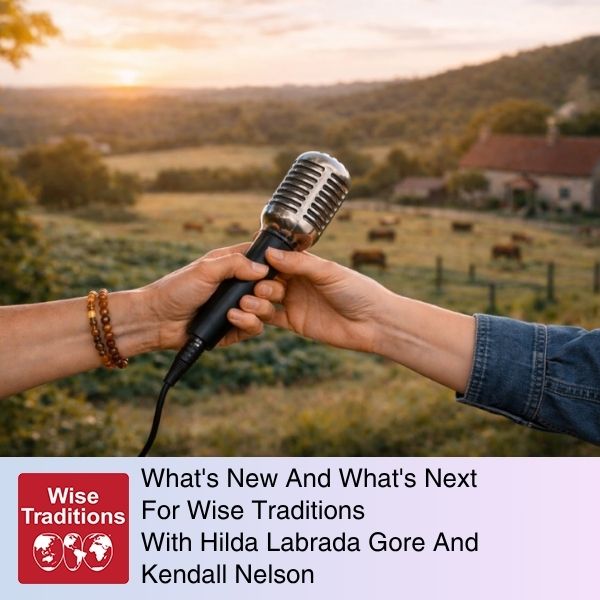
A pursuit of wise traditions may take you to Mongolia, Kenya, or to leave the podcast you’d been hosting and producing for over 10 years. On today’s episode, Hilda Labrada Gore, our podcast host and producer, passes the baton to Kendall Nelson, an award-winning documentary filmmaker behind The Greater Good and a longtime collaborator with the Weston A. Price Foundation.
Today, you’ll get to know Kendall as she and Hilda discuss what they have in common–like travels around the world and a passion for preserving ancient cultures and health traditions. They share what brought them to WAPF, insights they’ve learned along the way about wise traditions and what’s in store for the podcast.
Visit Hilda’s website: HolisticHilda.com
Visit Kendall’s website: GreaterGoodMovie.org
Become a member of the Weston A. Price Foundation
Check out our sponsors: Nutrition Therapy Institute and Oyster Max
—
Watch the episode here
Listen to the podcast here
Episode Transcript
Within the below transcript the bolded text is Hilda
Hilda Passing The Podcast Baton To Kendall
This is probably the most unusual episode I have ever recorded. A pursuit of wise traditions may take you all over the place to Mongolia, Kenya, or even to somewhere altogether unexpected. In my case, it is taking me away from the podcast altogether. This is episode 573, and our guest is Kendall Nelson. Kendall is the award-winning documentary filmmaker behind The Greater Good and a longtime collaborator with the Weston A. Price Foundation. I am also a guest, as well, because it is in this conversation that I passed the baton officially to Kendall.
She is going to be a wonderful person to take on this role, very well-equipped and well-suited. Together, we discuss our mutual travels to Mongolia, Kenya, the importance of preserving ancient cultures and health traditions, and what is in store for wise traditions. Kendall goes over what got her into this health and wellness space in the first place, and I share how I got here, too, and why. Though I am leaving the show, I am not leaving Ancestral Healthways by any means.
Before we get into the conversation, the Weston A. Price Foundation is working on a new initiative. It is a movie to highlight the importance of the work of Dr. Weston A. Price, particularly to address the fertility and chronic health crisis that is sweeping the United States. Go to Weston A. Price Donation to contribute to this wonderful new project and to support the film. It is time to get this health-saving and life-saving information out to the world in greater ways. Again, go to Weston A. Price Donation to contribute to this project. Thank you in advance.
—
Welcome to the show, Kendall.
Thanks, Hilda. I am so happy to be with you here.
I just realized that is probably the last time I am going to say “Welcome to the show.”
This is a big deal. Why are you leaving?
I have enjoyed being the podcast host for over ten years now. I love the Weston A. Price Foundation. There is no rational reason for me to leave. It has been a phenomenal journey. I have learned so much from Sally, from the people I have interviewed, from the travels and experiences I have had, but I had an a-ha moment.
This is probably about 6 to 8 months ago. I literally, Kendall, woke up in the middle of the night, and I had a flash of intuition. I am supposed to leave. I was even surprised because, as I said, “I love this thing. Why would I ever go?” I just knew it was the right timing. I have always been one to cultivate that inner knowing, that deep listening. I just knew it was what I was supposed to do.
Tell me, how did you start the podcast?
It is such a long story, but basically, I was a blogger back in the day. Someone contacted me. She was a friend of mine. She was in the publishing industry. I was like, “I am so excited. I am going to get my first book deal.” She literally said, “Your last post was horrible.” She said, “You wrote about sugar addiction. Obviously, you have never experienced that. You did not know what you were talking about. You can write from one of three perspectives. You can be a fellow struggler, where you are telling people I am in this fight with you.
I do not really have this all together, whether it is pickleball or eating or whatever, or you could be a signpost pointing to the expert, or you can be a sage.” She said, “You would be a great signpost. As a matter of fact, you should start a podcast.” That seed of an idea was watered when I had the opportunity to go to Kenya as a volunteer for the Weston Price Foundation.
Basically, in a nutshell, a Maasai warrior contacted the foundation and said, “Please send someone over, we are all getting sick.” He said, “I have diabetes, my wife has asthma.” He had witnessed the physical degeneration of his people in his tribe. He thought, “I can talk to them about how we need to return to wise traditions, but they might not listen to me.” I had the privilege to say, “Please do not eat the American way, eat your way.” It was when I was over there that I realized, “The Weston A. Price Foundation needs a podcast, and I would love to host and produce it.
It is amazing how things work out in life, isn’t it?
I know. Sally said, ” Yes, blows my mind. Now I was just talking about Kenya, but I know that you have been to Kenya and even Mongolia. I have been there too. Tell me what got you on all these travels in your place, in your situation.
Global Travels & Preserving Ancient Cultures
We have a lot in common. My background is in photography and documentary filmmaking. I have been invited to both of those places as a professional photographer and filmmaker. The Mongolia adventure was really exciting because I had just made a movie on cowboys called Gathering Remnants, and I actually spent years photographing cowboys.
Made a book about them first and then made a documentary on them. I hooked up with the Western Folklife Center in Nevada, and they were doing a cultural exchange where they were taking real working cowboys who were also Western singers, and they were bringing them to Mongolia on this cultural exchange, where we would meet up with the herdsmen who were throat singers.
They would do that incredible vocal type of thing, where it was like they would have their voices going. It was just amazing. We went on a huge journey across the plains in Mongolia, and we got to ride their ponies, listen to all of their stories, and learn about their cultures. We even got to share food with them, which was very Westin A. Price-ish, I must say.
Part of your mission, I understand, was that you wanted to help preserve traditional cultures. Is that right?
I was really interested in documenting cultures that are disappearing. For me, the cowboy was something that was starting to disappear, was starting to modernize, I should say. Some ranches were using ATVs or even helicopters. This was quite some time ago, but it was still rare twenty years ago to find a ranch where they were sleeping in cowboy teepees and eating off a chuck wagon.
I was really interested in documenting cultures that are disappearing. For me, the cowboy culture was beginning to modernize and fade away.
Some of the guys were sewing their own clothes, and the ranches were really remote. I went to the farthest ends of Nevada and Idaho, and these sorts of places, to find these cowboys. When I got to go to Mongolia, it was even more of a traditional lifestyle. There I was drinking fermented mare’s milk and eating lamb. It was one of the most amazing experiences of my life.
It was much like you said. The Mongolians are characterized by incredible hospitality. The country is one of the most sparsely populated places in the world. Yet, maybe because of that, they open up their yurts or gurrs to anyone passing by. I went to Western Mongolia and got to be with some Kazakh eagle hunters. Their food was so traditional and nourishing. Suddenly, I understood why Genghis Khan was able to expand the Mongolian empire because they had resilience from their nourishment and from their environment, which was really something to behold.
That is one of the things that our cowboys, who we brought over to Mongolia, were amazed by, which was that they are the descendants of Genghis Khan. They are hearty and healthy, and life is hard. It is harsh in Mongolia, and you are nomadic, and you are picking up your gear, and you are moving from one place to the other with your livestock. Our cowboys were completely amazed at the fact that these small ponies could go the distance and not only go the distance, but really thrive and just at the ferocity of the people. They were absolutely healthy and happy.
I remember riding behind one of the Kazakh Eagle Hunters. I think his name was Oscar, or his family’s last name was Oscar. I remember riding behind him on a horse, and we were traveling along, and he started whistling, and he was just whistling, not to impress us, not to teach us a little song, because he was just content. That is what Sally always says. She says, “Real food makes you high on life. There is this natural joy that bubbles up.” Speaking of Sally, I want to ask you, Kendall, how did you first come across the Westin A. Price Foundation? You were an author, photographer, and filmmaker. How did you get involved with us?
Kendall’s Introduction To Weston A. Price Foundation & Vaccine Documentary Work
I was a filmmaker, and I was doing all kinds of different things, none of which involved nutrition. I met Leslie Manookian, who now runs Health Freedom Defense Fund. We have become absolute dear friends. We decided to make a documentary about vaccines together. We made The Greater Good, along with our partner, Chris Pallaro, who has since passed away.
The three of us made an incredible team, I thought. We spent quite a bit of time going around, and we interviewed both the pro-vaccine side and the vaccine awareness side, and we made this movie. That was really my introduction to Western Price through Leslie. She was a chapter leader here in Idaho at the time. She was helping the foundation out with their action alerts.
Every year, many bills are either pro-freedom or not pro-freedom, and some support our views as the foundation for vaccines, while others do not support the views. She was writing action alerts. If you were in DC and there was a bill that needed a call to action that would be sent to you, and you could call your congressman and let them know your views. I took over that job from her, and that got me involved in the foundation.
What was your background when it came to vaccines?
I did not have any background with vaccines before I met her. I was brand new to the subject when I went to make the documentary, and I got an education very quickly.
Tell me, for the person who maybe is like you were back then, Kendall, what surprising fact did you learn that kind of made you think, “I need to reconsider how I perceive vaccines and their efficacy and safety?”
Honestly, they are defective by design. When I say that, I mean that there are no randomized, double-blind, placebo-controlled studies. When you have a vaccine and you want to get it approved, it is not the FDA that does the studies. It is the vaccine manufacturer that does them. They do not have to use an inert placebo. They are allowed to put aluminum in it and all the other toxic adjuvants that go into vaccines.
Instead of using an inert placebo that is made out of saline or something and studying two separate groups, one that gets the vaccine and one that gets the true placebo, they are allowed to use another vaccine in that placebo group, or they are allowed to add these adjuvants to that group. The truth is that not one clinical trial studying the safety of vaccines has ever used a placebo for infants or toddlers. It is just mind-blowing, I must say.

It does not make any sense. It is the opposite of a controlled, double blind placebo study. As you are saying, it is as if I were trying to study what harm this chewing gum does. One group is chewing gum, and the other group is supposed not to chew gum, but they still have some. It is like you are comparing things that ruin the study.
It does not make any sense. It certainly does not stand up to the gold standard of science. It is loony, really. Once I learned what is in a vaccine, I really had a hard time with the fact that there are things like mercury, aluminum, polysorbate 80, or foreign DNA and proteins in vaccines that we are injecting into our children. Let us put it this way. You would not put what is in a vaccine into a baby’s bottle and let them drink it. If you are injecting it, it is worse than ingesting it.
Admiration For Sally Fallon & WAPF’s Brave Stance
Powerful words. That is really a lot to think about. When I first got involved with the foundation, I did not know that much about vaccinations either. This is to Sally Fallon Morell and the foundation’s credit that, as a nutrition-focused group, they would stick their neck out about other things that the body takes in. I have always admired that about them.
I admire that so much. I cannot think of another group that dared to do it the way that Sally did. Of course, Children’s Health Defense and stuff, they have come out since, but Sally has been there from the very beginning and just been incredibly brave in putting out what she believes to be true. I love that about her.
Me too.
Lessons Learned From 10+ Years Of Podcasting
You obviously have learned a lot from doing the podcast. You have done this now for ten years. Is there anything that comes to mind that you would like to share with the audience?
You are asking me to walk down memory lane, and ten years is a long time. We launched in January 2016, and so it has been over 500 interviews, because some I conducted never even got published. I will say, Kendall, honestly, from every single guest that has been on the show. There is always something you can learn, actually, from anyone you encounter.
Of course, I got inspired by Dr. Price’s own travels to travel the world. It started out, I was in Kenya, of course, and like you, I want to preserve traditional cultures, and I have come across traditional peoples in Ethiopia, in Australia, all over the place. Many of them have one foot in modernity, just as Dr. Price noted 100 years ago, one foot in the modern lifestyle and dietary choices, and one foot in their traditions. I will never forget sitting in Kenya, and this was on my first visit. I was in Dickson Ole Keis’s house, and there was a relative of his, and she was wearing her beautiful Maasai beaded necklaces, earrings, and colorful clothing.
In one hand, she had a chai tea and in the other a white bread jam sandwich. I was like, “No.” I was happy to bring the message to please eat your traditional diet. Do you know that by the end of my visit, the pastor got up in front of this little congregation that they had in the village, and he said, “Starting today, the women will cook our traditional foods.”
What about your favorite episode? Do you have a favorite episode?
Favorite Interviews & Holistic Lessons
This is like asking a mom, “Who’s your favorite kid, right?” It is really impossible, but I do want to back up and share a favorite interview that I conducted that was never aired. It was with an elder in Dixon’s community in Kenya in 2015, because I had not started the podcast yet. This man came walking up to where we were, just using a walking stick. The people around me told me he did not know how old he was. He was nearly a hundred. Yet he was coming up to where I was under his own auspices. I thought, “I need to learn from this man.” First of all, when I said, “What did you eat as a child?”
He is like, “Whatever we could catch.” The Maasai are herders. Obviously, they are nomadic, but they have their goats and their cattle, and they hunt for their food. They use the cattle for the milk and the blood, really. They only slaughter them on special occasions. He said, “Yes.” It was whatever wild game they could catch and maybe some honey and some wild berries, but that was it. That was the diet. I said, “What did you do when you got sick?”
This elder said, “We never got sick.” I was astounded. I had to have him repeat himself. He is like, “We never got sick. If we ever felt like a shiver coming on, we would drink milk from the cow.” He demonstrated drinking it straight from the udder. I was like, “Wow.” Talk about wise traditions, right? I said, “What has made the difference?” He has seen his own village also deteriorating in terms of health.
He said, “It used to be, we would just eat whatever we could catch and all these things.” They say, “Disease is coming. You need shots, but we never had shots. Now they say the cold is coming, and you need jackets. We did not have jackets.” I said, “Why have things shifted?” He said, “Education.” Again, I was shocked because this was the beginning of my education, Kendall, that what children and what all of us learn in school and in our culture may be off base.
It may actually be removing us from our traditions. No wonder we are so lost and confused because we are being told one thing in the classroom and another when we get outside of it. That reminds me to answer your question. One of my favorite interviews was with Allan Savory. Allan Savory was a wildlife biologist from Zimbabwe, formerly Rhodesia. He studied how to protect the environment in a classroom.
When he got out into the wild, and they started assessing, he with some other scientists and so forth and biologists, they were like, “The elephants are stampeding everything. We need to cull the herd so that they are not damaging the environment.” They all decided together. They culled thousands of elephants. Do you know it did not restore the land one bit? Allan was like, “That did not work. What are we doing wrong? What are we missing?”
He started studying the land, and he came up with this whole holistic management approach, knowing that when you do something that is good for the land, it is good for the animals and the people and the economy and all the things. Do you know the other people, the other scientists or biologists, who gave him a hard time, and everyone was mad at him? This is the man who culled the elephants. I will never listen to him. He turned, he changed.
True learning and true science are the ability to do that. I always listen and interview. I am getting choked up now as I am telling you this, but it is true. I always listen very open-mindedly because if I come into an interview or conversation with a preconceived notion, I am not going to learn a thing. I have closed myself off to something that may be valuable. I always come in open. I loved talking to Allan Savory. It is really hard to leave, but I know it is what I am supposed to do because, as you may have guessed, I am a person of faith, and I do believe that if God calls, you have to answer like “Here I am, send me.”
If I am outside of the center of God’s will, I am blocking something that is supposed to happen. You, Kendall Nelson, are supposed to take this baton and run with the show, and you were supposed to do that, and I am supposed to do something new. I do not know what that is going to look like yet. The foundation is one of the best groups I have ever come across because they are committed to what is true, not what is hip, not what is trendy.
In particular, I will say that is what blesses me about Sally. She is a woman of tremendous conviction. She has always said to me, “I do not care about being relevant. I want to be right.” I am like, “Good for you. That is why she always brings the research that backs the ancient wisdom.” She is about research, education, and activism. This woman is just unflappable. She really is my hero.
She was fighting the diet dictocrats before anybody else was. She was saying, “Let us go to the past for good health today. She was all about butter and bone broth and ferments.” Now you can walk into Safeway, and there is kombucha. I am like, “What has happened? This whole MAHA movement is riding on the coattails of Sally Fallon Morell and the Weston A. Price Foundation.” What do you think, Kendall?
Lessons Learned From Sally Fallon and WAPF
You nailed it. I, too, love Sally and the foundation. I was going to ask you that. I was going to ask you what you have learned from Sally specifically. Maybe there is one more thing you can think of that she specifically has taught you.
It really is. I would say that you have to be grounded to be able to move anything forward. I used to come into staff meetings in my excitable way and say, “We need to do this.” I would get so excited, and Sally would be almost like a brother first. I was like, “What is happening? Why is she so calm?” That is a tribute to how well nourished she is that she has faced her hurdles, and so has the foundation.
There have been little blips and things, and she gets attacked and put down, but she remains slow and steady. Why? It’s because she is grounded. She taught me, actually, that bone broth, even specifically, if you have got nervous energy, it will bring you down to a healthy, regular energy level. If you have low energy, it will bring you up. It is like a great regulator because of the glycine and other components in it. Bone broth has helped Sally Fallon Morell and me.
It’s fabulous.
I was just going to say, I love that you have been in service to the foundation and that you and I have so much in common. We are both communicators. The fact that you made that cowboy movie, yes, but also the greater good, you have reached millions of people with information they would not have otherwise had. I feel so confident handing over this show to you because you know the value of communicating in a way that will make people sit up and listen. You are going to be a wonderful host of the show and producer. Tell me what you are looking forward to as you take over Wise Traditions.
Kendall Nelson’s Vision For The Podcast & Upcoming Film
So sweet, Hilda. Thank you. Honestly, I am really interested and looking forward to the fact that I get to expand. I have been the vaccine consultant for Weston Price. I have done their action alerts. I have written articles for them in each journal, but I have been in my lane, and I am ready to expand and be about, learn about food farming and the healing arts.
I have been in my lane, and I am ready to expand and learn about food, farming, and the healing arts.
Talk to us about this movie that you are going to make.
I am really excited about this as well. Both the podcast and the movie are going to blend so well together. Sally has asked me to make a documentary film about the Weston Price Foundation, about the work of Dr. Weston Price. It is going to be a character-driven film, similar to The Greater Good. We might meet a character who, for instance, let us just say a girl in Brooklyn. She has every health problem that you can imagine until she finds the Weston Price diet.
Maybe we meet somebody who is living the perfect farm life. They have their children on the farm, and they are collecting the eggs in the morning, and they are drinking their raw milk, and they are growing their own beef, and they are doing everything right, and they have a certain perspective. Life is hard, but it is worth it. We also want the film to largely encompass the fact that we have a fertility problem.
Maybe another couple that we meet is going to be a couple who is having trouble getting pregnant until they find the value of vitamin A and they find the Weston A. Price diet, and we watch them get pregnant and have a beautiful, healthy baby. That is what the film is really going to be about healthy babies, healthy children, healthy families.
My dream is to have it be character-driven and also to really spend a lot of time and get to know these characters that we choose, but also to follow in the footsteps of Dr. Price. He traveled the globe, and I could see us going to places like the small Swiss village, going back to Kenya and being with the Maasai, and going to these various places and figuring out, is there a place that is still eating an ancestral diet?
Even if we do not find the perfect situation where they are eating the ancestral diet, we are going to find the elders who remember, and they can tell the story. They can tell what has changed in their villages and stuff. I think the film is going to be an incredible educational tool. It is also going to be a beautiful film that you cannot take your eyes off. It is going to be mesmerizing and teach you something at the same time.
I love that entertaining and educational. It sounds quite ambitious. How is the foundation going to afford this baby?
We are starting to fundraise. If there is anybody out there who wants to get in touch with the foundation and help support the film, that would be wonderful. We are looking to do a campaign where we are going to fundraise. Everybody should just be on standby because that is coming pretty soon.
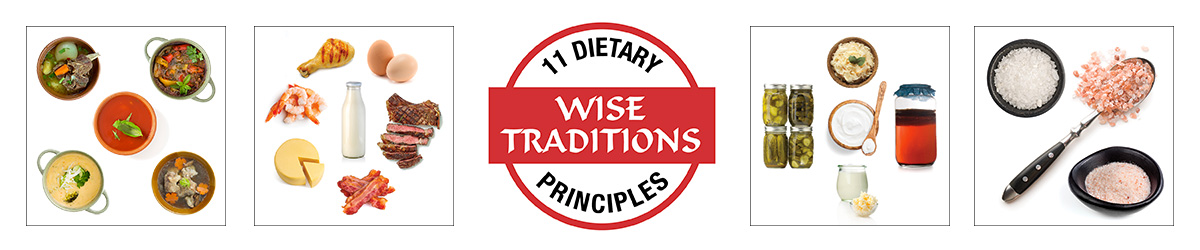
I bet you by the time we air this, we can put a link in the episode description so people can know exactly how to contribute because something of this scope is way overdue, Kendall. It is way overdue. It has been nearly 100 years since Dr. Price did his fourteen indigenous people group study and visited the ten countries around the world and stuff. This is going to be a phenomenal project. What I really like about the fertility emphasis, too, is that of the eleven dietary principles, number eleven is the one that has to do with preparing for pregnancy and future generations. Dr. Price noted that in his travels, did he not?
Yes. That will be a big part of the film, both men and women, what should they be eating prior to conception? What should they be doing? What should their healthy habits be? Of course, once they get pregnant, what should they be eating? What should they feed the baby afterwards? This will all be part of the film, and it will all tie beautifully to what Dr. Price was finding. When he found the healthy cultures, basically, we are going to be teaching the same thing.
I love it so much. It is very bittersweet for me to have to ask for the last time, the question I like to pose at the end. Again, I just want to say, Kendall, I think you are the perfect person to take the reins of the show. You are so good at researching. You are a brilliant mind. You understand communication using the tools of media. You are just going to be phenomenal. I am really thankful that we are going to stay friends and connected, of course, but also that you are going to serve the foundation in this way. I invite people to stay tuned, to be a part of the journey as you continue to lift up wise traditions on all these different platforms.
We are going to be really excited to follow you and see where you go. You have been a terrific mentor for me, and I admire you so much. I have got some big shoes to fill, but I am going to do my very best.
Final Reflections & Health Advice
You will do great. You forge your own path, baby. I am with you all the way. Kendall, I want to ask you the question I love to pose at the end. If the audience could just do one thing to improve their health, what would you recommend that they do?
That is a tough one. I am going to go with gratitude. If you have a gratitude practice, it makes for such a healthy spiritual life both spiritual and physical life. I saw something the other day that was a meme, and it said something about, if you are watching the media all the time, it does not matter whether it is alternative media or mainstream media or whatever it is, it is easy to fall into that trap of the doomsday.
A lot is going on in the world, and it is not such a beautiful world. If you can tune that out and actually get outside and look around, it is obvious that it is a beautiful world. Everything about it is beautiful. If you can have a gratitude practice and maybe even keep a little journal about the things that you are especially thankful for, it will really lend to being healthy.
I do that too. I have a gratitude journal, and it really helps me focus on what is beautiful and true and good.
Hilda, I would be remiss if I did not ask you the very same question. What would your answer be?
I would say that we should, or I recommend that we follow the sun in more ways than one.
Beautiful.
Kendall, I am so glad we had this conversation, and I am grateful that we are in this beautiful life together. I just want to thank you on behalf of the Weston A. Price Foundation for being who you are and taking up the reins of this wonderful show. Thank you.
Thank you, Hilda.
—
Our guest was Kendall Nelson. Check out her website, The Greater Good Movie, for information. I am Hilda Labrada Gore, the host and producer of this show, or at least this last episode, on behalf of the Weston A. Price Foundation. You can find resources and updates from me at Holistic Hilda. For the transcript for our episode, visit our website, Weston A. Price, and click on the podcast page. That’s it. It’s a wrap.
I am leaving this show, but I leave you in good hands. Kendall Nelson is experienced, professional, kind, compassionate, and curious. She is going to lead well and continue the tradition that we have of amazing, knowledgeable guests and lifting up content that is health and life-saving. Stick around with Wise Traditions, and until I see you again, stay well, my friend, and remember to keep your feet on the ground and your face to the sun.
About Hilda Labrada Gore
Hilda Labrada Gore, known as Holistic Hilda, is the Lead Brand Ambassador for Birthright animal-based supplements for women. She equips moms and children to cultivate endless energy and vibrant health through the Mother Code course and additional resources found on her website: holistichilda.com. She recently launched her @holistichildakids account on Instagram so that children can learn how fun and freeing a healthy life can be! She’s also on Instagram @holistichilda. Hilda is a world traveler, a popular speaker, and a tireless advocate for ancestral health traditions. She has energy to spare because she keeps her feet on the ground and her face to the sun.
About Kendall Nelson
Kendall Nelson is an award-winning documentary filmmaker with more than three decades of experience directing, producing, and distributing media that matter. She is the producer and host of the Wise Traditions podcast and a longtime collaborator with the Weston A. Price Foundation, where she serves as the Foundation’s vaccine policy expert, writes for the Wise Traditions journal, and is an honorary board member.
In 2011, Kendall directed and co-produced The Greater Good, a documentary seen by more than 20 million people worldwide that brought national and international attention to the vaccine debate. Having traveled the world as a photographer and filmmaker, her work reflects a lifelong commitment to health freedom, real food, simple living, and thoughtful inquiry, bringing clarity and balance to conversations that support families and human flourishing.
Important Links
- Kendall Nelson
- Weston A. Price Donation
- Holistic Hilda
- Weston A. Price Foundation
- Allan Savory on Facebook
- The Greater Good Movie
Episode Sponsors
🖨️ Print post
Ugh how did I miss this? Come back!
So sorry you’re leaving, Hilda. You will be missed. Really loved your upbeat, easygoing approach. I hope that Kendall will do this podcast justice, but we will miss you!
UGH! I wasn’t keeping up with my podcasts after having my baby in March. Suddenly Hilda was just gone! Come back!