





 🖨️ Print post
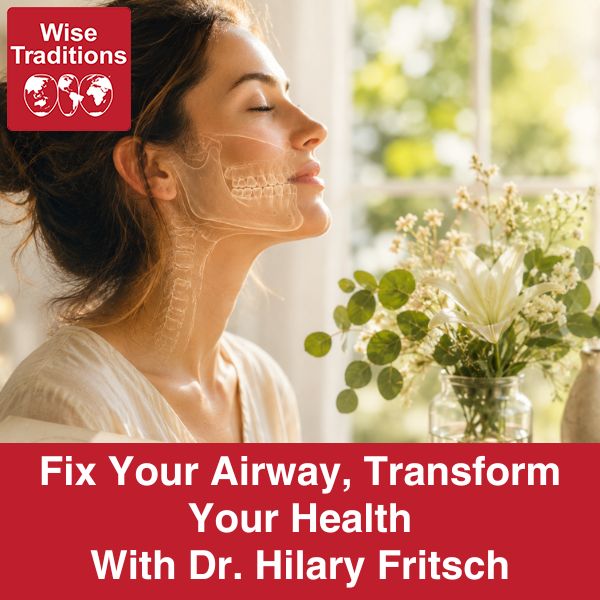
What if the shape of your jaw—and the way you breathe—could affect everything from your sleep and energy to headaches, hormones, and overall health?
Dr. Hilary Fritsch is a biological and airway dentist whose own health struggles led her to question much of what she had learned in conventional dental school. Her search for root causes led her to discover the profound connections among nutrition, jaw development, nasal breathing, sleep, and whole-body health.
In this episode, Hilary explains what airway dentistry is and why she believes the work of Dr. Weston A. Price is foundational to understanding the narrowing jaws and crowded teeth so common today. She reveals how an underdeveloped palate and mouth breathing can contribute to disrupted sleep, teeth grinding, TMJ problems, headaches and fatigue in adults—and hyperactivity, bedwetting and restless sleep in children.
We also explore the importance of breastfeeding and nutrient-dense foods for healthy jaw development, orthodontic expansion and myofunctional therapy, as well as Hilary’s concerns about fluoride, mercury fillings and root canals. Plus, she shares what to look for in a biological or airway dentist and the simple habit she believes almost everyone should prioritize: breathing through the nose.
WAPF Ad: Get your free WAPF info pack. Go to westonaprice.org and click on the “free info pack” button.
To learn more about Dr. Hilary Fritsch, visit @drhilaryfritsch on Instagram or her website at https://saddlepeakdental.com/
Join the Nourishing Our Children closed Facebook group
Check out our sponsors:
MASA CHIPS: Visit https://www.masachips.com/WISETRADITIONS and use code WISETRADITIONS for 25% off.
GODDESS VITALITY FROM OPTIMAL CARNIVORE: Visit www.amazon.com/optimalcarnivore and use code WESTON10 for 10% off.
—
Watch the episode here
Listen to the podcast here
Episode Transcript
Within the below transcript the bolded text is Kendall Nelson
Hilary’s Journey From Traditional Dentistry To Root-Cause Healing
What if crowded teeth, small jaws, mouth breathing, and even poor sleep aren’t simply problems to manage but signs that our faces and airways aren’t developing the way they are meant to? This is episode 606, and our guest is Dr. Hilary Fritsch. Hilary is a Biological and Airway Dentist whose path into this work began with her own health struggles. As a child, she had crowded teeth, difficulty breathing through her nose, chronic fatigue, headaches, and fragmented sleep.
By dental school, her health had deteriorated dramatically. She was diagnosed with an autoimmune condition. At times needed a cane because of severe back pain, and even took her dental boards wearing an eye patch because of inflammation affecting her vision. She was told her condition was genetic and that medication was the answer, but she began searching for a deeper explanation. That search eventually led Hilary to Biological and Airway dentistry and to the work of Dr. Weston A. Price, whom she calls her hero.
She believes Dr. Price’s photographs and research offer important clues to understanding why so many people have narrow faces, crowded teeth under the jaws, and difficulty breathing through their nose. In this episode, Hilary explains what airway dentistry is and why the size and shape of our jaws can affect more than our teeth. We talk about mouth breathing, sleep apnea, teeth grinding, TMJ disorder, headaches, fatigue, and some surprising signs of poor sleep and compromised airways in children, including hyperactivity, bedwetting, night terrors, and restless sleep.
We also explore how nutrition influences facial and jaw development, why breastfeeding and proper tongue posture matter, and what parents can do early in a child’s life to encourage healthy development. Hilary explains why she believes Dr. Price’s observations about traditional diets are just as relevant today, and why returning to nutrient dense foods, including raw dairy and organ meats are a big part of the solution.
We go beyond airway health to discuss biological dentistry, including Hilary’s concerns about fluoride, mercury fillings, and root canals, how she uses ozone in her practice and what to look for if you’re searching for a biological or airway dentist. Before we get into the conversation, I want to let you know the Weston A. Price Foundation offers a free info pack that gives you background on the foundation.
Along with our most popular brochure, Timeless Principles of Healthy Traditional Diets. You’ll see pictures taken by Dr. Weston A. Price and guidelines for living according to Wise Traditions. To get your free info pack, just go to Weston A. Price Foundation and click on the Free Info Pack button. Now, let’s welcome Dr. Hilary Fritsch.
—
Hilary, welcome to the show.
Thank you so much for having me. I’m super honored to be here. Weston Price is my hero. This is a big deal.
I’m honored to have you on the show. Hilary, before we get into airway dentistry, which is what you specialize in. I want to understand how you got here. You’ve talked about having sleep apnea as a child and later becoming so ill with an autoimmune condition that at one point you struggled to see and even walk. Can you take us back to what happened to you? Maybe paint us a picture of going to dental school. At what point did you realize that it wasn’t the whole health picture that you were being taught in dental school?
I knew that in my gut all along, but I was deep in the system and trying to live that world during dental school. I was told that I have an autoimmune disease. It’s genetic and there’s nothing I can do about it. These are the drugs I need to take. Meanwhile, the stress of school and me not taking good care of myself was causing that flare-up in my eye. I had to take the dental boards with an eye patch, and the pain in my back was so bad. I was using a ski pole as a cane at times.
I’m the type of person that just gets it done, like limping through it. I remember my dad being like, “You need to start taking better care of yourself.” I was like, ” Dad, this is what they’re teaching me. It’s genetic,” but I knew that he was right. I finally came around to that where I wanted to get pregnant after dental school and didn’t want to be on any medications. My sister had gone gluten-free and I knew I needed to heal my gut.
I started to take all the steps to get off of those medications so that I could get pregnant safely. That was the beginning. I always knew. There’s got to be a root cause for this flare-up. I was being like, “Why do I have this autoimmune disease? I know it’s genetic, but what turned it on?” There was an awakening as I started to heal myself and work through my gut issues and get the inflammation down, that we could do things a different way.
I had to get out of my traditional dental school mindset and think of a more root-cause approach. That was the beginning of me looking at airway and biological dentistry. It took a long time to find the right people, the right mentors, and the right answers on how to do dentistry and take care of myself in a different way.
Understanding Airway Dentistry And Facial Development
You said that Weston Price is your hero. Tell me a little bit about that. What do you know about Dr. Price?
I just feel that he is a father of biological dentistry and airway dentistry because when I started looking at biological dentistry, it was like nutrient-dense foods and healing the body with what you eat. Sleeping and breathing well, and getting down to foundational stuff. He was the grandfather of that whole way of thinking. Airway dentistry is completely his work, like jaw development, why our faces are changing, what’s causing us to not be able to sleep and breathe well, why don’t we have enough room for all of our teeth and why does everyone need braces. That’s everything in that is Weston Price. Starting to dial it back to foundational stuff, he was the hero of all of that work.
You go to a conventional dental school and then you realize that maybe you have an interest in more biological dentistry and airway dentistry. How do you make that leap?
It’s scary because in traditional dentistry, we don’t talk about nutrition, sleep, and breathing. We don’t talk about any of the toxins that we use in dentistry. To take a step outside of that and be willing to go in a different direction, took me finding the right people to hold my hand. Dr. Chris Hahn that works with me was foundational. He’s from Germany originally. He’s older than me, too. He had a little bit more strength to be like, “This is okay to look in this direction. Here’s the people that can teach you.” That was the path that I went down. I just kept finding the right mentors ahead of me so that I didn’t feel like I was taking chances and straying from my dental field completely on my own.
You had mentors, but if somebody wanted to go into this profession, are there schools for biological dentistry and airway dentistry?
They do not teach biological dentistry or airway dentistry in dental school. I heard Tufts is now teaching some airways. I think that’s going to change. Biological dentistry is the future of dentistry. Patients are going to want non-toxic dentistry and they’re going to want a root cause approach. The whole field will move in that direction very slowly. Everything takes 50 years longer than it should. There are people that you can go and train with.

There’s Dr. Dome Nischwitz. You’ve had him on the show. Judson Wall in Utah is good. I trained with the BioDentist down in Colorado and Judson Wall. There’s a handful of people in biological dentistry that know what they’re doing and are out there teaching. You just have to find them and go train with them. Airway was even harder, honestly, to find the right people, because there’s all these different schools of thought about how it should be done.
That part took me like ten years and half a million dollars in CE to find the right people and get trained on, like, “Here’s the finish line. This is what an ideal airway structure should look like. Here’s how we’re going to get there. Here’s how to back up the nasal breathing habit afterwards.” It was complex to find the right answers. One of the reasons I’m teaching airway dentistry now is because I want to make that easier for more doctors. We should be doing airway dentistry in every single dental practice in the country. The American Dental Association thinks so too.
In 2017, they mandated that all dentists evaluate airways, but nobody’s doing it because they don’t know how. One of my goals is to awaken people so that they realize that this is an option. When patients go to the dentist and ask for it, it will start to push the dentist to get trained. There’s also a lot of dentists like me that want to do a more root-cause approach and they see that there’s a problem here. They just don’t know how to fix it. That’s a fun, fulfilling way because every patient in this country needs their airway evaluated. If we only have half a dozen of us that know how to do it, it’s going to be hard to take care of everyone.
I have to confess. I had never heard of airway dentistry before I started doing research for this episode. Can you go into a little bit more depth about what airway dentistry is? Is it different from biological dentistry? Maybe describe the two.
I feel like they overlap a lot. Airway dentistry is mostly using orthodontics to restore the jaws. One of the things Weston Price discovered was that traditional diet went to a modern diet. In one generation, we had proper jaw development. We went from room for all the teeth to crowded teeth. When we have crowded teeth, that means that we don’t have enough room for our tongue, which means our tongue has nowhere to go but back into our airway. This is why everybody has apnea, because every human is affected by this jaw development issue at this point.
We’re many generations now into a modern diet. Airway dentistry’s focus is using orthodontics to rebuild the jaws. I find that fascinating because, as a dentist, I never thought that I would have this impact on people’s lives, but we are the only profession that’s capable of restoring the jaws. Your ENT can’t help you with that. They can take tonsils and adenoids out and improve your nasal volume, clean up your sinuses. Lots of amazing things, but they cannot help you rebuild the jaws. That’s airway dentistry.
Biological dentistry overlaps with that because in biological dentistry, we take a root cause approach, like, why is this person getting all these cavities? The first biggest reason is mouth breathing. When we breathe, our mouth dries out. We don’t get the neutralizing effect of saliva. The environment gets acidic. If you’re a good biological dentist, you should be looking at mouth breathing on everybody. If that’s the case, that we’re mouth breathing, then we step into airway dentistry. Why are we mouth breathing? How do we treat that?
The roof of the mouth is the floor of the nose. If a patient has a high vaulted palate, it’s going to change the volume of the nose, shrinking it vertically and horizontally. The palate shape impacts our nasal breathing. The tongue posture impacts our nasal breathing and the structure of the jaws. All of that compounds on itself to send you down this airway pathway if you’re going to do root cause biological dentistry.
When you look at pictures that Dr. Price took in the 1930s. You see the big, beautiful jaws and straight teeth. What are you seeing that most people looking at those photos probably wouldn’t notice?
Those pictures break my heart because I feel like, how could this entire race of humans not develop the faces that they were meant to have? I see so many things. I see we don’t have the cheekbones that we were meant to have. We don’t have the jawline that we were meant to have. We don’t have straight teeth. We don’t have room for all of our teeth. When we smile now, we have what we call dark buccal corridors where we have dark triangles in the corner because the arches are so narrow.
When those people smile, it’s like teeth from corner to corner. I see a big, wide palate. I see room for their tongue. I see usually healthy teeth too because they’re not getting cavities and their diet was so nutrient-dense that they also weren’t getting. It’s not just the mouth breathing, but they also had strong teeth. I see people that can breathe through their nose. I see people that can sleep well at night. I see people that are getting nitric oxide, enough oxygen, not having these hypoxia issues.
It’s like the downstream effects of mouth breathing. It lowers IQ. It leads to Parkinson’s, dementia, diabetes. All of these health issues that we struggle with, all are affected by an inability to breathe well through your nose and have enough room for all your teeth and your tongue. To me, it’s wild to think that our health is impacted so much by what’s happening right here.
Childhood Mouth Breathing And Chronic Health Struggles
We started the interview talking about your own personal health and how you got sick during dental school. Did that have to do with the development of your palate, of your jaw, of your sinuses? Was that related?
I think so, because I grew up with crowded teeth. I luckily had a dentist who was brave enough to try some stuff to get me expanded but it was definitely not enough. I still had a five-year-old and because of that, I had a high-vaulted palate. I could not breathe through my nose. My whole life, I was a mouth breather. That meant that I was getting fragmented sleep. As soon as you open your mouth, your tongue can fall back and close off your airway. Which you maybe won’t have apnea, but you’re going to have to do little micro-arousals all night to save your airway and get the oxygen back.
Those micro-arousals will affect growth hormone. I was like little. It took me forever to grow. I was tired all the time. I had chronic headaches and stomach aches. I was a figure skater. Every afternoon, my figure skating coach would have to buy me a Coke so that I could get through my practice. I didn’t know why I felt like that. I just thought maybe there’s some magic in this Coke. Looking back, I was so tired. I was getting fragmented sleep. Decades of that.
By the time I was in dental school and I was like 23, it was starting to catch up with me. This autoimmune disease came on. When I was in college, I started to get symptoms for the autoimmune disease. I think it was because my system was way overtaxed with the depletion of poor sleep and then all the things that I was achieving in life. I was compensating well, but it was taking a toll on my body.
Let’s go back to your dental school and what you were learning there. What are some of the things that they are teaching that you are opposed to?
Instead of looking at mouth breathing for one, they’re just like, “Let’s give everyone fluoride,” which I’m completely opposed to. It lowers IQ at any level. We have good research on that now. I don’t know why we are putting fluoride in the water without people’s consent and then putting them on high doses of fluoride instead of being like, “Are you mouth breathing at night?” That is way more important to treat than the MOD filling on number 29. That’s not going to change their life but if we can get them nasal breathing at night and sleeping better. They’re missing that big time.
They don’t know anything about tongue space. Inadequate room for the tongue means the tongue has nowhere to go but back into the airway. That’s a big piece that they’re missing. They talked nothing about nutrition. I don’t remember. Maybe Weston Price was mentioned in dental school, but I learned about him afterwards. We didn’t talk about jaw development. We didn’t talk about nutrition and the dangers of fluoride and mercury.
We were placing mercury fillings in dental school and drilling them out with no protection. To me, it’s very old-fashioned. If it were stuck a hundred years ago, maybe they’d be talking to Weston Price. It’s stuck somewhere between the brilliance that he had and us getting into this faster type of dentistry where it’s like, “How do we do crowns, root canals, fillings, and cosmetic stuff?” How do we make it easy and simple for everyone instead of, like, “How do we dial it back to the foundational stuff, healthy, just choices for patients?”
In your practice, you see a lot of people that come in that need help. You talk about orthodontics. What are you doing for people to help them expand their palate or to be able to breathe better or to cure their sleep apnea? What’s the process?
It depends on the patient. Basically, we need to see if they need their palate expanded. For kids, we can use a few different types of tools. There’s removable appliances. There’s a brand called Toothpillow that a lot of people know. It’s a guide that helps them breathe through their nose at night. It pushes the tongue to the roof of the mouth and helps the jaws develop as they were meant to. We can also do fixed expanders where we glue an expander in and turn the key. That widens the jaw incrementally daily.
We can do removable expanders. In my practice, I have a non-surgical approach. There are surgical ways to do expansion, but I use a non-surgical expander. It’s a removable retainer for adults that you put in and turn the key. It pushes on the bone to remodel the bone so that we can change the architecture of the palate.
The Power Of Tongue Posture And Myofunctional Therapy
Even as an adult, your bones can change and can widen. There seems to be a craze for trying to have a certain aesthetic. A certain look to the jaw. I believe there’s something even called mewing. What is that?
Mewing is basically myofunctional therapy. Myofunctional therapy is PT for the tongue and the lips. It’s a way to train the body how to put the tongue in the right spot and get the tongue nice and strong. When we have the tongue suctioned to the roof of the mouth, its job is to be the architect of the face. It’s like the tool that helps us grow forward and wide. When we mew too, it’s a way to suck this tissue up because you’re lifting everything and putting it up on the palate.
It became a craze with kids to teach them how to have a good tongue posture, but they also realized that makes them look good. In a way, I love it because it brought so much awareness to tongue posture and the power of the tongue and what happens with jaw development. A lot of times, it’s happening in teenagers and it’s a little bit late. We need like two-year-olds to be using good tongue posture and breathing through their nose.
What is good tongue posture? Where should our tongue be in our mouth the majority of the time?
You want the tip of your tongue to be on the incisal papilla, which is that little bump in between your two front teeth. The rest of your tongue should be sectioned up against the roof of your mouth. If you close your lips and swallow it, you should feel your tongue seal up against the palate. That’s what it should be, gently pressing the whole palate and fitting within the teeth. As most people’s tongue doesn’t, it overflows onto their teeth.
That’s an indication that you have improper jaw development and not enough room for your tongue. If you look at babies, they should have it suctioned up like that. It can do its job as the architect of the face and then also do its job as gauge retainer. After we do all this orthodontics, I want to know that your tongue is going to hold what I do, even though I’ll make a retainer just in case. It’s meant to also balance the forces. The lips and the cheeks are pushing in and the tongue is pushing out, so it’ll maintain everything that we do.
You mentioned babies. When we spoke earlier, you talked about babies having sleep apnea. How is that possible?
I know it’s sad. It’s because of epigenetic changes since baby formula came out. That was a huge one and the lack of nutrient density in our food. We’re now many generations in and each generation has gotten worse and worse. We’re at the point where 99% of humans need jaw development help. These babies are born with jaws that are too small and a tongue that can’t suction to the roof of their mouth and their mouth breathing. When they’re mouth breathing, they develop apnea.
If your jaws are too small and you’re breathing through your mouth, your tongue is going to fall back and cause apnea, even in a baby. It’s heartbreaking because I get DMs from parents every single day, like, “Can you help me? My kid has this problem. I don’t know what to do.” We can’t intervene until age three. They’re just too little. The things that parents can do is look for tongue ties because tongue ties are common now. We think it’s coming from folic acid, which is a synthetic version of folate.
We take folate to help close the midline to make sure we don’t get cleft lips and cleft palates. They put folic acid in every prenatal because it’s cheap and easy. Especially people with MTHFR. They are not metabolizing folic acid well and we think it’s over-closing the midline and causing the tongue to be tethered down.
That frenum under the tongue can be tight and then the baby can’t get the tongue up. It’s causing problems with nursing. Lip ties too can be an issue. If the tongue’s tethered down, it can’t do its job as the architect of the face to help us grow forward and wide. It makes it hard to nurse. Breastfeeding is the secret sauce to growing a beautiful airway.
Let’s talk a little bit about that. Why is breastfeeding so much better than bottle feeding for the airway?
The nutrient density of breast milk is obviously far superior to any baby formula. I understand that baby formula has saved lives and there’s mothers who can’t do it. It is God’s plan, in my view and in every dentist’s view to breastfeed because when the baby nurses, they have to bring their lower jaw forward to latch. The nursing mechanism is very physical. When we use the muscles, we develop the skeleton. The more that these muscles grow and develop and get strong, the more that they’re going to grow this jaw properly.
When we use the muscles, we develop the skeleton. The more that these muscles grow, develop, and get strong, the more that they’re going to grow this jaw properly.
When you’re nursing, you breathe through your nose. The tongue, the cheeks, and the jaw get strong. The nose breathing gets established, and then the baby’s tongue can continue to do that good work all day to help them grow their jaws properly. When we breastfeed through a bottle, it’s not as physical. It comes out so easily. That unfortunately doesn’t develop the strength in the tongue. We see that all the time when children and adults have weak orofacial musculature. You can tell their tongue is not capable of doing the work that it needs to do.
Earlier you talked about dentistry school and how dentists are still using mercury. Are they doing that still?
Yes. In fact, to pass the boards, I had to place mercury fillings. I was not allowed to do a composite filling to pass the dental boards. Mind you, that was many years ago. There may be places where that has changed, but they’re still doing mercury fillings.
What’s the justification for that?
I don’t know if they have a good one. It’s just what has been done and that feels like rounded in some history. It’s difficult to place a mercury filling. You have to cut the box of the tooth in a retentive shape so that it locks in. You have to like to learn how to manage the material so that it’s not crumbling and contour it properly.
There’s some skills that are learned in that process. I worked with mercury for four years constantly. We got to the point where we would not even have a glove on because you got normalized to touching it, which is crazy. If a thermometer broke, everyone would be like, “There’s mercury,” then we were just willy-nilly putting it everywhere.
If somebody was to come to you with mercury fillings, how do you get them out? It’s dangerous to take them out, correct?
There is a procedure. That has some certain guidelines in it. We use an extraoral suction. We have this big machine that has an extraoral suction, so it’s pulling all the vapors. We put the patient under a rubber dam. We drape them so that no mercury can land on them. We use high-volume suction right by the tooth as well. We try to take it out in big chunks, so that we’re not drilling because it vaporizes quite easily. I try to cut around it and take the whole thing out in one piece.
Honestly, I don’t want to do those anymore because I can’t even protect myself enough. It’s hard to not get mercury toxic if you’re taking those out. In traditional dentistry, I was taking out mercury fillings and putting crowns on people all day long. I was doing that while I was pregnant. It’s crazy to think now. I wish I had been smarter about it, but I don’t know a way around it. If you’re doing traditional dentistry, you’re going to be drilling out mercury fillings because they crack teeth all the time. We have to switch the mercury out for a crown. You’re just going to get a lot of mercury exposure.
What about root canals? I’m assuming that’s something you probably don’t do in your practice as well.
We don’t do root canals. We pull a lot of old root canal-treated teeth because I have a CT scanner in the office, which gives me a 3D image of the jaws, the airway, and all the teeth. Almost every root canal has an infection notable on the CT scan when you check it. What we tell patients is like a long-term temporary. These usually fail within 5 to 7 years. The research shows there’s bacteria in that tooth from the get-go. They try to soak it in bleach and pray that the miles of pores of that tooth all get disinfected, then they clean it out.
Even a well-done job is going to fail at some point because you can’t get all the bacteria out. They start to, over time, the infection grows and then eats away the bone. It’s getting into the bloodstream and getting all the nasties in. We are constantly trying to help people get rid of them because we see it draining into the sinus and causing an infection or contributing to all kinds of bigger health issues. We are big fans of getting those out, then using a biological protocol to treat that infection.
We put patients on high doses of vitamin C and IV the day of their extraction because the vitamin C helps fight the bacterial infection. We use ozone to help fight the infection. We use lasers. We eventually put a ceramic implant in there, which Dr. Chris is fantastic at. Those are technique sensitive. He’s good at placing those. It’s a nice, natural, biocompatible alternative to trying to keep this dead, infected tooth.
What have you seen from people who come in with the lingering infection? How does that affect their health?
I find that usually they’re more fatigued and more prone to getting sick. They don’t feel like they’re thriving. I have never seen a patient with breast cancer who didn’t have an infected root canal. It blows my mind. We weren’t taught anything about that in dental school. They would say that’s all quackery, but it’s super obvious when you start looking at it with an open mind.
You said that you treat it with ozone. Can you talk a little bit about the microbiome in relation to oral health and the ozone treatments that you do? What else goes with that?
I love ozone. Ozone’s that good smell after a thunderstorm. It’s three oxygen molecules that temporarily bind together. It’s basically God’s way of sterilizing the earth. I’m using the word sterilize loosely because we can’t. This is like a swimming pool in your mouth. There’s no way to shock it and get it all clean. What we want to do is reduce the pathogens. You can make ozone gas and you can make ozone water in dentistry.
You can make ozonated oil as well, but we don’t use that as much. It’s a nice way to kill basically different pathogens that are in the mouth without hurting the body. We use it to clean out an extraction site. We use it to treat gum disease. We use it in all of our cleanings. It’s a way to knock down pathogens. We introduce good probiotics to a patient where we feel like the microbiome’s off, like they’re getting too many cavities. We got to treat mouth breathing. We work on the microbiome or anytime that we want to disinfect a tooth before we put a restoration on it, or when we do an extraction. There’s a lot of cool uses for ozone.
When somebody has an underdeveloped jaw or a compromised airway, can we go back and talk to us a little bit more about what are some of the things that happened to them when they have that? What are some more symptoms, like fatigue, TMJ?
In an adult, we often see teeth grinding, so worn teeth. When we clench, it’s a way to take a collapsed airway and get oxygen in as a technique that the body uses to compensate. You’ll see a lot of breakdown on the teeth. A lot of times TMJ because this joint gets arthritic changes from the wear and tear that it’s having that it shouldn’t be. We see pain, headaches, trigeminal neuralgia. A lot of times, chronic neck pain because patients who don’t have a good airway have to keep their head forward to keep the area open. If they were to straighten completely up, it can pinch it down.
We’ll see dark circles under the eyes because mouth breathing causes this vasodilation and vein is pooling there. We can see heartburn. That can cause acid breakdown on the teeth. When they’re trying to breathe in the night, it will pull acid up. We see some palatal tori, mandibular tori, which are big bony bumps that the body grows extra bone to support this clenching habit. There’s other things that we look for inside the mouth like does the tongue have scalloping on the side? That will show that the tongue is trying to make more room.
Recognizing The Hidden Symptoms Of Compromised Airways
Do they have a fissured tongue, like a crack in the middle? That means they’re folding their tongue to fit it in the roof of the mouth. Fatigue is obviously super common. In kids, it’s different. It’s like bedwetting, hyperactivity, and ADHD. Again, we’ll see teeth grinding, heavy sweating in the bed, and restless sleep. They’ll be rolling all over. Adults do that too. I had a 35-year-old telling me his girlfriend’s like, “Where are you going? You’re rolling all over in bed.” What happens is every time you have a micro-arousal, you have to do something to get your airway back. That causes this restlessness and talking in the sleep, nightmares, night terrors.
A lot of times people don’t get enough REM sleep because in REM sleep, we’re paralyzed. We can’t clench and grind to keep the airway open. There’s a lot more apnea, which will cause us to wake up out of the REM or micro arousal out of the REM. That can cause depression and anxiety. There’s big hormone changes. With me, I didn’t have enough growth hormones. Sometimes, these kids are small. It could affect testosterone, progesterone, and estrogen. It’s like every cell in the body is affected by poor sleep.
We can see a variety of symptoms, but some of the biggest, most obvious ones are fatigue, dark circles under the eyes, a face that grows long and narrow instead of forward and wide. I have a classic mouth breather face. I have a high angle on my mandible. If they have a square jawline, that means they were not mouth breathing as a kid. Some of those patients end up mouth breathing later in life. We still have to help them get it back. Those are like the biggest, most obvious signs.
Every cell in the body is affected by poor sleep. We can see a variety of symptoms, but some of the biggest, most obvious ones are fatigue and dark circles.
I get most of those. Most of those sounds connected to me. How is something like bedwetting a symptom of poor oral health?
I know, it’s wild. It’s because there’s a hormone called vasopressin that the body makes in order to have us stop making pee. Vasopressin tells your body, “Stop making pee. We’re in bed.” If you have fragmented sleep, vasopressin will get disrupted. Adults will get up in the night to pee. Kids will wet the bed.
Ancestral Diets, Epigenetics, And Restoring Jaw Health
Let’s go back to Dr. Price. Here he was. He was traveling around. He was looking at all of these different cultures. He was finding that if you ate an ancestral diet, you had these big, beautiful jaws, these straight teeth and good fertility and all of these wonderful things. He found that when the displacing modern foods of commerce came in, the sugars, all the stuff that affected the teeth and the health of the people, that it could change within one generation. Can you talk a little bit about how sensitive that is regarding nutrition?
The nutrient-dense foods that these ancestral people were eating were helping their jaw development. It compounds on itself. When we have a healthy microbiome in our nose, then we can breathe through our nose. When we’re drinking raw milk, for example. That’s helpful to good sinus health. A lot of people have an allergy to modern dairy and then they find that they get a runny nose from it. Basically, what he found was all that nutrient-dense food that they were eating was helping their bodies grow properly, which makes so much sense.
We live in this depleted world where I’m taking organ meats to try and get back what I need so that I have the energy that I need for the day and I have the health and vitality that I need. If we were eating that diet and had that lifestyle from the get-go, we would grow a different face. That’s what he found. I don’t know if you remember in the ‘90s. That’s why all the supermodels came from third-world countries because they had these beautiful faces that we should all have. That’s the thing that breaks my heart. We should all have that face. The reason that we don’t is because of this modern diet that we consume.
Back to Dr. Price. Let’s say there was a woman and she had six children. She was eating a traditional diet and her first three children had big, beautiful, broad faces and good health. These modern foods would come in. She would start eating those foods. Her next child would have, say, a cleft palate or some disfigurement. Not as big of a jaw. I’ve even seen where if she went back to eating a traditional diet, that then her next children would be back to normal. Is that something that we could see? Could we fix this problem?
I think we can make big changes, but I don’t know if we can fix it. I see mothers all the time who are like, “I do everything right. I follow the Weston Price diet. I breastfed my kids. How did this happen?” What we’re seeing is epigenetic changes. If someone in your bloodline didn’t breastfeed, then it’s going to make some epigenetic changes that you’ve got to push up against. My grandmother didn’t breastfeed. She was told that baby formula was better and only poor people breastfeed.
Which was corporate greed. Baby food, this whole Gerber thing that happened was also corporate greed where they were telling you, “You can’t feed your babies a piece of steak. They’re going to choke on it. Everything has to be pureed. Buy it from us. Get it in this jar. It’s more perfect and better.” We got away from, like, the baby-led weaning techniques that people are coming back to now. Unfortunately, these mothers get upset. You can do everything now and still have a baby with a mouth breathing habit or underdeveloped jaws, and they need airway intervention.
In your opinion, what can we do to change things? Where do we start?
We have to go back to basics and eat a non-processed diet. I love a Weston Price diet. It simplifies everything. There’s so much information online about what you should eat. If you just eat what your ancestors ate, you’re going to be doing well. I love raw dairy, organ meats, and unprocessed foods that require effort to chew. These are all things that are going to help develop the jaw. Nutrient-dense foods, breastfeeding, and checking for tongue ties. Every baby needs to get looked at age three, so that we can help them develop.
Sometimes it’s as easy as putting them in one of those Toothpillow guides, and maybe that’s all they’re going to need. If we get them nasal breathing at age three, we still have a long time before their jaw development is done to help have them catch up. Maybe there’s a way that if we continue to, generation after generation, get back to this diet. Maybe we can move the needle back. At the moment, it feels like we’re up against some changes in our DNA, unfortunately. I don’t know if it’s in the DNA, but epigenetic changes that’s causing parents to do everything right, but still have some issues.
After listening to you, our audience is going to be inspired to go find a biological dentist or a special airway dentist. You mentioned there aren’t very many of you. What do we do? How do we find the proper person if we no longer want to go see our conventional dentists?
Biological dentistry and airway dentistry are hard because there’s not a certification that you could say, “They did that. Now I know that they know what they’re doing.” Some people are out there saying they’re biological. Maybe they’re just removing mercury safely, but they’re not doing the root cause. Some people are out there saying they do airway, but they don’t know how wide a Caucasian’s palate should be and how to get there. I’ll take them just analyzing it and helping the patient bring some realization because maybe they can find their way to someone.
How To Find A Qualified Biological And Airway Dentist
I have a document on my Linktree in my Instagram that says, “How to Find an Excellent Airway Dentist.” You want to go to their website and see what different products that they’re using because there’s some brands that we use that are the most effective. If you see them using those brands, that can help. I like a doctor that’s using a guide like a HealthyStart or a Vivos guide or a Myobrace or Toothpillow. If they’re doing that, that’s a sign that they’re aware. If they’re working with a myofunctional therapist, that’s a sign that they’re aware. That’s essential, that myofunctional therapy piece cannot get missed.
If they’re using clear aligners in a way that goes forward and wide, because a lot of traditional orthodontics is making airways worse. The brands that are doing that are AIRTHO and Candid. Mostly some Invisalign. I don’t love it, but if they don’t have the philosophy that we can push teeth forward and wide, they’re not going to get you an airway result. I want to know that their upper and lower expanders in kids is the gold standard. If they’re doing upper only, they’re only going to be able to widen so far before the upper arch is way bigger than the lower.
It’s not going to be enough expansion. Upper and lower is the gold standard for knowing that they are doing expansion properly. I like the brand Vivos. That’s the removable expander that I use. It’s super safe. We never have bad side effects. Sometimes a patient can get a sore on their palate from it but it heals easily. There’s another thing called MARPE. There’s something called DOMEzero.
Those are expanders that are put in the palate with implants. There’s surgical approaches. There’s a lot of different ways to go at it. What you want to do is find someone who has a ton of experience. I think of doing airway all the time, because if they are just dabbling in it here and there, it’s hard to know that they know what they are doing.
This is all super good information. I’m so glad you’re sharing this with us. As we begin to wrap up, Hilary, I’d like to ask you, if there’s just one thing that you think people can do to improve their health, what thing would you recommend the most?
You need to breathe through your nose. When we breathe through your nose, you get nitric oxide. Nitric oxide dilates your blood vessels, lowers your blood pressure, and helps you get into rest and digest. Nasal breathing stimulates the vagus nerve, which also helps us get into rest and digest. It makes sure we’re not getting fragmented sleep. If you’re nasal breathing, you’re going to have much better sleep. You’re going to have much better cardiovascular health. You’re going to get that downtime where you get into rest and digest that we all need so badly. Without it, it’s very hard to achieve those things.
When we breathe through your nose, you get nitric oxide. Nitric oxide dilates your blood vessels, lowers your blood pressure, helps you get into rest and digest.
That sounds like perfect advice. Thank you, Hilary, for being with us. I appreciate your time and your expertise.
Thanks for having me. This was fun. I appreciate you.
—
Our guest was Dr. Hilary Fritsch. To learn more about her work, her approach to biological and airway dentistry, and her resources for finding an airway dentist, visit her at Saddle Peak Dentistry or find her on Instagram at @DrHillaryFritschDMD. Our conversation reminded us that our teeth can tell us far more about our health than whether or not we have cavities. Hilary explained how narrow jaws, crowded teeth, poor tongue posture, and mouth breathing can compromise the airway and interfere with restorative sleep, with effects that can ripple throughout the body.
We also explored the remarkable connection between Hilary’s work and the research of Dr. Weston A. Price. His photographs of traditionally nourished people with broad faces, wide dental arches, and naturally straight teeth offer a striking contrast to what Hilary sees in so many patients. She believes returning to nutrient-dense traditional foods, breastfeeding when possible, encouraging proper tongue posture, and addressing mouth breathing early can help give children a better foundation for healthy development.
Hilary also challenged us to think differently about conventional dentistry, from mercury fillings and root canals to the importance of the oral microbiome. Perhaps most importantly, she encouraged us to pay attention to how we breathe. If there’s one thing she wants us to do for our health, it’s to breathe through our noses. A simple habit, she says, can profoundly affect our sleep and overall well-being. If you are enjoying the show, we’d be grateful if you take a moment to leave a rating or review wherever you tune in. Your feedback helps others discover the podcast and become part of this growing community. Thank you for spending this time with us. Be well, be nourished, and be free.
About Dr. Hilary Fritsch
Dr. Hilary Fritsch, DMD, is an airway and biological dentist and the founder of Saddle Peak Dental and Western Sleep Solutions in Bozeman, Montana. Practicing dentistry since 2006, she specializes in jaw and airway development, sleep apnea, breathing disorders, and airway-focused orthodontics for children and adults. Her approach is rooted in the connection between oral health and whole-body wellness, a passion shaped in part by her own experiences with childhood sleep apnea and autoimmune illness. Dr. Fritsch is a Diplomate of the International Academy of Sleep and has pursued extensive advanced training in airway dentistry, craniofacial development, and oral microbiome health.
Important Links
- Dr. Hilary Fritsch on Instagram
- Dr. Hilary Fritsch on Linktree
- Saddle Peak Dentistry
- Dr. Chris Hahn on YouTube
- Judson Wall on LinkedIn
- BioDentist
- American Dental Association
- Toothpillow
- HealthyStart
- Vivos
- Myobrace
- Candid
- Invisalign
- DOMEzero
- Nourishing Our Children
- MASA Chips
- Optimal Carnivore
🖨️ Print post

Leave a Reply