



 🖨️ Print post
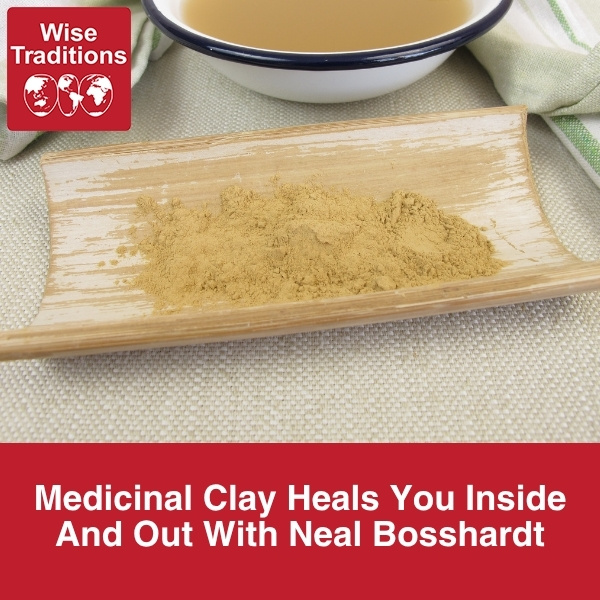
Arthritis. Acne. Colitis. Celiac’s. This is just the beginning of a long list of ailments that clay can address. Medicinal clay has been used historically by people around the world to remedy a variety of illnesses. Taken internally or applied externally, the results are astounding. Neal Bosshardt expounds on how he got over his initial skepticism to embrace the healing properties of this natural wonder!
Visit Neal’s website: weeatclay.com
Register for the Wise Traditions conference: wisetraditions.org
Check out our sponsors: MASA chips (Ancient Crunch) and New Biology Clinic
—
Watch the episode here
Listen to the podcast here
Episode Transcript
Within the below transcript the bolded text is Hilda.
What if I were to tell you that there was a single, simple remedy for arthritis, acne, colitis, digestive issues, celiac disease, and more? You might think it was hyperbole at first, but our guest insists that this natural remedy exists and has very special properties that work with a wide range of conditions. This is episode 541, and our guest is Neal Bosshardt. Neal is a speaker and the author of We Eat Clay & Wear It, Too! Neal tells story after story of healings using clay. He offers the signs behind why clay taken externally or internally helps with many conditions. He also talks about how he overcame his initial skepticism to become an educator about the wonders and the curative properties of clay.
Before we get into the conversation, I want to invite you to the Wise Traditions Conference from October 17th to the 19th, 2025, in Salt Lake City, Utah. We would love to see you there. Neal is going to be there, along with Sally Fallon Morell, Tom Cowan, and Odette Wilkins, who was on the show. Join us. Why don’t you? This is the conference that nourishes in every way. There’ll be wonderful speakers, but also wonderful foods, all wise traditions-friendly. It’s the best. We love it so much. Join us. Go to the Wise Traditions Conference to register. Do so before the Early Bird deadline expires, which is August 31st, 2025. We hope to see you in Salt Lake City.
‐‐‐
Welcome to the show, Neal.
Thank you for having me on the show. I’m tickled.
Clay To The Rescue: A Four-Year-Old’s Miracle
It’s about time we had you on. You are a clay expert extraordinaire. As we start to dive into this subject, I want to ask you to start us off, or kick things off here, with a story. You were telling me earlier about a little four-year-old girl and a horrible accident that she had in her kitchen. What happened, and how was the clay a part of this story?
You asked me to tell you a favorite story. It’s hard for me to pick out a favorite, but this is certainly a significant one. Many years ago, our secretary’s little four-year-old daughter, one night, put her hand on a stove right after it had been turned off. Heidi had turned off the stove, taken the pan, and headed for the table. Out of the corner of her eyes, she saw her little girl pushing the stool over toward the stove. She knew what was going to happen if she didn’t get there.
She was running back. She got there, but this little girl, scrambling up onto the stool, put her hand on the stove to pull herself up onto the stool. Her mother got there in time to grab her wrist and pull it back not in time. Every ring of the hot plate left a blistered line across the fingers in the palm. On the heel of the hand where the little girl had put the most weight, pulling herself up onto the stool, the flesh came off from the hand and was stuck on her smooth top range.
The mom grabs this little girl, who is instantly screaming in pain. She steps to the sink and puts it under the faucet. Even with clay, you want to run water on it for a few minutes to get the burn out. They got the clay and buried that whole hand in clay, and then she sat down in a rocking chair with this little four-year-old girl who’s screaming her lungs out. Her little girl was asleep in her arms within fifteen minutes. She had not just quit crying, but was asleep.
Mom gets up, takes a bread sack, and slides a bread sack over her hand and up her arm. On a burn, you don’t want clay to dry at all. A plastic bag will do that. She took her little four-year-old girl who was asleep and laid her in her bed. That little girl slept through the night in spite of the fact that after she was in bed, her mom took a spatula, scraped her flesh off the stove, and threw it in the garbage can.
The little girl slept through the night, pain-free, and came to her mom the next day asking if they could take the bag off her hand. She was oblivious to the fact that she had been burned. Mom says, “No, you have to leave that on there today.” After breakfast, she saw her little girl riding her little bike trike out on the driveway with both hands on the handlebars, one inside a plastic bag full of clay.
She told me this little girl was playing with her friends in and out of the house. That night, 24 hours after the accident, the mom couldn’t stand it anymore. She said, “I have to see that hand.” She took her into the bathroom, took the plastic bag off, washed her hands, and never did another thing to it because it looked so good. I saw that hand two days later. Her daycare fell through, so she brought this cute little four-year-old to work. I’d heard the story, so I said, “Let me see this hand.” She stuck her hand out, and there were no lines, no blisters, nothing. Except on the heel of the hand, there was a line of pink skin. There was no scab or scar, just pink skin.
How did she know to use clay?
It’s because she was our secretary. At that time, I worked for a company that had a clay product.
From Pond Liner To Panacea: The Bentonite Revelation
Your introduction to clay, as I understand it, was when you read that book, Our Earth Our Cure. Tell us a little bit about that.
Back in the early 1900s, in the 1930s, my grandfather bought a farm North of Redmond, Utah. He bought it as a farm, but on the edge of this farm, there was a deposit of this white mineral. It was a clay bentonite product. He was selling it as a pond liner because you could take this clay, put a 2-inch layer in the bottom of a pond, and it wouldn’t leak. When this clay got wet, it would form a gel, like mayonnaise or mustard, and then water couldn’t pass through it.
Grandpa was selling the clay as a pond liner for many years up until the 1970s when the health food people came to us with that book, Our Earth Our Cure, by Raymond Dextreit, asking if our clay, which grandpa was selling to line ponds, would do what the French clay would do. We looked at that book and laughed for three days. I’m not kidding. If I meet the author, Raymond Dextreit, in heaven, I will apologize because we thought he was a quack. He said that there are certain clays that have medicinal properties. There are many types of clays as there are breeds of dogs. Some clays have medicinal properties, and some don’t.
He said, “If you found a clay with medicinal properties, it would bring the body into balance. It would respond to the organism. It would do one thing for you, but something else for me, and bring the body into balance.” These health food stores that had this book wanted to know if our clay would do what the French clay was doing. We didn’t know. We had never eaten it. These people wanted to eat it.
You were like, “Wait. This is a pond liner.”
We were like, “This is dirt.” We wouldn’t even sell it to them. We said, “It’s not for sale, not if you’re going to eat it.” I called the Food and Drug in Denver and said, “There are some crazy nuts over here that want to eat our dirt. What should we be concerned about?” They gave me a list. Lead, mercury, arsenic, barium, chromium, streptococcus, and staphylococcus. We had it analyzed for everything that guy at the FDA said might be a concern, and it came back inert. He said, “It’s harmless. It won’t hurt a soul.”
Through a series of events, we then began to use it. We offered it for sale. We took some of our clay and pulverized it into a fine white powder. Some of the French clay was a fine powder. We made our clay, which was a fine white powder, and offered it for sale. A couple of people might have bought some. As our family had medical issues that conventional medicine couldn’t fix, we tried our clay as directed by Raymond Dextreit’s book, and it worked.
Unpacking Clay’s Healing Power: Personal Testimonials
What were the concerns that your family had?
The first one was that there was somebody in the family who was pregnant. Due to the ironing, the prenatal vitamins, this poor gal was having one bowel movement every week or ten days. That’s not healthy for either mother or baby. She tried through diet to get her bowels to work, and nothing worked. Finally, she tried the clay. Within three days of drinking the clay every day as directed by the book, she was having daily, gentle, easy bowel movements. That was the first one.
The next one was our grandmother’s neighbor had diarrhea so bad that it would be down both legs and in her shoes before she could even get out of the church, the post office, or the grocery store to go home. Within a week, that little lady came to our office and hugged me like I was her grandson. This was many years ago. I looked like a grandson. Now, I look like the grandfather.
She hugged me and thanked me for this product. She said, “You don’t know how good it is to go out in public again without fear of embarrassment. You gave me my life back.” I said, “No, I didn’t. This is not our creation. Don’t thank me. Thank Heavenly Father. This is His creation. We were blessed to learn about it.” With tears in her eyes, she sobbed and said, “You don’t know how good it is to go out in public again without fear of embarrassment.” Raymond Dextreit said, “It would bring the body into balance. It would do one thing for you, something else for you,” and that’s what it did.
The Science Of Earth: How Clay Becomes Medicine
I’m astounded that it can help heal or remedy both diarrhea and constipation. I did look at the handbook you wrote some years ago called We Eat Clay & Wear It Too! It seems to me that this is a remedy from God and nature that can help both internally and externally, everything from acne to diverticular colitis to menstrual cramps to colitis to celiac disease. Let’s go back for a second and talk about the properties of clay that make it medicinal.
There are some that we understand. In Raymond Dextreit’s book, he says that clay has the ability to respond to the organism. He said mankind is not smart enough to ever figure out all the reasons and the ways that clay can work. There are some theories, and I’ll share those. He said that for those people who won’t use clay until they have total scientific evidence, they will never benefit because mankind is not smart enough. There are some reasons.
The clay has a negative electronic charge. Most free radicals, heavy metals, toxins, and poisons have a positive charge. Since opposites attract, the clay then has the ability to pull out toxins, poisons, and heavy metals, but it doesn’t pull out the beneficial vitamins, minerals, and nutrients. One theory is the electronic charge, and it makes total sense.
Another is that the clay is very alkaline. Most of us are too acidic because of our diets and our lifestyles. The clay, being very alkaline, helps us become less acidic, more alkaline. That’s the reason. Another is that clay has 70 trace minerals in it in a form that the body can assimilate and use those that are beneficial. With this broad spectrum of minerals, some people take the clay daily as a mineral supplement. Minerals, alkalinity, and electronic charge are three of the aspects of clay that make sense as to why it does the good that it does.
What year was this book written, Our Earth Our Cure?
It was written in the early 1950s. It was translated into English in 1974 and brought to us in 1975.
The wheels are turning here. I’m trying to figure out that if clay has been used for thousands of years, as he says in his book and as I understand it, and if it is so beneficial in ways in which we can’t even understand, why hasn’t it been promoted or endorsed by more people, or at least by mainstream medicine?
It’s because of mainstream medicine. It’s because of money. There is no way you can patent clay. There is no way that any company is ever going to invest the millions of dollars necessary to get FDA endorsement or AMA approval. Nobody is going to spend those millions of dollars unless they can patent it and then recoup their investment by selling it at high prices. Since it’s a natural product, nobody is willing to invest that money with no hope of ever recouping it.
Nobody’s going to spend millions to patent clay and then recoup their investment by selling it at high prices.
It’s true. You can’t patent anything that’s found in nature. You can only patent something that you invent in a lab or something like that.
That’s right. There’s evidence that Hippocrates used clay. Gandhi used clay. During World War I, soldiers on both sides of the conflict were issued clay as part of their rations. Those regiments that had clay in their rations weren’t devastated by the dysentery that other regiments were devastated by. There’s way too much historical evidence. Nobody can ever come up and say, “I invented clay and how it works.”
Integrating Clay Into Your Wellness Journey: Internal & External Use
There’s much historical evidence. There are all the stories you hear of people who have taken to heart your PDF or this book, Our Earth Our Cure. Let’s talk a little bit about how we might begin if we wanted to adopt it as part of our health regimen.
This is one of the reasons why the FDA doesn’t want people to use clay. There are as many kinds of clays as there are breeds of dogs. Some clays have medicinal properties, and some don’t. You don’t know. There’s no test to determine which clay is effective and which isn’t. Because of that, you can’t go out on the market and say, “I’m looking for clay.” A lot of people have clay in their backyards and gardens. You can say, “My garden has clay soil. Should I eat it?” Don’t do that.
The clays that work, generally, are more of a bentonite-type clay, also known as montmorillonite. It’s a mineral that has certain properties. When this mineral was discovered in Montmorillon, France, it was called montmorillonite. When the same or similar material was found in Fort Benton, Montana, it was called Bentonite. There are variations in bentonites. Some bentonites work, and some bentonites don’t.
How to get started would be to find a bentonite that either someone else is using with success, and try it. You’ve got to be careful there, too, because nobody has spent millions of dollars on the research and the information that’s out there. A lot of it is not very accurate. There are a lot of inaccuracies. We use the clay for a bath. It’s amazing.
This is a fun story. A lady in St. George, Utah, had a case of shingles earlier in her life that had left a lot of nerve damage. In her later years, she was troubled with constant pain. She had pain all day and all night. She said she was miserable 24/7. She felt that if she could detoxify, she would feel better and would improve her quality of life.
She didn’t have access to a tub, so she soaked her feet. She did a foot soak. That’s simple. All you need is a little plastic tub or bucket that is big enough to hold your feet, use water, as hot as you can stand, deep enough to cover your ankles, and only two tablespoons of clay. She did a foot soak and, within a few days, she called me as excited as a kid on Christmas morning. She said, “I’m sleeping through the night. I’m pain-free. I haven’t felt this good for ten years. Would you send me some literature that I can share with my friends here in the trailer park?” That’s where she lived, and we did.
She called back a few days later and said, “I’ve been talking to a neighbor. Would you send her some literature?” We did. She called and said, “I’ve been talking to a friend in California. Would you send her literature?” We did. She said, “I’ve been talking to a friend in Oregon. Send her literature,” and we did. That went on and on forever, it seemed.
One day, the receptionist on the intercom said, “Neal, June Rowley is on the phone.” That was this lady’s name. I picked up the phone and didn’t say hello. I said, “June, who are we going to mail it to today?” She said, “What happens if you put clay on plants?” I thought, “On plants? Where is this coming from?”
I said, “It’s good for them. You can make a foliar spray and use it. You can stir it in the soil, and it will mineralize your plants like it mineralizes our bodies.” In a tearful voice, almost in tears, she began to sob and said, “I should have known better.” I’m bewildered. I said, “June, what’s going on?” She said, “Here in St. George, Utah, where I live, it’s a desert. We’re told to conserve water. As I began to soak my feet, I thought, “What can I do to use the water?”
She said, “I came up with a good idea. I decided to use it to water my house plants. All of my friends, when I would tell them about soaking their feet to detoxify, I’d be like, “Use the water on your house plants.” She said, “I was talking to one of my friends and told her that every plant in my house has died except for one.”
Her friend said, “Mine aren’t dead, but they’re looking sick.” We decided there was something lethal in that clay to plant.” I said, “No, there isn’t. Now you know what you did, don’t you?” She said, “All of the toxins that it pulled out of us were in that water.” There’s a guy in Hawaii who killed a section of his lawn from the water after soaking his feet.
Drink Up! How To Consume Clay For Health
If it’s doing that to the plants, think of what it must have been doing to her and so many people on the inside, unbeknownst to them. I know you have so much to share. Let’s say we find a good source of clay. That’s step one. Step two. Should we take it internally or externally? Should we do a foot soak, or can you drink some clay water solution?
Certainly. My book is We Eat Clay & Wear It, Too! I sell those on request. I have a website. My website is We Eat Clay. That’s probably where you got your PDF copy of the book. I would get some instructions from somebody somewhere who has used the clay. You can take the clay internally. We followed Dextreit’s rules in Our Earth Our Cure somewhat. We found that a lot of his rules weren’t hard and fast rules.
He said to take a teaspoon of clay in a glass of water. That’s what you do. If you’ve got intestinal issues, it’s one teaspoon of clay in a glass of water. I suggest 8 to 10 ounces of water. You can either stir it in the water and drink the whole muddy mess, or you can stir it in water, set it aside for a few hours, and come back. I made mine with about 12 ounces of water, and that’s a teaspoon of clay in the bottom. It looks like more than a teaspoon because the clay swells. When I put the teaspoon in there, it looked like a teaspoon at the bottom. Since the clay swells, it looks a lot more.
At this point, the minerals have dissolved into the water. The sediment is on the bottom. I have two choices. I could drink the clear water off the top and throw the sediment away, or I could shake it up and drink the whole thing. The benefits are the same either way. You can do that once a day, twice a day, once a week, or twice a week. Some people will do it daily as a detox. Other people will do it occasionally as a mineral supplement. Some people will do it as needed if they have heartburn, hiatal hernias, and other issues. That’s how you take it internally.
It’s also good for people to find a reliable guide or maybe a health practitioner who can guide them, because I suppose there might be some negative results from using clay, or some dangers, or some precautions.
There are very few. If you’re using good clay, which is the clay that we have used for 50 years, in 50 years, we have never seen a negative reaction. We have never seen an allergic reaction or a negative side effect at all. The worst thing that we’ve ever seen happen is nothing. You can take too much. If you take too much clay, your body reacts the opposite of when you take too much vitamin C.

If you take too much Vitamin C, what happens? Diarrhea. If you take too much vitamin C, your body lets you know you’ve got too much vitamin C by giving you diarrhea. If you take too much clay and are not drinking enough water, then it can cause constipation, which is ironic because if you’re constipated, you take the clay to stimulate your bowels to work. We’ve never seen a negative side effect or an allergic reaction.
You’ve talked a little bit about what to do if we want to take it internally. What about externally? You started with the story of the little girl with a hand burn. Let’s say someone is suffering from arthritis. Can they put some poultice on their knees? What do you recommend there?
You bet. What I recommend is that everybody have a quart mason jar of the clay gel in their kitchen cupboards. What lives in our kitchen cupboard is a glass jar with a plastic lid. It’s like mayonnaise or mustard.
It looks like that consistency.
It’s thick enough that it won’t drip, but thin enough that if we have a grandchild who’s got an owie, it spreads very easily on an owie. I don’t have to push it. The last thing you want is a child in pain. Here, grandma or mom is shoving on his owie because the clay is so stiff. That’s what lives in the kitchen cupboard.
In my vehicle, I want to have clay, but I don’t want a glass bottle rolling around in my vehicle. I have a plastic tube. In the plastic tube, what comes out is like mayonnaise or mustard. That will roll around under the seat of my truck or in the trunk of the car, 365 days a year. If we’re traveling and we need clay, there it is. Once you mix it up, it never separates and never goes bad. You want it mixed up. With the little girl who put her hand on the stove, gratefully, she didn’t have to scream for a long time while her mother found some clay and mixed it into a gel to put on her hand.
You mentioned arthritis. For the first 30 years of using clay, I would tell people to put it on externally as a poultice. You take the mayonnaise-like gel, put it on the arthritic joint, a nice thick half-inch or three-quarter-inch layer, and then cover it. Hold it in place. Some will cover it with plastic wrap. Some will cover it with fabric and then leave it on overnight.
I’ve had people tell me they did it one night, and the next day, their joint was pain-free. Maybe some arthritis pain won’t go away overnight, but some has. I do it every night until the pain is gone. That’s what we told people. I’ve had people tell me their arthritic knees were helped, or their arthritic hands were helped. That was for the first 30 years. In the last couple of years, I’ve had more people tell me that not only do they use it externally, but drinking the clay helps their arthritis.
Ancient Wisdom: Historical Uses Of Clay In Medicine
That’s amazing. From the inside out and the outside in. Can you tell us about the historical medicinal uses of clay? How far back do any writings or records go, demonstrating indigenous people from around the world using clay?
A lot of the indigenous people didn’t leave records, or at least not that we know of, so how far back it went, we don’t know. Here in the United States, when White men came to the West, talking with Indians, clay was part of their regimen. We know that it would have been in the 1800s that the Indians were using it. Socrates used clay medicinally. You can say thousands of years. I don’t know if there was a time when clay wasn’t used.
It’s such a simple, natural remedy. I’m thinking a little bit about pregnant women who sometimes have cravings for clay. The doctors called it PICA or something. I don’t know that they ever understood why. What is your theory on that?
It’s a mineral imbalance, or they need those minerals. They’re craving those minerals. Animals do the same thing. There’s documentation of parrots in South America that eat poisonous berries as a major part of their diet. Those parrots don’t die because another major part of their diet is clay outcrop. The parrots are getting protection from the poisonous berries in the clay that they eat.
That’s so amazing. They instinctively know, “We can eat these berries as long as we’re eating this clay.”
Exactly. A lot of clay companies, including the one that I used to work for, sell clay for people, which is what we’ve been talking about here, but they also sell clay for animals. The clay that they sell for animals, a lot of it goes into dairies for dairy cows. It will condition and improve the digestion of the dairy cow, so that the dairy cow doesn’t have all the acidosis that they get from the feed that they get.
Many dairymen have told me that if they put out the agricultural grade of clay for their dairy cows, their cows will eat it, free choice, as needed. Especially a heifer, a cow that has had a calf for the first time, once she has that calf, she will pig out, to use an expression, on the clay for days until her body comes back to normal. She gets into her lactation period, and then she will back off. She will still eat some of the clay, but she won’t gorge on it like she did when her body was trying to get back into its rhythm. Animals will eat, free choice, on the clay.
That’s so interesting. There’s a parallel with us learning about intuitive eating. There’s a trend of people considering paying attention to and tuning into what their body needs. That’s exactly what these animals are not far removed from.
They’re smarter than we are.
Sometimes. What has been the most surprising use of clay that you’ve ever come across? Maybe not the most surprising. Tell me some of the surprising ones, then.
I had a case of diarrhea. I went to Peru years ago as part of a humanitarian trip. Knowing how many people in foreign countries have intestinal issues, I was drinking the clay every day. I thought, “I’ll drink it once a day, and I won’t have any trouble.” On day three in Peru, as I walked into the hotel room that night, I thought I was going to pass some gas. It wasn’t gas. It was liquid.
I then went into my room. Gratefully, it happened as I was walking into the hotel. I got myself cleaned up, went in, and drank a glass of clay water. Within the hour, I drank a second glass. My diarrhea continued for the first half of the night. I drank a third glass. I drank three glasses, probably within 2 to 3 hours. By morning, my bowels were controlled, and I got on a bus. I was confident enough to get on a bus for a two-hour ride to the top of this mountain to a village.
I was grateful for clay. Other people also had trouble at night, and they didn’t get on the bus the next morning. If I hadn’t had clay, no way would I have gotten on a bus for a two-hour bus ride up to this village where the restroom is a hole in the ground with two boards over it. From that point on, I drank clay twice a day.
You might as well. The worst it can do is nothing. In this case, you knew it was shoring up your digestive tract and so forth.
If you drink too much clay, you can get constipated. That’s what I wanted, or at least controlled.
If you drink too much clay, you can get constipated.
Skeptics To Believers: Overcoming Doubts About Clay
What do you say to the clay skeptic? You were one time as well. You said when you first came across that book, you guys were laughing for days. What do you say to the person who’s like, “That is just dirt. I’m not going to drink dirt. What are you, crazy?”
I don’t fault anybody for being skeptical because nobody was more skeptical than me. I would say have a more open mind than I had, and it will bless your life. I had a friend who broke her ankle many years ago. They had to pin it. It was a bad break. They had to pin the ankle to have it heal, and those pins got infected. This lady was going to the wound clinic twice a week for four months to deal with this infection. All during those four months, her sister-in-law was begging her to put the clay on it. This lady flat-out refused. She said, “No way on earth am I putting mud on this infected wound.”
After four months, the wound clinic began to prepare her to be an amputee. They had lost hope. The infection had gone into the bone. They began to talk to her about becoming an amputee and life as an amputee. When they started talking about amputation, this gal, Lori, called her sister-in-law, Connie, and said, “I’m more open-minded today. I’d like to hear about that mud again.”
They packed her foot in a half-inch or three-quarter-inch thick layer of clay. The clay is not a cream or a lotion. You mentioned the word poultice. Poultice is a half-inch or three-quarter-inch thick right on the wound. They wrapped it with fabric. As it dried, it sucked out the infection. Within a week, it had made a world of difference. It was night and day.
I’ve got pictures of her wounds, the week before she started clay, and after a week. She had gotten better and better. Long story short, her last email to me said, “Thanks to the clay, I still have a foot.” For the skeptics, I would say to try it. Make sure you’ve got clay that’s safe. If a clay happened to come from an old mining lead and zinc mine, it could have some hazardous minerals in it. If you’ve got a good reputable clay, you’re good.
I’ll mention this because I bet a lot of people in your audience wonder this. On most packages of clay, even the one that I’ve used for 50 years, the package has a cancer warning on it, which is Prop 65. It says, “This product is known to contain a substance known in the state of California to cause reproductive harm. This product is not appropriate for pregnant women and children.” That’s on the package.
I’ve been eating it for 50 years. We’ve had eight children while we’ve been using that product. I’m not saying the product caused those eight pregnancies, but it certainly didn’t interfere with them. The warning is on there because there is a tiny trace of lead in most natural clays. What’s interesting is that in the clay I use or in a good clay, that trace of lead is lower than the allowable level of lead in broccoli, collard greens, and Brussels sprouts.
It’s lower, and yet it comes with this warning label that you wouldn’t find on the broccoli and the Brussels sprouts.
If they put that warning on broccoli and Brussels sprouts, can you imagine how hard it would be to get your children to eat vegetables?
Harder than ever.
It’s only in the state of California.
I’ve heard interesting things, especially about Prop 65 and how it can mislead people and alarm them unnecessarily. We will invite people to check out your website. I want to pose to you as we wrap up the question I love to pose at the end of the show. If the audience could do one thing to improve their health, what would you recommend that they do?
I was warned about that question, and I love it. Health is such a comprehensive issue. There’s certainly no one single thing, but you asked for one. Since we’re talking about clay, I should say they should eat clay. Clay is good, but I wouldn’t say it’s number one. I would say to avoid processed foods as much as possible. Eat as close to a natural diet, which is what our grandparents ate, as much as practical. I say practical because in our society, most of us can’t avoid it. I would say to avoid processed foods, drink lots of water, eat clay, read the Bible, and follow the commandments.
That’s beautiful. Thank you so much. On behalf of The Weston A. Price Foundation, it has been a pleasure talking with you.
It’s been a joy for me. If people want to contact me through my website, We Eat Clay, I’d be glad to answer questions. If they want hard copies of the book, I mail those out. The PDF version is right from the website.
Sounds good. We will see you at the conference in October 2025.
I’ll be there. I hope a lot of your readers are. Take care.
You, too.
‐‐‐
Our guest was Neal Bosshardt. Visit his website, We Eat Clay, for more information and find his PDF. Here is a review from Apple Podcasts. I want to know from you. Is this true? ShawnJohn22 says this. “If you are a woman, then this is a great show for you, as they almost exclusively focus on women’s issues.” Is that true? Let us know. Leave us your own review. I’m super curious.
You could also email us at Info@WestonAPrice.org and give us your feedback on the show, or better yet, leave your own review. Go to Apple Podcasts, give us as many stars as you want on the Ratings & Reviews section, and tell us if you think this show is worth tuning in to, whether you’re a man or a woman. Thank you so much for tuning in. We appreciate you. Stay well, my friend, and remember to keep your feet on the ground and your face to the sun.
‐‐‐
The content of this episode is provided for informational purposes only and is not intended to substitute for the advice provided by your doctor or other healthcare professional. It is not intended to be, nor does it constitute, healthcare or medical advice.
About Neal Bosshardt
Neal Bosshardt was born and raised in Redmond, Utah. He graduated from Snow College in Ephraim, Utah and then from Brigham Young University with a degree in Business Management. He returned to Redmond to work in the family business in 1974 when he was one of 6 employees (5 of those were family members), and worked there until he retired in 2018. He worked in every aspect of the business from mining, packaging, to marketing. He was involved with all of the products from table salt to livestock salt to de-icing salt and helped expand their markets from strictly the western states to be the entire United States, as well as Canada, New Zealand, and Japan.
His passion is teaching people the medicinal benefits of unrefined salt and natural clay. Here is his comment as to why he teaches classes even after retiring: “Natural Clay and Unrefined Salt kept us out of the emergency room, the Doctor’s office, and drug store so many times over the years that I feel badly for parents and grandparents who don’t have these natural products or know how to use them.
He and his wife, Marcia, have 8 children and 28 grandchildren. When not teaching classes on natural salt and clay, he enjoys making sauerkraut, compost, working in the garden and spending time with family.
Important Links
- We Eat Clay & Wear It, Too!
- Our Earth Our Cure
- Wise Traditions on Apple Podcasts
- Wise Traditions Conference
- Info@WestonAPrice.org
Episode Sponsors
🖨️ Print post

This works WONDERS for poison ivy. Mix equal amounts with apple cider vinegar and apply twice daily. Wash off after fifteen minutes.
What companies use good quality clay for their product?