


 🖨️ Print post
What if one of the most important health decisions you make every day has nothing to do with food—and everything to do with what touches your skin?
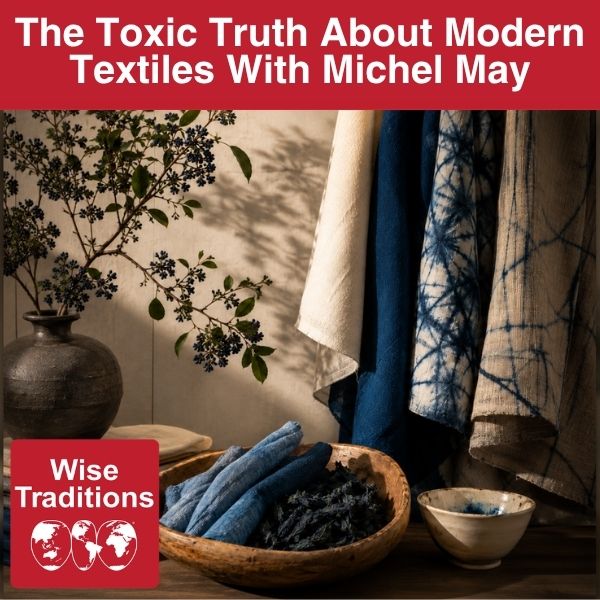
Michel May, founder of AIZOME Textiles, joins us to explore the hidden world of modern fabrics, synthetic dyes, and the chemicals woven into many of the clothes, bed sheets, towels, carpets, and other textiles that surround us. After witnessing his mother’s reaction to conventional textiles during cancer treatment and discovering traditional Japanese dyeing practices, Michel began a journey that led him to question the materials most of us rarely think about.
In this episode, Michel explains why many clothing labels may be far more misleading than informative, how synthetic dyes and fibers became the industry standard, and what researchers are learning about microplastics, the skin microbiome, and the potential health effects of modern textiles. He discusses athletic wear, fast fashion, indoor air quality, environmental pollution, and why textile fibers make up a surprisingly large portion of the dust in our homes.
We also explore the differences between natural and synthetic fibers, the role of traditional plant-based dyes, and why Michel believes the items that touch our skin the longest deserve the closest attention. In fact, he argues that the most important place to start isn’t your wardrobe at all—it’s your bed. Since we spend roughly a third of our lives sleeping, Michel believes our sheets may be one of the most significant textile choices we make.
Whether you’re concerned about microplastics, interested in creating a healthier home, or simply curious about what’s really in your clothing, this conversation offers a fascinating look at an often-overlooked piece of the health puzzle—and practical steps you can take starting today.
WAPF Ad- 50% Pledge – Visit westonaprice.org/50-50-pledge.
To learn more about Michel May and his company AIZOME Textiles visit https://aizome-textiles.com
As a special thank-you to Wise Traditions listeners, Michel May at AIZOME is offering 10% off your order with the code WISE10 at checkout. This discount is valid whenever another sitewide promotion is not already running. Enjoy the opportunity to experience Aizome’s beautifully crafted, naturally dyed textiles at a special savings.
Join the Nourishing Our Children closed Facebook group
New Biology Clinic – “Use code WISETRADITIONS to get $100 off your membership activation fee, or code WAPF to get your first month free on an enrichment services only membership. Codes must be in all capital letters.”
Earthly Wellness – “Use the code WISE10 for a special discount for the Wise Traditions’ audience.”
—
Watch the episode here
Listen to the podcast here
Episode Transcript
Within the below transcript the bolded text is Kendall Nelson
Welcome to the show. Most of us spend a lot of time thinking about what we put into our bodies. We read ingredient labels, avoid ultra-processed foods, filter our water, and swap out plastic containers in our kitchens. Few of us stop to consider something that touches our skin nearly every hour of every day. Our bedding and our clothing. What are they made of? What chemicals are used to create them? Could they be affecting our health in ways we never imagined? This is episode 591, and our guest is Michel May.
Michel is the co-founder of AIZOME, a company creating textiles using traditional Japanese plant dyeing methods. His journey into the world of healthy textiles began after his mother developed severe sensitivities to conventional fabrics while undergoing cancer treatment. Determined to understand why, Michel discovered a hidden side of the textile industry, one that relies heavily on petrochemical dyes, synthetic fibers, and surprisingly little transparency about what actually ends up in the sheets we sleep on and the clothing we wear.
In this episode, Michel explains how traditional Japanese wisdom views textiles not simply as decoration, but as tools that can support health and well-being. He shares the fascinating history of indigo dye, why ancient warriors wore it beneath their armor, and how modern synthetic dyes came to replace natural alternatives. We discuss the growing concerns surrounding petrochemical dyes, microplastics, synthetic athletic wear, indoor air quality, eczema, infertility, and a surprising lack of regulation requiring companies to disclose the chemicals used in textile production.
Most importantly, Michel reminds us that we do not have to overhaul our lives overnight. Small, thoughtful changes matter. By starting with the things that touch our bodies most, our bed sheets, underwear, socks, and favorite clothing, we can begin creating healthier homes while also supporting a more transparent and regenerative approach to the products we use every day.
Before we get into the conversation, we invite you to make an investment in your health by purchasing more of your food from local farms. It’s good for you and the economy in your community. Take the 50% pledge. Spend at least half of your food budget supporting local farms. It’s a simple way to keep farms that are doing it right afloat. We have resources on our website to help you out. Find out more at WestonAPrice.org/50-50-pledge. Thanks in advance. Now let’s welcome Michel May.
—
Japanese Traditions And The Modern Textile Industry
Michel, welcome to the show.
Kendall, thank you so much for having me. I’m really excited.
I have to thank you for staying up so late. I understand you’re in Japan, and it’s nighttime for you, and that you live there. I’m curious. My first question for you is how traditional Japanese culture has influenced your pursuit of healthy textiles.
To anybody who’s been to Japan, one of the things that we find fascinating about Japan is how, among these super modern things, all traditional things just continue to live alongside, and Japanese people see absolutely no conflict. You see people, the geishas or people wearing traditional clothes, having a mobile phone or a smartphone, anything. These things just seem to exist in parallel. Japanese inherently understand the value of keeping traditions alive, even if they sometimes do not understand the meaning of these traditions. To our eyes or to our experience, this is amazing because you can go and really dive into very old traditions that are still kept alive and find your own value in them.
What about the textiles specifically? What have you learned from Japanese culture about textiles?
Initially for me, the disconnect with textiles came when my mom underwent chemotherapy. We realized that she started reacting to certain textiles, and the oncologist told us, “Sometimes it can be the dye in textiles.” At that moment when he said this, I just could not believe that it was even true. I also did not know anything about dyes. I did not know what a dye is, or what these things are made of. Obviously, if you do one Google search, you realize that all the dyes we have in textiles. Pretty much all the textiles are made from petrochemicals, the same thing that’s making plastic.
A few years later, when working in Japan, I actually took my now wife and then girlfriend on a date, and I said, “We have this traditional Indigo Dyer, and we can spend some time with him, and he will tell us about his techniques, and we can get to make our own clothing.” He was explaining this totally differently than what I expected. I thought that the dye function is just the color, but he basically said, “The color is more a side effect. The plants that traditional dyers use for textiles are more to enhance the textile for its function.”
He explained that indigo is an antimicrobial dye. It helps with wound healing. It’s great for work clothes, for warriors. He showed me, and I was like, this is crazy. It already dawned on me. Hang on, have we potentially replaced something good for our health with something bad for our health for somebody’s profit or convenience? He showed me this very old woodblock print, this very beautiful, almost comic-style block print. That was like 300 years old. There was a fight between the three samurai with arrows flying through the air.

He said, “Look, all of the warriors under the armor, you see a sliver of blue clothing. That’s because they’re all wearing indigo directly on their skin. They observed that when you get wounded in battle, and you’re wearing an indigo shirt, your wounds will heal faster.” At that moment, my brain just exploded. I was like, “If even just ten percent of that is true, then we’ve made the biggest mistake in just changing textiles in that way.”
You mentioned your mom and that she was ill, and what happened? Did you do something to change the textiles that she was wearing or sleeping on or something that helped her in some way?
We did replace, I mean, I have to say it was already a stage four brain tumor, and it was the last year of her life, and it was really just about making her comfortable. It was all so terrible and so uncomfortable, but changing to undyed bedsheets reduced what looked like sores, but it was just like black spots on her skin, and it got better with undyed textiles, with bedsheets particularly. That to me was very interesting, just to see that maybe potentially dyes are not a problem for the average person in the average of their health, where their health is. Some people are not on average, and we are not always on average. It seems to stress our skin and our immune system. I was like, “Is it possible that we all have to live with that?” It’s not a conversation.
Tell me about starting your company and what you are famous for.
The Business Of Healthcare Vs. Prevention
I was famous for it. It was really that moment with my girlfriend back then. She was working for a big cosmetic company in Japan, and I was working for an oncology company. I said it to you before the episode. I was used to working in this company with extremely intelligent people. I saw literally miracles being performed, like late-stage cancer treatments and extending somebody’s lifespan by another year. At the same time, I also realized the marriage of healthcare and capitalism is really that we’re trying to sell one cure after another.
The marriage of healthcare and capitalism is really that we’re trying to sell one cure after another and there’s clearly more money in treatment than in prevention.
There’s clearly more money in treatment than there is in prevention. It’s just the nature of things. If a doctor tells you you have a year to live, you’ll say, “Take all my money and everything if you can make it go away.” When it’s about prevention, when you hear you should walk 10,000 steps a day, it’s free of charge, people are like, “I cannot be bothered today.” It is in our psychology, so capitalism in some way just exploits that naturally. I felt one particular area where I felt like this was so weird was textiles because I thought all these sustainable companies talk about whatever, cotton being organic and this and that.
It all seemed to me a little bit like greenwashing because I just want to know what’s healthy for me. You’re talking about the cotton, but you do not even mention the dye, like it does not exist. I call customer service, and usually it’s like, “Do not worry. It’s nothing really.” There’s also no regulation to disclose any of the things. Even worse, there’s no requirement for companies to know what dyes they’re using. They basically just buy it from somewhere else, and it’s not considered by law to be of concern at all. That’s just at odds with what we understand now.
This is maybe twenty years ago you could still defend that the claims aren’t there. In the last ten years, and I would say there’s a very famous book from Alden Wicker, which really dives deep into the connection between the dyes in textiles and autoimmune diseases. For anybody who hasn’t read the book, it’s called To Dye For: How Toxic Fashion Is Making Us Sick–and How We Can Fight Back. We really understand this, and there are also court cases and things that are going on, and it’s really time to make that part of their legal requirement to understand what dyes and what chemicals are in their textiles and transparently disclose this.
People can still choose whatever they want to choose, but we should have transparency. That idea for me was so obvious that I thought, “We have no idea, let’s just make a video and put it on Kickstarter or Indiegogo and see what happens.” At that time, I was still working full-time and so was my wife too. In a couple of weeks or months, our phone just went bing, bing. I remember that I had problems just swallowing my food because from when we started breakfast to the end of breakfast, we’d sold $20,000 worth of product.
I was like, “I cannot even digest food anymore. We basically had to quit our jobs and do that full time.” We were absolute idiots. We had no idea how to do anything, how to even register a homepage. What we did at that time, we did have confidence because we were on the phone a lot, and we actually flew out to a couple of dye factories and talked with them about this. We felt like there were enough people in the industry. There are very few, but there are enough people who see the problem and say, “We have to change this, but we have to find a way to reach consumers and make it a thing, make people aware it’s for your health.”
That’s how we started. There’s this whole story that there are so many big brands. So many people basically said, “You’re idiots. This is never going to work. Nobody cares. Plant dyes are stupid. They’re medieval, and they’re too expensive.” You have to deal with farmers instead of just getting your chemicals from a big chemical corporation, which is obviously much cheaper. I just do not know. I felt like, yes, I hear you, but I still do not believe this is really the end of it. I do not see a future where we have a product like textiles being non-biodegradable and potentially toxic.
There’s no real way of recycling it. I do not see that this is a realistic future. It’s like a dystopia, but it’s not where we as humanity want to steer towards. That’s the driving force, obviously. Everybody broke once. The company almost died during COVID, and then we had to shut it down for two years. Not shut it down, only my wife ran it while I started doing healthcare consulting again so that we have money to funnel back into the company.
Everything changed in 2023. We started hiring again. Since then, it’s been a huge change. The conversation is now that people understand clearly that there’s lots of plastic in textiles. There are a lot of undisclosed chemicals. It is really positive to see that this is definitely a change that I think nobody can hold back anymore. Most people still do not know about it, but everybody who knows acts differently because it is an obvious change that we can make as a society.
For our audience who are wondering what your company is called, it’s AIZOME, right? Is there a specific reason, and do you specialize in bedsheets and cotton T-shirts? Can you tell me where you get the name AIZOME? Is there a significance to the name?
That was when I sat down with the dyer in Japan, and I basically asked him, “What is the name of the craft?” He said AIZOME. AI is the Japanese word for indigo, and ZOME, it means dyeing. It’s the concept for aizome. He explained to me, and on our YouTube channel there’s a video about this. He had this really beautiful philosophy about AIZOME where he said aizome does not mean to just dye with indigo. What it really means for him is to understand that we are part of nature and that when you dye with plants, you have to respect the materials and you think about where they come from, what they do when they’re used, and how they return to the earth.
Dyeing with plants means understanding that we are part of nature and that when you dye with plants, you have to respect the materials.
It’s really this cradle-to-cradle idea. For me, there’s so much beauty in the way these artists, him particularly, live this craft that I thought that’s the name that I want to carry on as an art form and make textiles in the same way. We did start with bedsheets because it was the most obvious thing that people already relate to their health. We are now in July. Actually, we always expand through pre-orders because we do not want to take outside investment, really. We did expand this year into towels, where we collected a lot of pre-orders for towels that we are delivering now. In July, we start with pajamas, where we take pre-orders for pajamas.
Why Conventional Textile Dyes Are Toxic
Let me talk a little bit about the dyes themselves. The dyes that are used in traditional clothing and why you consider those to be toxic.
It’s good. I’m always stumbling over traditional and conventional because traditional is what I think that’s how it’s been for millennia. That’s where I think ingredients are. Where we want to come back to traditional and conventional. That’s what right now most of us are using. Conventional dyes are made from coal tar, from heavy metals. Largely, the ingredients are petrochemicals. When you take oil out of the ground, you can split it up into a lot of different things, some tar or oil or petroleum.
The thing about the dependency that we have on oil is that there are a lot of side products that then become very cheaply available because the companies that make oil or produce oil want to sell petroleum. Just want to get rid of these chemicals. It’s also a miracle of modern science, all the things that we can make from it. I’m not one person to say plastic is evil. There are definitely use plastic cases. We have to respect the material.
We have to understand how complicated it is, how long it takes the earth to create plastic, what an amazing material it is, and how it will eventually return to the soil. Plastic in itself, I do not condone, nor the chemicals made from petroleum. It is how we’re using it with complete disregard for the material itself. These ingredients basically are a very cheaply available ingredient for dyes. You can turn it into any color, and you make it stick to a fiber. By the way, it is very similar to plastic. It has almost the same ingredients as plastic. The difference is that plastic sticks to itself, so you can form it, while dyes stick to other materials. You can use it to color something.
How do you believe that these affect our health? What problems are we seeing from having the modern dyes in our bedsheets and in our clothing?
As I mentioned before, Alden Wicker’s book is very interesting because what we can see is that there are a lot of connections to dyes and textiles. One thing that makes it really difficult and potentially dangerous for people like me to speak about it is that you can easily jump to conclusions. There are endless books about, “Does your bra cause breast cancer?” It may do, but the chain to prove it is not strong enough for people to really make an argument, especially when the name starts selling you something else. There are very interesting cases, and one of the cases, which is also widely discussed in her book, but it has developed since then, is the case of the airline attendants.
Three different airlines in the US have sued, where the flight attendants have sued their companies, their employers, because they said the uniform is making them sick. It’s an interesting question. Why do they say that? Why are these airlines? One of the problems is that textile itself is just one factor in modern-day life. You wear a t-shirt while you’re also going to work, you drink different things, you use cosmetics and so on. How can you ever prove that whatever your infertility, your eczema, maybe the developmental issues of your child, how could you ever prove that is connected to your textile size?
It’s really difficult to ever make that definite proof. What we do know, though, is what chemicals are in there, and we do know that at certain levels they definitely pose that risk, but the safety level is really hard to determine. Let’s get back to the cases of these airline tenants. Why is this interesting? Chance or nature or whatever or God has created the almost perfect study condition. You have 10,000s of different people of different ages working in exactly the same work condition. It’s almost the same. For all of them, at the same time, one factor in their life is changing. It’s closing.
Everything else stays the same. The randomness gets equaled out. When you see months later, 7%, 8%, 9% of the people reporting health issues and you see one, I think it’s up to 1% or 2% with really long-term disabilities that all happen at the same time, then it’s really hard to ignore. Actually, Harvard did a study on this. This is one of the cases where it’s safe to speak because we actually have a clear case where it’s not just like, probably this has caused this and that. When we talk about the issues that can come from dice, there are things like infertility and endocrine disruption.
There is a case of eczema. is a particularly famous doctor, Ian Miles, who works for the NIH, for the US government, who has what’s called the sibling hypothesis. He says, “Why is it that so many people who have eczema, lifelong eczema and struggle with that, happen to be older siblings? Why is that?” His hypothesis is they get the new clothes and the younger siblings get the hand-me-downs. We’re talking with people here who, as children, have been exposed to textiles and then have a lifetime of dealing with eczema.
I can just tell you from party cocktail conversations, when obviously this topic is brought up, and I’ll entertain everybody with my textile stories, there’s always somebody who says, “I have eczema.” I’ll ask, “Are you an older sibling?” 9 out of 10 people say, “Yes, I’m an older sibling.” These are things where I just feel like this is more than just somebody on TikTok trying to scare you into buying something else. This is something big that is happening and that the world is finally waking up to.
The Dangers Of Synthetic Athletic Wear
Speaking of TikTok and social media, there’s been a lot of talk about athletic wear. I live in a town where everybody’s an athlete, and we all run around in our athletic wear all the time. What are your personal thoughts on being in these clothes that are obviously made out of synthetic materials and then we’re sweating in them as well? Do you have thoughts on how dangerous that just might be?
It’s the worst, and it’s a huge irony because you’re dressed to be healthy and you’re literally dressing in the worst possible clothes. This whole thing about performance, where I just want people to understand that’s all marketing. You’re not running faster because you’re wearing a polyester t-shirt. You can run as fast with a cotton t-shirt. Somebody recently told me that the record for, I think, a hundred-meter sprint is still done in cotton clothes. I do not remember if it was a hundred-meter something, but the records that are still held in sports are often done when people were not wearing polyester.
The thing is, what I want people to understand, since I’m not a manufacturer, it’s so cheap to make this polyester clothing. There’s really no other reason that it’s been extremely cheap. One way of making it attractive is to say, “Look, it sits on your body. It shows your female shape or whatever it is. Most of that, I would say, is marketing. The cases in which things like stretch and certain synthetic materials bring advantages. They exist for sure. Maybe let’s say a sock is better if it stays up. If it is, it’s hard to make a sock without at least one band of elastic, but the cases are lower. What makes it even worse? That’s a very easy thing to understand for anybody who’s doing their own laundry.
Most people still do their own laundry. Synthetic clothing eventually develops that smell, and you cannot get it out. What is that smell? That smell is an organism, mold, or a fungus living in your textiles that you cannot wash out anymore because the synthetic clothes are hydrophobic. They do not really let any water go in there. What happens if you put mold infested textile on your body? What happens to your skin, my own? It stinks. Why does it stink? Your body tells you, “Put this away. This is not good.” People or companies.
Synthetic clothing stinks because your body is telling you: put this away, this is not good.
Let’s say society goes like, “No, here’s this fragrance washing detergent that just overpowers that smell with something else.” You also put this on your skin. You all go back to like, we have an amazing body given by our parents, by God, by nature, that has a microbiome that scientists still are studying and finding out every day something new and amazing about how our skin biome protects us from all kinds of things. We do not really want to mess with our skin biome because, just the other day I spoke with a skin biome expert. She told me something.
I was like, “What’s new in skin biome research?” She said, “We understand now that a healthy skin biome that people had a hundred years ago has a very high UV protection, which means you basically do not need sunscreen. Most of us do not have healthy microbiomes anymore on our skin. It takes a long time to recover because we’ve destroyed it. Just saying, as to basically prove that we still find out amazing things about the skin biome.
That’s with the Atlantic, where I feel like the tragic thing here is we on TikTok advertise to young women or men like to do yoga, connect with nature, and your inner self. The first thing they do is they wear a textile that’s so far away from nature, and it immediately starts changing the nature of their body to something that’s not good for them. It’s all done. I know I’m so like a socialist here. It’s all done in the name of profit. We’ll just have to wake up to that. I would say when you exercise, use natural fibers and do not worry that you may lose 0.001% of performance because you may run a little bit slower. That’s a good trade-off.
That’s good advice. Let’s talk about the fabrics themselves. What exactly should we be wearing? You’re saying to wear natural fibers when we work out, and I imagine just in our daily lives. What are the safe fibers?
It’s always trusting your nose. A big problem with textiles in general is how the labeling is not very strictly enforced. I’ve bought natural linen and textiles, and they start smelling. When they start smelling, when you feel like you can really smell your own sweat and it’s uncomfortable, and you have this stinky feeling, and you cannot wash it out, there’s probably synthetic fiber in there. As a general rule, just want to say this right off the bat.
Anything that’s less than five percent does not need to be mentioned at all. Any parts and components, treatment finishes, dyes, and so on also do not need to be mentioned. On top of that, even though technically everything has to be mentioned, that’s 95% and main fiber, many companies still mislabel it. They say it’s 100% cotton when it’s really only 50% cotton. DFTC in the US does not really have any enforcement mechanisms, so they cannot really punish companies for mislabeling it. That’s one thing I also want people to understand.
The label on your textiles isn’t really meant for you. It’s meant for the customs officer to go like, all right, cotton from India, text at seven percent. That’s what it’s actually for. It’s not an ingredient label. If you use it, at least to have some idea of what fabric it is. You can obviously always communicate with brands and say, “I want only 100 % cotton. I do not want twenty percent stretch or nylon or anything in there.” For your skin, it’s a very easy, very simple rule.
Everything on your skin that touches your skin should be a natural fiber. This can be cotton or linen are the two main ones. Be careful with things that pretend to be natural, like bamboo, for example, bamboo and some of the rayon fabrics. That’s wood pulp broken down chemically and then turned into fiber. It is possible to make these pretty good, and there’s a Swiss company called Tencel that is known for their very strict protocol. Tencel is everything.
All studies that I’ve read show that they perform pretty well. It is possible to chemically break down wood and make it into a good and natural fiber, but a lot of companies like rayon and bamboo fibers. They’re not very strict with the chemical management, and you end up having a lot of synthetic chemicals in so-called natural fiber. The number one thing is to have natural fiber on your body. If your rain jacket or your second layer has more synthetics in there, at least you have a protective layer. I would say that the basic rule is for your skin, for what you touch with your skin, choose a natural fiber.
The natural fibers include cotton and wool. Would hemp be considered a natural fiber? Hemp. What about cashmere? I imagine cashmere is considered a natural fiber. Bamboo, we should be aware of. That’s probably not made the way we think it is. I do not think that before I started researching what you do, I really understood what the bad fibers were. I didn’t really have an idea of what exactly is in polyester or nylon, or can you go through just a little bit of a summary as to what’s in those types of materials and which are the ones that we should really look out for and never trust or want to wear?
Choosing Natural Fibers Over Plastics
You named the main ones already. Polyester is the big one. Polyester is really just plastic. It’s a very thin plastic. It’s obviously like plastic. It has advantages for manufacturing. It’s very cheap. It’s very durable. As I said earlier, it’s hydrophobic, which is one issue that does not allow water to wash it. It really collects not only pathogens like E. coli or yeast fungi or other things that you really do not want to have on your body, but also a lot of other chemicals in the production process. You cannot wash it with a washing machine. That’s one of the big issues. You cannot really get it fully clean. Polyester is the big one. Spandex, nylon, these are different kinds of plastics with more elasticity.
You have to look at the semi-naturals, which are rayons. That I mentioned before. Bamboo fiber, which is a natural product broken down chemically. It is partly natural, but it uses a lot of chemicals. There is an endless list of new named materials that often, almost all of them are synthetic, and they’re coming up with new names that sound like, “I’ve never heard about this.” We need a lot of innovation for problems, with fibers, cotton, linen, hemp, cashmere, wool. These are amazing fibers that we want to have in our body. No matter how many things we invent, still, our biology is old and ancient. We do not need something new.
Our body needs something it’s used to for generations and generations to deal with. We can deal with these natural materials because our body understands this from an evolutionary point of view or from just a natural habitation point of view. When you add new materials and new synthetic fibers. The reason why plastic is stored in our tissue is literally that our body does not know what to do with it. It’s like, I cannot deal with this. I’ll just put it here, and we’ll see what happens. That does not happen with natural fibers. They can be broken down in our lungs or in our body.
Choose something that’s natural that you understand. Also talk with brands, like online brands, if they do not, if the customer does not know what’s in there and they cannot explain to you what things are, they’re not doing a good job, I think, with being transparent within their company. Ask, say you want 100% cotton, and if they say we’re using, say we use only a little bit of nylon, maybe they say, we use nylon, but it’s wrapped in cotton, for example.
Does not touch your skin or whatever. At least have an understanding of what’s in there. The biggest problem is really that a lot of brands have absolutely no clue what’s in there because they do not really have to. That is the big issue. They basically just use this massive loophole just to say like, “We didn’t know.” It’s not good enough anymore. That does not cut it.
The Truth About Microplastics And Textile Toxicity
A lot of us understand that there are things like microplastics in our environment. We’ve gone through our kitchens, and we’ve gotten rid of our plastic spatulas and our cookware and stuff that isn’t good for us because it has microplastics in it. I’m not sure a lot of us understand that our clothing contains these microplastics. I just recently watched a film on Netflix, The Plastic Detox, and that was all about how plastics are affecting our infertility. One of the most shocking things I walked away with and remembered was that they said that the average person has an entire plastic spoon worth of plastic in their brains. Do you know of any science or anything that’s new or has? What can you contribute to those thoughts?
The study of microplastics is that there are two different ways of looking at this. On one hand, It’s true. Plastic is literally everywhere. We find plastic on the North Pole in an ice bear. We find plastic in parts of the Amazon that we thought humans had never been to. We also know we have plastics on our bodies and so on. The oceans are polluted, and so we are polluted. That causes a huge alarm. On the other hand, we also have to understand that the science of studying microplastics is like a year old, and I’m not even exaggerating.
Last year was when we first really developed tools to track microplastics through their cycle, how they go through the world. You also have to think plastic is like, it’s such a large term. It could be so many different things. A microplastic can be round, it can be sharp, it can be made of dozens, hundreds, probably thousands of different materials, and all of them will behave completely differently. For example, asbestos. Asbestos. Why is asbestos so poisonous? Asbestos is actually one of the rare cases.
It’s a natural material that’s extremely poisonous. The reason why it’s so poisonous is that it only appears inside, basically inside large rocks, and it’s never airborne, ever. It’s never been airborne. When it gets airborne, it’s really an absolutely unique thing for any living biology because we have never experienced that. It locks into our lungs, and the reason why it’s just poison is that it has serrated edges and it locks into our lungs. Our bodies have no mechanisms for dealing with it because, in millions of years, they’ve never seen anything like that. It causes chronic inflammation, and that chronic inflammation increases your risk of cancer.
That’s how asbestos has killed so many people. Now, when you look at microplastics, you have something that we totally do not understand. It’s very new to our biology, and we do not know what it does. You can look at this from two ways. You can say, like, the people who say, like, it’s going to kill us are alarmists because we really do not know yet. You can also say that complacent people, they’re idiots because we’ve seen that we’ve seen it when what happens with materials that are new to biology, and we literally just put this on the whole planet and everywhere, and now we’re just all part of this experiment.
Let’s find out what happens in twenty years. That is the state of microplastics where we are. There will always be people who say, “Study with the spoon. That’s not accurate because now we understand that it’s actually less or it’s actually more,” but it’s not the point. Where people get carried away if there is no argument, if it’s a plus. Is it a plastic spoon, or I do not know, is it just a pinch worth? It does not matter. I do not want to have any plastic in my brain. It does not matter how much it is. There are obviously some cases now where they think that I’ve read recently that the gloves from the researchers have tainted a lot of studies because plastic has come when they touch things, then the plastic comes on from these gloves.
A lot of studies may have been wrong, but I think this is all besides the point. The point is really, if you collect household dust at home, the majority of that is from fibers, and all of these fibers are synthetically dyed, which is a problem because synthetically dyed fibers behave very similarly to synthetic fibers. If the base coating is synthetic, then it does not really help that it’s cotton that makes it maybe a little bit better. A lot of it obviously is from synthetic polyesters, sofas, carpets, and so on. Plenty of studies show the indoor air is often more polluted than the outside.
That’s great news because it means we can change something. It means you can start by cleaning up your home and your house. You do not have to go out and try to fight for better environmental rights on the other side of the planet, and things that a lot of companies are trying to tell you, “Look, we’re doing this for the workers here and there,” but I just want to clean my house. I just do not want to have synthetic fibers flying around in the air and my kids crawling on a polyester carpet and having all these plastic things at home.
I want to have natural materials at home that I know, and I understand, and that biodegrade. Obviously, that’s the reason why we started making bed sheets because we feel like that’s point zero. That’s the one thing that has to be cleaned. Your bed. You start with your bed. With your bedroom, with your home, clean your home. If we all start cleaning our own home, the problems on the other side of the planet that I do personally care about will be solved by themselves because the customer demand is shifting. I feel I’ve gone off a bit of a tangent here, but I hope you’re still with me.
Environmental Impact And Global Textile Waste
Of course. We’ve talked a lot about our own personal relationship with these synthetic materials and these dyes that aren’t so great for us and stuff. What about the environment? What happens to the environment in the processing of these toxic materials?
With dyes, first of all we have to think about the scale of textiles. We make so many textiles. The Ellen MacArthur Foundation has this terrible statistic that I think I’m probably quoting this wrong now. I think every minute a truckload of textiles is dumped into the ocean. I honestly have to say, “Was it every second or every minute?” It’s on a sheer scale. It is just so enormous.
Thirty-five percent of the plastic, of the microplastic in the ocean is from textiles, which I think is a very important thing to know because we often worry about plastic bottles and these other things polluting the ocean, which is all right, but the biggest pollution in the ocean in terms of plastic comes from textiles and already enters the ocean, enters the waterways as microplastics through washing machines.
Obviously, also landfills and so on, but obviously washing is a huge contributor. When it comes to dyeing in particular, obviously I’m talking a lot about textiles in general. Our company is really focused on that second ingredient, the dyes, that I think is so often forgotten as a huge part of the problem. There is no good study really to show how much water we’re using. The World Trade Organization and the United Nations have several times said ten percent of the annual drinking water pollution is just from textile dyeing.
Most likely it’s not that much, but it’s still a huge amount of water that gets polluted just from dyeing. The reason why we need so much water with dyeing is really the washing. You have to think that most synthetic dyes are so extremely toxic that the only way of using them in consumer products, big air quotes for people who are just listening, huge air quotes, safely, is by washing them many times. When you wash a textile, or a company says, “You should still wash it a few times before you’re wearing it,” that’s basically saying, keep washing it. We’ve washed it ten times. It’s probably still toxic. Textile dyeing uses a lot of water.
To a lot of people who are active in environmental or sustainability movements, they often do not really think a lot about textiles because it seems like nothing. The tricky thing with textiles, it’s just a thin layer of nothing, and you do not really think about it. Today, you can buy a t-shirt for a couple of dollars. It does not occur to us as a huge contributing factor, but we are eight billion people. The number of full-time nudists is percent-wise very small. All of us wear a lot of textiles, and no generation has ever worn more textiles than we do. I think the average person buys their own body weight in textiles every one or two years.
Now I think the average time a textile is worn before it’s not worn anymore is only like five times. We’re really consuming textiles like crazy, and not just people in the US or in Germany, in Japan, like everywhere. That’s why it’s a huge environmental issue that is just not addressed. There’s also one thing I want to say. Fashion and textiles, I think it’s deliberately, sometimes I feel it’s almost deliberately made into like this. It’s not like it’s not for serious people. It’s not an environment. Who goes to a fashion show? No environmental scientists go to a fashion show.
I can tell you, I go to technical trade shows for things like machinery where textiles are made. There are zero sustainability influencers on this show. Sustainability influencers for fashion are invited to more fancy stuff where there are trade shows, fashion shows, and so on. I do not know. It’s just, in some ways, it’s a hidden thing. We do not really think about it when it really is a huge, huge problem for the environment. I always just want to bring it back to your health. You can start dealing with your own health.
Practical Steps For A Healthier Wardrobe
Michel, as we begin to wrap up, let’s talk about what advice you might have for the audience. If the listener could do just one thing, like take one step towards becoming more healthy regarding textiles, what advice would you give them?
Do not despair. Number one is this sounds like we said it before the episode, right? We said, there’s this element of like, “I can only go become an Amish.” There was a recent episode on the Joe Rogan podcast where Dr. Swan was who produced this detox documentary where he was like, “What about textiles? What can I wear? What’s the dye?” She said, “Yes, the dye is really toxic.” He was like, “I have to become an Amish person.” The number one thing is you do not have to despair. You do not have to throw everything out that you have. When you buy new stuff, you can start slowly replacing new stuff and really start with the basics. What are you touching the most for the longest time?
Obviously it’s your bed sheets. The next thing is the t-shirts, your underwear, your socks, maybe your favorite lounge sweater, and so on. Once you start looking at stuff, you realize it’s harder to find, and you will have fewer opportunities to just mindlessly buy. What that great opportunity is. If you buy half as much, you can pay twice as much and get probably ten times better quality. You can buy a sweater that does not, instead of, I do not know, $30, costs $60, but it’s actually made from organic cotton from a company that has a transparency statement on what dyes they’re using and so on. You can really upgrade and make textiles something you really understand and love and cherish for a long time.
Michel, this has all been really important information that you’ve given us. I appreciate you being here with us. I hope to have you back on the show again sometime soon because you were just a wealth of information. I hope everybody visits your website, AIZOME, and checks out your story and what you have to offer. I wish you a wonderful evening.
Thank you so much. Everybody who’s interested, subscribe to our newsletter. We’ll often share stories of things that are happening. I mentioned that before. It’s also what we are trying to do. We’re growing through pre-orders and people, moving us into one or the other direction. Right now we are starting to do more clothing things, plus people are asking this, and it’s really something we can not only ask one company, but other companies are also moving in that direction. It’s together with a community of people that care and want to do better things that the world slowly changes. I really appreciate it. Since Kendall, that you’ve invited me to the show, it was a pleasure talking to you.
Thank you, Michel.
—
Our guest was Michel May. To learn more about his work and the mission behind AIZOME, visit AIZOME-Textiles.com. This conversation was a thoughtful reminder that health extends beyond the foods we choose to eat. The environments we create, including the fabrics we sleep in, exercise in, and wear against our skin each day, also shape our well-being in ways we are only beginning to understand.
We explored the emerging science surrounding synthetic fibers, petrochemical dyes, microplastics, and indoor environmental exposures, while also considering what traditional cultures may have understood intuitively about the relationship between textiles and human health. Michel encouraged us to approach these questions with both curiosity and discernment. Rather than fear or perfectionism, he advocated for informed decision-making grounded in transparency and common sense.
He pointed to a growing body of research, suggesting that what touches our skin matters, while reminding us that small changes, made consistently over time, can meaningfully reduce our exposures. Perhaps most importantly, he challenged the assumptions of our throwaway culture. Fast fashion has trained us to prioritize convenience, novelty, and lower cost over craftsmanship, durability, and quality. By choosing fewer, better-made pieces crafted from natural materials, we not only invest in our own health, but we also support a more thoughtful and regenerative relationship with the resources we use every day.
I’m Kendall Nelson, the host and producer of the show on behalf of the Weston A. Price Foundation. For a full transcript of this episode, visit WestonAPrice.org and click on the podcast page. If you’re enjoying the show, we’d be grateful if you’d take a moment to leave a rating or review wherever you listen. Your feedback helps others discover the podcast and become part of this growing community. Thank you for spending this time with us. Be well, be nourished, and be free.
About Michel May
Michel May is a healthcare entrepreneur and founder of AIZOME, an award-winning textile company redefining how fabrics are made. Combining expertise in healthcare, regulatory affairs, manufacturing, and environmental health, he has challenged industry assumptions by applying medical-grade scrutiny to everyday textiles. His work has earned international recognition, including Cannes Lions, Clio Health, D&AD, Eurobest, Fast Company, and coverage in Forbes, WIRED, and other leading publications. AIZOME was among the first companies in its category to achieve FDA registration and has been recognized by the National Eczema Association. Today Michel explores the intersection of traditional plant knowledge, modern science, and human health, advocating for greater transparency in the products people wear and sleep in every day.
Important Links
- Michel May on LinkedIn
- AIZOME
- 50% Pledge
- To Dye For: How Toxic Fashion Is Making Us Sick–and How We Can Fight Back
- Ellen MacArthur Foundation
- Weston A. Price
Episode Sponsors
🖨️ Print post
Leave a Reply