
 🖨️ Print post
In many traditional cultures, the weeks following birth are understood as a critical window—one that shapes a mother’s long-term health, energy, and emotional well-being. But in the modern world, postpartum care is often rushed, minimized, or overlooked entirely.
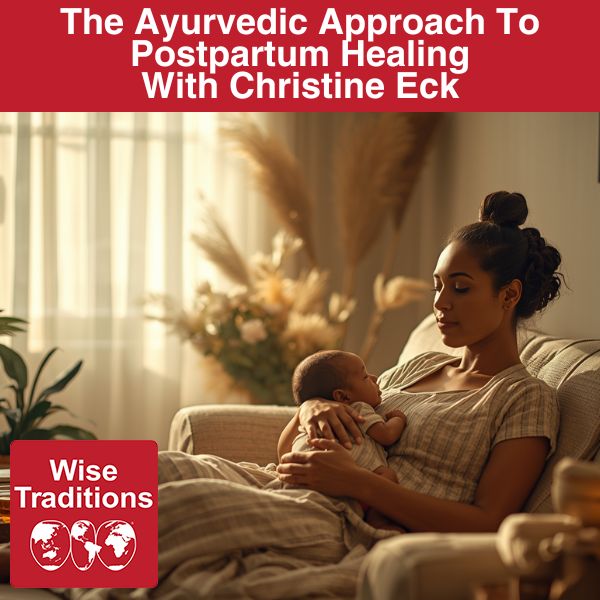
In this episode, Christine Eck shares an Ayurvedic perspective on postpartum healing—one rooted in rest, nourishment, and intentional support for the mother. Drawing from both traditional wisdom and her clinical experience, she explains why the body is especially vulnerable after birth, what it truly needs to recover, and how simple, time-honored practices can help restore balance.
Christine discusses the role of warmth, digestion, and nervous system regulation in the postpartum period, along with the importance of hands-on bodywork in helping the body realign and heal. She also addresses the long-term consequences of neglecting this phase—and why many chronic issues women experience later in life can be traced back to an unsupported postpartum recovery.
Whether a mother has just given birth or is years beyond it, this conversation offers a powerful reframing of what postpartum care can—and should—look like.
WAPF Donation Ad
Visit Christine Eck’s website to learn more
Join the Nourishing Our Children closed Facebook Group
Check out our sponsors:
Goddess Vitality from Optimal Carnivore – “Discount code WESTON10 for 10% off” and
Lumiram – “Discount code WISE for 10% off”
—
Watch the episode here
Listen to the podcast here
Episode Transcript
Within the below transcript the bolded text is Kendall Nelson
Introducing The Sacred Window And Long-Term Health
What happens after the baby is born? It is a question we do not ask nearly enough. Yet for many women, the weeks that follow birth can be some of the most physically, emotionally, and even spiritually demanding of their lives. We explore a powerful and often overlooked idea that this period after birth is not something to simply get through, but a critical window that can shape a woman’s health and well-being for years or even decades to come.
This is episode 579, and our guest is Christine Eck, founder of the Center for Sacred Window Studies. Christine is an Ayurvedic practitioner, postpartum doula, and educator who is helping to revive a more intentional, nourishing approach to postpartum care, one rooted in ancient traditions but deeply relevant for modern families. In this conversation, Christine explains what she calls the sacred window, those first 42 days after birth, and why this time is so important for restoring balance in the body, supporting the nervous system, and setting the stage for long-term health.
She walks us through the Ayurvedic perspective on postpartum recovery, including the concept of the Vata state, and how simple practices like warm, nourishing foods, rest, and daily care routines can make a profound difference. We also talk about what is missing in the Western model of postpartum care, why so many women feel blindsided after birth, and how community support, bodywork, and even small daily rituals can help mothers during this transformative time.
Before we get into the conversation, I want to let you know that the Weston A. Price Foundation is a 501(c)(3) nonprofit organization. We rely on memberships and donations to help us carry out our mission of education, research, and activism related to food, farming, and the healing arts. If you like what we are doing and would like to join hands with us, please make a gift of any size to WestonAPrice.org.
—
Christine, welcome to the show.
Thank you so much. It is a pleasure to be here.
I am so happy to have you on the show. I want to start by asking you a question about the sacred window. I know that is a term that you use to describe the weeks after birth. You say it can shape a woman’s health for years to come. What do you mean by that?
Thank you so much. It is a term and a phrase that I am super passionate about, never tired of learning more about. The sacred window, I guess I could answer this in a number of ways, but what first comes to mind is this concept in Ayurveda, but I think it is also reflected in lots of different ancient traditional ways around healing after birth, is that there is this window of time where every part of a person’s body, heart, mind, senses, identity is shifting and transforming.
There is a change on all levels that opens us up to great sensitivity, great possibility for renewal. It is like the tissue systems are just ready to be reset. How we care for someone during that time or how we give ourselves the honor of that window to really allow that transition to happen while providing the elements of care that are going to allow the body to do its work, which it so wisely knows how to do, we impact our health for decades to come. We have this ripe opportunity. This is the sacred window. Teacher Aisha Oakes would say 42 days for 42 years. What we do during this window of time helps set us up for this radiant, vibrant, strong parenting, living, partnering that we want to experience in the future.
There is a window of time when every part of a person—body, heart, mind, senses, and identity—is shifting. That change across all levels opens us to deep sensitivity and the possibility of renewal.
Explain that a little bit more. How exactly does this 42-day period have to do with what happens years down the road?
Ayurvedic Perspective On The Vata State And Restoration
There are so many layers to it, Kendall. The way we are used to seeing the postpartum window in our Western model is ultimately that it may just mean depressed. Maybe that word postpartum, people associate it with an experience of depression. Maybe people just assume it is this period of time we just sort of have to muddle through and somehow get past it. When we look towards ancient medical systems, we see that there is a very intentional change happening.
Nature knows what it is doing. When we look at it in terms of the elements in Ayurveda and other ancient sciences, we are really looking at how the human experience interacts with the natural world and the elements in nature. We can learn from the elements that are shifting within us how to restore balance and homeostasis in the body.
When we look at it that way, we can see there are very specific shifts that are happening in the body. We look at it as an elevation of air and space element in the body, and this is going to create some feelings of dryness. People might experience constipation right after birth. Our ability to have that fiery, robust digestion that we might be used to, all of a sudden, we are like, “I am not hungry,” or “I cannot digest my food well,” or I have gas now.” We might feel it in our state of mind. All of a sudden, we are a little scattered, or feeling uncertain or anxious. This is too much air and space in our mind and our nervous system tissue. A lot of these shifts are so wisely organized by nature.
However, the way that we receive care, the way that we are nourished through food, the way that we are nourished through care routines, the way that we are nourished through body work, these are ways that we can help to bring balance to that elevated air and space through providing some good fats, some warm, soft, well-cooked foods that the body has no problem digesting. When we have all those balancing qualities coming in, we find that people recover beautifully. The postpartum window, this is not depression, this is not a disease. This is a transitional window, and everybody who gives birth is going to go through a sacred window.
I imagine that the Western model of postpartum care is lacking. Would you agree with that statement?
Lacking Western Model Of Postpartum Care
I would. That is why I am here. That is why I do this work. I was one of those people who, I have met so many of them since starting down this path, where I felt really empowered during pregnancy. I felt really empowered after my birth. I frankly felt blindsided after he was born. I was just at a loss as to why I was struggling. It was because I had no idea, number one, that I needed the support that I actually needed. I had no idea that I could not digest the foods I was normally used to eating.
I had no idea how to start to put those balancing practices and elements and qualities back into my life in a variety of ways that would have helped lessen the aggravated air and space element, that Vata dosha, that natural elevation of these qualities that, when they go unchecked, can lead to more severe experiences of imbalance, particularly in the nervous system.
I think absolutely in the gut, which then, of course, is connected to our nervous system, can lead to lots of imbalances and the ability to breastfeed and produce enough milk for our babies successfully. It can impact, of course, just our overall sense of depletion. It is heartening to see the conversation around postpartum care really coming up more often.
The gut—closely connected to the nervous system—can play a major role in imbalances that affect breastfeeding and a mother’s ability to produce enough milk.
In a lot of spaces, there is so much more in terms of resources and learning opportunities that were not around when I was first becoming a parent. Systemically, we have a long way to go. I have heard Western medical providers call the postpartum window a black hole in maternal healthcare. This does not have to be, and so much of it is structured around the home and how communities and families are showing up. This is not complex care. This is actually really intuitive care. We have a long way to go.
What does that black hole look like? If you do not get this conscious care, what can a woman expect after she gives birth if she does not know to seek out somebody like you who can give them a better form of care?
I guess I will speak to my own experience after my first child because I think others might find similarities in what they experienced. I had set up for my mom to come for a week. She lived out of state, but she was going to come and stay. My mother-in-law was actually there for my son’s birth, and she stayed for a few days.
I had read that it was good to freeze some meals. I had worked hard during my third trimester to make casseroles and some baked ziti and freeze them in the fridge. I had read that it was a good idea to pump and store a bunch of milk. I had this whole plan about how I was going to pump milk and store it. What happened? I had a really great, smooth birth, actually. It was long, but I felt good.
Very quickly, within a few days after he was born, my husband had to go back to work. I remember starting to experience some clotting that was scaring me a little bit. I started a couple of days after that, experiencing some light fever. I was starting to get some clogged ducts. I certainly was feeling pretty anxious. Over time, I think that manifested in a fixation on sleep or lack thereof, like constantly checking the times, the windows of sleep I got. I cried a lot.
I overall just felt pretty isolated, and this is all pretty commonplace. I had midwifery care. I had probably the best you can get in terms of people checking on me, people looking out for me. Many people leave the hospital, and they are given an appointment at six weeks, and they are told, “I will see you then.”
Without the resources or frankly, the simple awareness that all of these things are expected because of this sacred window, this shifting in our bodies, this shifting of air and space, these new ways of operating that our body is trying to navigate under that seeking of balance, it is going to create things that we need support with, most importantly, rest and proper nourishment to do that. Without our systems really encouraging that, we are left to falter.
Modalities For Conscious Care Focusing On Nourishing Food
If you were to work with a client, what would be some of the modalities that you would use or suggest?
This is the good stuff. This is really where we realize that there are so many ways to nourish somebody, and all of that can be really focused around who this person is, what are the things that make them feel safe? What are the foods that they grew up loving? What did their grandma and their mother make for them when they were sick? What are the things specific to this person that create an experience of being cared for?
We can look at the Ayurvedic tradition, which is this beautiful 10,000-year-old tradition of care, where there is guidance on the postpartum window specifically and what brings the system back into balance. We can use this framework of care and lay that over the person so that we are really tailoring our cooking, our way of communicating, our care tools to what specifically will support them in the best way. In general, when we are looking at food and nourishment, the qualities that we want to be included are things that are warm, things that are soft, and maybe more on the soupy or mushy side, some good fats. Good fats are really supportive to the nervous system, to tissue rebuilding, to all the things, as you know.

I am sure all of your listeners really understand deeply that we want to boost that Agni, that digestive fire. We can do that through the use of spices and warmth, a little bit of appropriate heat to help jumpstart that appetite to get their system hungry again. With the understanding of those qualities, we can adapt that to a lot of different cuisines that may be really in line with this person’s normal way of eating. As we do that, we get the opportunity to just observe, how was that meal yesterday? How did that feel? Are they still constipated? Do they still have any kind of digestive upsets? We can tweak.
Maybe they are just not ready for the complexity of a recipe yet. We can start really simply. In that first couple of days, we are starting pretty simple, like maybe a chicken congee or a really soupy type of kitchari or a rice pudding, things that are really simple and nourishing. We build in complexity from there, which really gives the Agni a chance to grow into a robust campfire in our gut, if you will, that will help us to process. That is a little bit about food, but I will just pause in case you wanted to go deeper there.
What I am hearing is that the woman is in the Vata state, right? Things are sort of empty and cool, and you are trying to bring about more of the digestive fire, get things going again, and it sounds like you are doing that through foods. I have heard you say that we need to mother the mother. What other modalities do you use to do that?
I would say the pillars of Ayurvedic postpartum care are nourishment through food, as well as herbal support foods. This is not really a time when we are treating anybody. It is not a time for a bunch of supplements, really. The most available for our medicine is through food. Herbal support foods are a really great option, whether that is little snacks or beverages or milk tonics, things that we can put herbs and spices in that specifically support things like cell rejuvenation, lactation, digestion, and the nervous system. All of these are really four important areas where all of our care is directed towards nourishing and rebalancing.
Bodywork And Abhyanga For Nervous System Nourishment
The other area that I will speak about is bodywork. We practice what is called Abhyanga, which is a warm oil massage. Traditionally, this is a daily practice in Ayurveda for everybody. Just putting warm oil on your skin allows it to be digested by the largest organ in the body. What happens is the oil is ingested by the body, it starts to loosen any of those toxins or build up that we have inside, and it helps it to move into the gut, where it is then able to be digested and eliminated from the body.
We have this beautiful opportunity in postpartum, which is a unique time of cleansing in a way. We have this ability to offer this warm oil massage, which is, of course, so much more than simply cleansing the body. This is about nourishing that nervous system. It is about rebalancing the emotional landscape after this transition into parenthood has settled. It is about supporting digestion. It is about nourishing those tissues of the body that are sore, that have been through a lot. It is about rest. I have had so many women on that massage table who fall asleep, who maybe start to cry, who just are soaking in this attention.
Warm oil massage is one of the most beautiful practices we can offer in postpartum for people. There are other wonderful bodywork practices in this tradition, but that is really the staple. I think that even I remember the first time I was preparing for my own sacred window when I knew about all of this care. I expressed concern to my teacher that I do not know anybody who does this. I do not have someone who can do this, or I do not have the resources to make this happen.
She said, “It is okay. There is so much that you can do just with your own awareness.” Abhyanga actually, in Sanskrit, means self-massage. We can put the oil on ourselves. We can do all of this ourselves. We do not have to have a practitioner doing this. The idea is to create a routine of self-love. Another fun fact is that the word Sneha in Sanskrit means two things. It means oil, and it also means love. That act of putting oil on the body is an act of self-love. For postpartum, this is a transformational healing practice.
Extending Care To The Baby And Family Unit
Are any of these modalities used on the baby? Does your care extend out to the family in any way, or is it more about the mother?
Yes. One thing that we teach is Ayurvedic infant massage. The babies absolutely benefit from this. What I think is so important and what is missing as well in the Western perspective, is the synchronicity of needs between the parent and the baby. We have really very similar things that we are looking at in the postpartum window for both the birthing parent and the baby.
We are looking at their tummy, how are they feeling? How are they digesting food? We are looking at their cord care, their incision care, or their bottom. We are looking at their warmth. We are looking at their sleep. All of these go hand in hand. I think when we can really look at them as a unit versus separate, this is where really impactful care and healing come in.
This type of conscious care is something that you find in other cultures, too? Is it very specific to Ayurvedic practices that you might have found in India? Could we expect to have found this type of care in many different traditional cultures?
You can absolutely see overlap on every continent. The differences are what plants grow in that region, and what foods people are normally used to eating. The similarities are really beautiful to learn about. That is one thing we have students look at what is your background, and what are the practices from your ancestors, and how does that overlap with some of what you are learning in Ayurveda?
The quality of warmth, the quality of rest and seclusion, the quality of I think when we look at the different types of foods, we are looking at soups and teas and mushy things that people are used to eating with bathing, different types of whether it is steaming or warm baths, mother roasting. All kinds of practices from different parts of the world that help to warm up the parents. That drawing back from society a little bit, giving the person time to be cared for, where you are removed and allowed to integrate outside of your normal busy routine, that is a similarity.
Another one that we see is a ceremony, where people are around the world. Some specific rituals and ceremonies are intended to address that spiritual shift that we go through and really honor this new status, this new place in our own identity that we have moved into, and to be seen by our communities. That is when I think that oftentimes, for a lot of people who do not have that community that is paying attention to that spiritual shift, we might feel a little bit bereft or a little bit unseen.
What I am hearing is that it is a lot of mind, body, and spirit. It is not just a simple method of care. You are addressing all of these different elements of what makes us human.
Yes. In Ayurveda, the definition of health is really the physical body, the emotional body, the mental body, the senses, and how we eliminate. All of that is included in an understanding of perfect health, which is that we each have our own balance of what that is for us. The other thing that really sticks out to me about that approach is that every client is their own unique person. Rather than coming in with this way that I am now going to place on you, I am first going to find out everything I can about this person. What foods resonate with them? What makes them feel good? What is their constitution ultimately? From there, I can begin care in a conscious way.
It sounds like we really need to slow down a little bit. You are living in this super busy culture, and women are expected to have their baby, maybe sometimes go back to work right away, and do all of these things. It sounds like a lot of your care has to do with just being very conscious about being thoughtful about what you do and changing the pace. Is that true?
It is very true. That can be hard. I have practiced this stuff and taught this stuff for years, but I remember, even with my babies, it was hard to go slow. There is a natural restlessness that we might feel. When we look around at the qualities we see in society around us, which is high pressure and a focus on productivity and efficiency. These are all very masculine ways of experiencing life. While they all serve their purpose, there is also this need in human healing and human balance and the human experience, where, in order not to let that get out of control, we have to have this aspect and quality of rest.
This is really what the postpartum window calls for. I absolutely have seen people who receive this care. They begin to heal very quickly and beautifully, and they are feeling so good. It is almost after the doulas go home or their care ends that they start to like, “Now it is on me.” They start to feel that pressure or the reality of this fast-paced, pressure-filled world that we live in. I always find it to be a practice at each stage of parenting, of how I can create some slowness and opportunities for just simply being fully present. That is a practice, a daily practice.
The sacred window that you are talking about sounds like a beautiful way to frame this time after giving birth. I am wondering if there are other sacred windows that we should be respecting throughout life. What about other transitions that we have? Is this a good lens to view things through?
This is a beautiful lens, and I think it is one that, when you know it for one window, you can apply it to so many more. In the classic Ayurvedic texts, they point towards menarche, the first period for girls. They also point to menopause. I really draw a lot of parallels between the care that we offer to people during those windows, but more commonly, I think what we try to talk a lot about with our students is that every single person can take a sacred window when they need it.
Maybe it is after recovering from illness or surgery. Maybe it is during a massive life change. Maybe it is after a loss. Maybe it is after a big move. We have a lot of times in our lives when we are going through transitions that are overwhelming. Anytime there is Vata elevation, which is this increased air and space element, these types of practices are appropriate.
Definition Of Ayurveda And The Three Doshas
Can you explain to me a little bit more about Ayurveda itself? I have heard the terms Vata, Pitta, and Kapha, but I am not sure I 100% understand what those mean. Could you just go a little bit deeper into, first of all, what Ayurveda means? Maybe talk about those three doshas.
I would love to, thank you. Ayurveda literally means the science of life. Whether or not anyone listening has heard of the word Ayurveda, we are all living it. We are all in a human body living this life, and therefore, Ayurveda applies to us. Ayurveda is probably a ten-thousand-year-old medical science from what we now know as India. What is so beautiful about this framework is that we have so much documentation that has survived over the millennia to learn from. This bears lots of similarities to other systems, such as traditional Chinese medicine, which I have been taught derives from Ayurveda.
What we are really looking towards as a way to understand it is how we are observing nature’s qualities within our human experience. Each of us has our own constitution. This means that we have each been born with a certain amount of each of the elements within us. If people have heard of the doshas, these are just three combinations of elements in the world. We have talked a lot about Vata dosha, which is air and space.
We have Pitta dosha, which is fire and water. We have Kapha dosha, which is earth and water. All of us have this unique constitution. Some of us might be. I have more Pitta-Kapha in my constitution. I have this fiery part to me, but I am pretty grounded. I feel pretty balanced when these are at a good place for me. Some people might be naturally more Vata dosha, meaning they naturally have this lightness and this spaciousness to them.
Other people who are more heavily Kapha have a solid, they are very settled, and consistent. There are lots of ways we can observe those elements in our physical bodies, but also in our behaviors and our tendencies, the way that we feel day to day. We look at what we are born with, this constitution we came into the world with, but then we also look at how our sense of balance is shifting day to day based on our environment.
This is really the key. If we can pay attention to where we are, balance is not this destination where you get there, and then you are good. This is really about learning to recognize when I have started to shift away from a place of balance in any one area and understanding the qualities that I can include in my food and in my choices and my routines that help to bring me back. When we understand that for ourselves, it is a tremendously empowering, autonomous place to be.
Balance isn’t a destination you arrive at—it’s something you continually notice and return to. It’s learning to recognize when you’ve shifted out of alignment and using food, choices, and routines to gently come back. That awareness is deeply empowering and self-directed.
We are not relying on the whims of circumstance that dictate, sometimes, I think, particularly in postpartum, people are like, “I hope I do not get depressed. I hope I can nurse. I hope that this happens.” We are not at the mercy of that because we now have the understanding of what helps to make these systems, these processes work smoothly.
You mentioned postpartum depression. I am curious what that really is. Do you see that in your practice?
It is a reality in our modern day that there is a tremendous amount of perinatal mood and anxiety disorders, which is the term that is used at this point. A lot of it depends on what is our background with our own mental health. Absolutely, it is so much impacted by the presence or absence of care and of these qualities of balance. We learn in Ayurveda that the gut and the mind are intrinsically connected, and all disease begins in the gut.
When we are looking at nourishment and fostering a healthy digestive process for ourselves or our clients, we are already mitigating the lack of resiliency that might impact someone’s nervous system. We want to really create this juiciness, this ability to withstand. My colleague and I were just talking about this, and she used the analogy of those really windy days where there is all this air and space that is whipping around and blowing. If you try to put a big log on that campfire on the beach, it cannot really be burned through. It is just going to be this smoldering, undigestible piece of wood there. We can think about our own digestion in that way.
When we understand that the way we feel in our mind, and the way we feel in all of our tissues are really dependent on the ability to be nourished through the food that we are eating, to have that be assimilated, to have that be processed and used as this fuel for healing, we are able to avoid a lot of those perinatal mood and anxiety disorders already. Each person is unique and different in the way that we communicate.
The way that we show up, the way we offer a sense of being loved and cared for, is incredibly important. When people during that window of time feel isolated, or they do not feel comfortable asking for help, that impacts that sense of that juiciness in our heart of “I am seen, I am being loved on, I am being given care.” There is something so powerful about just someone making you a cup of tea and sitting down with you and looking into your eyes. This is a time when we have so many opportunities to do small things that create an impact in someone’s subtle channels of the heart and the mind.
Three Implementable Postpartum Practices
If you could see maybe three small things being implemented after birth, what might those three things look like?
I guess one that I am just going to say is that I would love to see people plan before their baby arrives for a robust community of care, whether that is hiring a postpartum doula, finding out who a local lactation consultant is just in case, setting up little visits from friends, maybe if you have older children, really creating a circle of care that you know is there for you because that goes a long way in helping people to feel grounded during that window.
During that window is not when you want to arrange that. I will say that. I will also say a thermos of hot water to sip on. Maybe it is a gentle tea, but something warm that is always available for you to be sipping on at all times. I guess the third one I will say, because food is sometimes more accessible than body work, is to follow those simple guidelines of easy-to-digest, warm, simple, good fats, soupy, those kinds of qualities in our food.
The work you are doing sounds absolutely beautiful. I wish I had known you when I had my child, because I did not get this type of care. I just want to thank you so much for being here. As we wrap up, I do want to ask you one more question. For the general audience out there, if they could do one thing to improve their health, what might that be?
I did not plan ahead for this, Kendall, because I always know that the right thing comes in the moment. I feel like in this moment, you mentioned it earlier, but slowing down. When we slow down and we give ourselves just a few minutes of quiet each day, we get the opportunity to notice who we are in our gut, who we are in our tissue systems, what feels good, what does not feel good, and we get the opportunity to start to really, really live in our bodies in a way that is using our wisdom to guide us in our next right choices. That connection is easily bypassed when we are going too fast. My answer would be to just give yourself some time to slow down and get to know what your body is telling you.
That sounds like a perfect answer. Christine, thank you so much for being with us here. I hope to talk to you again in the near future.
Thank you so much for the opportunity. It is such a pleasure, Kendall. Thanks for all you do.
Thank you.
—
If this conversation resonated with you, consider how you might bring even a small piece of this wisdom into your own life or into the life of someone you love. As Christine reminded us, healing does not have to be complicated. It can begin with something as simple as slowing down, creating space to listen to your body, and offering yourself or another mother the kind of care that is so often missing.
If you know someone who is expecting a baby or has recently given birth, this might be one of the most meaningful conversations you could share with them. To learn more about Christine Eck and her work with the Center for Sacred Window Studies, visit SacredWindowStudies.com. If you enjoyed this episode, please take a moment to subscribe, leave a review, or share it with a friend. It helps us continue bringing these important conversations to you. Thank you so much for tuning in. Be well, be nourished, and be free.
About Christine Eck
Christine Eck’s passion is accessing the subtle and unique keys to healing and vitality. She is a busy mother to 4 boys and practices her skills daily. Christine is an Ayurvedic Health Consultant, a Birth and Postpartum Doula, and the Founder of the Center for Sacred Window Studies, an education platform for Conscious Postpartum Care inspired by Ayurveda and other universal traditions found around the world. She established the Universal Mother Principles as a way of accessing the foundational qualities of giving and receiving effective care. The Center for Sacred Window Studies certifies postpartum caregivers from around the world in their online and in-person training programs. Christine runs the Sacred Window Podcast and blog, along with hosting monthly educational events to build awareness and educational opportunities for people who work with and support new families.
Important Links
- Christine Eck on LinkedIn
- Center for Sacred Window Studies
- The Weston A. Price
- Nourishing Our Children closed Facebook Group
Episode Sponsors
🖨️ Print post

Leave a Reply