

 🖨️ Print post
What if many of the treatments we rely on to relieve symptoms are actually interfering with the body’s ability to heal?
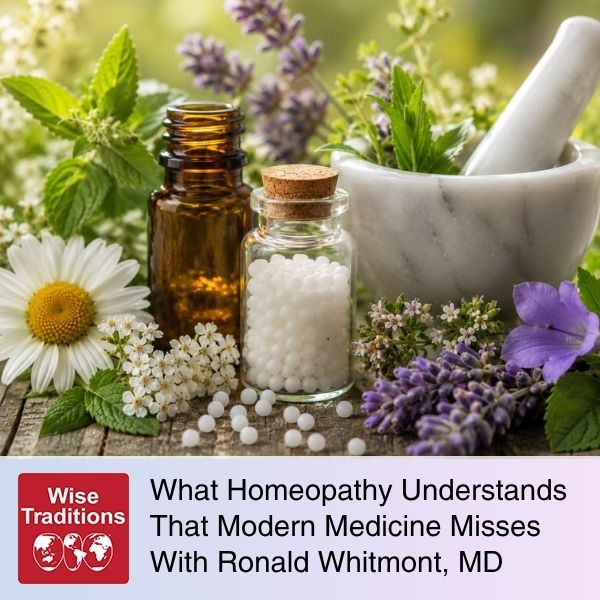
Ronald Whitmont, MD, has spent decades exploring that question. A board-certified physician, homeopath, and former president of the American Institute of Homeopathy, he joins us to discuss the fundamental differences between conventional medicine and homeopathy—and why he believes modern science is beginning to validate what homeopaths have observed for more than 200 years.
Dr. Whitmont explains how homeopathy works, the fascinating story behind its discovery, and why it was once one of the most widely practiced forms of medicine in the United States. He also discusses the Flexner Report, the decline of homeopathy in America, and the growing body of research on the microbiome that is reshaping our understanding of health and disease.
Along the way, we explore symptom suppression, chronic illness, the body’s innate healing capacity, and even the use of homeopathy in plants, livestock, and infectious disease prevention.
Whether you’re completely new to homeopathy or have used it for years, this conversation offers a thought-provoking look at healing, science, and the future of medicine.
WAPF Ad – WAPF Membership – Visit westonaprice.org and click on the “member yet” button. Use the code pod10 to join for only $30 in the U.S. for the year.
Visit Dr. Ronald Whitmont’s website to learn more
Join the Nourishing Our Children closed Facebook group
Check out our sponsors:
Paleovalley Beef Sticks -Visit paleovalley.com/wise to receive 15% off your first order
Goddess Vitality by Optimal Carnivore – “Use code WESTON10 for 10% off”
—
Watch the episode here
Listen to the podcast here
Episode Transcript
Within the below transcript the bolded text is Kendall Nelson
What if many of the chronic health problems we see aren’t caused by a lack of medication but by too much medical intervention? What if healing isn’t something that comes from outside of the body, but something the body already knows how to do when given the right support? In this episode, we explore one of the most misunderstood and most controversial systems of medicine in the world, homeopathy.
This is episode 588, and our guest is Dr. Ronald Whitmont. Dr. Whitmont is a second-generation homeopathic physician who grew up in a family deeply rooted in homeopathy, psychology, and holistic healing. Dr. Whitmont attended medical school, completed conventional medical training, served as a medical officer in the US Navy, and has spent nearly three decades helping patients recover from both acute and chronic illnesses through homeopathy.
In this conversation, Dr. Whitmont explains what homeopathy is, how it differs from conventional medicine, and why he believes modern microbiome research is beginning to validate observations homeopaths have made for centuries. We discuss the history of homeopathy in America, the impact of the Flexner report, common misconceptions about homeopathic remedies, the role of homeopathy in animals and agriculture, and the growing body of research examining its effects.
We also explore the broader question of what it means to be truly well and whether medicine has become too focused on suppressing symptoms rather than supporting the body’s natural resilience. Before we get into the conversation, I want to let that the Weston A. Price Foundation is a member supported group. In other words, we can only do education, research and activism with your help. There’s just no other way. Please become a Weston A. Price Foundation member. Go to Weston A. Price Foundation and click on the Member Yet button. Use the code POD10 to join us for just $30 a year. Thanks in advance and welcome to the family. This is Kendall Nelson and you’re tuning into Wise Traditions.
—
Growing Up In A Homeopathic Household
Dr. Whitmont, welcome to the show.
Thanks very much, Kendall. It’s nice to be here.
I’m so happy you’re here. Let’s go back in time a little bit. I want to start talking about what your childhood was. I think it would be considered a little bit unusual for today’s standards. I know your second-generation homeopathy. Can you talk to me about what it was like growing up in your household?
As you mentioned, I’m second-generation because my father, Christopher Whitmont, was a homeopath. He was also an anthroposophical extended physician. He trained with Karl König in Vienna, Austria, before he was forced to leave the country and then came to the United States, where he became a homeopath. I grew up knowing homeopathy as this was our form of medicine. There was no comparison. There was nothing to compare it to other than being raised in a household where homeopathy was commonly used and talked about.
Conventional treatments focus on suppressing symptoms, but true healing requires supporting your body’s natural resilience.
It was a common dinner-time conversation. My parents were both somewhat eclectic in their backgrounds. They met through the Anthroposophical movement here in New York State. I believe they spent time together for a very short time at Threefold Farm in Upper New York State before they were married, in fact. My mom was very interested in Psychology, and she became a therapist. My father, who started out as an anthroposophical extended physician, became a homeopath and then started going into Jungian analysis himself, then became a Jungian analyst and founded the Carl Jung Institute in New York City.
I had grandparents. My grandmother, who I never met, was one of the founders of the Waldorf School in New York City. It’s in my blood to be talking about this stuff. It goes back a couple generations. I’m the youngest of five siblings. We were all raised under that roof with those kinds of words and thoughts going around.
You were raised in this environment practicing homeopathy but you decided to go to medical school. Tell me why you decided to go to medical school. What was that experience like? What did you learn?
From Conventional Medical School To India
To me, when I was growing up, in high school, I started first thinking about going to medical school. I just wanted the best education possible. From a fairly early age, I knew my dad loved what he did. I knew he was successful in treating people and got a lot of pleasure from working with people. I started doing more psychological work. In high school, we had encounter groups. We had a lot of human relations projects going on. I realized the mental and physical parts of health were so intriguing to me.
I then decided if I wanted to do something like homeopathy, which incorporates mental and physical health aspects. Medical school was the best place to start to form a foundation in biophysical medicine and then you can just build on top of it. Anything you want. That’s where I began. I was not successful in getting into medical school the first time, and then I ended up doing work in India. I also worked in very rural clinics in a mobile hospital in India. I studied meditation.

Every stop along the way, I felt like I was adding things to my armamentarium and what I could utilize to help people get better and to heal. Along the way, he was working at a psychiatric treatment center for young adults in Litchfield, Connecticut. We had a very integrated program in treating people with all forms of different therapy, involvements, work programs, psychotherapy, pharmacology, and bioenergetic. My dad was eclectic as well and that taught me to gather things together. If you think it relates a little bit, bring it in and medicine was the first of those. Bring it in and then see what are the limitations and what can you learn from it. What can you do?
I’ve heard you say that there are some dangers to just going the allopathic route. What do you feel about that?
That’s a big question. I don’t even know where to start scratching the surface of that. I find it very helpful to contrast the allopathic route with the homeopathic route. In the sense that the allopathic route is about manipulation. You want to manipulate the environment to meet your needs. It’s about man against nature or woman against nature. From the very start, it’s extremely disruptive to health. It’s a great form of intervention when it comes to emergency medicine, trauma, and acute life-threatening conditions. It is so amazingly powerful like intensive care medicine but in terms of a sustainable form of medicine, it is not.
The Dangers Of Conventional Medicine
The more we’re learning about the ecology of health and by ecology, I mean that, inside the body, we have ecosystems that have been described more and more through research in microbiome science. All of this research is showing us that the ecology of our health, like the ecology in the environment, is critical to our well-being, our mental and emotional health, and our physical health. When you use conventional medicine in anything but a non-emergency situation, you’re going in there like a bull in a China shop.
It’s extremely disruptive. It is very effective as we know. Unfortunately, it’s got a huge negative impact on long-term health and that’s one reason why we’re seeing such an epidemic of chronic inflammatory conditions in our society and virtually in every society that is using conventional medicine and those drugs. That’s what we’re seeing in microbiome science. It’s exposing the dark underside of conventional medicine.
Conventional medicine, I assume when you went to medical school, that you learned how to diagnose a problem and treat it most commonly with a drug. Correct?
Our bodies aren’t machines to manipulate. They are ecosystems that flourish when we stop disrupting them with aggressive drugs.
Correct.
If you’re trying to just suppress symptoms, what happens to the body when you don’t deal with the root cause of the illness? I see it like putting a band-Aid on it. You’re suppressing the symptoms and taking away the cough or whatever the ailment is. Can a person ever truly be well if they don’t get to the root cause of the ailment in the first place?
There’s been lots of different information that comes out about that question. I believe that you cannot just be well if your focus is only on making sure no one has symptoms of illness. Though conventional medicine is often built as a form of scientific medicine, it doesn’t focus on the continuum of health throughout one’s life. It focuses pretty much on the short-term recovery from very specific and controlled circumstances.
For instance, a urinary tract infection is focused on within a very short time frame. What’s the best time frame to treat it? What’s the shortest course of antibiotics you can use? There’s no consideration beyond that time frame for what are the long term manifestations and what are the long term ramifications of, if you go after a urinary tract infection with an antibiotic? That then disrupts the ecology not only of the urinary tract but of the gut and of all the other microbiomes in the body that are functionally interacting.
In homeopathy, that idea of suppression that you mentioned, where you’re putting a Band-Aid on it. You’re getting rid of a symptom. You’re temporarily levitating a problem. Homeopaths have looked at this for a long time and said, “Phenomenologically, we see that this is a problem that we see when you treat and suppress symptoms they often go deeper. The condition or the inflammation becomes not as superficial, but goes deeper or into what we call more vital organs.” An example of this is, treating someone who might have a respiratory condition and you give them an antibiotic.
A year or two later, they have a chronic respiratory condition. They now have asthma or someone who has an inflammatory condition that you are treating, maybe antibiotics or anti-inflammatory medicines. A few years later, they’re showing signs of heart disease. This is something that we’ve noted phenomenologically in homeopathy for centuries. The microbiome is now showing that this is factual. We’re looking at the studies that have been published in peer-reviewed, conventional medical journals showing the increased incidence of asthma after antibiotics are used in the first year or two of life.
As you know, companies have been forced to withdraw anti-inflammatory medications because they were causing people to have heart attacks. This is the same thing that we notice phenomenologically. Now, it’s being shown through the science of genetic sequencing technology, microbiome science and epidemiology that this is real. It’s not just what a few doctors observed and you can discount it. This is science. It’s cutting-edge science showing that the ecology of the body and the ecology of the microbiome, when it’s disrupted, has negative implications and negative consequences that are often permanent.
You might go through a period of feeling better and you might go through a period of, “That urinary tract infection or that respiratory infection has been resolved.” If you look down the road at another inflammatory condition, conventionally they may say, “That’s different.” If you look epidemiologically and you look at the statistics. You see it’s not different. You’re now seeing an increased risk of these things across the board. That’s the nice thing about putting science together with this beautiful field of homeopathy that was able to find tools to help people get better without those negative complications.
It’s my understanding that homeopathy is the second most common practice medicine around the world. If you go to Europe or traditionally, the royal family. They always used homeopathy, and Mother Teresa praised it, and our US presidents were praising it up to a certain point. What happened? Why don’t we have the amount of homeopathy colleges that we used to have? I’m under the understanding that we used to have maybe a couple hundred homeopathy hospitals in the US. What changed?
The Flexner Report And The Decline Of Homeopathy
There’s still ongoing discussion about what happened, but you’re absolutely right. President McKinley, at the time of 1900, I believe it was, dedicated the Hanuman Monument in Washington, DC. It’s a beautiful monument, but it was a presidential dedication that was done at that time. At the turn of that century, there were over twenty different homeopathic medical schools and there were probably more than 100 homeopathic hospitals and mental health centers and sanatoriums that treated mental and emotional conditions as well very successfully.
I’m going to simplify things and it’s much more complicated than I can describe, but there was a period leading up to1900 and 1910 when there was not as much organization. There are a lot of collective practices that are taking place. There wasn’t a centralized, powerful or strong lobby behind homeopathy. It was in its heyday. There were a lot of physicians using homeopathy, but it may not have been the highest quality of homeopathy. At least that’s what I’m told. It was the Carnegie Foundation working with the American Medical Association and the Rockefeller Foundation that established and decided that they needed to control this field somewhat.
They hired a guy named Flexner to report on the state of medical education in the United States. Flexner was a man with no medical training or whatsoever. He visited all the medical schools, including alternative and conventional. They were open at the time and he filed the Flexner report, which was a damning report. It basically criticized all the non-conventional schools for being inadequate in some way. Largely because they were not teaching pharmacology. This was believed to be the cutting-edge science of that time.
The ramifications of the Flexner report were tremendous. It led directly and indirectly to the loss of funding, the loss of applications, the loss of interest in non-allopathic medical schools. That was the beginning of the end. Without a steady stream of physicians coming in, you couldn’t hold the infrastructure or the educational system intact. It required interest, money, and strength and numbers. That was the beginning of the end of homeopathy in the United States. It went underground. It can continue to be used by groups like the American Institute of Homeopathy, which was founded even before the American Medical Association continued to exist.
Homeopathy works like a catalyst. When you choose the right remedy, it prompts your body to heal itself from the inside out.
Their population dwindled from tens of thousands of physicians before the Flexner report, down to literally hundreds after that. It was a systematic assassination of not just homeopathy, but other alternative fields. Naturopathy suffered. Different eclectic approaches suffered as a result of that and it changed the landscape of medicine in this country. Partly as a result of that, the conventional medical system is the strongest lobby of our government as it is now. They have like five lobbyists for every member of Congress. It’s outrageous. It may be higher than that, but it’s quite lopsided.
I watched the movie Introducing Homeopathy. I thought one of the interesting things in there was that they went to a man-on-the-street interview. They asked people randomly on the street, “What is Homeopathy? Do you know what it is?” They selected the ones that didn’t know but there seemed to be a lot of people that didn’t know what it was. Can we just back up a little bit and can you describe for me what homeopathy is?
Demystifying The Law Of Similars
I’ve been struggling with that my whole life and I don’t think they had to search far at all to find people who didn’t know what homeopathy was. That was probably just completely a random survey. What is homeopathy? First of all, homeopathy is the second most commonly used form of alternative medicine in the world. The first is herbal medicine. Homeopathy is often confused with herbal medicine because they’re both natural forms of medicine. Homeopathy is a form of medicine based on the Law of Similars.
The Law of Similars is a phenomenon. It’s a repeatedly observed phenomenon that was discovered by a German physician named Samuel Hahnemann several years ago. The way it came about was that Dr. Hahnemann was translating medical texts or pharmacological texts into German. He spoke 7 or 8 languages. He was a very bright scholarly man. He was translating a treatise by a Scottish pharmacologist named William Cullen, who was describing the benefits of Peruvian bark for its use in treating relapsing fevers like malaria.
We now know that bark was effective because it did contain small amounts of quinine in it, which is currently the treatment of things like malaria and other logical conditions. Cullen in his treaties, said that the Peruvian bark was effective because it was an astringent herb. Hahnemann, while translating said, “This is absurd. I know many astringent herbs that don’t have any impact on relapsing fever.” For some strange reason and you’d have to be a Hahnemann scholar to know why, but he decided to start taking the medicine himself.
He just started to take that herb himself. Lo and behold, he developed symptoms of fevers, aches, and body pains that were so closely parallel to the condition of relapsing fevers that Cullen had described using the herb for. He had this a-ha moment and said, “Could this be why the herb works?” Not because it’s astringent but because when you take it and you’re healthy, you develop the symptoms of the condition. From that moment, he started testing other medicinal products to determine if he also developed symptoms from them and could you use those products in medicinal form to treat a similar condition. He found that to be true. You can.
He felt like he stumbled upon a universal law. It turned out that Hippocrates also had mentioned that you can treat illnesses two ways. One was similar and one with opposites. He uncovered this phenomenon. Homeopathy is nothing more than the science of studying very carefully and meticulously what are the qualities and effects of any individual substance on a group of people. That was called drug proving, and it turned out to be that this was the first time a double randomized placebo-controlled, double-blind test was done in medicine. Up until that point, everyone was doing everything theoretically.
Think homeopathy is just a placebo? Double-blind studies in veterinary medicine show it works beautifully on livestock and plants.
They thought, “This is a warm substance or this is a caustic substance so it should work in this condition.” Hahnemann said, “You don’t theorize how it’s going to work. You demonstrate the quality of the medicines and then you demonstrate in a blinded fashion, whether it works in someone who has those similar symptoms,” and that’s what he did. He cataloged about a hundred different medicines in his lifetime using his own body and those of volunteers who agreed to do it. They meticulously recorded symptoms that were from the mental and the physical sphere.
They catalogued them, and then, as a physician, he treated people with those similar patterns with the medicine that would evoke the most similar parallel or mirror-like image in a healthy person. That’s what became homeopathy. It’s something that was evolving and something that was never set in stone. It had to be proven, reproving, and tested, and retested again and again.He started writing about it and other physicians became interested in taking up the work. It spread around the world from that point onward and came to America in 1825. It went across the West with settlers, but homeopathy is the science. It’s based on a phenomenon of the Law of Similars.
When I go to my homeopathy clinic, she prescribes a certain medicine. What is it in that medicine that I’m getting?
You’re touching on an issue that becomes not primary to homeopathy but as we recognize it, it’s a central part of it. That is, the preparation of a medicine generally involves a process of diluting a medicine and shaking it extremely vigorously. There’s machines that do that. The reason for that is that as Hahnemann was experimenting and doing this work, he found, let’s say he was giving the quinine or the bark from the Peruvian tree to treat someone with a fever. He found that many people would also get side effects from that bark because it was astringent. It did cause effects on your mucous membranes.
If you gave too much of it, it could be poisonous. I don’t know how this happened but somehow, he started using less and less of it and diluting it more. The report is also that the medicine said he did a lot of house calls. The medicines that he transported with him to households were getting shaken up because he was either on horseback or he was walking. Those medicines were being shaken and he found that they worked better than the ones that were in his office.
He started testing different ways to make medicine and arrived at this process of diluting and succussing, which is this vigorous shaking. When you buy a homeopathic medicine, it has been diluted and succussed anywhere between 6 to 30 to 200 to 1,000 times. One of the supposedly biggest or most incredible things about homeopathy is that you’re giving sometimes such a small dose of medicine that is hard to find a single molecule of the original substance.
Why Nanoparticles Matter In Microdosing
There’s been research over the last decade or two that demonstrates that even in the most highly potentized homeopathic medicine, there are nanoparticles of the original substance present. Hahnemann didn’t know that, and we’ve only known that for a decade or so. The idea or the accusation that homeopathic medicine contains nothing is not true. That was one of the most frequently used arguments against homeopathy, saying it’s anti-science. It defies the laws of physics. Therefore, it can’t possibly work.
Those arguments were false because there is nanotechnology and medicines are now being researched that deliver nanoparticles of substances. They do work. The way our bodies’ hormones work is through nanoparticles of hormones. Nano quantities of cytokines. This is not unique to homeopathy. This is more the law of medicine than it is the uniqueness of homeopathy. What’s unique is the massive amounts of drugs that are delivered conventionally. That’s unique. That should be considered an outlier in medicine. Not the homeopathic because the homeopathic is most compatible with what the body does organically and naturally, anyway.
There’s a lot of misconceptions about homeopathy. One of them is the fact that you have what you’re talking about with diluting. Also, the idea that the smaller dose is more potent than the higher dose of something. It’s hard for people to wrap their heads around this. What are some of the other misconceptions about homeopathy?
Most of the misconceptions we have around homeopathy are because most of us have been raised from the earliest time under conventional medicine. We’re sent to school, and we’re taught this, and we’re taught that you have to keep taking your drug or it won’t work. You have to keep taking an antibiotic or Tylenol or aspirin because it will lose its effectiveness. One of the things that homeopathy has clearly demonstrated is when you get the right medicine, you don’t have to keep repeating it. You give it. It acts like a catalyst in the body.
The goal of homeopathy is to give it as infrequently as possible. This is curious because you have probably the least toxic form of medicine on the planet because it’s inherently been reduced to such a small quantity. Yet, homeopaths are very hesitant to give it more than once in a day. Not like you take a conventional drug every four hours or twice a day. Homeopaths have treated very severe pathology by giving a single dose of a medicine and watching the results take place as the body heals itself.
That’s the other misconception, is that somehow a drug heals the body, and it doesn’t. A drug will interfere with the way the body heals. It’s good at doing that, but the body must heal itself. Anyone who’s going through a true healing has experienced that at some level. Homeopathy can act like a catalyst. When the right medicine is chosen, there’s a catalytic effect and transformation can take place. When the wrong medicine is chosen, nothing happens. It’s as if you have given something that is null and void. It doesn’t have any impact.
When someone says, “This medicine doesn’t do anything. I can swallow the whole bottle of it.” If it’s not the right medicine for you, it won’t have an impact, which is another reason why it is so safe. If you are working with a very finely tuned machine, you only need to apply a very small amount of pressure and the machine responds. If you’re working not by individualizing your medicine, you’ve got to hit it with a sledgehammer. That’s what conventional medicine does. It uses the maximum amount that’s tolerated by the body and takes milligrams or grams of medicine because you’re forcing the body to do something it does not want to do.
When you are using homeopathy, we’re recognizing that the symptoms that the body produces are cries for help. It’s information that tells us what would be the most similar medicine and how would the body be best helped in itself trying to heal itself. Another misconception is that man heals illness. In fact, when you look at conventional medicine, I have to think for a few minutes to find anything that’s healed with conventional medicine.
At one point, I couldn’t think of anything that we’re healing other than an acute self-limited condition that’s going to gut better on itself anyway. We manage conditions. We manage them medically. We manage diabetes, heart disease, and stomach problems. Unless they’re surgically removed or when you’re dealing with trauma and emergency medicine, very few things are cured or healed. That’s because you’re not working with the body. You’re working against it in most situations.
I know you’re a big proponent of a healthy lifestyle, healthy eating, and exercising and all of this stuff. I think I’ve heard you say that conventional medicine does more harm than anything that we could possibly be doing lifestyle-wise. In other words, if you’re not eating properly and you’re not exercising properly. Maybe some other lifestyle choices are not perfect. Is it true that conventional medicine may be even more harmful than improving those areas of our lifestyle?
On an individual basis, it’s an interesting question because sometimes, when I talk to people in my office and they are complaining about a particular problem or symptom that has been bothering them. Looking at their medical history and their medication list provides the answer to what’s going on. It’s like, “Did anyone ask you if you have that symptom? Are those side effects from the drug you’re taking?” These things are so common. We feel volumes of their whole books devoted to the side effects of these drugs.
They’re not rare. They’re not unusual and not uncommon. They’re so common, but you’re right and I agree with you. Our lifestyle plays a critical role in our health. We have very good evidence and that’s growing too about the impact of things like diet, sunlight, exercise, and the benefits of those things on keeping one healthy. As you asked earlier about growing up, my parents ate well. We had huge salads at every dinner and followed by a vegetable and then maybe a small portion of meat, then fruit for dessert. These were things that were ingrained in me from an early age.
My father and mother both spent endless hours in the sun and reaped benefits from those things. Now, conventional medicine tells people to avoid sunlight because it increases the risk of skin cancer. What they’re not telling you is it decreases the risk of every other form of cancer in our bodies directly. We’ve done so much harm to people even by these medical fads over time. An example is the American Academy of Pediatrics who told parents, “You better avoid peanuts until your children are like five years old.”
They reversed themselves when the science showed that the earlier you expose your kids to allergens like peanuts, the better they do. The less likely they will go on to develop allergies. We have a very harmful system of medicine that is maybe on the surface benevolent. Maybe on the surface people trying to do good and trying to do the best buy their patients but giving information that’s bad. This happens again and again. This is why I love science because why don’t we do a study on it rather than tell people that is bad? Why don’t we look at the results of doing these things?
Unfortunately, that happens. There was a British journal who looked at conventional medicine a few years ago. I think they published a book called Clinical Evidence and found that less than half of the practices conventionally were evidence-based and 10% to 11% were known to be harmful. Unfortunately, we have a business model behind medicine that is the way things are run. Physicians, although they may be well-meaning, they don’t have time to do the research themselves. They don’t have time to look at the studies and to question the data that should always be questioned and to look at the science.
Unfortunately, this is partly by design that physicians are trained in such a way not to ask questions, but to memorize, regurgitate and to learn from your teacher, your drug representative, your lobbyists, your government advisory board to tell you what to do. Not to learn by experience and not to look at the science yourself. You have a population of well-behaved and well-mannered physicians who are not asking the right questions as a result of their selection on that basis. You don’t get to medical school by asking questions. You get there by getting good grades. Unfortunately, we’ve created a society of physicians that aren’t looking out for their patients’ best needs.
My other job at Weston Price is working as a vaccine consultant for them. They’re a vaccine policy. I’m forever frustrated by what doctors learn in medical school regarding vaccines. The fact that they’re not open to basically learning what the diseases and what to treat them with for the vaccine. I’m curious how homeopathy can be used as a prophylaxis for vaccination? Is that something that you do in your practice?
I could probably say on any topic, we need more research, but everyone says that no matter who they are or what they’re studying. There’s some eye-opening research papers on this topic. I think the most important one was done in Cuba. We’re talking about many years ago, but they get seasonal leptospirosis that occurs epidemic in the island as a result of heavy rainfall and all sorts of issues of nutrition and living conditions. At the time that this study was done in Cuba, they couldn’t manufacture vaccines. There was some problem with the vaccine manufacturing in Cuba. They knew that they were going to be way behind in vaccines.
Somehow, they decided to generate a homeopathic medicine for leptospirosis. In fact, they used the leptospirosis organism itself. It created an oral homeopathic dilution for it and they distributed it. One of the great things about homeopathy, it can be manufactured extremely rapidly from extremely small quantities. You can generate massive amounts of deliverable drugs. They did the study at the same time. Not only did they spread it out. They delivered it but they also looked at the results and they looked at an area that they couldn’t reach as a control population.
They looked at everyone else and compared it to previous years of leptospirosis. They found that when they use the homeopathic nosodes, which was a preventive measure. They found drastic reductions in leptospirosis that year. In the populations that were not treated, they saw the expected rise in leptospirosis. They statistically analyzed it. They had statisticians and scientists. They had good science. They wrote a paper and no peer-reviewed medical journal would publish it. They sent it to the New England Journal and General American Medical Association. They ended up getting it published in a peer-reviewed homeopathic Journal of Homeopathy, which as far as I know the only peer-reviewed homeopathic journal that’s listed in the Library of Congress and the PubMed.
Modern microbiome science is finally beginning to validate what homeopathic practitioners have observed for over two centuries.
Again, there’s this ivory tower and this blockade of information. That information doesn’t reach your average clinician because they’re not reading homeopathic medical journals. They’re only reading the New England Journal and they’re only reading the summary of the articles in most situations. Yet, the answer to your question is, yes. There’s very highly suggestive information that these medicines can provide immunity. We don’t know how long the immunity lasts. We need more studies done.
We don’t know exactly how powerful it is. Will it work for things like Ebola? Will it work with COVID? Yes. We have some studies from COVID. Good Science has demonstrated the benefits of homeopathy and COVID. Ebola is a very interesting problem because a group of homeopaths tried to get into an Ebola ward or compound in Africa many years ago, whenever that last outbreak was and they were refused.
They were volunteers. They wanted to go in and they were told, “You can’t go in. We won’t let you. It’s unethical. It’s unethical to try something like homeopathy.” There’s a stone walling taking place, but there’s little glimmers of science that you see around it. It’s very positive. I wouldn’t say go out and use homeopathy instead of anything. At this stage, I would love to have some more science to base that recommendation on.
We’ve talked a lot about homeopathy with people in the interview. What about homeopathy for plants or animals or our livestock? How could it affect our food supply?
You’re also raising the point that for so long can conventional physicians have argued against homeopathy saying it’s just placebo. It has to be Placebo because as we know, you’re not giving enough of a drug to do anything. That argument completely ignores the evidence and the science that has been done in the environment, on animals, in veterinary medicine, on children, infants and newborns, on people who are in a coma and in plants.
We have, so far, two research conferences held at the University of Connecticut in Farmington, Connecticut, back in 2025 and 2023, where we pulled together the leading researchers looking at homeopathy around the world. Research in homeopathy, if not all research in homeopathy is done outside the United States because the National Institutes of Health in their unbelievable wisdom, decided that homeopathy wasn’t worth funding anymore.
Homeopathic Applications In Nature And Livestock
These scientists have done very high-quality research looking at the effects of homeopathy in lakes and measuring its presence in a lake using bioluminescence and different spectroscopy. Some of the highest and most sophisticated technology can measure the effects of homeopathy in the environment. We’re not even talking about the human body. It’s very exciting. They’ve found that homeopathy can be used in place of pesticides, protecting plants like strawberries against pesticides, which is one of the most heavily treated crops here in the United States.
In veterinary medicine, it’s being used around the world. A lot of the good research in veterinary medicine comes from the United Kingdom. It’s used in sheep and pigs. There have been randomized placebo-controlled studies done in pigs demonstrating the effect of homeopathic medicine in preventing and treating diarrhea, which kills piglets. It is a significant, so great question. The evidence is there. We’d love to have more of it. We’d love for it to happen in the United States.
I am curious what you see in your practice just day-to-day. I know you’re a working homeopath. Give me an example of some amazing cases that you’ve had. What do you see that’s commonly cured with homeopathy?
I see a slice through the spectrum of what’s out there because most of my patients are families that I’ve treated. I’m treating three generations of people in the same family, taking them through everything from their common colds, flus, and COVID, and if they have other more serious illnesses. I see people who come to see me for the first time when their conventional treatment methodologies have failed, or the side effects from their treatments were intolerable, or they just decided, “I don’t want to have anything to do with living the way they say I’m going to have to live if I follow their guidelines.”
I’m seeing a cross-spectrum. Everyone from acute conditions to a high blood pressure, heart disease, diabetes, asthma, and rheumatological conditions. There’s a lot of people who have rheumatological conditions that are treated suppressively. Treated with things that turn off your immune system. I have treated a patient who has rheumatoid arthritis now for 15 or 20 years. Their physician tried to put them on one of these disease-modifying agents that turns off your immune system, increases your risk of cancer, and raises your risk of getting tuberculosis because your immune system can’t work.
She hasn’t had to use any of that and has remained completely symptom-free for 15 or 20 years. It’s a marvelously effective system of medicine if you follow the guidelines and if you practice it through the science of the way it’s been observed to work. If you utilize it haphazardly, randomly or the way you think it should be used. Who knows what the results would be? In my experience, I work and live in an area that’s very endemic to Lyme disease. Over the years, I’ve been in practice almost 30 years now. Numerous cases of Lyme disease in my practice very rarely have to use antibiotics. Most people have very good results and consider themselves to be free of Lyme disease.
Dr. Whitmont, as we begin to wrap up. I want to ask you one last thing. We’ve talked a lot about conventional medicine and the harms that it can cause and the benefits of homeopathy. Is there hope in the gap between cutting edge science and homeopathy narrowing?
It is. I’m amused. I’ve studied medicine. I did residency in Internal Medicine. I did an internship. I worked for the United States Navy for years as a medical officer. I’ve treated people conventionally and I followed the science. I look at the research both in homeopathy and in conventional medicine. What continually astounds me is how the conventional approaches to say, “None of that works. It’s all hogwash. It’s all your imagination. It’s all placebo.”
Lo and behold, they discover this new discovery for them that something works. Now it’s the greatest thing. Microbiome science is the cutting edge of medicine. As long as it’s permitted to continue, we are finding more and more about the harms of conventional treatments. Microbiome science is showing that all conventional medicine disrupts the microbiome and causes dysbiosis. Dysbiosis is the precursor to chronic inflammatory illness, from heart disease to cancer to autoimmune diseases across the board.
Will the gap narrow? It will very reluctantly narrow. We will see people trying to cling to the paradigm of conventional medicine in the face of increasing knowledge and increasing science demonstrating the paradigm is wrong. That the germ theory of medicine only represents a tiny fraction of the reality of medicine. The rest of it is like an atom bomb in your body. I do believe that can’t help but be brought to light. Researchers conventionally are saying, “How do we have our cake and eat it too? How can we give that antibiotic and then restore the microbiome? How can we destroy the microbiome and then bring it back again?
The fact is, you can’t. They still are reluctant to say, “Maybe the premise is wrong. Maybe this idea that germs cause illnesses is wrong.” That’s what Hahnemann said forever. Maybe it’s the environment. Maybe it’s the microbiome or the ecology that has to be worked with. They say in medicine, as in many fields, progress takes place with funerals because people don’t like to change their mind. They don’t like to admit that they’re wrong and they don’t like to say, “I made a mistake,” so they hold out. It’s the newer generation that comes in and says, “You guys didn’t have it right. It needs to be like this.”
I have hope for that, but change takes place very slowly. We’re seeing the destruction of medicine as we know it. It’s just collapsing all around us because it’s barking up the wrong tree. It’s creating its own mess and it doesn’t realize yet how bad it is, or at least that those who are delivering it don’t realize that. The manufacturers and those who are higher up recognize that it’s very destructive, but that’s their income. What is the main thing that keeps people working? You have to support your own family. We know from past societies and from some of the most atrocious regimes in history that people will do almost anything if they keep feeding their own families. This is a dangerous part of human nature.
Dr. Whitmont, you’re such a wealth of information. I hesitate to let you go but the good news is, you’re going to be at our conference in Washington, DC in October 2026. Our audience will be able to meet you in person and hear you talk there. I have just one final question for you. It’s what I ask all of my guests, and that is, if the reader could do just one thing to improve their health. What would you suggest?
Get sunlight regularly and allow yourself, your immune system, and your body to flourish in that sunlight. Get outdoors and eat a healthy diet. Avoid the junk.
I couldn’t agree more. Thank you very much for being with us here. I appreciate your time and I look forward to meeting you in DC.
It’s my pleasure. I look forward to meeting you, too, Kendall. I’m very pleased that I was invited to this event. I’m looking forward to seeing you there.
Thank you.
—
Our guest today was Dr. Ronald Whitmont. You can learn more about his work, his clinical practice, and his contributions to homeopathic medicine by visiting his website at Dr. Ronald Whitmont. This conversation was a fascinating exploration of a medical system that has been both widely used and widely misunderstood. Dr. Whitmont challenged us to reconsider some of our most deeply held assumptions about health, healing, and the role of medicine itself. We discussed how homeopathy approaches illness. Not as something to be suppressed, but as a process to be understood.
We explored the importance of the body’s internal ecology, the emerging science of the microbiome, and the growing evidence that long-term health depends on supporting, not disrupting, the body’s natural resilience. Dr. Whitmont also shared the remarkable history of homeopathy in America. He explained why it largely disappeared from mainstream medical education and offered a thoughtful perspective on where modern science and traditional healing systems may have eventually converged.
Perhaps most importantly, he reminded us that healing is not something that can be manufactured in a laboratory or prescribed in a bottle. Healing is a capacity that already exists within us. Our job is to create the conditions that allow it to flourish. If you enjoyed this episode, please share it with a friend, leave us a review, and consider supporting the Weston A. Price Foundation. You can learn more at the website. Thank you so much for tuning in. Be well, be nourished, and be free.
About Dr. Ronald Whitmont
Ronald D. Whitmont, MD, is a second-generation homeopathic physician practicing Classical Homeopathy in Rhinebeck, New York. Raised in Westchester County, New York, he graduated from Hampshire College, where he majored in interdisciplinary studies combining biology and psychology. While there, he completed a Senior Honors Bachelor’s Thesis on the treatment of mental illness in young adults at a residential treatment center in Litchfield, Connecticut.
Dr. Whitmont worked at a medical clinic in India before pursuing his medical degree at the SUNY Health Sciences Center at Brooklyn. He completed his medical internship at St. Vincent’s Hospital and Medical Center in Greenwich Village, New York, and subsequently served as a general medical officer for the US Navy. He then completed his residency in Internal Medicine at the Reading Hospital and Medical Center in West Reading, Pennsylvania, achieving board certification by the American Board of Internal Medicine (ABIM). Later, he became a founding diplomate of the American Board of Integrative Holistic Medicine (ABIHM).
Throughout his career, Dr. Whitmont has served diverse communities, including a brief tenure at the Pine Ridge Indian Health Service Hospital in South Dakota. He is a former president of both the Homeopathic Medical Society of the State of New York (HMSSNY) and the American Institute of Homeopathy (AIH)—America’s oldest extant national medical association. In academia, he served as a Clinical Assistant Professor of Family and Community Medicine at New York Medical College, where he taught third- and fourth-year medical students the essentials of Complementary, Alternative, and Integrative Medicine (CAIM), with a specialized focus on homeopathy.
Currently, Dr. Whitmont serves as the president of the National Homeopathic Product Certification Board (NHPCB), a trustee of the AIH, and a medical advisor to the consumer advocacy group Americans for Homeopathy Choice Action (AFHCA). An international speaker and published author, his lectures and articles cover a broad range of topics, including homeopathy, Lyme disease, lifestyle medicine, and the human microbiome. Outside of his medical practice, he is an avid supporter of organic, biodynamic, and sustainable community-based agriculture.
Important Links
- Dr. Ronald Whitmont
- Weston A. Price Foundation
- Carnegie Foundation
- American Medical Association
- Rockefeller Foundation
- American Institute of Homeopathy
- American Academy of Pediatrics
- Clinical Evidence
- Good Science
- Nourishing Our Children closed Facebook group
Episode Sponsors
🖨️ Print post
Leave a Reply