


 🖨️ Print post
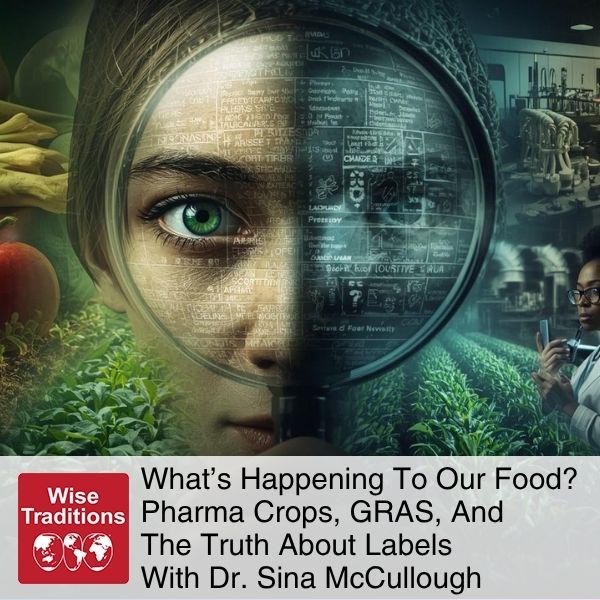
In Part 2 of this conversation, Dr. Sina McCullough returns to unpack what may be one of the most overlooked—and unsettling—developments in our food system.
She introduces the concept of “pharma crops”—foods like corn, rice, and lettuce that are being genetically engineered to produce pharmaceutical compounds, including vaccines. While this technology has been in development for decades, Sina explains why its potential entry into the food supply raises serious questions about safety, transparency, and control.
We also explore the gaps in regulation—how these crops are tested (or not), what happens when contamination occurs, and why consumers are often left in the dark. Sina walks us through the “GRAS” loophole—“generally recognized as safe”—and how thousands of chemicals have entered our food supply without meaningful oversight.
From there, we take a closer look at what’s actually in our food today… why labels like “gluten-free” can be misleading… and how processed foods dominate the modern diet.
Finally, Sina brings it back to the individual—offering a grounded and empowering perspective on how to navigate all of this without fear. She shares simple but powerful steps for becoming a more informed consumer and reconnecting with your body’s own wisdom.
This episode is both eye-opening and empowering—a call to look more closely at what we eat, how it’s produced, and the choices we make every day.
WAPF Ad- WAPF is active on IG, FB, MeWe & Telegram – Join us!
Visit Dr. Sina McCullough’s website to learn more
Join the Nourishing Our Children closed Facebook group
Check out our sponsors:
Nutrition Therapy Institute “WAPF listeners get 50% off their first course ” and
Goddess Vitality From Optimal Carnivore – “Discount code WESTON10 for 10% off.”
—
Watch the episode here
Listen to the podcast here
Episode Transcript
Within the below transcript the bolded text is Kendall Nelson
What if some of the biggest threats to our health are not always obvious? What if they are hidden in labels we trust, chemicals we rarely question, and policies that quietly shape what ends up on our plate? What if the most powerful response is not fear, but informed choices and personal responsibility? This is episode 581, and our guest is Dr. Sina McCullough. Sina is a Nutrition Scientist, Educator, and the Author of Hands Off My Food. She joins us for part two of our special series to explore what she uncovered about the modern food system.
From pharmacrops and edible vaccines to the GRAS loophole that has allowed thousands of additives into the food supply with limited oversight. She also explains why corn has become so pervasive in modern foods, how labels like gluten-free may not tell the whole story, and why she believes consumers have far more influence than they realize when it comes to shaping the marketplace. This is a thought-provoking conversation about transparency, accountability, and reclaiming agency over what we eat.
Before we get into the conversation, I want to let you know that the Weston A. Price Foundation is active on Instagram, Facebook, MeWe, and Telegram. Join us on social media for communal support and help us spread the word about the wise traditions that nourish us best. Now, let’s welcome Dr. Sina McCullough.
—
Welcome back to Wise Traditions, Sina.
Thanks for having me again.
I’m so glad you’re here for part two. I’m still struck by everything you shared in part one. What you went through, how you found your way back to health, just so much that you’ve done and so much that you’ve learned and releasing this whole veil of unearned trust. Now I want to turn to talking about food as medicine, and maybe not in the way that the reader might at first think. I want to talk about pharmacrops. I know that’s a passion of yours, and it’s something that I don’t think a lot of people know about. Can you just start very basic? What are pharmacrops?
The 30-Year Secret: Edible Vaccines And Pharma Crops
Yes, I love that. Pharmacrops have actually been around for more than 30 years, which shocks most people. Most of us have heard companies trying to manufacture vaccines in lettuce, for example, and they think that this is a new scientific breakthrough, but that’s not actually true. Since the early 1990s, scientists have been growing medicine in our food. Corn, rice, lettuce, potatoes, you name it, they’re being genetically engineered to churn out vaccines, pharmaceutical drugs, and other medical compounds right inside the cells of those foods.
The food is actually being rewritten not to nourish us, but to serve as an industrial drug factory. For example, let’s say you have a cornfield in Iowa. It looks like the corn that we would eat. It tastes like the corn we will eat. However, in those little corn kernels, scientists have engineered them to manufacture, let’s say, Hepatitis B surface antigen. That’s the same compound or component that’s used in many injectable vaccines. The ear of corn itself is now a vaccine factory. The problem is some of these pharmaceutical crops are grown in open fields, so they’re not being contained in like a greenhouse, for example, or some building.
Some of them are, but we know a lot of them are not. Let’s say you have this pharmacrop corn growing in this open field. The pollen can drift on the breeze to a neighboring farm or on pollinators or on animals, and what if it mingles with fields of corn that are destined for our food supply? How do you control dosage even? What might shock people is that we’ve already actually had contamination of our food supply with pharmacrops. One case was the Prodigene contamination incident. This was back in 2002. There was genetically engineered corn that was designed to produce a vaccine for pigs.
It actually contaminated 500,000 bushels of soybeans in Nebraska. It cost $2.7 million. The land was used to grow the genetically engineered pig vaccine, then it was used to grow soybeans for human consumption, and the corn grew amongst the soybean. That’s how they figured it out. “What if they had grown corn instead of the soybean?” They most likely would not have figured it out because it would look the same. The same year of that contamination, Prodigene had another contamination in Iowa. It was 155 acres of a cornfield. It had to be burned.
At that time, back in 2002, Prodigene had already received 85 test permits for experimental open-air trials of genetically engineered pharmaceutical and chemical crops, and they were slated for 96 different locations. This is the scary part. We don’t know how many pharmaceutical crops are being grown, and we don’t know exactly where they’re being grown. The USDA handles permits for when they grow in these fields. If you go to the USDA’s website, most of the information on these permits for these outdoor trials is heavily redacted.

I went through them, and what I was able to confirm is that these pharmacrops are a multi-state field activity. They’re grown or have been grown at least in California, Kansas, Missouri, Iowa, North Carolina, North Dakota, Washington, Kentucky, Arkansas, Minnesota, US Virgin Islands, and Texas. That’s just what I was able to confirm on their own documents. If you ask the USDA for more information, which I did, and I asked them, “Where are these crops being grown and what types of crops are being grown because we have a right to know? Are these being grown next to our food supply?” they told me that I had to submit a Freedom of Information request. I don’t think most people realize that foias are supposed to be answered within 28 days.
I’m guessing you didn’t get your answer in 28 days, or maybe never.
FOIA Failures And The Near-Horizon Threat Of Edible Vaccines
Did you know the average response time is 278 days? When they respond, it’s usually just acknowledging that they’ve received the request. Right now, we don’t actually know how many there are. We do know that some products have already made it to the market. Right now, the ones on the market are mostly reagents or processing enzymes, like trypsin or recombinant avidin or endocellulase, those types of things. I’ve seen brazzein on the market. The one that’s most concerning to me is the one that’s on the near horizon.
It is the Hepatitis B booster. This is being manufactured by Applied Biotechnology Institute. They have engineered a Hepatitis B booster vaccine into corn. They are saying that this could be the first edible Hepatitis B booster to reach the market. They’ve already done the preclinical studies. It’s ready to go. When I talked to the president of that company, he said they just need someone to test it in humans. They’re at the cusp of this actually being available on the market. They’re not the only ones doing this.
In 2024, Tennessee came out with a bill requiring that food that’s containing vaccines or vaccine material has to be labeled as a pharmaceutical drug. The reason they did that is because there’s a researcher at UC Riverside conducting a project that was aimed to create edible vaccines through adding mRNA to spinach and lettuce. The long-term goal of that research project is for people to be able to grow these vaccine-producing plants in their own gardens, and they want a single plant to be able to produce enough mRNA to vaccinate a single person.
Let me ask you. What could possibly go wrong? If you think about eating edible vaccines, my head is spinning with all the things that could go wrong. What do you believe could go wrong?
Okay, so an obvious question to me as I researched this was. How are you going to control dosage? For example, there’s another company who has been working on vaccinating the wildlife population against COVID, and they’re doing it with creating these little food pellets. They would put it in food pellet stations. The wildlife would just come up and eat these pellets. I had the opportunity to speak to the president of that other company, and I asked him, “How do you control the dosage?” That company developed this technology by getting a grant from the government. They’re working with the government on it.
He said it’s their company’s job to create the product, and it was the government’s job to figure out how to do the dosage. I reached out to the government, and I said, “Okay, how do you control the dosage?” They said to me, “The company has to figure that out.” I said, “No, the company just told me this is your responsibility. You’re going to be the one figuring it out.” They said they’d get back to me. It’s been like eight months. I’m not holding my breath. They don’t know.
When I asked the president of the company, “What do you think could possibly happen if an animal comes and eats all the pellets? One animal’s eaten all the pellets,” he said, and I’m paraphrasing here, but the worst case is they get extra doses of the boosters. You just get more doses of the vaccine. For a lot of your readers, that’s infuriating. We’re like, “This is just unbelievable, the mindset here.” I’m telling you, one thing that has really helped me is trying to understand people’s motives. Trying to really talk to them and see where they’re coming from instead of acting out of this state of fear myself and out of my emotions.
When I talked to this man, I’m telling you, he is convinced that he is doing something amazing for our society and for our world. He thinks this is the answer, and so he is so passionate about it because he thinks he’s doing good. Someone with that mindset, of course, if somebody gets extra dosages of a vaccine, “How could that be a bad thing? You’re just more protected from it.” For me, it helps to understand their motives, their incentives how they’re thinking about these things, because it helps you stay calm and rational and to be able to provide solutions.
I’m not calling for people to get outraged. As we talked about in the first part of this series, the root cause of autoimmune and chronic diseases is actually emotional imbalance. We don’t want people to become stressed out or outraged. Think of it like a scientist. These are the facts. This is why they’re doing it. They’re convinced they’re right, and we’re convinced we’re right. Just move forward with a solution that works for you.
Lack Of Oversight: The Hidden Risks Of Open-Field Pharma Trials
Let’s talk a little bit more about the regulations. What regulations are put on the pharmacrops? How does anybody have any idea whether these things are being studied properly or whether you’re going to be protected if one day they do come out with an edible vaccine or another drug that we might take that’s plant-made?
The pharmacrops, since they’re in these open field trials, they’re regulated by the USDA. They have these permits. It’s thought by some people that they don’t actually want them to be deregulated. Most genetically modified crops are deregulated by the USDA. If the USDA doesn’t think that it’s like a pest management issue, they will just say, “Okay, they’re deregulated,” which means the USDA isn’t regulating them. It means exactly what that word says. The USDA will not regulate that genetically engineered crop.
Pharmacrops don’t fit into that deregulated category yet. They are fitting into these open field permits. One thought, and I don’t know if this is true or not, I’ve just known people who have told me that this is probably what’s happening, is that it’s possible that they’re not going to shift over into the deregulated part because then more of the information has to be made public.
Right now, all I know is it’s in this open field permit stage. It can conceivably stay there because you can see them saying. “We want to have some regulation over it because it is growing like a drug in it or a vaccine in it.” Whether that has some nefarious intent behind it, I don’t know. That’s what some of the insiders are speculating is happening.
What about farmers who are growing their crops next to these crops? You talked about pollen drifting and contaminating their crops and stuff. Is there is there any way for them to take action against the people who are growing the pharmacrops if their crops get polluted?
Right now, the way that the system’s set up is that it’s not their legal right to know. Okay. You would have to first figure it out somehow, and like I said, the crops look the same. Yeah, this is a very difficult one. If it ever does get deregulated, then it will most likely fall under the bioengineered guidelines, which has all those loopholes and most genetically engineered crops and particularly like precision gene-edited crops are not actually labeled because that label was watered down. That’s what they wanted, the bioengineered label is what they wanted to get past because it keeps you in the dark.
In all likelihood, we are eating some of these plant medicines at this point. Because it’s getting contaminated onto the crops that are being sold as food?
Okay, so this is speculation, but since it’s been around for 30 years and it’s been across the country, I would suspect there’s some contamination that’s already occurred. What we learned from the StarLink contamination, that was that was back in 2000. For those who aren’t aware, StarLink was a variety of yellow corn that was genetically modified to express a protein that acts like a pesticide. It was approved for use in animal feed and biofuels in 1998, not for human consumption. In 2000, StarLink corn turned up in corn shells and chips and cornbread.
It actually contaminated 50% of that year’s corn harvest even though it was only planted in 0.5% of US corn acres. Half a percentage of the corn planted in the US was this StarLink corn and it contaminated 50% of the corn harvest. What happened was nationwide, we had recalls of over 300 products. It was upward of $300 million that were lost. People got sick. It’s off the market now. StarLink corn is off the market but the EPA itself does lab tests and they said that you can still sometimes find positive test results for the presence of this StarLink corn. It’s still there.
It stays for a while. Based on that example alone and I already told you we already know that the Prodigene contamination has been documented, that was actually used in the case that Tennessee brought forward as far as why we have to have this labeling. The fact that we already have all these examples that are in place would lead me to believe that there is some level at least of contamination already in the food supply.
At a minimum, they should make sure that they’re doing all of these pharmacrop trials enclosed, like in greenhouses, you know? Because even animals could come in and pick up some of the food the corn kernels or whatnot, and move them to other locations. It’s very difficult to control these types of experiments.
It sounds like the good news is that they’ve been at this for 30 years and we still don’t have edible vaccines and we still don’t have very much that’s on the market. Maybe that’s a positive. We have people like the Governor of Tennessee who’s demanding labeling of such products. I believe Congressman Massie has also stepped in. He’s trying to prevent our tax dollars to pay from this to pay for this, is that correct?
Yes. In 2023, Thomas Massie passed an amendment to the House to stop the government funding of the pharmacrop research. He didn’t want our tax dollars used for it. The prohibition wasn’t included in the subsequent omnibus spending bill. Even though people voted for it I believe unanimously, it didn’t go through to the spending bill, so it’s not actually in place. All that would actually do is stop the tax funding of it.
There are loopholes there as well, and there’s companies that can step up and fund it or private people like Bill Gates can step up and fund the research. I applaud him for attempting to do that, and we should move to stop it at all these different pathways that we can think of, but it’s really not going to make a difference.
The Ubiquity Of Corn: From The Grocery Aisle To Our Plates
You mentioned corn, and that’s one of the big crops that they’re using for these plant-made medicines and stuff. I can’t help but think about all the stuff you wrote about in your book about corn. Now I look at the grocery store and I imagine the grocery store as this giant corn palace. Let’s talk a little bit about corn itself and can you tell me like what food products it’s in, how much of the grocery store is consumed by corn?
I will say, so for the pharmacrops, one of the reasons why they chose corn was because they said, “It’s a food crop already that a lot of people eat and so they’re less likely to have an allergic reaction to it.” The thing is, like you mentioned, corn is ubiquitous in our food supply. It is in the vast majority of foods. Just some examples. Aside from corn on the cob or popcorn, corn is in most gluten-free foods. Corn is in most cereals, drinks, cookies, chips. Corn is fed to most livestock, so it shows up in your meat or corn derivatives at least.
Corn is ubiquitous in our food supply.
It’s in the meat, it could be in the eggs, the chicken. Corn is even in the produce aisle outside of the corn on the cob because a lot of our produce now is covered in wax because it’s shipped in from other locations, and so they usually scrub the good microbes off of it as they’re trying to clean it. Pick it unripe, scrub it, they put the wax on it, and then they ship it, and then they tend to ripen it like gas ripen it usually when they’re ready to sell it to you at the store. In that wax coating are often grass chemicals and corn-derived chemicals.
There’s even corn on the outside of much of your produce, and you can’t just wash it off. By the chemistry alone, wax doesn’t just wash off with water. It’s there and you’re probably already eating it. Corn is ubiquitous in the food supply. It is a problem particularly for people who have a sensitivity to the gluten. This is an aside too, because people get upset when I talk about gluten, but I’m not talking about like how people get gluten sensitivity. That’s a whole another topic.
What I’m saying is if somebody is already sensitive to gluten and they’re trying to avoid it for now in the grocery store, you can’t trust the gluten-free label because all grains contain gluten. That label is a lie. The FDA has defined gluten foods as containing wheat, barley, and rye, and there’s sometimes contamination in oats is what they talk about. That definition alone is outdated. That definition is from World War II when there’s a pediatrician that realized that when the famine occurred during the Dutch famine, the children he was treating in the hospital were starving the wheat supply was cut off, and the children healed.
You can’t trust the gluten-free label because all grains contain gluten. That label is a lie.
They were getting better. After the war, when the wheat supply returned, the children got sick again. Through experiments, they figured it out that it was a gluten protein in the wheat that was making the children sick. Wheat, rye, and barley were the staples of Northern Europe at that time, so gluten became synonymous with only wheat, rye, and barley. That’s the definition the FDA still uses today. It is largely outdated. We know that there’s at least hundreds, if not thousands, of different gluten proteins in different grains. Wheat, barley, and rye are just some of them.
Corn has its own type of gluten, it’s called zein. Oats has avenin, rice has oryzenin. And this is all documented in the scientific literature. We’ve known since 1979, at least in the literature, that corn and rice can trigger illness in an individual who’s sensitive to them. It can provoke antibody response. There’s actually this landmark study that was published on people who had Crohn’s disease, ulcerative colitis, and celiac disease, and it showed that when they ate corn, they had significantly elevated antibody levels. That means like an increased antibody level is a sign of increased mucosal permeability or leaky gut. Okay, so it’s a big deal.
The interesting part about this is that the corn that they gave these subjects in this study that caused leaky gut was the corn in Kellogg’s Corn Flakes. The study themselves actually thanked Kellogg’s for donating the Corn Flakes for the study. If you look at the Corn Flakes box even today, it says it’s a safe gluten-free breakfast staple and it’s not. Corn, as I said, has a type of gluten in it. There’s lots of studies now that have actually demonstrated immune response, even in some of these studies, when they were testing people who had gastrointestinal issues like colitis, you would expect some of them to have a response.
They tested them against control groups that didn’t have a reported response to glutens, and they found that even some of them reacted to the glutens. It’s just it was a level that didn’t trigger a symptom yet for them. Lots of researchers have been calling for relabeling of these products because what happens is we walk into the grocery store if you’re trying to avoid gluten and you think, “It says certified gluten-free, so that must be safe.” It actually keeps a lot of people sick, like me. It kept me sick because I thought that they didn’t have any grains in them.
We think from the literature that about 50% of people who are sensitive to gluten will develop antibodies to corn and possibly rice. It’s not everybody, but it is a large enough percentage of people that that gluten-free label should be changed. Kennedy was working on getting feedback from people about this label, but again, it’s another example of how the government misses the mark.
They wanted to know things like, “Are you having problems with cross-reactivity?” like when you’re eating oats and things. It’s not a cross-reactivity, it’s in the oats. It’s documented. We’ve known this since, like I said, the ’70s. It’s in the scientific literature. You have scientists in the literature arguing back and forth about it and saying, “Why isn’t anybody doing anything, especially for little kids who are fed a lot of corn and rice? We should be doing something about this.” You have an FDA that still can’t even get the definition right. Like, they can’t realize that they’re outdated, living in World War II times. Don’t trust the label.
Beyond Wheat: Why ‘Gluten-Free’ Labels Are Outdated
If it doesn’t say, or if it says specifically on the label that it’s gluten-free, or probably many other things that aren’t just pertaining to gluten, how are we supposed to give our informed consent? How are we supposed to be informed consumers if the labeling is bogus?
You have to go beyond the label. Instead of gluten-free, you’re looking for grain-free. You want to turn over that box and you want to read the ingredients because I have even found grain-free products that still have ingredients there that were derived from grain and they don’t realize it because sometimes they’re named differently. Corn has hundreds of different chemical names that can be on your ingredient list. For example, a lot of people aren’t aware that a lot of Vitamin C comes from corn and comes from genetically modified corn that’s been sprayed with glyphosate.
We think Vitamin C, that’s in oranges, it must have come from a citrus fruit. No, a lot of this comes from corn. There’s lots of corn ingredients or potential corn ingredients like maltodextrin. What I say is, I guess a first easy step is to see, does it say grain-free on it? Always look at the label, and if you can’t pronounce that ingredient or you don’t know where it came from, I’d say put it back on the shelf because either it’s derived from corn or it’s probably a grass chemical.
The GRAS Loophole: When Industry Approves Its Own Additives
I think this leads us perfectly into the subject of GRAS. Generally Recognized As Safe. Can you speak a little bit to that?
Yes, okay. GRAS came out of a 1958 food additive amendment that Congress passed. It’s a loophole in our laws that has allowed thousands of synthetic chemicals to enter our food supply with virtually no oversight. What happens is a company will hire a “expert” to declare that a new chemical is safe. That expert basically says, “Yes, it’s safe.” as soon as he declares it safe, the substance can go directly into your food and there doesn’t even have to be a review by the FDA or testing by the FDA or a waiting period. It can just go right in.
The part that the public doesn’t usually know is that that entire process of even notifying the FDA- so, like, if a company puts a chemical in the food and they’re going to notify the FDA that they did that, that process of notification is voluntary. The company is not required to tell the FDA that they’ve added a new chemical to our food. Even HHS Secretary Kennedy has admitted that because of this, we don’t know how many chemicals are in our food. It’s estimated that there’s roughly 10,000 chemicals in our food and that since the year 2000, 99% of those chemicals are estimated to have been approved by industry and not by the FDA. Here’s the real kicker for me. Guess who made that notification process voluntary?
Who?
The FDA themselves made it voluntary. I don’t know if people don’t realize, they’re like, “The FDA’s testing all our food for safety, and I’m sure they’re doing long-term safety testing and they did toxicity testing.” No. The FDA actually made it voluntary so it made it so the companies don’t even have to tell them that they put this chemical in the food. They certainly don’t track it. They’re not tracking these chemicals in the food. Even if the chemical is made in China and it comes into our food, they don’t know, they’re not tracking.
This is just a basic question, you can ask a six-year-old this question and they’re going to get it right. The FDA touts that their job is to protect our food and ensure its safety. If they don’t even know of thousands of chemicals that are in our food, how can they possibly ensure us that the food supply is safe? How can they even announce a recall if there’s a problem with one of these chemicals?
They can’t because they’re not tracking them. Here’s the part that made it even worse for me. We’ve been talking about GMOs. Genetically modified organisms. People would think that because, like I did, that if a company is actually changing the DNA of a plant or an animal, you would think that the government tested this for safety. No.
The GMOs got on the market because the FDA “presumed” GMOs to be GRAS. They did not test them. The companies determined if the GMOs were safe. Which is crazy if you think that like corn, corn is crossed with bacteria. It’s genetically engineered to have this bacteria in it called Bt toxin, so it’s a pesticide.
90% of the corn that’s now grown in America is genetically engineered to express this Bt toxin, which is a pesticide, and it’s sprayed with glyphosate to boot. To think of the fact that that never went through like any FDA testing or toxicity testing. We relied on the company to make sure that was safe and if you follow these Monsanto court cases, we all know what happened there and how the corruption and cover-up that’s been coming out.
We also haven’t talked about the synergistic effect. We’re eating these products over and over again. Do you have any statistics on how much Americans’ diet is through processed foods? How do we know how much chemical exposure we’re getting?
We’re getting quite a bit of exposure because on average, 75% of the calories that someone consumes in America comes from processed foods. We don’t actually know. There was a study that came out where they started testing, “Is there a cumulative effect or a synergistic effect if you’re combining additive A with additive B?” For example, what if you’re consuming this food dye with BHT? Is there some kind of additive effect, negative effect that’s happening?
On average, 75% of the calories that someone consumes in America comes from processed foods.
When companies step up and say, “Well, this chemical is safe, so it’s going to be GRAS now,” they don’t actually do that kind of testing. They do single-ingredient testing. They don’t do this comprehensive, “Let’s see what happens when you eat this ingredient with this.” That’s just not done. It wasn’t done for glyphosate either. They tested with just glyphosate itself, they didn’t test the real-world application that also has surfactants and other additives. The reason is because those other ingredients are classified as inert co-formulants, so they’re exempted from toxicity testing.
Now this is important because under deposition, Monsanto’s lead toxicologist admitted that Monsanto never tested Roundup to see if it caused cancer. They only tested glyphosate. Now multiple independent studies have revealed that when you test that full formulation, it can be up to 1,000 times more toxic than glyphosate alone. The industry studies that have been conducted and, in this case, the entire EPA approval process doesn’t even matter because it doesn’t apply to the real world. They’re basically regulating a fantasy while we’re living in a high-risk reality.
It’s the same thing with these GRAS chemicals, they’re tested individually. In that study that I mentioned, they did test different combinations or even artificial sweeteners combined with different additives. They did find that some of these combinations resulted in an increased damage that was done. We do know now, we have data to show that some of them are more harmful when you are eating them together. There is no way for us to know at this point how much harm that is actually doing to us.
Unmasking Ancel Keys: The Flawed Foundation Of Dietary Guidelines
These are the same people who we trust, that are also putting together the dietary guidelines that affect so many people. Can you talk just real briefly on the dietary guidelines?
Yes, okay. This is one of my pet peeves because so the dietary guidelines are better right now because they changed them and I praise them for promoting real food. But it’s crazy that it took like 60 years almost for the government to say you should eat real food. That’s just common sense. The one thing that they really didn’t do, though, they fell short on removing that antiquated 10% cap on saturated fat. This is a lingering ghost of the old dogma.
What happened was in the 1950s, this 10% saturated fat cap became the bedrock of American nutrition policy. It started with Ancel Keys and his lipid hypothesis. It basically said that if you eat saturated fat from things like butter, red meat, it’s going to raise your cholesterol and then high cholesterol in turn is going to cause heart disease. If you look into it, the foundation of that theory is very weak. Originally, it was inspired by studies on rabbits, which are herbivores, they’re not designed to even metabolize dietary cholesterol.
It was based on that and a single observational study by Ancel Keys himself, which was known as the Seven Countries Study. This is his famous study. It’s deeply flawed. He claimed to find this correlation between increasing consumption of fat and heart disease. He, in essence, cherry-picked his data. There were 22 countries he looked at, he selected seven that fit the hypothesis. He ignored nations like France and West Germany that had higher fat intakes that did not correlate with high heart disease rates.
Greece, he used their data and it was collected during Lent, where most of the population wasn’t eating animal foods so it didn’t even show their true diet. Here’s the thing that a lot of people don’t know. The study itself only included about 12,800 men, and the diet records were only collected for 5% of the people. That means the 10% saturated fat cap that continues to restrict our diet now was largely based on about 500 people.
It gets worse. Keys’ study was an observational study. It cannot demonstrate cause and effect but it became the foundation for our guidelines. In the 1960s and 1970s, governments around the world recognized that it was just an observational study and they said it’s not sufficient. They started funding larger randomized control trials. They wanted to settle the debate once and for all of whether or not we should stop eating saturated fat.
These core trials collectively tested this diet-heart hypothesis on about 67,000 people. These trials lasted between 1 and 7 years, and many of them compared the standard saturated fat intake, which actually was up to about 18% of calories. They compared the standard saturated fat intake against this diet where the saturated fat was replaced with the polyunsaturated vegetable oils. The endpoints, they didn’t just look at cholesterol, they looked at things that matter to us like heart attacks and deaths.
The totality of these trials did not support Ancel Keys’s hypothesis. They actually said that reducing saturated fat did not stop death from heart attack. Even worse, two of the most rigorous studies showed that when you reduced saturated fat, it caused harm. If you reduce it and replace it with these vegetable oils, it caused harm. That data was buried for decades.
One of them was the Minnesota Coronary Experiment that was done in the ’60s and ’70s. This was the largest double-blind randomized control trial of its kind. It involved over 9,000 patients who were institutionalized. That means they controlled their diet, they gave them the food, like this is one of the best ways you can study a diet. For decades, the full results were unpublished because they showed the opposite effect. In 2011, there was an NIH researcher, Dr. Ramsden. He actually tracked down the son of the lead investigator of this huge clinical trial because the lead investigator had already died.
This NIH researcher tracked down his son. The son searched through his childhood home, his dad’s boxes, and he actually found the raw data. It was on like these ancient magnetic computer tapes. It was hidden in this old cardboard box in their basement. This NIH researcher analyzed this recovered data and the results were shocking. While the vegetable oil group lowered their cholesterol, they did, so when they ate vegetable oil their cholesterol was lower. However, for every 30 milligrams per deciliter drop in the cholesterol, there was a 22% higher risk of death.
That’s what I guessed you were going to say. More heart attack, more death, more learning disabilities, more everything.
Exactly. Two years later, that same NIH researcher, he finds data that was also buried from the Sydney Diet Heart Study. This study also tested replacing saturated fats with safflower oil, so another vegetable oil. The results showed that the group consuming the vegetable oil had a significantly higher risk of death from heart disease compared to the ones eating the saturated fat. I’ll say these studies were not outliers.
They were the gold standard and still are of the way that you are supposed to conduct research. They were left to gather dust while Americans were told to swap out your butter for margarine. This is speculation, but I think one of the reasons might be because, for example, the Minnesota Coronary Experiment, the co-lead on that study was Ancel Keys.
Of course.
There were people who dissented. This is all documented. You can go to the government’s own documents, and I reference these in the book, and they talk about, like the Senator George mcgovern, he released the dietary goals for the United States in 1977. This was the first document that explicitly capped saturated fat at 10%.
They didn’t even have a reason to pick 10%. If you look through the conversations, like they brought in leading experts and they would say things like, on record, that the scientists would say things like, “We don’t even know if reducing your cholesterol reduces the risk of heart attack.” They said that it’s unproven, that it’s still presumptive. One of the leading clinical nutrition researchers said, “The proof is not there.”
One of them pleaded in his report that they needed more research before you announce this to the American public. They had no basis really for this 10% cap. Someone speculated that the way they got the 10% was they were like, “Okay, we’re going to suggest 30% of the calories from fat, let’s just divide it 10% in each of the fat categories,” so 10% saturated, 10% PUFAs, 10% mono. They literally just randomly chose these values, apparently.
We’ve had this evidence from the beginning, like very early on, that this was a lie, basically. It was pushed forward by one man and you didn’t oppose him. People got eviscerated in the public square, discredited, you could lose your grant money if you went up against him. There’s a lot of pressure and he happened to be friends with the President’s medical doctor and he had his ear, so then you have the President on board here. It’s just this who you know and literally this corruption that comes out of this one man who could not admit that his hypothesis was not correct.
The President had had a heart attack. He was probably buying into all of this.
That’s right. Once again, we see this theme of fear, like I mentioned, I think in the first interview together, the FDA was born out of fear. We got these dietary guidelines out of fear. If you think about it, when the FDA was born, we were afraid and so we handed over the control of our food supply to the federal agencies.
Here once again out of fear because the President had a heart attack, heart attacks appeared on scene, it seemingly rare before that and all of a sudden, people are dropping dead, you know like, “How is this happening?” once again out of fear we hand now over to the government again for them to basically come into our kitchens and tell us what we should and should not be eating.
Not only do they stop being the watchdogs, but we’re like, “Okay, now you can nudge us. Now you can nudge us into deciding what each bite of food should be that goes into our mouths.” It affects everything. You’re affected by the guidelines even if you don’t have like the pyramid in front of you and you’re measuring out your portion sizes based on that. Most of us were raised in that era of low fat and so even now I find that there’s some conscious fear of fat as well.
When you’re trying to help people reverse diseases, one of the fastest ways to do it, one of the statistically speaking most successful ways to do it is to raise your level of healthy fats in your diet and lower your cholesterol. It’s not across the board but it helps the vast majority of people. I even have a hard time getting people to consume enough healthy fats because it’s still so ingrained that fats are bad, you can’t have too many of them. It also affects your food label.
When you’re looking at the Nutrition Facts panel, for example, that’s based on the dietary guidelines. If you go into a hospital and you’re fed the food there, it affects them. It determines what the military going to eat, what children in schools are going to eat. We’re all affected by it some way or another. It also affects your medical treatment because it perpetuates this myth that you have to have your cholesterol like under 200 or whatever and then they put you on statins.
People don’t realize that connection, that the dietary guidelines affect more than just like this printed-out food guide pyramid that’s plastered on the walls in schools that your children might see or your grandchildren might see. It affects you even when you go into the doctor’s office. It affects what types of medications they might prescribe and at what levels they might prescribe them to you as well.
Reclaiming Agency: The Power Of Informed Choices and Emotional Detox
I think the message of this whole episode is that we can’t live in fear, and we have to take responsibility for our own health, and we have to be sleuths. We have to go figure out what’s in our food and really be informed consumers and use our dollars to buy the healthy foods and leave the unhealthy foods on the shelves. Sina, I thank you so much for being here with us once again, and just so for fun, let me ask you the same question. You’re going to have to come up with a new answer. If the reader could do just one thing to improve their health, what would it be?
I already said choose organic and practice forgiveness. I would say the thing that I do when every day, or like say I’m starting to experience symptoms of like a cold coming on, I actually do an emotional detox. I start tapping into my body and I’m asking it, whatever the symptom may be, like let’s say there’s sinus pressure or something.
I actually just try to use my intuition, my God-given intuition and start talking to my body and ask, recognize what it is, “I’m having this congestion in my nose, can you tell me why am I having this congestion? What are you trying to tell me?” Emotions, I see them as like children. What does a child want? A child wants to be seen, wants to be heard. You can try to hide from your emotions all you want, but they’re not going to go away until you acknowledge them.
Every symptom is tied to an emotional imbalance, and so what I have found and oftentimes that if you just address the emotion and ask, “What are you here to teach me?” sometimes it just wants to be acknowledged and it will just release on its own. That is probably one of the most powerful tips I can ever share with anybody because it can help you find balance from any health ailment that you may be experiencing, whether it’s acute or chronic.
Every symptom is tied to an emotional imbalance.
Perfect. Thank you, Sina. You’ve been wonderful and so fun to talk to you and I hope to have you on the show again sometime soon.
I’d love it.
Okay, have a wonderful day.
—
Our guest was Dr. Sina McCullough. To learn more about her work, visit DrSinaMcCullough.com. If you’re enjoying the show, we’d be grateful if you’d take a moment to leave a rating or review. Your feedback helps others discover the podcast and become part of this growing community. Thank you for spending time with us. Be well, be nourished, and be free.
About Dr. Sina McCullough
Dr. Sina McCullough is the best-selling author of HANDS OFF MY FOOD and co-author of BEYOND LABELS, written with world-renowned farmer Joel Salatin. She is the creator of the online program GO WILD: How I Reverse Chronic & Autoimmune Disease and co-host of the Beyond Labels Podcast alongside Salatin. Together, they empower thousands each week to reclaim their health, happiness, and freedom. An expert in nutrition, disease reversal, functional medicine, exercise, and energy medicine, Dr. Sina holds certifications as a Natural Healer™, Master Herbalist, and Gluten Free Society Practitioner.
She earned a PhD in Nutrition and a B.S. in Neurobiology, Physiology and Behavior with a minor in Exercise Physiology from the University of California at Davis, where she also taught Biochemistry and Bioenergetics. She later served as Director of Research and Development for a nutraceutical company. Despite her extensive academic background, her most profound insights came from a personal crisis. After reversing a near-fatal autoimmune disease without medication, she now dedicates her life to helping others find their second chance. Above all, her greatest joy is homeschooling her three children.
Important Links

Leave a Reply