

 🖨️ Print post
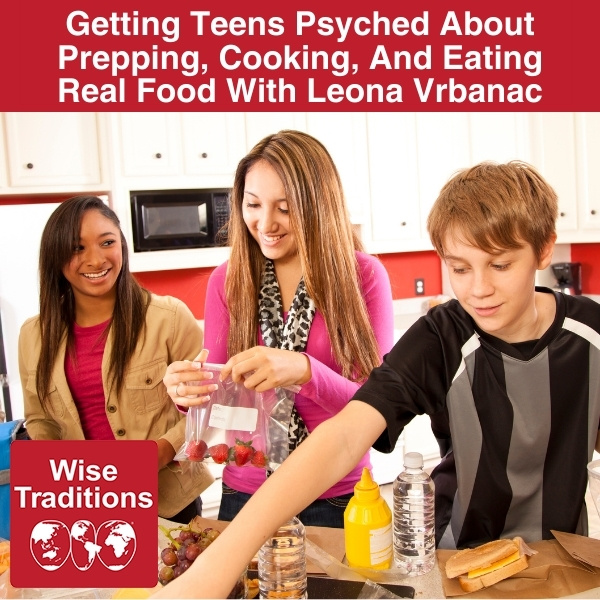
A teacher offers a culinary class at a traditional urban high school in Ohio. There is a waiting list to be in the class. What gives?! How is this teacher making real food – preparing it, cooking it, and eating it – cool? Leona Vrbanac shares her secrets and tips in today’s episode. She explains how she helps teens move from embracing junk to nourishing themselves with food that they harvest and learn to prepare themselves! The skills she helps them acquire serve them for the rest of their lives.
Follow Leona on Instagram at @eat.love.learn
Join our Nourishing Our Children group at nourishingourchildren.org/groups
Check out our sponsors: American Blossom Linens and Sirius Nutrition
—
Watch the episode here
Listen to the podcast here
Episode Transcript
Within the below transcript the bolded text is Hilda.
Takis, Gatorade, Crumbl cookies, and fast food. Honestly, ultra-processed food is as close to our teens’ cell phones and the corner 7-Eleven. How do we help them move away from the junk that is damaging their health and toward real food and traditions that enhance it? This is episode 543, and our guest is Leona Vrbanac. Leona is a culinary teacher in a public urban high school in Ohio. Her class is so popular that she has a waiting list of students who want to take it.
What’s her secret? How is she making real food, ancestral traditions, gardening, and cooking cool? What resources does she offer? What tips and tricks does she have? Her approach may hold keys for you to inspire your teenagers and pretty much anybody around you into eating and living in a more ancestral fashion and to have their health benefits, too.
Before we get into the conversation, are you a parent, a would-be parent, a grandparent, or an adult interested in children’s health? Nourishing Our Children is a project of the Weston A. Price Foundation. It was launched in 2005 with a focus on timeless principles for supporting learning behavior and health through optimal nutrition.
Nourishing Our Children has an active closed Facebook group that offers support on how to nourish and not merely feed your children. If you join, you’ll have complimentary access to the group focused on adults for a donation of $5 for the calendar year. The moderators ensure that no question goes unanswered. Go to Nourishing Our Children to sign up. That is Nourishing Our Children to learn how to join.
Do you want to know more about it? Check out what Catherine Jimenez has to say. “I am a first-time mom of a soon-to-be nine-month-old and a member of the Nourishing Our Children private Facebook group. I began with The Nourishing Traditions Book of Baby & Childcare, but I felt I needed encouragement and support in implementing some of the recommended food practices.
Joining the group became instrumental in helping me navigate the barriers that I had to giving my baby his first nourishing foods. I’ve had so many questions and have been so grateful for the clarifications and answers. My questions are always answered, and in a prompt fashion as well. Thank you, Nourishing Our Children. You can check out this resource. Go to Nourishing Our Children to find out more.
‐‐‐
Welcome to the show, Leona.
Thank you so much. I am delighted to be here.
Taking Students Out For Raspberry Picking
Tell us a story about when you took a group of students raspberry picking.
My classroom is a traditional high school classroom from grades 9 to 12. I have all students together, and I have about 24 at a time. We planted a garden. We went outside to the garden, and I said, “We are going to do some picking. We’re going to pick some berries and come in and make smoothies with the yogurt that we’ve made.”
The students went out, and they started picking. One of my juniors, who would be sixteen, said, “These are the most delicious strawberries I have ever had.” All the students started eating the strawberries, and I said, “Wait a minute. We might want to hold on to some of those.” They said, “Why do they taste so delicious?” I said, “It’s because those aren’t strawberries. Those are raspberries.”
At 16 and 17, even though we’ve been eating our whole lives, everything has been presented in a package. We don’t know the difference between a strawberry, a raspberry, or a blueberry. The list goes on and on. In our class, we enjoy looking at whole foods, tasting whole foods, and trying everything. I love that they are learning what real food is.
I remember spending some time with some kids in the inner city here in DC. A lot of them thought meat came on a styrofoam tray covered with plastic. They didn’t know its origin. Do you find kids learning about those sorts of things as well?
Absolutely. We will take a shoulder roast of pork and braise it. They will be very afraid and concerned about meat on the bone. It is a little bit difficult to come to culinary class because Ms. V is going to stretch your horizons. The students might say, “We didn’t trust you at first, Ms. V, but now, everything is so delicious.” Once they start tasting, it’s all good, but before that, especially meat, can be very intimidating.
What do you do to build that trust?
We work a little bit at a time. When the students come in, I do say to them, “This will be challenging for most of you. We might have to think in our own bodies and in our own brains, “Am I sensitive? Do I have thoughts about food? Can I stop and consider what I’m being presented with?” I say, “I would like for you to embrace every edible opportunity with optimism, so please try it. Try the tiniest taste, and we will celebrate that you are so brave.” We start a little bit at a time and then build from there.
Embrace every edible opportunity with enthusiasm. I love that phrase.
I’m like, “Try it. If we can try it, we’ll probably love it.”
Common Preconceptions About Food
What are some of the preconceptions that you were alluding to that students come into the classroom with when it comes to food?
Most students come in thinking that they should be vegetarian, and that it would be better for the earth if we were all vegetarians or vegans. They come in afraid of touching or working with raw meat. Even aside from that issue, that’s a separate sensory issue that they seem to struggle with. A lot of them have very limited experience with a palate. It can be that the smells and flavors can truly be overwhelming on some days. I would say multifaceted. They’re working through all kinds of issues to connect with food, so I am very proud of them when they are so brave.
What A Food Insecure Community Looks Like
You said, as I understand it, that you work in a food-insecure community. What does that look like, and what does that mean?
What that means is that in our community, we might have lower socioeconomic income combined with a lack of public transportation and groceries more than 1 mile, 2 miles, to 5 miles away. Truly, to connect with food, my students need to go the distance. I am so thankful to say that my community is growing since I started a farmers’ market, which is twice a week. We have a butcher in our town. We are growing. The community is growing, but there is a lack of fresh food on a daily basis.
With what you are teaching, why does it matter? Some would say that if it’s a food-insecure community or folks from a lower socioeconomic class, maybe they should be learning trades or something more practical.
I grew up in the town where I teach. I love my town and the people, but I know from having lived here my entire life that we do have a higher than average rate of obesity and need for mental health services. There are ways that my community is struggling, and I believe with my whole heart that nutrient-dense food is one of the ways we can start to address the needs in our community.
I believe that if my students can connect with food, take what they’re learning home, teach their younger sisters, and maybe a parent or a guardian can learn, we can have massive amounts of change, which excites me. I base this theory on the work of Dr. Drew Ramsey, who wrote a book called Eat to Beat Depression and Anxiety. I read his book and said, “I’m going to go with this.” We don’t have to change everything. We can start with these small changes, and they will grow. That’s why I believe that this is so important because our community needs health and wellness.

Kids can’t pursue dreams if they’re too tired to get out of bed. If they’re depressed or obese, that’s going to hinder where they might end up in life.
There are days when I come into school, and I’ll look into the classrooms, and so many students have their heads down. They look lethargic. They look tired. People always talk about students being angry or having a lot of angst, or, “They’re just teenagers.” I find that when they are fed and hydrated, they are the most beautiful, curious, engaged people. It can be truly an instantaneous change or a pick-me-up to have good food.
When teens are fed and hydrated, they become the most beautiful, curious, and engaged people.
Transforming A Lethargic Student Into An Enthusiastic One
That must be so encouraging to witness. Can you tell us a story of a child where you might have seen that kind of turnaround, from maybe an aggressive or lethargic student to an enthusiastic one?
Yes. My favorite, named Shay, was a transient student. We do have a high rate of students who are transient, homeless, or under the care of a guardian. He was the best boy, but so tired. He was a big, strong young man. He would say, “Ms. V, I’m so tired today,” or, “I’m feeling angry today.” We keep an herb garden outside, so I would start to say, “Shay, go get what you need from the herb garden. I’ll put some hot water on. You can come back in and have some tea. We’ll put some salt in it and get you hydrated.”
He would go out, and he might choose peppermint if he wanted to be picked up or chamomile if he wanted to calm down. He knew what he needed based on our class. He would go out for about a week. Every semester, he would come back until he graduated. I still love him so much. He would say, “It’s a new semester, and I need my tea. I need to be hydrated. I need to think clearly. This is where I’m going to get what I need.” I know that he carries that with him throughout life when things are hard. It truly helps to hydrate the body. That’s the kind of change and ownership that I like to see.
Leading A Culinary Class The Wise Traditions Way
That’s so beautiful. When did you decide that you were going to lead this culinary class the Wise Traditions way? What gave you that conviction and that impetus?
I moved to my school only about a decade ago, which in a long career of teaching is not that long. The high school said, “We need a culinary teacher with a Home Ec degree. There are not very many dinosaur Home Ec teachers out there, but you are, so please come over.” I jumped from elementary to high school. That’s when I noticed that students were not feeling well. The heads were down. They were tired. They had dark circles.
I knew we were a community of free breakfast and free lunch. I thought, “If this is meeting the standards but not meeting the students’ needs, I need to look elsewhere for what might be healthy,” so I started reading. I read The Dirt Cure and Wild Fermentation by Katz. I thought, “This is a lot of work.” I was looking, and then in one of the books, it said The Wise Traditions and The Weston A. Price.
I came home to my husband and said, “You are not going to believe this. There’s this group out there. It has all of this information, and it’s in one place. I can go there. This is so exciting.” At that time, my husband and I joined the Weston A. Price Foundation. We are involved. We love to go and learn. I’ve been attending the conference for several years. Every year, I learn what I need to know. I am so grateful for Wise Traditions and all I’ve learned.
Dealing With Epic Fails In The Classroom
It’s so cool that you’ve taken it and you’re translating it to this generation or to these young people that need it so desperately. I do have to ask you. Have you ever had any epic fails in the classroom where you were like, “That didn’t work at all.”
If we don’t have at least one epic fail a semester, we’re losing our touch. We have to have a great failure. High school needs to be legendary. That’s our motto. I would say maybe mishaps. We have more mishaps. I can honestly say that we use the Nourishing Traditions. We use Dr. Bill Schindler’s work. These recipes do not fail, but we do sometimes catch an oven on fire.
One time, we were doing sourdough pizza. A student decided to put his head in the oven and caught his hair on fire. That was very disconcerting. We were safe. We saved him. He’s fine. Everything was okay. We checked in with Grandma. We’ve had some good mishaps, but in general, the recipes work.
That’s so encouraging. I also mean, has there been a time when you tried to do a lesson on liver, let’s say, and kids were like, “No.” Do you know what I mean? Has there been resistance?
Yeah. When we did sauerkraut the first time, the students were like, “I don’t know. This smells. This is too much, Ms. V. I don’t know what you’re thinking.” Luckily, we noticed that outside, a block down from the school, was a German food truck. I said, “That’s it. Field trip. Everyone, let’s go.” We all started walking down to the food truck, and we were like, “We are afraid to try our sauerkraut, but you are a German food truck. We thought you could try it.” They did, and they said, “This is good sauerkraut.” After that, a few of the students were willing to try it. From there, everyone was willing. There have been a few times they had to fight for it.
Getting Kids Excited About Eating And Cooking
How do you get kids excited about eating or cooking this way that is so unfamiliar to most of them?
We start with skills. Instead of presenting all of the recipes or all of the ingredients upfront, we’ll start with the skills. We will make sure that we have safety procedures around knife skills. Every student will get a nine-inch chef’s knife, and every student will practice their chopping, their handling, and their safety. As we develop these skills together, they’re willing to use their skills. We’ll chop for fermentation, or we’ll chop and then we’ll bread and use some tallow to make some chicken, and they’ll love it.
The excitement or willingness comes with the building of skills. Are we using the mixer? Are we using a dehydrator? Are we using the food processor? Are we going to stand with our own knife? Students want to chop. They will use their knife the entire period. The excitement comes from letting them own these skills and prepare food in the way that it’s been prepared for generations.
That must be so encouraging to see them empowered with a life skill. They’re going to know their way around the kitchen. They’re going to know what a dehydrator does and what a slow cooker does. Can you tell us? Is there an order in which you present things each semester?
Yes. Our first is a hydration drink. When we come to a new semester, usually, it’s also the beginning of the new sports teams, the band is getting ready to go, and everyone’s naturally needing to drink. We start with the Redmond Real Salt hydration drinks. We do an herbal infusion, so we talk about the herbs. We then move on to our knife skills unit, which, honestly, is about a week of practicing handling a knife and all the safety procedures that go with that. From there, this 2025, we’ll be doing global food, so we will cook our way around the world. We’ll start in Southern America. We’ll start with caramelizing corn and making our tortillas. We’ll then work our way around the world, picking up Asian countries and European countries, and doing some traditional dishes.
I understand why you have a waiting list for your class. How many years did that take to build up, and what does that look like?
About three years to hit a nice pace with the students. They know. The word’s out that the students should take global foods. That is a school unit.
That’s so amazing. That makes me so happy. It must bring you so much pleasure. Have you ever thought about helping to replicate this at other schools or expanding the program to adults? It personally sounds like something I would love to do.
I asked chapter leaders. We have started offering sourdough classes in our home. When the community hears about it, they say, “We want to know this information, too.” The way we’re addressing them is by hoping to grow a local chapter. I haven’t worked with other schools, but I did learn through this that there are some other teachers. Kimberly does a Weston A. Price unit and talks about her travels. It is being done a little bit. There is some other work being done.
Positive Feedback From School Admin And Parents
Some of us are afraid sometimes to bring this up in a public school setting because we’re considering that there will be resistance from the administration or maybe parents. It’s not only foreign to the students, but it’s foreign to adults as well. Have you encountered any of that?
No. I have not encountered any resistance. It’s almost the opposite. Our administration is so grateful that the students are engaged, the students are eating, and the students are out in the garden. They’re caring for the soil and composting. I’ve only ever had positive feedback from administration and parents. When a parent says my student came home and made dinner, they’re like, “It was the simplest, delicious dinner we’ve ever had. Who would’ve thought that we could have sausage and spinach, and it would be delicious?” The guardians seem to be happy as well.
I believe that, as public schools, it’s part of who we are to embrace our community. Chefs will come in and cook with us. It’s a beautiful way to engage our local community. I would encourage people that their public schools are their community. I encourage them to step in and speak into the lives of students because they are truly hungry to know.
Spending Time On Reference Books
Speaking of having them know, how much time do you have them diving into reference books, like maybe Nutrition and Physical Degeneration, Nourishing Traditions, or the book you mentioned, Eat to Beat Depression & Anxiety? Do you offer those as part of the curriculum?
Yes. Three days a week, we’re cooking. I have the students in 40-minute periods. I will have a group of 24 students every 40 minutes throughout the day. It takes us, in general, three days to make it through a recipe. We will spend the other two days a week looking at the countries from which we are cooking, and then the other day, the research behind it.
We will use Eat Like a Human quite a bit, from Dr. Bill Schindler. We use some work from The Glucose Goddess Method to learn about our own bodies and the way our food is metabolized, a little bit of Farmacology by Daphne Miller, and then the yellow books. I have it right here. Even the children’s cookbook is such a good, basic course. We’ll use a lot of information from The Nourishing Traditions Cookbook for Children.
A Student’s Inspiring Aha Story
You told us about that young man who started to recognize, “I want to chill out. I’m going to have chamomile from the herb garden,” or, “I need a little more energy, so I’m going to seek out this other herb.” Can you tell us another a-ha story of a student who started to understand more about their body, maybe about how their body responds to a glucose spike or something like that?
We focus on how we might not all feel good every day, but can we be good at feeling where we are? I referenced this a little bit earlier, but I had one student who said, “Ms. V, I didn’t trust you.” That has stayed with me. We were doing some work with vegetables, and she was not a vegetable eater at all. Students will often make a blanket statement, like, “I don’t eat vegetables,” or, “I don’t eat fruit,” or, “I don’t drink milk.” What they’re saying, in my mind, is, “I’ve had such a poor experience,” or, “I felt so unwell after an experience.”
Instead of focusing on not feeling good every day, we can be good at feeling where we are.
We had some vegetable chopping. We did a beautiful saute. It was a lo mein. It was gorgeous. We spent a lot of time mixing our sauce and making it right. She was willing to take a bite, and she said, “This is so delicious. I can’t believe it.” I said, “I know, and you made it yourself. Isn’t it fabulous? This is something you can do again and again so easily.” She said, “Ms. V, we have to learn to trust you.” I said, “You do, and you can.”
How Leona Wraps Up The Semester
That’s so beautiful. How do you wrap up this semester? You’ve given us a nice overview of how you travel around the world with the foods and incorporate some of the books and resources. How do you wrap things up and tie them up with a bow? What do you hope that the students will walk away with?
I hope they walk away with curiosity about food. I hope they walk away with so much more of an open mind and an open palate that they’re willing to continue using their skills. Once they have the skills to chop, dice, saute, and ferment, they are set for life if they continue doing it. Some people might say, “You’re in a food-insecure community. Why do you focus so much on regenerative, organic, farm fresh, out-of-reach food?” Since we have farmers’ markets in so many communities and we can go meet more farmers, vegetables are very affordable, and salt is accessible. We can ferment. We can saute. We can prepare our food in beautiful ways.
To me, giving them the skills of chopping and the skills of creating some ferments and some yogurts makes food so much more affordable and nutrient-dense. That’s the way we release the nutrients in our food. It is by the way we prepare it. That’s my hope for them, that their bodies have access to nutrients in food so they can live well and healthfully.
How Leona Nourished Herself
As you’re speaking, I can’t help but think that you have probably felt this own difference in your own life. Have you always nourished yourself so well and so deeply?
I believe that I always tried and I was careful, but until I learned the Weston A. Price principles, I was not as vibrant, well, and energetic as I am now. I’m in my 50s, and I feel better than I felt in my 20s and 30s. It’s amazing. Part of my message is me learning, too. I’m on the journey, too. As I see life getting better and better in my 50s, you can see it in your teens. That would be so great to start this way and have all these extra years feeling great.
Creating Lasting Ripple Effects
I bet some of what you’re sharing and what you’ve experienced is also what parents can do. Not everyone tuning in to the show is going to be an educator, but in some way, shape, or form, we are. A lot of us have families, loved ones, or friends around us that we can nourish in this way and start to see this ripple effect, right?
Yes. Parents, grandparents, aunties, uncles, cousins, and even teenagers who are in charge of the younger kids, start experimenting. When we keep it about the process, it keeps it fun, lighthearted, and exciting.
Keep it playful and know you might have some mistakes or mishaps, like you suggested. A moment ago, I was asking about resistance from the administration and the school. Have they had a ripple effect? I know Hilary Boynton, with School of Lunch, has said that when she started working at this particular school, serving kids lunches and snacks that were nutrient-dense and the Wise Traditions way, the principal and teachers started wanting that food, too. Have you noticed any of that?
Yes. We do a sourdough unit, which is supported by King Arthur, who sent us some flour. We then bake a loaf and give a loaf. The teachers are so thrilled. They’re the most beautiful loaf of bread. It was sourdough, and it was so delicious. The principal says, “We may have a student maybe exhibiting some less-than-acceptable behavior in other areas of the school, but they come over to culinary and they are citizens of the world. They’re so kind, so helpful, and so engaged.” Teachers notice that healthy food helps students be their best selves. It’s a very good place to be.
Leona’s One Tip To Improve Your Health
That is so beautiful. I hope that this conversation will inspire others to consider how they’re nourishing themselves and how it’s affecting their behavior, and to get in tune more with their own bodies. This has been wonderful. I want to pose to you the question I love to pose at the end of every episode. If the reader could do one thing to improve their health, what would you recommend that they do?
I would recommend that they plant a seed or a handful of seeds and watch that seed grow with delight, and also take a little bit of responsibility for their own food. Once we start outside with our hands in the soil and heads in the sun watching our food grow, it’s life-changing. It’s such a beautiful beginning to a journey.
Take a little bit of responsibility for your own food. Once you work outside with your hands in the soil and head in the sun watching food grow, it is life-changing.
We are looking forward to seeing you at the conference. Thank you for being a part of this show with members only. It has been a pleasure. On behalf of the Weston A. Price Foundation, thank you for your time.
Thank you so much.
‐‐‐
Our guest was Leona Vrbanac. You can find her on Instagram @Eat.Love.Learn. Leona is going to be at our Wise Traditions Conference this fall in October 2025. I’m going to be there, too, so is Sally Fallon Morell, and a whole slew of amazing speakers and wonderful people who love Wise Traditions. Won’t you join us? Go to the Wise Traditions Conference to register. We hope to see you in October in Salt Lake City, Utah. Thank you so much for tuning in. Stay well, and remember to keep your feet on the ground and your face to the sun.
About Leona Vrbanac
Leona Vrbanac is a culinary teacher and garden manager in a traditional urban high school. She brings a strong commitment to counter the status quo and connect students deeply nourishing food. Her core curriculum is rooted in the principles of the Weston A. Price Foundation, emphasizing traditional, nutrient-dense foods. Leona guides her students in ancestral culinary practices such as fermenting sourdough and dairy, nixtamalizing corn, sprouting legumes, preparing meats, harvesting herbs, creating herbal hydrosols, growing vegetables and composting to develop nutrient dense soils in the class garden.
She encourages her sometimes reluctant students to “meet every edible opportunity with optimism.” Surprises abound. Students have had such an overwhelming positive response that classes quickly filled to capacity and the school hired a second teacher to provide more class sections. Students are hungry to learn, to connect, to grow!
Important Links
- @Eat.Love.Learn on Instagram
- Nourishing Our Children
- Wise Traditions Conference
- Farmacology
- The Dirt Cure
- Wild Fermentation
- Nourishing Traditions
- Eat Like a Human
- The Glucose Goddess Method
- Eat to Beat Depression and Anxiety
- Nutrition and Physical Degeneration
- The Nourishing Traditions Book of Baby & Childcare
- The Nourishing Traditions Cookbook for Children
Episode Sponsors
🖨️ Print post

Blessings on your project, education and love of children/young adults. Kudos for every step taken toward good health. Gotta love our young ones!