


 🖨️ Print post
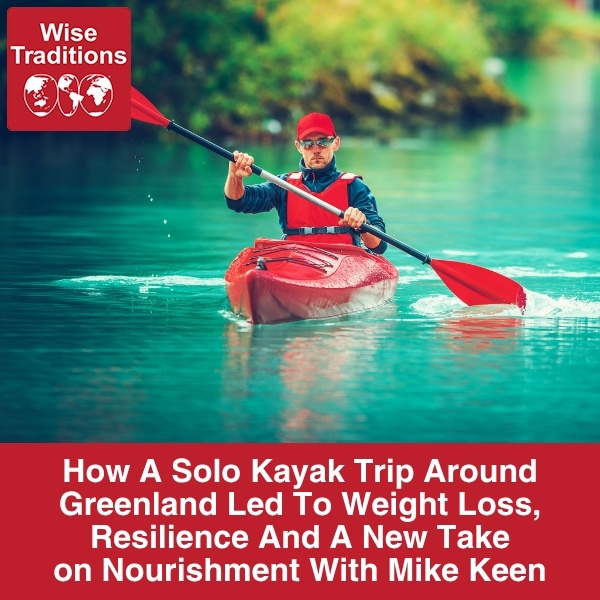
Mike Keen came up with the idea of a kayak expedition off the coast of Greenland before he had any clue about how transformative it would be for his life and health and worldview! Today, he dives into what went down—what it was like eating the traditional Inuit diet (including fermented seal!), how his body responded to the kayaking and change in diet, and insights gathered by the microbiologists examining his stool samples (yes, his poop).
Now, he has planned to explore more remote places and to continue diving into traditional diets to see how his body responds.
A former chef, Mike now admits that he learned more from this experience kayaking around Greenland than from the many decades prior, when he was purchasing and preparing overly processed foods.
Visit Mike’s website: eatyourenvironment.com
Register for the Wise Traditions conference in Utah at wisetraditions.org
Check out our sponsors: Paleovalley and Optimal Carnivore
—
Watch the episode here
Listen to the podcast here
Episode Transcript
Within the below transcript the bolded text is Hilda.
A man dreams up a kayaking expedition around the coast of Greenland over a couple of beers with some friends. What he didn’t realize is that moment would turn his world upside down. His unexpected lessons are told in this episode. This is episode 538, and our guest is Mike Keen. Mike was a chef for nearly four decades, but he gained a new appreciation for his relationship to food and the most nourishing food on the planet as he undertook this solo expedition, kayaking.
He calls himself a regular guy, and yet he was able to push through some extreme conditions thanks to the traditional Inuit diet that he was eating there. He has made a documentary about his experience that’s coming out in 2025. In this episode, he talks about the difference between fermented food and rotten food, and how his paradigm about the use of refrigerators and what constitutes real food completely shifted as a result of his experience.
He also talks about how he submitted to tests about his microbiome and what he learned and felt in his body as a result of all that he went through. He talks about how his health, his weight, his microbiome, and his perspective shifted through the experience. He shares with us all of the a-has in this episode. He also inspires us because if Mike, a self-described regular guy, can not only survive but thrive on traditional foods, maybe we can, too.
Before we get into the conversation, I want to invite you to the Wise Traditions Conference. Mike Keen, our guest, will be there. I will be there along with Sally Fallon Morell, Tom Cowan, Mark and Samantha Bailey, and other amazing speakers. Come join us. We cannot wait to see you. This is the conference that nourishes in every way. From the food to the speakers, there’s wisdom at every turn. Head over to Wise Traditions to register. It is October 17th to 19th, 2025, in Salt Lake City, Utah.
—
Welcome to the show, Mike.
It’s good to see you. I’m very happy to be here.
Kayaking Greenland: A Crazy Idea Over A Beer
Your adventures have captured our imagination. Our group, the Weston A. Price Foundation, is all about wise traditions and learning from traditional people and cultures, particularly their dietary and health lifestyles. You were solo kayaking around Greenland and experienced so much. Let’s start with this. Is it true that you were drinking a beer when you suddenly got the kooky idea of kayaking along the coast of Greenland?
Yeah. I was working in Greenland at the time, down the fjord from Nuuk, the capital. I’ve always been into fermentation, looking at ancestral methods of cooking, and wondering how we got in the mess that we are. I was talking with an Inuit friend of mine. We were talking about the language and how many Qs. The town in the south is called Qaqortor, and the town in the far north is Qaanaaq. The Greenlanders invented the kayak as well. It’s got this guttural q. I said, “Wouldn’t it be great if you could kayak from Qaqortor to Qaanaaq?” It tripped off the tongue. That was it. That was it. I committed to it there and then. I started adding the diet thing to it, trying to make it as eco as I could along the way.
The Inuit Diet: An Unexpected Expedition Objective
Tell us a little bit about that. Was your objective to eat the Inuit diet when you were there?
Not initially. I’d been to Greenland 3 or 4 times. I’ve been watching the traditional kayakers. I haven’t got a kayaking background at all. I rode kayaks for less than two years when I started this expedition. It amazed me how the weather can turn, and storms can occur. You think, “How did the Inuit survive and thrive in this hostile environment?” They were going out in all weathers in these kayaks. It was amazing.
That was what hooked me. It was like that boy’s own adventure type of thing, initially. I was thinking, “Hang on a sec. Thousands of years ago, they would’ve been doing this, but no expedition food, ration packs, or anything. They would’ve been eating the environment. There’s no veg or fruit.” I’m a chef by trade, so it has been indoctrinated into me more than most about five a day, how you’ve got to have a good mix of foods, and all this.
I was thinking, “How is it possible that the Inuit managed to do it?” According to conventional science and the narrative in the West, it’s not possible to survive without veg fruit for 3 or 4 months, which is what the expedition ended up being. From there, I tried to get sponsorship. I dangled this microbiology Inuit diet testing thing in front of a few people.
I managed to get this super group of microbiologists, Aviaja from Greenland University in Nuuk and Sonenberg from Stanford in California. I had all these people interested in it. From there, it snowballed. The day before I headed out for Greenland, I had 2 or 3 hours of quite extensive tests. I had blood tests. I had 40 little samples and tubes to take along the way. The results, which we’ll talk about later, were amazing.
You had a couple of years of kayaking under your belt, and you were a chef who had heard that you’re supposed to have five a day. You had a lot of curiosity and a willingness to take on this adventure, which I find admirable. What were the first foods that you found that the Inuit are still eating, these traditional foods, and how did you start incorporating them into your diet?
That was the third time I’ve been to Greenland, and I was super into the food. For me, the holy grail of anything ancestral and fermented is called Kiviaq, which they make in the far north, which is 300 or 400 little auk seabirds, little fellas like that. They pack 300 or 400 intact dead birds inside a seal, sew the seal up, push the air out, and bury it under rocks. That’s left for six months, and then they cut the seal open. You take the feathers off and eat pretty much the whole thing, apart from the skull and bones. You are eating the guts and the meat. It turns into this pate.
The ambient temperature is above the safe zone for a fridge. I was thinking, “How can you marry the extreme regulations that we have in terms of food in the States, Europe, and England? Everything’s got to be kept in the fridge and thrown away if it’s past its sell-by, or over three days old, or all this kind of rubbish. You’ve got this raw poultry that’s been fermented at about 8 degrees centigrade for 6 months. You can eat it, and not only can you eat it, but you can thrive off of it. It’s a super food.
To me, that was one of those light bulb moments where you think, “1 of these 2 stories isn’t adding up here.” That tipped me down that rabbit hole. As a professional chef, everything revolves around the fridge. Even in the domestic home, everything revolves around the fridge. If it’s not in the fridge, then you’ve got to throw it away. How did we survive?
I did a little bit of digging. It turns out that even in England, in 1963, only 5% of domestic houses had a fridge. That’s only a few years before I was born. The States were about 40 years ahead of us, so it was before the war. You guys led the way with the fridges. To me, it was incredible that our whole food system now is based on keeping stuff at temperature, labeling it, and keeping it in the fridge. For the previous million years, we didn’t have that, so how did we survive? Not only that, how did we thrive to get to be seven billion people without having fridges and all these regulations?

Fermentation Vs. Rotting: A Chef’s Revelation
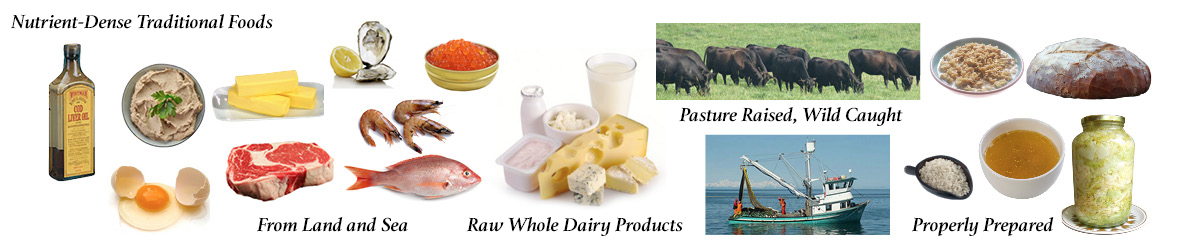
One of our eleven dietary principles that the Weston A. Price Foundation has put together is that all traditional cultures that we’ve examined had fermented foods as part of their diet. It was both a preserver of the food but also a way to make the food even richer in nutrients, and make them more bioavailable. My question to you is, how did it taste? Did you try these birds sewn up in the seal?
I loved it, genuinely. Initially, it was, “That’s quite interesting.” I didn’t expect the fermented meat. Pretty much all the fermented meats that I’ve had, if you closed your eyes, you’d swear that it was a blue cheese that you’d forgotten about at the back of the fridge since Christmas that had been festering away there. It takes the skin off the roof of your mouth because it’s that strong taste. When it’s attached to a beak or whatever, it doesn’t quite match up with your expectation.
Another part of my study is that I’m talking with a professor at Michigan University about disgust. Disgust is not a hardwired reflex for humans. It’s an environmental and cultural learned reflex. When you’re a kid, you hate everything apart from pizza, chicken nuggets, or whatever. You go to these amazing indigenous places like Greenland, and the kids are tucking into super strong stuff that the kids here would be aghast at. They’d be horrified. It’s a thing. It didn’t take too many tastes for me to get into it.
Disgust is not a hardwired human reflex; it’s an environmentally and culturally learned response.
What it makes me think is, unfortunately, we are changing the palates of our children. The reason everything that’s real tastes icky to them at first is because their palates have been accustomed to all the processed foods, all the sugar, and all the additives that make it taste a certain way and very zingy and attractive to their little mouths. If they were eating these fermented foods from the get-go, it would likely appeal to them, as you saw in your experience in Greenland. Certainly, this wasn’t the only fermented food you came across when you were there, right?
No. They pretty much ferment. When I say ferment, most people would call it rotting. Fermentation is controlled rotting, if you go back to the actual definition. This is another little side project of mine. I am trying to find out where that line between fermented and rotten lies. The Kiviaq or the fermented seal, which is a dead seal left out for six months with no salt, nothing, is roadkill effectively here. It’s like there you’d find behind a hedge.
I’ve done some experiments where I’ve been rotting raw meat. At first, I started incorporating raw meat into sauerkraut, so you’ve got that base population of lactic acid bacteria, which will exclude any pathogens. That was my safe way into it. When I was in Mexico a couple of years ago, we were doing a workshop on it and talking about it. I fermented or rotted some fish heads and some beef heart and left them out in the Mexican sun for 7 or 8 days.
There were maggots and everything going on. I ate it as part of this workshop because, in my mind, it’s how we’ve evolved. I’ve eaten enough heavily bacterial-laden food for me to be sure that I’ve got a fairly good stomach. It wouldn’t upset my microbiome too much. I’ve never gotten sick from any of my experiments into fermented and rotting meat.
What I’ve been doing is talking to anthropologists because there’s this theory that when we moved apart from apes from millions of years ago, our brains were quite small. At some point, our brains ballooned to a much bigger capacity, which enabled us to invent or discover communities and work together to make tools and hunt big again.
The theory is that meat and fish were the driver for that increase in brain size. What doesn’t get discussed is that for millions of years, we wouldn’t have had the tools to take down big game, so we would’ve been scavengers, chasing hyenas or whatever game and eating it. In the tropics, especially, meat will go off super quickly. That whole fermented thing would’ve been more in tune with our evolutionary process than cooking would’ve been.
Cooking, depending on who you talk to, started anywhere between thousands and millions of years ago. For the previous million years, when we started eating meat, a lot of it would’ve been fermented. There are well over 200 documented instances where, when tribes in the tropics get a fresh kill, rather than eat it raw or have that beautiful filet or anything, they’ll bury it or hang it up for five days or longer to let the bacteria and the flies work on it.
It’s predigested, which makes total sense because it’s all about energy. If you can skip that process where your body is using the energy to digest it, let the bacteria do it, and then you eat it, you can metabolize it pretty much immediately. You’ve skipped that process, which is one of the many beautiful things about evolution and how our bodies work. It’s endlessly fascinating.
You’re right. Before refrigeration, fermentation was a way that people intuitively knew would be beneficial. The people in the tropics weren’t immediately eating what they scavenged or hunted, but they would leave it, and then it would ferment. I love that question that you brought up about the distinction between when it is fermenting and when it is rotten. Some people suggest that it never gets rotten. What do you think of that idea?
I’m very much behind that. The only reason apart from the occasional pathogens or if it’s been kept in an anaerobic environment or more of a man-made environment. I’ll touch on that later. If you’ve got a good microbiome, which you’d get by eating all this stuff gradually, I don’t think you will get food poisoning. The only reason we’re getting food poisoning is because we’re instantly transporting ourselves to the other side of the world via planes. That would never have happened. We would’ve gradually migrated. That would’ve been a gradual thing.
Now, we can fly to India immediately, and everyone says, “You’ll get Delhi belly,” or, “You’ll get diarrhea.” Why don’t a billion Indians have diarrhea? It’s because they’re used to the food. It’s only because we’ve picked ourselves up out of one microbiome in England and dropped ourselves in a different environment. All those bacteria are on the food that you’re ingesting. You’re going to get ill, but it’s not necessarily food poisoning.
Microbiome Culture Shock: Adjusting To Ancient Foods
You did that, though, and you’re going to continue doing that because I understand you’re going to be with Sami in the fall. You picked yourself up from wherever you were and went over to Greenland. Was there an adjustment period, or was your microbiome so robust that you could handle these new foods without any problem?
It doesn’t matter how robust your stomach is or your microbiome. You will always get some kind of culture shock or microbiome shock because that bacteria doesn’t exist in your current environment. In the whole kayak thing, I’m zipped up in a dry suit. If I have diarrhea, I’m in real trouble. Plus, I’m ten kilometers out to see. You don’t want to have an accident in a dry suit. That’s not going to be pretty.
Since I’d never gone carnivore before, I gave it ten days of transitioning. I went straight into the Greenlandic diet because that’s what the medical testing guys wanted. It made sense for me to be on my normal English diet. Go, and then straight onto the Greenlandic. From then on, we can measure the microbiome and bacteria in my poop. That first time took a good seven days of explosive diarrhea. After that, I was perfectly fine. I talk about poo a lot, but it’s such an important indicator. After that, it’s once a day or maybe two days, mainly. It was a beautiful number four on the Bristol Stool Chart. Do you have the Bristol Stool Chart there? Do you use that?
I haven’t.
It’s a grading of 1 to 7 of your poop. It’s hilarious. Number 1 is hard, little pellets through to number 7, which is diarrhea. You want to be aiming for number four. I was hitting number fours all the time.
You want your number 2 to be a number 4 on the chart. I’m very curious about what results these microbiologists discovered once you got back with all your little samples of poo, since we’re on this subject. What did they find about your gut microbiome, and how did you feel?
I felt incredible. At the time, I was 54. I’ve never been in the Military. I’ve always kept fairly fit, but I’ve never been in Special Forces or done loads of expeditions. I’m a very average guy. My intention was to do 30 kilometers a day on average on the kayak. I ended up doing 40s and 50s a day. My best was 85 kilometers in a day, which was like 15 hours of straight kayaking. I never thought that was going to be possible, and that improved throughout the expedition.
The first time I weighed myself, which was about three weeks in when I got to Nuuk, I weighed and thought the scales were broken because I’d lost 14 kilos, which is 2 stones in 3 weeks. I was never obese. I was never fat. The first time I saw myself in the mirror, which was three weeks in, I thought, “Wow.” Checking the scale, I was 75 kilos. I was a little bit worried for a while. I thought, “I must be using all my energy and fat reserves. At some point, probably when I’m ten kilometers out to sea, I’m going to crash, keel over, and drown or freeze to death.”
This is the beauty of being immersed in a natural environment. It went down to 75 kilos and stayed exactly the same through the next 3 months. It was incredible. It’s only when you totally immerse yourself in your environment. You’ve got no petrol, fumes, or diesel going on. You’re eating what’s only been caught within ten kilometers of where you are.
You’re sleeping outside. You’ve beached a kayak and you’re barefoot. You’re in a tent, and the wind is on your face. You’re sleeping within your circadian rhythm, so you’re in touch with everything. You can’t be closer to nature after all that we’ve done for millions of years, up until the last few hundred years. I think that is my optimum weight for that environment. That was me being in harmony with nature, which I’d never been before.
Despite being a chef, I’d never particularly questioned if the food that the government said we should be eating or the food that was in the supermarkets was anything but good for me and the stuff that I should be eating. It’s embarrassing to think that I went 30 years as a chef before I started questioning, and the wool was pulled from my eyes.
I was thinking, “Hang on. This stuff in the supermarket is purely there to make money. Nothing about that is beneficial for you. It’s nothing about community or any of the values that we held for millions of years and have evolved with.” Pretty much since World War II, money has taken such a big stake in the game and is controlling everything.
I love that idea of going back and being in harmony with nature in that environment. I think that if I’d gone to Ecuador and lived in Ecuador, eating similar stuff that was native to Ecuador, I would’ve hit an optimum Ecuadorian weight and been thriving in my best possible way with that environment. I believe that’s what would happen.
I like how you’re giving us the big picture. I know Eat Your Environment is your mantra. From what you communicated, it’s clear that you understand it’s not just the diet that makes us well. It’s connecting with nature. It’s grounding. It’s being in a place that helps the body be vital and strong.
The real shame about the Western world is that we can’t ever go back to how evolution guided us here through selective breeding. I’m not talking necessarily about GMO or anything laboratory, but selective breeding of selecting the best wheat, fruit crop, or whatever. Over hundreds and thousands of years, that has changed. With the fruit that we have now, especially if you Google and look at bananas compared to what bananas looked like many years ago, or avocados, they look nothing like the stuff that we get in the supermarket.
Part of my project is to look at what humans would’ve been eating many years ago when they came into Europe, England, and these areas, because the climate was different. The food was different. It’s not good enough to eat to go carnivorous and eat pigs or cows. You’ve got to take a deep dive into what’s behind that and what those cows and pigs have been eating. If they’ve been eating commercial feed, which is full of the crap that we eat in the supermarkets because they are full of sugars, palm oil, and all this rubbish to fatten them up, if we eat those, then that’s not going to be particularly good for us.
It’s a real minefield out there. I’m speaking with some amazing anthropologists and paleobotanists about the stuff that would’ve been around many years ago. We evolve so incredibly slowly as a species that we’ve barely changed over the years. By far, the biggest change that we’ve ever put on our bodies is ultra-processed food. We’re not eating anything like how evolution intended for us to eat. No wonder everyone is getting sick and the health systems are in crisis because we’re all getting ill.
The Supermarket Deception: A Chef’s Aha Moment
What’s interesting is that you were a chef for so long, and somehow, you weren’t connecting the dots. Did you have an a-ha moment when you were kayaking around Greenland, or when exactly did this all strike you that the stuff on the shelves is for profit and not for our health?
I didn’t have a light bulb moment. I’ve been questioning myself as to why I didn’t have that. There are many foggy layers. It’s not as simple as A or B or black and white. There are so many layers in having to work, getting the bills, and what’s available to you. For most people, they haven’t got a choice but to go to a fast food place or a supermarket. It depends on where you can go to get it.
Luckily, here in England, we’ve got some amazing farmers’ markets and organic food that you can get hold of. It all comes down to money. If you want to make money, you’ve got to create it as cheaply as you can and sell it for as much as you can. There’s no leeway there at all. That is the be-all and end-all of capitalism. Buy it cheap and sell it expensive.
You’ve got to make a profit.
It’s one of the massive problems that we’ve got. It’s such an immense problem that there are only a few places left in the world, such as Greenland, where you’re still able to connect with nature and do that. There are not many places left that don’t have a supermarket.
There are all these foggy layers. I’m thinking of the readers who are like, “This all sounds great, but I am not going to be able to go kayaking around Greenland anytime soon. As a matter of fact, I live in a city and I hold a job that has a lot of responsibilities. I work full 60-hour work weeks, so I have to stop at the grocery store and make do with what I got.” What would you tell a person like that?
Firstly, the kayaking is incidental. That weight loss that I had of 14 kilos in 3 weeks, I recreated the diet the following year. I went to East Greenland for 60 days. I ate exactly the same diet, but I didn’t do any kayaking or anything. I lost exactly the same amount of weight, but in five weeks. I came down to 75 kilos again by eating the exact same food, which blew my mind.
I’ve since spoken to a lot of media celebrity nutritionists and doctors over here. It turns out that unless you’re on some kind of Olympic training regime, exercise isn’t going to bring you any weight loss. Exercise has a minimal effect on weight loss. It’s super important for other stuff, like your fat-to-lean ratio, mental health, and body tone. There are so many other things. I’m not saying by any stretch don’t do exercise, but if you want to lose weight, it’s 100% your diet.
I’m pretty sure that in the States, it’s the same as in England. If you are in a city, you do have access to organic food. I know there isn’t a simple answer to it because it is expensive. If you go to the supermarket and you’ve got a choice between a $5 chicken or a $40 chicken, what are you going to go for? The big thing is if you’re aware of it and you look at the label, and that’s a naturally reared one that’s been outside compared to this battery chicken that’s been pumped full of antibiotics and hasn’t had a good life or a good death, then that is the fuel that you’re putting in your body.
If you go to the gas station, do you put rubbish, cheap grade fuel in, or do you put a premium one in? You know what will happen. You’ll get all kinds of rubbish in your engine, and you’ll end up paying for it in the long run, which is exactly what we do with our health. You buy and eat cheap in the short-term, and in the long-term, you’ll be spending the last twenty years of your life on medication or having a less-than-optimum lifestyle.
It’s difficult for us humans to project long-term. For us, it’s all about short-term gratification. We think, “I’ll have these beers,” or, “I’ll have this bottle of wine. I’ll be all right.” By the time it comes to you not being all right when you’re 70 and you’ve got gout or whatever, you can’t turn the clock back. It’s all about the food. Unfortunately, you’ve got to bear in mind that this capitalist society has become hypercapitalist. Whereas many years ago, the food would’ve been okay to eat. Now, it has gotten even cheaper. They pumped it with even more rubbish, and it’s killing us.
Modern Food Vs. Ancestral Wisdom: Why We’re Getting Sick
We often say you either pay your doctor or you pay your farmer. I would rather invest in my food and avoid all the healthcare or sick care systems, or the alternative. I do want to ask you, though. You were talking before about how we’ve even hybridized some of the vegetables and fruits. A banana from so many years ago looks so different from a banana now, and an avocado is the same. How can we go back to more traditional fruits and vegetables, do you think? Is there a way?
You either pay your doctor or you pay your farmer.
There’s no way. You can’t turn the clock back on evolution unless you’ve got a spare million years. In which case, we could probably engineer all the way back. There’s no doubt about it. Avocado nowadays, compared to the one that had a tiny sliver of flesh around a massive stone, is nothing like that. That’s why meat and fish were so important to us in developing and increasing our brain size. The short answer is it’s not possible to go back to eating that, but the key thing is to be aware of what you’re putting in your body.
Speaking of going back, when you went back to England, did you continue to eat the Greenland diet, or did you switch back to your English diet?
The Greenland trip screwed my whole career up. I can never work as a chef in a traditional restaurant anymore because it’s so carb-heavy, seed oil-heavy, and processed food-heavy. Everything’s deep fried, or everything is expected to have potatoes or rice with it. I’m aware of how much carbs I eat. I don’t eat pasta, rice, and potatoes. If I do, I’ll have wild rice. I’ll eat some of my own sourdough or a good sourdough as opposed to a supermarket sourdough, which more often than not has loads of rubbish in it to taste like a sourdough. It’s been engineered again.
My tastes are simple. Over millions of years, we would’ve only eaten single-item food products at most of our meals. We wouldn’t have combined seven different vegetables, a grain, and a sauce, and then have dessert and a glass of wine. Can you imagine all the signals that are being sent to our bodies, trying to adapt to that and trying to get, “What is going on?” Whereas millions of years previously, we’ve had meat, legumes, fruit, or honey. We’ve rarely eaten it in such a crazy combination. We’ve never eaten it with all the emulsifiers, additives, food coloring, and all that kind of stuff.
Going back to weight loss and trying to eat effectively, all those things mess up your signaling, like your leptin and insulin levels, which are so crucial for your body in maintaining that ideal balance. Every time you put something manmade or lab-made into it, you’re scrambling all those signals, which is why we find it difficult to stop eating. We find it difficult to stop eating these sugary, addictive foods.
What I find endlessly fascinating is that it all goes back to evolution. Every time I have food, I’m asking myself how divergent that is from our evolutionary path. This traditional family recipe for a loaf of bread, which has fifteen ingredients in it, is that what we would’ve been eating for millions of years? It’s not. Even sourdough, we’ve only been eating it for 12,000 to 15,000 years, which isn’t long enough for us to assimilate it into our physiology and evolve with it. It’s letting our microbiome and our digestive system do the heavy lifting on that to make it and change it into a suitable element for us to process. You keep that in your mind the whole time.
Beyond Greenland: New Adventures And The Future Of Diet
I know you have another adventure coming up among the Sami and Northern Norway. Was it also over a beer that you came up with this idea?
No. The kayak thing is being turned into a documentary, which is out in September 2025. We’re launching it at the Nuuk Film Festival. This idea came up with the production company, which is Norwegian. They’ve got some great contacts up there. The plan at the moment is for me to row a sewn boat made of reindeer skins sewn together up the Far North of Norway and speak to the Sami about how they’re surviving and how Western civilization and Western ways are encroaching on those traditional ways of living that they’ve had for thousands of years.
This is all part of my big diet project, which is a 12-month project, of which I’m going to subject myself in 3-month increments to the major diets of humankind. Starting in September 2025, for the first 3 months, I will be on a hunter-gatherer diet. That’s meat, fish, and legumes. I’ll get back to what we would’ve been eating many years ago.
The next three months will be spent on the agricultural revolution. Here on my homestead, I’ve got an acre and a half. I’ll be growing einkorn and emmer wheat. I’ll be getting an ancient breed of cow. I’ll be looking not only at the logistics of what it means to grow your own wheat and make your own bread, which baffles me because it’s so intense. It’s such an intensive labor process. It seems crazy that we get onto it.
It’s very different from getting meat and letting it rot in the sun.
That’s the second three months. I’ll do these with full medical testing before, during, and after. The 3rd set of 3 months is going into a processed diet or industrial diet. I’ll be getting 60% of my calories from processed food. I’m not looking forward to this one at all, but it’s to measure it in comparison to the others. I’ve got a whole bunch of experts looking at the results, my mental well-being, and everything for the three main diets. We are then going to use those results to create a discussion about what an optimum diet in this world looks like.
Clearly, we can’t all go carnivore with seven billion people. Is there a way of navigating those rapids and selecting optimum parts from each of the diets? I very much doubt there’ll be anything from the industrial diet that will end up there, but we have to bury it in mind. It’s impossible for everyone to go back, eating an optimum diet from thousands of years ago. It can’t be done nowadays. It’s mainly to create discussion and awareness of what we’re putting in our bodies and whether there is a way to make the most of this crazy food world. That should be interesting.
Your adventures and your willingness to be a part of these experiments are intriguing and fascinating to me. I can’t wait to see you at the conference in October 2025. It’s going to be amazing. I want to conclude with the question I love to pose at the end of the show. If the reader could only do one thing to improve their health, what would you recommend that they do?
It’s education. Educate yourself. Look at how long we’ve been on the planet and how slowly it takes us. A brief Google into anthropology about what we would’ve been eating and how incredibly tiny this bad trend of eating rubbish has been with us. Look at the illnesses that it’s causing. Bear that in mind every time you go for a meal or buy food. You think, “That doesn’t look like anything evolution has picked out for us,” and pick something better. Pick something that’s more suited to human survival. Would nature have wanted us to eat that? Most of the things from the supermarket are a big fat low.
Most things from the supermarket are a big fat lie.
Thank you again for your time. On behalf of the Weston A. Price Foundation, it has been a pleasure.
It has been a pleasure for me, too. It was an absolute pleasure to be on here. This is brilliant stuff. Thank you.
—
Our guest was Mike Keen. Visit his website, Mike Keen, to learn more. Please follow the show on your favorite platform. That way, you won’t miss a thing. If you’d like, you can even find an app that we’ve developed on iOS and Android devices. Type in Wise Traditions Podcast in the little search bar, and sign up for free. You can get our show directly sent to your phone without any middleman. Thank you so much for tuning in. Stay well, and remember to keep your feet on the ground and your face to the sun.
About Mike Keen
Mike is based in Suffolk, England and gives talks and cooking demos around the world on evolutionary food preservation and cooking techniques. When not researching and experimenting with food on his homestead he can often be found in remote regions testing out how his body copes with differing natural diets whilst immersing himself in the environment. A documentary on Mike’s solo kayak expedition in Greenland eating only an Inuit diet is launched later this year.
Important Links
Episode Sponsors
🖨️ Print post

Leave a Reply