


 🖨️ Print post
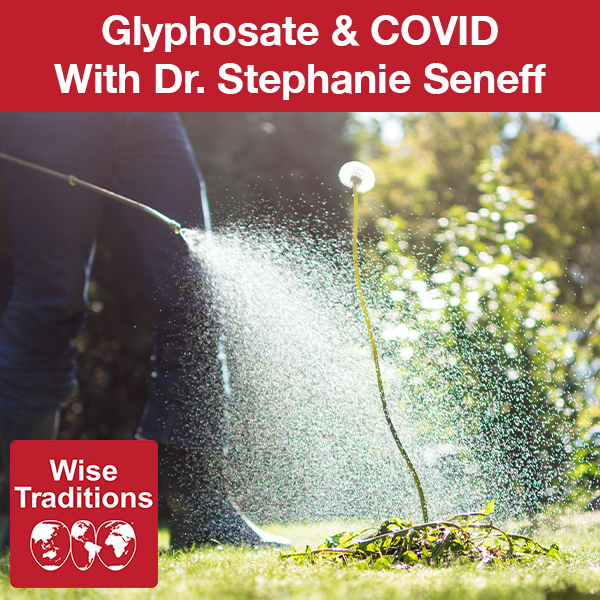
Glyphosate residues are in our food, air, and water. How can we combat this carcinogenic toxin? And could it be contributing to our current global health crisis? Dr. Stephanie Seneff, an MIT scientist, has been studying the effects of glyphosate for decades. Today, she highlights glyphosate’s role in respiratory illnesses (including COVID), how its presence in bio-fuels is contaminating our air, and what a glyphosate map overlaid with COVID cases reveals.
Stephanie also talks about what we can do to lessen glyphosate’s effects on us – from Epsom salt baths to nutrient-dense foods, to sunlight and grounding. She also offers an idea for an overall solution for preventing glyphosate contamination.
—
Listen to the podcast here:
Glyphosate & COVID
Episode Transcript
Within the below transcript the bolded text is Hilda
Glyphosate residues are in our food, air and water. How can we combat this carcinogenic toxin that could be contributing to our current global health crisis? Our guest is Dr. Stephanie Seneff, an MIT Scientist. She has been studying the effects of glyphosate for decades. In this episode, she highlights what she’s found. She discusses glyphosate’s role in respiratory illnesses including COVID, how it is found in biofuels, which are touted as environmentally beneficial, and what a glyphosate map revealed about spikes in COVID cases and the possible relationship between the two. She also talks about what we can do to lessen glyphosate’s effects on us, from Epsom salt baths to nutrient-dense food to the benefits of getting sunlight and grounding. She also offers an idea for an overall solution for preventing glyphosate contamination.
—
Pre-order Stephanie’s upcoming book at https://www.chelseagreen.com/product/toxic-legacy/.
Welcome to the show, Stephanie.
I’m so delighted to meet you. Thank you.
We are going through a very difficult time with this COVID-19 pandemic marching across the world, as you have said. I know you are an expert in glyphosate and I understand that you have a theory that it might be playing a role in the spread of this virus. Can you explain?
Yes, I think that’s a possibility. I have become aware that glyphosate disrupts the innate immune system and in part because it disrupts the gut microbiome. That’s so crucial for the development of the immune system. When your innate immune system is weak, your adaptive immune system kicks in and it can cause damage because it overreacts to the virus. That’s what I’m seeing in the cases that are ending up in the ICU. People who have been exposed to more glyphosate throughout their lifespan may be more susceptible to ending up in the ICU if they catch this COVID-19 virus.
I know glyphosate is in our food stream. Where else can we find it?
Glyphosate is all over the food supply. The thing that I found interesting as I started to look into COVID-19, I started to notice, first of all, Wuhan is a city that’s known for air pollution. I figured something in the air could be causing lung damage. There are many toxic chemicals in the air that do damage the lungs so that is part of the problem. There’s a question of, whether glyphosate could be in the air and that could be something new that wasn’t true years ago. I knew about ethanol, in the United States, it has played a leadership role in putting ethanol into gasoline. We now have like 10% ethanol in most of our gasoline supply in this country, which is much higher than what most other countries do.
We also have a much higher problem with COVID-19 and those two could be connected, although it looked to me like the epidemiology was pointing to something else because Europe was also hit hard by COVID-19 and they had a lot less ethanol in the gasoline. I thought maybe that’s not the case. Maybe that’s not the problem. I became aware at that point that there’s actually another kind of biofuel called biodiesel. I wasn’t aware of biodiesel until I started to look into COVID-19. Europe has always embraced diesel much more than the US has. 20% of their vehicles are diesel-driven cars. We have a lot of diesel trucks and buses are often diesel fuel but ours are mostly run on gasoline, maybe 2% diesel. That would favor Europe over the US.
The introduction of biodiesel was something I was not aware of. I started reading about it and there are many different ways to end up with biodiesel. All of them involve some kind of crops, either the forest industry or the food industry. In Europe, they convert olive oil into biodiesel, and olive trees are routinely treated with glyphosate around the trees to kill the weeds so there could be glyphosate in the olive oil. Europeans import a lot of their biodiesel from Argentina, which is a major supplier of biodiesel around the world. Argentina exports maybe half of its biodiesel. Their biodiesel is derived from GMO Roundup Ready soybean crops. That’s likely to have glyphosate in it.
The United States has played a leadership role in developing a kind of biodiesel that’s based on the residue after you have harvested the crop. That’s attractive because now you are not turning your food into fuel. You still can harvest food from the crop, and then you take what’s left over after you have harvested the corn or the wheat. There’s still residue. There are various stalks and whatnot that you can scoop up and sell on to a barge and ship them down to a site where they can turn it into biodiesel fuel. That’s much more problematic because we spray wheat with glyphosate right before harvest and corn is a GMO Roundup Ready crop.

In other words, we thought by coming up with biodiesel fuel, we were helping the environment, right?
Yeah. That’s what I’m afraid of. It’s all speculation at this point. It needs to have some science behind it but it’s an interesting thought. New York City has played a leadership role in the idea of putting biodiesel into the diesel fuel and they have some 11,000 vehicles on the road in New York City that runs on biodiesel, at least in part. New York City is by far the biggest hotspot in this country, with a huge amount of problems with people ending up in the ICU and dying from COVID-19. It’s a Metropolitan area so the air is polluted. In any case, diesel itself is toxic.
Biodiesel has actually been investigated by many papers where they have shown that it causes an inflammatory reaction that’s worse than whatever is caused by diesel itself. They know there’s something in the biodiesel that’s causing inflammation. Inflammation is what’s causing trouble in the lungs when you respond to COVID-19. The adaptive immune system goes into overdrive and produces cytokines. It’s what’s called a cytokine storm when it becomes so out of control that you end up with sepsis and multiple organ failure because of this acute reaction of the adaptive immune system. That’s because the innate immune system is too weak. It has been hurt by glyphosate and other chemicals that are in our environment.
I want to make sure I get this straight. The adaptive immune system is like a backup plan or a second line of defense against whatever is attacking our bodies. It kicks in to drive when the innate system is overwhelmed. Is that right?
That’s exactly right and the innate system gets overwhelmed because it’s weak and it’s weak because of glyphosate and other chemicals that we are exposed to. I suspect if it is true that glyphosate is in the biodiesel, it’s getting incorporated. It’s working together with the organic material from the diesel itself that’s toxic. There are these organic compounds that are known to be toxic in diesel fuel. Those are mixing with the glyphosate and, as I’m suspecting, they are increasing the likelihood that glyphosate would be taken up by the cells in the lung because of the surfactant effect of these oils, of these other ingredients in the biodiesel fuel. Does that make sense?
Yeah. If I’m understanding you correctly, you are saying that this isn’t necessarily the cause of the virus but it is making us much more vulnerable to it.
It’s making people much sicker when they catch the virus. Other people don’t even know they have it. They are finding people testing positive who have no symptoms whatsoever. What’s the difference between someone who ends up in the ICU and someone who has no symptoms? The difference is the strength of their innate immune system. Normally, you would be able to clear the virus and not even think twice about it. Maybe get a little cold but because of this damage to your innate immune system, your body is not able to fight the virus properly and you end up overdoing the adaptive aspect, releasing all these cytokines and also having insufficient antioxidant defenses.
A lot of things that they are recommending to take in the alternative medicine community are all antioxidants, things like melatonin, getting sunlight and vitamin D is important for your immune system and taking glutathione or taking precursors to glutathione like N-acetylcysteine, things that would boost your glutathione and taking high-dose vitamin C. Those are all excellent antioxidants and the problem is that your immune system is releasing all these oxidizing agents trying to kill the virus because it can’t scoop up the virus and remove it, which is what the innate immune system should be able to do but it’s not able to do that so the virus multiplies and gets out of control.
There are a lot of information to take in. I’m glad that you mentioned those supplements. Would you actually recommend that we take more of those to try to help our innate immune system?
I generally don’t like supplements. I prefer, as you know, natural things. Eating foods that are high in sulfur. I do like Epsom salt baths. That’s my one big exception concerning supplements. Epsom salt baths will give you the sulfur. Sulfur is super important for the immune system, getting out in the sunlight, walking along the shore barefoot to get the grounding, and getting the sunlight and the hydrogen sulfide gas from the ocean, all those are going to be helpful. Eating organic food is super important.
Those of us who may be in the urban Metropolitan areas are may be more susceptible because of the biodiesel fuel that contains glyphosate. We may be breathing in polluted air that again is compromising our innate immune system and even making the adaptive immune system struggle to combat this virus. What about those people who are living somewhere far from the maddening crowd? How does your glyphosate map so to speak, overlap with the map of infectious cases?
Most of the big infections are in the cities and especially in places that have airports. For example, out West, Denver and Salt Lake City are both hotspots that stand out in the Midwest and those that have major airports. It may very well be connected to the airplanes that are flying with biodiesel fuel. That’s a thought that I have. Metropolitan areas have polluted air and there are lots of pollution in the air. All these nanoparticles, probably aluminum works very badly with glyphosate. All of those things are mixing in.
It’s hard to say to what extent. It’s glyphosate versus all the other stuff that’s in the air pollution. I definitely think anybody who is living in a place where the air is bad needs to be worried and if you can live far away from that, you will be good as long as you are not hanging out next to a bunch of the fields where they are growing glyphosate-contaminated crops. If they are spraying glyphosate in the air on the farm next door, you are not going to be in good shape.
Speaking of not being in good shape, I think of the trend of vaping. Can you speak to that and its possible role in this as well?
Yes, it’s extremely interesting and that’s what actually led me to write the article that I wrote for Jennifer Margulis on her blog site. I was aware that vaping was causing odd lung disease, some bizarre lung disease that they had not seen before. This was true before COVID-19 even appeared on the scene. I was aware of it even before COVID-19. I was curious about it and I was looking into it because vaping is based on a new way of getting a cigarette and getting nicotine through a mechanism that’s not the same as normal smoking of a cigarette. It involves this liquid mix that has glycerol as the main component.
The glycerol is derived from the residue when you process the raw materials of the biomass to turn it into biodiesel in those factories where that’s done. The residue can be used to make glycerol. I’m suspecting that the glycerol in the cigarettes is contaminated with glyphosate and causing damage to the lungs. It turns out that the symptoms of that condition look exactly like an infection with COVID-19 infection. COVID-19 disease is characterized by a dry cough and difficulty breathing is a very strong feature of it, a slight fever and no runny nose.
Colds usually have a runny nose but there’s no runny nose with this COVID-19 disease. That is exactly the same symptoms that you see with this lung disease that’s happening with eCigarette smokers. I think that’s very curious and that’s what led me to feel more confident in saying that it could be a consequence of this introduction of biodiesel fuel because that is a new thing that’s happened and had been escalating in the last few years. That’s what separates it from other forms of glyphosate exposure, which have been going on for much longer.
I have heard news reports of young people who would have these horrible symptoms. The ones you were describing that have been associated with COVID-19, the dry cough, the fever, the difficulty breathing and it was alarming but somehow, these things are still on the market. Explain that to me, Stephanie.
I wish I could explain that to you. I do not understand why any of these things are on the market. I hope that we will eventually wake up as a species and realize we can’t keep doing this. We need to shut down a lot of factories where these toxic chemicals are being produced and get rid of them. It would be so sweet if we could do a worldwide ban on glyphosate and shut down the factories where it’s being produced. I would love to say if we did that, how would our health change. To what extent is glyphosate the problem versus all the other stuff would we see no difference or would there be a substantial improvement? I don’t know.
I think glyphosate is a major player in many of these diseases that we are seeing, diabetes, heart disease, lung disease, all of these things are going up dramatically in the population with the rise of glyphosate usage. When you have these diseases, you have a higher risk of a bad outcome ending up in the ICU with COVID-19. That has been shown in many studies coming out of China showing that people who have these addictions are more at risk.
I understand there have been some studies done on the lungs of mice and the effects of eCigarette vapors. What were the results of those studies?
That study was extremely interesting and that was what tipped me off to like, “Maybe this is something,” because it connected very nicely to my theories about how glyphosate works, how its toxicity happens. In that study, for about three months, they exposed them to vapors from eCigarettes and then they infected them with a flu virus. They were expecting and anticipating that it would cause them to be more susceptible to the virus. Indeed, it did and it caused this inflammatory response that’s characteristic of how people are responding to COVID-19 but they specifically looked at the lungs to see what was going on. They observed two things that were singled out in the paper.
One was an accumulation of fatty deposits inside the macrophages in the lung. The macrophages are the immune cells that come in to fight the infection and they loaded up on fats. The second thing was that the surfactant was messed up. The proteins in the surfactants were suppressed by the effect of the fumes that they had for the three months. Those proteins are very interesting to me because they have something that’s called a collagen-like stalk on these proteins. These proteins are important for trapping viruses and helping the macrophages to remove them.
Those collagen-like stalks are very interesting to me because they are a long sequence of amino acid chains that goes GXY/GXY, where every third amino acid is glycine. They are loaded up on glycine. That’s the same that’s true for collagen and collagen is the biggest and most common protein in the body. Something like 25% of our proteins is collagen molecules and they have long sequences of GXY/GXY. A tremendous opportunity for glycine to get substituted by glyphosate, which is what I think is happening. It’s so terrible what glyphosate is doing to the body.
It’s messing up collagen in our joints and our bones. That’s why we have so much trouble with back pain, shoulder pain and hip replacement surgery. All these troubles that we are having with our joints are connected to glyphosate messing up the collagen. Glyphosate is messing up the collagen in the surfactant proteins and causing them to be unable to clear the viruses. That’s what I suspect is happening. That’s what they saw in this study that those proteins were affected by the fumes. They didn’t look for glyphosate. They weren’t thinking of it at all because people never do but that would definitely be something that should be done to see if there is glyphosate in those fumes. That could account for this, in which case it would also strengthen my theory.
Surfactant proteins are found in the lungs in addition to other places, obviously.
That’s very important in the lungs, the surfactants. Lungs have a lot of surfactants that trap debris that comes into the air and allows the macrophages to clear it. It’s very important because the lungs are exposed to all kinds of environmental factors all the time. They need to be able to efficiently clear them. I managed to get back to the fatty acids because that was also very interesting that the macrophages in the lungs were accumulating fat. This is what you have seen in other studies on rats exposed to low-dose glyphosate below the regulatory limits. Exposure to these rats and these people studied their liver and they found out that these rats accumulated fats in the macrophages in the liver. It’s the same pattern that was going on in the lungs. It happened to the liver when they were exposed orally, through the digestive system through glyphosate. It’s, whichever organ gets hit first gets hit with this problem that caused it to accumulate these fats.
Stephanie, people are frightened of each other. We are all afraid that we are going to catch this virus from each other when maybe we should be paying attention a little bit more to the environmental factors at play.
I feel like if you are being careful about environmental exposure, you should think of this as getting a cold. If you’ve got a good, strong immune system, you shouldn’t worry about this virus.
I know you have said before but to reiterate to our audience, glyphosate is in our food stream. It’s in our air, apparently. It’s in the water. How is it this contaminant has taken over and how can we get rid of it?
It’s a hard problem. Certainly, eating certified organic is very important. That’s a great way to reduce the burden in your gut. It hits hard on the gut. It messes up the gut microbes and causes a lot of gut dysbiosis, as you know. Also, getting a nutritious diet. Make sure you have plenty of micronutrients and minerals. Have a healthy whole foods diet, a Weston Price style diet. I noticed that Germany and South Korea both seem to have a fairly mild response to COVID-19 and both of those are places where people eat a lot of fermented cabbage, the kimchi in South Korea, and the sauerkraut in Germany. Fermented cabbage is probably an extremely healthy food to be eating. Cabbage is a very good source of high-quality sulfur, as well as some interesting polyphenolic compounds, some of these almost medicinal-type molecules that are found in plants.
The fermentation is providing microbes a suite for probiotics that may even be able to break down glyphosate. I’m hoping that’s true. I know that I have found that some species of Acetobacter can fully metabolize glyphosate. Those microbes may be showing up in the sauerkraut. Sauerkraut was used in an experiment with cows and showed that it improved their health. Cows that had been poisoned by glyphosate. That’s very interesting to me. There was a study. I don’t know how they thought to give them sauerkraut juice. It was actually sauerkraut juice that was part of their treatment program. I would love to know whether these microbes in the sauerkraut can clear the glyphosate in your gut, which would be wonderful if it’s true.
Have you been able to share your theory with other scientists or people who may consider it, and then perhaps address the patient’s symptoms or infection differently?
I have been talking to friends of mine who are chemists and friends who are practitioners and sharing my ideas with them. Generally, they are quite receptive. I’ve got one who’s got another friend, who’s an expert on diesel and he’s trying to get his friend interested in looking into biodiesel and seeing if there is glyphosate in it. That would be fantastic. I hope that somebody reading who has the skillset necessary to be able to perform some of these experiments will do that to see if there’s any truth to what I’m saying.
I have a couple more questions for you before we wrap up. First, tell us what you know about Bhutan. It’s a landlocked country in the Eastern Himalayas and you say that it’s had very few cases of COVID and you have a hypothesis for why.
It’s known to be extremely conscious of the environment. It has extremely healthy air. It’s very low on air pollution and they were committed to trying to maintain organic, to try to be the organic capital of the world. The government has a messaging, this concept that it wants to be emphasized organic food. I think they are getting a lot less exposure to glyphosate and particularly a lot healthier air in Bhutan. They have a very low infection rate with the COVID-19 virus.
What you have been saying makes so much sense. It’s so almost commonsensical that an issue with our lungs might have something to do with the air that we are breathing.
That’s certainly why that was where I looked. That was my thought, too. Since I’m always looking at glyphosate because I do feel glyphosate is a major player in the crisis that we are facing in so many different dimensions right now.
Can you tell the readers the story of the couple that lived in Seattle, Robert and Elizabeth Maher? What happened to them? Tell their story.
They both got COVID-19 at about the same time. They both died of it within a couple of days of each other. It made the news because of that and they ran a popular restaurant in a section of Seattle that was a short distance away from Interstate 5, a major Interstate eight-lane highway, that was probably spewing out toxic fumes all day long near their restaurant. I’m wondering and I used them anecdotally as perhaps the reason why they were both so susceptible is that they worked in an environment where the air was polluted. There are also a lot of glyphosate being used in the Puget Sound area.
There are a lot of water around Seattle and I’m wondering, whether we are getting exposed to glyphosate from water supplies. Again, studies need to be done. This molecule has not been adequately studied. It’s what it comes down to but they use glyphosate to control weeds along the waterways. They have had some invasive weeds that have caused them to use glyphosate there and the killer whales are in bad shape and nobody understands why. All of that may be connected as well.
Stephanie, wasn’t there a lawsuit against the makers of Roundup because some landscaper posed the lawsuit against them because he had developed some non-Hodgkin’s lymphoma and he won. Didn’t that make any changes to how much industry uses glyphosate?
That was certainly very impactful. I was so shocked and very pleased that he won that case with a pretty large settlement on punitive damages because of Monsanto misleading people on this chemical. He was the first of three so far that has successfully sued. There was a second one, and then was a third one that was a couple who had used Roundup extensively on their property and they both got non-Hodgkin’s lymphoma. All three of them won large punitive damages. It’s still being challenged. They are going through higher courts and whatnot. I don’t think any of them have seen that money, which is very frustrating but it’s also caused a lot of other people to rise and have their complaints as well. There are some 10,000 or something cases pending now linking glyphosate to non-Hodgkin’s lymphoma.
That certainly has caused people to be more aware that this chemical is toxic and has had a lot of repercussions and Bayer stock also tanked because of all this happening. I would have hoped that it would lead to Bayer voluntarily removing the product from the market but that hasn’t happened yet and they are still fighting back. I always think Monsanto finds a way to weasel its way out of every problem that comes its way. It’s very skilled at fighting. It fascinates me that these people don’t care that they are causing so much damage, not just to humans but to all life on Earth in my opinion.
It’s giving me pause, which is why I’m pausing briefly to let that sink in. I had even heard that Monsanto was going to like develop a new weed killer but it was going to probably have different toxins in it, not necessarily glyphosate. Have you heard that, too?
They are always coming up with new ideas. They do have this mix now that has dicamba and dicamba is supposed to be much more toxic than glyphosate. They have had a lot of issues with nearby farmers’ lawsuits because the dicamba being used on the neighbor’s crop is killing their crop. They sell a dicamba-resistant. It’s soy that’s dicamba-resistant and glyphosate-resistant, then they sell a product that goes with that with both of those chemicals in it. It’s a hopeless task to try to control weeds with toxic chemicals. We should stop even trying to do that with any toxic chemicals. There should be solutions, for example, robotics solutions. There should be ways that we could control weeds without poisoning our food. There has to be a solution and I think there are people who are working towards that goal.
Many farmers are growing organic food and I am so thankful for them. We need more of them and we need to have a real reckoning with the farmers to realize that they cannot put poisons on our food crops. They simply cannot do that. We have to stop all the chemicals, not just the herbicides but the insecticides and fungicides. We need to learn how to grow our food the way we used to without chemicals.
Such a good word. I agree wholeheartedly. It sounds like we all if we want to protect ourselves and our families, should heed the word to the wise, which is to eat certified organic foods, to pay attention to the air that we are breathing, and where we are situated. Our home, if it’s close to airports or places where there are a lot of exhaust coming, we have to be careful because that is going to impact the function of our lungs. It could make us more vulnerable to any virus coming our way. Is there any other tip you could give us, Stephanie, for protecting ourselves, our families and our communities at this time?
Certainly, the antioxidant defenses are important and that’s one of the things that glyphosate disrupts. It messes up, for example, glutathione, which is one of our most important antioxidants, which is a problem in this COVID-19 infection because you get an overreactive immune system producing all these oxidizing agents that are damaging. Eating foods that are rich in sulfur will give you a base to make glutathione because glutathione is a sulfur-containing molecule. There are supplements even you can take that will help to boost your glutathione.
Vitamin C is another one. People are talking about high-dose vitamin C. A lot of my friends are recommending that vitamin C is a fantastic antioxidant and also melatonin. People are recommending taking melatonin, which again your body normally produces melatonin, not your pineal gland, which is what helps you sleep. Throughout your body, your cells can make their own melatonin, which they use to protect themselves from damage. Melatonin comes out of the shikimate pathway, which is a pathway that glyphosate famously disrupts. We have a melatonin deficiency as well because glyphosate that’s helping to cause oxidizing damage that we can’t protect ourselves from.
This is so fascinating. Everything is connected. People think, “I can’t sleep. I guess I’m working too hard or I’m stressed,” but actually something in the environment or their food could be impacting their ability to sleep, glyphosate.
It’s amazing. Glyphosate gets everywhere. It’s so incredible to me all the things that it does. I am in awe of that molecule, I have to say. It’s incredibly damaging.
Thank you for enlightening us on this subject. I want to ask you now the question I often pose at the end. You may have already answered it but you might have something else to share. If the reader can do one thing to improve their health, what would you recommend that they do, Stephanie?
The one thing I haven’t said yet or maybe I said it is, get vitamin D and get natural sunlight exposure, which is not about vitamin D. The sun is incredibly healing and it will strengthen your innate immune system, which is what you desperately need in the face of COVID-19. Get out in the sunlight without sunscreen, without sunglasses.
Thank you so much for that advice and that is so simple for any of us to do whatever situation we are in, wherever we live, to get outside in that sunshine, especially if it’s not against the laws. Thank you, Stephanie, for your time. I really appreciate it.
Thank you for having me.
—
About Stephanie Seneff
Stephanie Seneff, PhD received her Bachelor’s degree in Biology with a minor in Food and Nutrition in 1968 from MIT. She received her Master’s and PhD degrees in Electrical Engineering and Computer Science in 1979 and 1985, respectively, also from MIT. Since then, she has been a researcher at MIT, where she is currently a Senior Research Scientist in the Department of Electrical Engineering and Computer Science, and a Principal Investigator in the MIT Computer Science and Artificial Intelligence Laboratory.
Throughout her career, Dr. Seneff has conducted research in diverse areas including human auditory modeling, spoken dialogue systems, natural language processing, human language acquisition, information retrieval and summarization, computational biology, and marine mammal socialization.
In recent years, she has focused on the problem of glyphosate and its ill effects on our health. Her up-coming book is Toxic Legacy: How the Weedkiller Glyphosate Is Destroying Our Health.
Important links:
- Seneff MIT page:
https://people.csail.mit.edu/seneff - Seneff personal webpage:
stephanieseneff.net - Preorder Stephanie’s book on the Chelsea Green web site:
https://www.chelseagreen.com/product/toxic-legacy/ - Order the WAPF free info pack.
- Check out our sponsors: Redmond.Life & Earth Runners
- Rate and review our podcast.

Another brilliant podcast thank you Hilda