


 🖨️ Print post
What if the foods you believe are nourishing your gut are actually preventing it from healing?
Monika Holland knows what it feels like to be told there are no options left. After years of debilitating illness, she was diagnosed with life-threatening Crohn’s disease and given just months to live. Today, she helps people with some of the most severe digestive, neurological, and autoimmune conditions recover through the GAPS protocol—and a little-known therapeutic approach called No Plant GAPS.
In this first of a two-part conversation, Monika shares her remarkable healing story and explains why Dr. Natasha Campbell-McBride developed No Plant GAPS for those with the most damaged digestive systems. She discusses why meat stock—not bone broth—is the foundation of healing, how the protocol aims to repair the gut lining and restore the microbiome, and why temporarily removing plant foods may help some people recover from chronic illness.
Monika also addresses common concerns about nutrient deficiencies, explains the concept of metabolic flexibility, shares dramatic recovery stories from her clinical practice, and discusses the powerful connection between emotional healing and physical health.
Whether you’re struggling with digestive problems yourself or simply want to better understand the therapeutic side of the GAPS protocol, this episode offers a fascinating look at one practitioner’s approach to restoring health from the inside out.
In Part 2, we’ll explore another important piece of the healing journey: therapeutic enemas, detoxification, and practical strategies for continuing recovery.
WAPF Ad- Membership: Visit westonaprice.org and click on the “member yet” button. Use the code pod10 to join for $30/year.
To learn more about Monika Holland, visit https://www.noplantgaps.com/
Join the Nourishing Our Children closed Facebook group
Check out our sponsors:
LUMIRAM: Visit healthlighting.com and use code wise for 10% off your first order.
NUTRITION THERAPY INSTITUTE: Visit ntischool.com/wisetraditions. Weston A. Price podcast listeners get half off their first course – a $475 savings.
—
Watch the episode here
Listen to the podcast here
Episode Transcript
Within the below transcript the bolded text is Kendall Nelson
For years, Monika Holland lived with debilitating illness. She battled severe Crohn’s disease, overcoming fatigue, neurological symptoms, hormonal dysfunction, and was in so much pain. She says that she often prayed not to wake up. After exhausting conventional medical treatment, doctors told her that major surgery was her only option. Instead, she began searching for another path.
This is episode 595, and our guest is Monika Holland. Monika is a certified GAPS practitioner whose own healing journey led her to a specialized therapeutic protocol known as No Plant GAPS, developed by Dr. Natasha Campbell-McBride for people with severe digestive compromise. This approach is intended as a therapeutic intervention. Not a permanent way of eating. As Monika explains in this episode, the goal is to restore digestive health and metabolic flexibility so that people can eventually return to enjoying a broad nutrient-dense traditional diet as promoted by the Weston A. Price Foundation.
In this first of our two-part conversation, Monika shares her remarkable healing story, explains the different stages of the GAPS protocol, why meat stock and not bone broth is the foundation of early healing, and what she means by healing and sealing the gut. Also, why her approach focuses on calming inflammation and repairing the digestive tract before gradually rebuilding the microbiome. We also discussed the role of emotions in healing and why she believes recovery requires addressing both the mind and the body.
Before we get into the conversation, I want to let you know that the Weston A. Price Foundation is a member-supported group. In other words, we can only do education, research, and activism with your help. There’s no other way. Please become a Weston A. Price Foundation member. Go to the website and click on the Member Yet button. Use the code POD10 to join for just $30 for the year. Thanks in advance and welcome to the family. Now, let’s welcome Monika Holland.
—
From Environmental Toxicity To Severe Chronic Illness: Monika’s Story
Monika, welcome to the show.
Thank you for having me.
I’m so glad you’re here today. Before we get into our discussion about No Plant GAPS, I’d love to start with your own story. It’s important for our readers to know that you didn’t come to this work as an expert. You came to it as somebody who desperately needed healing and that you had been ill since you were nine years old. Take me back in time. If I had met you before you discovered No Plant GAPS and GAPS, what would I have witnessed?
You would have witnessed a lot of pain, a lot of misery, and trying to survive rather than thrive or live or enjoy life. I grew up in Poland. First of all, I grew up in an area which was basically so industrialized. There were active coal mines. I think there were around 9 or 11 active coal mines, and there was a lot of heavy industry. If you ever watched a miniseries on Netflix called Lead Children, I grew up five kilometers, which is around three miles away from that place. You can imagine how much lead and mercury I had in my body.
When I was six years old, I was exposed to the nuclear plant explosion in Chernobyl. A funny, not funny story. My mom told me that one night we had a bonfire with friends, with family and so on. It was a nice and very pleasant evening. Me and my friends, as little kids, are running half naked. We’re rolling in the sand and in the grass. The next day, my mom watched the news and she heard the announcement that the previous night was the highest radioactive rain.
All these particles from the Chernobyl explosion hit hard in the area where I grew up. Straight away, we got some iodine but obviously that wasn’t enough. My whole hormonal health was whacked. On top of that, I grew up in a house with black mold. All of that put my health into besmear. I experienced over 250, up to 300 symptoms. I stopped counting, but I ended up with a life-threatening state of Crohn’s disease. For anyone who understands what that condition means, it’s not only digestive issues. It’s a severe digestive issue. It’s a combination of sometimes diarrhea with lots of blood. Sometimes constipation, vomiting, and sometimes both.
You sit on the toilet, and you vomit, and then you have diarrhea. It’s just relentless and stabbing pain in the abdominal area. I couldn’t even drink water because it was so painful. Any food would send me to a hospital where they didn’t have many solutions apart from the standards like steroids, drip, immunosuppressants, and so on. I had so much candida and other types of yeast in my body that there was like this massive ball. It looked bigger than a tennis ball in my abdomen, and it was moving.
Initially, I thought, “I’ve got cancer. It’s a massive tumor,” but then I thought, “It’s moving,” because it was just moving through the abdomen. It cannot be a tumor. Over time, I’ve learned it was a lot of yeast and parasites. On top of that, my brain, my nervous system was so dysregulated and damaged, starting from a basic one, brain fog, cognitive function. I couldn’t read a page in the book, but the more intense ones were like a burning sensation in my brain, burning nerves, and lots of twitches. I was living in constant fight-or-flight.
I had so many panic attacks, anxiety. Sometimes, I had, let’s say, a nightmare that the spider would jump into my bed. It was so horrendous and so realistic that it would take maybe 4 to 5 minutes for my husband to calm me down. Lots of OCD and zero stress resilience. Over time, doctors started suspecting multiple sclerosis because there was lots of numbness, lots of tingling, pain in the eyes, blurry vision, slurry speech, vertigo, feeling dizzy, and even electric shocks like brain zaps. I started being even worried about stroke.
On top of that fun cocktail, no energy whatsoever, and hormonal health on its knees. The PMS was so extreme. I’m not only talking about painful cramping, heavy bleeding, enlarged painful breasts, crazy moods, crazy sensitivities to everything like sound, touch, smell, and even people talking. There’s lots of issues like muscle joints. You name it. It was there in the body. Every system in my body was pretty much on its knees. I was praying to die because I didn’t want to live in that fun cocktail. That was my experience.
Overcoming A Terminal Prognosis With The GAPS Protocol
I believe that you told me the doctors had given you three months to live. I’m curious how you go from the Western medicine care? Where were they giving you this dire outcome to a road to recovery? What happened?
At that time, I was already living in the UK. In the UK, the National Health Service is very different from the USA. When you’re on the road to death, you get amazing care. Taxpayers pay for it. I wasn’t worried that I couldn’t afford it. What does it mean? I had access to the best gastroenterologist in the country. In fact, every month there were ten best gastroenterologists from the whole UK. We’re meeting in a London hospital discussing the most severe and complex cases. I was one of those cases.

Secondly, they appoint you once you are in that very, very end state of any complex situation. They give you a very experienced Crohn’s nurse who meets with you once a week. I do remember feeling so blessed and so grateful. I was like, “What an amazing support. They care about me. They support me,” but it was foolish to believe that because those meetings were like, “What is your pain now? Should we go through the operation? Do you want me to get a doctor to give you another steroids? Should I take you to the hospital?”
It wasn’t care. It was just solutions, which weren’t solutions. At some point, a gastrologist said, “We’ve tried everything, immunosuppressants, steroids, biologics, antibiotics, medications and lots of MRIs with contrast and some more heavy metals. I had lots of hospital visits, and they said, “We’ve tried it all. We have to cut it out or you’re going to die in the next three months.” That’s what they said. I came back home, I sat on my sofa and I pondered, “Is that the only way? There must be another way.”
I started researching and I went to the Crohn’s and Colitis website, which is affiliated with the NHS. The UK-based medical system. The statistics and the prognosis for those who went through that operation. Not only that operation is very complex, but 80% of people who go through this operation have to repeat it within the first year. Imagine you do this operation. It takes you 5 to 6 months to recover.
If you’re lucky, for another 2, 3, or 5 months, maybe you enjoy life somehow, then you have to repeat it. I was meditating, praying, and thinking to whoever, word, God, or universe. I said, “If I have to go for that operation, I will but if there is another way, give me a sign.” I had a yellow book and I’m referring to Dr. Natasha Campbell-McBride’s Gut and Psychology Syndrome book. That book just summoned me. That sign was so strong that I couldn’t disregard that sign. That’s what I did. I’ve opened the book, and I’ve looked at the list of the food.
I couldn’t tolerate 95% of the food. I said, “I will start with 5%.” That’s what I did. It wasn’t only until I discovered No Plant GAPS, where the real healing happened. It was only when I removed all the plant matter, then I started healing deeply. That was the great foundation for the further journey. I had to do other things, of course. I did iodine protocol to help that radiation to leave my body. I was doing chelation therapy to help heavy metals to leave my body. I’ve done homeopathy, tissue salts, herbs, emotionally healing, changing the lifestyle, all of the other stuff. Without that, I couldn’t touch anything else. I will be grateful to Dr. Natasha for designing this protocol because it saved my life.
I think most of our readers are aware, but for those who are not, let’s start with what is regular GAPS? What is Dr. Natasha Campbell’s protocol for regular GAPS?
Dr. Natasha designed it as a GAPS diet and GAPS lifestyle. It’s not only about food, but let’s focus on the food. The GAPS protocol comes with a different spectrum of GAPS. Full GAPS, where you have obviously animal-based foods, plant matter, including vegetables and fruits. It removes all the sugar, starches and so on, the things that would feed the unbalanced microbiome a little bit more and something that would be a little bit more damaging for the body.
If somebody is a little bit more compromised, we’ll do something called intro GAPS, where you have less fruits, less complex foods and much more gentle cooking methods. On full GAPS, you have the whole spectrum of cooking methods, including barbecuing, roasting, and so on. You also have other spectrums like GAPS fast, where you can have a quick reset. You’re basically drinking a lot of meat stock. It’s the form of fast. You’ve got keto GAPS, where you basically up your fats and lower your vegetables to help the body to get into ketosis.
You do have no-plant GAPS and you also have more plant GAPS. Everyone is different, depending on their needs. It’s so bio-individual. Everyone needs something else. Also, each solution is the right solution at the right time. What does it mean? If I started no-plant GAPS, that protocol, that spectrum would be too healing and too detoxing for my body. I started with intro GAPS, very adjusted intro GAPS with the foods.
Each solution is the right solution at the right time.
It didn’t send me to the hospital. They were still very painful. They were still giving me symptoms, but I could tolerate them somehow. I still had strong detox and healing reactions, but that prepared my body to go deeper into much more therapeutic, much more deeper protocol. No Plant GAPS is designed for the most damaged guts. The goal is to heal and seal the gut and restore that very damaged microbiome. On No Plant GAPS, we remove all fiber, all plant toxins and all the difficult-to-digest cooking methods, for instance, barbecuing, roasting, and so on.
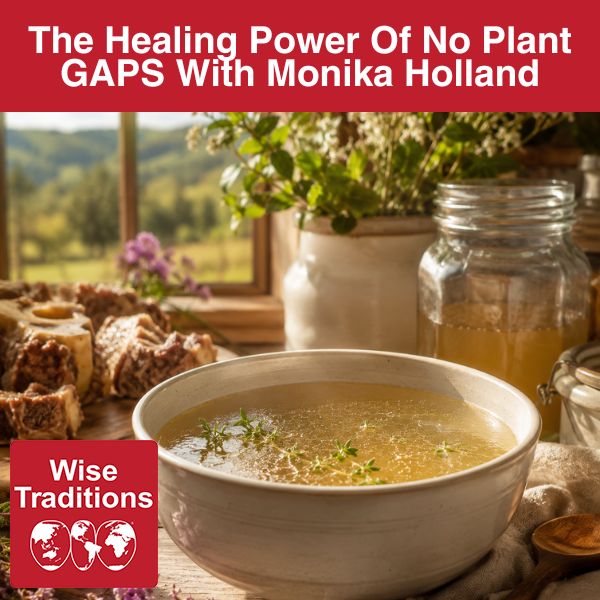
What is important is that we do start that protocol with just drinking meat stock. If we are so severely damaged, people with severely damaged digestive tracts cannot even digest and tolerate solid matter. By sipping that meat stock, it brings that inflammation down. It calms the whole system down and gives space for deeper healing. That’s more or less the difference between different spectrums.
Why Meat Stock Beats Bone Broth For Deep Gut Repair
Let’s talk about the meat stock for just a second. Tell me why meat stock rather than bone broth. What is it about the meat stock that is so powerful? What’s it made out of?
You can prepare the meat stock in different ways. Depending on which spectrum of GAPS diet you are, then you can either use vegetables or not, obviously. On No Plant GAPS, we do not use vegetables. It’s just meaty bones, meat, water, and mineral salt. That’s it. If you are doing intro GAPS or full GAPS, you can use some plant matter. Meat stock is very easy to digest and this is the superhero. It helps to heal and seal the gut. It’s so-called pre-digested food, which means that all the proteins, all the fats, all the minerals, and all the vitamins come in bioavailable form.
What does it mean? It means that when you consume or sip that meat stock, your body doesn’t have to spend energy on digestion. It can spend that energy on regenerating your digestive tract, on healing that digestive tract. We’ve got a bucket of energy. Even if that energy is low, you want to be very strategic on how you utilize this energy. Digestion is very demanding on energy. It takes a lot of energy to digest. The second thing about meat stock is it’s very high in something that is called hydrophilic colloids. Which basically means it’s like water-loving particles.
It means that meat stock attracts digestive juices. That’s good news for anyone with local low stomach acid. That’s specifically important for those who have a lot of heavy metals. A lot of, let’s say, radiation and mold. Those things will be suppressing the production of stomach acid all the time. Meat stock itself improves the production of stomach acid. Meat stock is also something called protein sparer, which means that any protein you eat is going to be utilized more efficiently by the body.
On top of that, it’s full of minerals, vitamins, collagen, and amino acids. Those things are all needed to recreate your connective tissue. Remember that the majority of our physical structure, not only of the gut lining, of every single organ in our body is connective tissue. When we eat that meat stock, that digestive tract rests. Energy can be used on rebuilding and healing. You’ve asked what’s the difference between meat stock and bone broth. Bone broth has been promoted as a very healing food. It is but it’s at the right time as well.
Bone broth is very high in minerals but it’s also very high in something that is called glutamic acid. When we are in a more complex, severe situation, when our digestion and our nervous system is so compromised. That glutamic acid can act a little bit too excitatory for our brain and our nervous system. There could be a risk of over-exciting the nervous system. There is some evidence that people were getting even some epileptic or seizure-like episodes. That’s why meat stock is shorter cooked, and also it has less histamines. It’s much more gentle. That’s why it’s more healing.
This is the approach. Once we heal and seal the gut enough through no plant GAPS, we progress to intro GAPS, then we go to full GAPS. We then transitioned to Weston A. Price’s way of eating. This is the goal. We want to get the full metabolic flexibility so we can enjoy everything that Weston A. Price is teaching us about. That’s very important to remember. We want to get there.
This is a therapeutic protocol. You mentioned getting to metabolic flexibility. Can you explain to us what that means?
It means that everything in your body starts working. If your metabolism doesn’t work, your mitochondria are not producing energy. If we don’t have energy, your hormonal system doesn’t work. Your neurotransmitters do not work. Your digestion doesn’t work. Your brain doesn’t work. You want to achieve that metabolic flexibility, meaning that you can consume not only animal-based food. You can consume fruit and not suffer.
If your metabolism doesn’t work and mitochondria are not producing energy, your hormonal system, neurotransmitters, and digestion do not work.
You talked a lot about healing and sealing the gut. Can we discuss the microbiome a little bit? What exactly is going on there when you have the gut damage? What are we trying to heal? What are we trying to seal?
The Fiber Myth: Why Fiber Can Harm An Inflamed Gut
The most important thing to understand is when we have a leaky gut, what does it mean? There is a lot of inflammation. What does inflammation mean? Inflammation means that there is a lot of tissue which is hot, swollen. Maybe there are some cuts or some acceleration. Hot tissue attracts pathogens. Any inflammatory situation in the body, regardless if it’s in the gut or if it’s in the brain or if it’s in the heart. It doesn’t matter. It will attract pathogens.
How do we restore that microbiome on No Plant GAPS? I’m sure your readers are very educated people because you are doing a fantastic job educating them for all the conferences and shows. Many people are led to believe that eating fiber is the only or maybe the best strategy to create a healthy microbiome but this is half-truth. Why? It’s because the context matters. In a healthy person or a semi-healthy person, you don’t have to be a fully healthy person with a more or less balanced microbiome. Eating fiber can indeed feed beneficial microbes.
Therefore, making that person stronger and healthier. If a person has a very compromised microbiome and a very compromised, damaged gut lining, fiber will cause more damage. Why? There are two reasons. Number one, fiber will feed all microbes without discrimination. What type of microbes do we’ve got? We’ve got three groups, the good, the opportunistic, and pathogens. When there are more opportunistic microbes and more pathogens, then the fiber will make them stronger. Basically, making that dysbiosis even deeper.
The second reason why fiber is not good news in the context of that compromised gut lining and microbiome is because physically, it’s very harsh on the gut lining. Think about it like this. Fiber is like sandpaper and your gut lining is inflamed, is covered in open wounds, and raw. You probably have raw patches of an open skin in your gut lining. Imagine rubbing sandpaper on that very damaged lining. It will cause more inflammation and more pathogens. It will deepen that damage.
In this case, fiber is not the answer for this situation because it will be causing more pain, more bloating, and more constipation. There are so many pathogenic microbes where they are being fed or when they are being killed. It doesn’t matter. Either way, they will exhale toxic gases. One of the toxic gases can paralyze the whole gut. Everything just stops, then the constipation is just relentless. That’s where no plant GAPS takes a very completely different approach to microbiome.
Any inflammatory situation in the body, regardless of if it’s in the gut, brain, or heart, will attract pathogens.
Instead of focusing on feeding the microbes to start with, no plant GAPS focuses on repairing that terrain. We have to repair the terrain first. How do we do it? Number one, we remove that plant matter. If you think about oxalates, saponins, lectins, and any other anti-nutrients. They will be causing more inflammation to that already damaged gut. That inflamed gut will attract more pathogens. That’s number one. Number two, meat stock will be healing and sealing that gut lining. Therefore, that environment is not going to be very favorable to pathogens. Meat stock itself can suffocate yeast.
That’s another matter. Since we remove plant matter, things which are more difficult to digest. One important thing is, fiber is only digestible by microbes. We don’t digest fiber. It’s the microbes which digest fiber. If we have a very unbalanced microbiome, we do not have enough microbes to digest that fiber. What does it mean? You have lots of particles of undigested food in your gut. What does it attract? It attracts even more pathogens. It’s like a vicious cycle. Since we remove it, we remove another source of food for those pathogens. At some point, we start feeding the microbiome.
How do we start feeding? We start implementing fermented foods like 24-hour fermented dairy, like kefir, yogurt, cultured cream, and fermented vegetable brines. We’re not eating the plant. We start very slowly introducing some plant matter, but in a form of liquid. That’s how we start restoring microbiomes on no plant GAPS.
How are we getting all of the vitamins and minerals that we need if we are eliminating plant foods?
Based on Dr. Natasha’s clinical experience and helping, I don’t know how many times people came up with the no plant GAPS in the way that there are nine phases. We have to introduce it face by face to make sure that we do everything correctly. She designed it the way that all our nutritional needs are fulfilled. All of them. We’re not missing anything on no plant GAPS. There is no mineral and vitamin which is missing from the diet.
How long are people expected to be on no plant GAPS before they start seeing results? What’s the longest that maybe somebody would have to be on it?
Remarkable Transformations: Reversing Ulcerative Colitis & Schizophrenia
It depends. Everything goes back to what’s the level of severity in the gut, but I can give you a few examples. I had a client. A lady in her mid-30s who had a very severe ulcerative colitis with lots of diarrhea with blood. We’re talking 20 to 30 times during the day and during the night. Great urgency after each meal and lots of pain after each meal. Lots of cramping and no energy. She’s very depleted.
Within the first week, the bleeding stopped. Within the second week, the stool frequency started stabilizing. She would have between 2 and 5 toilet visits and that’s massive. That’s only within two weeks. Within four weeks, she reported to me there is no urgency. Her digestion felt predictable. She used that word predictable so she knows what to expect. What was very important was when she said, “I no longer fear eating food.” If your digestion is so compromised and you have to run to the toilet every five minutes or you’re in such pain. You’re afraid to eat because you don’t want that pain.
The moment you start fearing eating food, then the deeper healing starts. I had a client. Her daughter, a young woman, had a very aggressive form of schizophrenia. To the point that she was hospitalized many times. For her own safety and for the safety of the mother, the mother has to put a lock on the door when she is staying at home, on her door during the night. She also had to put the bars in the car like in a police car, between the back seat and the front seat so that her daughter couldn’t attack her when she had that aggressive episode.
After two days on meat stock, the aggression was gone. We’ve worked much longer on schizophrenia itself because this is a very complex solution. However, she’s been working alongside her medical doctor on reducing her medication. For example, a male in his late 40s with severe psoriasis. We’re talking about the whole body with very severe skin inflammation. He was using lots of steroid creams, which again was suppressing some of the symptoms. We know that it always comes back and makes it worse long term. Within three months, his skin started looking well hydrated. Some elasticity came back. It started looking beautiful.
I have lots of those stories. Even a four-year-old boy with diabetes type one. He was very pale, very weak, and had no energy and injecting insulin. Within a few months, he gained weight. He increased his energy levels. He got back the color in his face and reduced insulin intake massively. All blood tests were showing remarkable improvements. It depends. Those with severe digestive issues, sometimes we see results overnight.
Monika, can you talk about digestive issues? What kinds of ailments do they cause? I think we just think, Crohn’s disease or the obvious ones that we hear about all the time. There are a whole host of things that are caused by a disruption in the gut. Can you list some of those things? Do you think that all diseases are caused by the gut? Tell me more.
I do believe that all diseases come from the gut. Gut is our second brain. The clients I see, and they see improvement in the context of severe digestive issues or severe IBS, SIBO, Crohn’s, ulcerative colitis, diverticulitis, and lots of other even undiagnosed diseases. Sometimes it’s just a collection of digestion that doesn’t work. Quite often when we talk about other severe cases, let’s say when I work with clients with schizophrenia. You may think the digestion is not too bad, but then it turns out that they don’t poop for a few days.
Typically, parents report, “They can digest. Why are we working on the gut?” We do have that gut-brain connection which affects the whole body. I do believe that a leaky gut causes it all. We do have other root causes like big emotional shocks in somebody’s life, which can cause whatever disease or whatever biological reaction and the chain of healing symptoms. Either way, the gut is important and even if we go through those biological adaptation symptoms, the body still needs the real food which will support all the processes in the body.
The Mind-Gut Connection: Releasing Trapped Emotions And Overcoming Fear
When we spoke earlier, you were telling me about your own personal story. You talked about having to heal your emotions, and you just mentioned emotions. Tell me how important that is to cure any illness.
I would say very important because when we have trapped emotions in the body, they will start attracting emotions inflammation there. They will start attraction attracting some disease or unwanted symptoms. There are different evidence suggesting that different type of emotion is held by different organs. The anger is in the liver lungs, and sadness and so on. One thing I’ve noticed, before I started my healing journey, I had a massive wall, and I couldn’t express my emotions.
I didn’t read people’s emotions because they were buried, because it was difficult for me to deal with those emotions. I was a very cold person in that matter. What I’ve noticed when I started providing the right foods, and when I’ve changed lifestyle, when I’ve started introducing other modalities, other healing modalities, everything started opening up. I started expressing anger. It was very uncomfortable.
I started expressing sadness and crying. I started expressing guilt. It felt so uncomfortable, but it created a lot of space in my body, in my soul, and in my whole emotional body. I think they are all connected. Our physical body and our emotional body is one. We need to start with the foundation, which is working with food and to create that space to utilize and use other modalities.
This is such a fascinating conversation. I’m excited that we’re going to be doing a two-part episode out of this. We’re going to be talking more about nourishing and detoxing in part two. I want to let everybody know that you’re going to be at the Weston A. Price Foundation Conference, the Wise Traditions Conference in DC in October. You’re going to accompany Dr. Natasha Campbell-McBride, and you’re going to be talking specifically about No Plant GAPS. She’s invited you to participate during her lectures.
That’s going to be a wonderful opportunity for everybody to get to meet you and to ask you more questions about No Plant GAPS, because that might be new to a lot of our readers. Before we wrap up today, Monika, I want to ask you one question that we like to pose at the end of each episode here. That is, if the reader could do just one thing to improve their health, what would that one thing be?
Do not fear. Work on your fear. That’s one thing I would say because fear makes everything worse. Even if you’re in the worst pain or the world is collapsing. Even if you think that there is no hope on your healing journey, work on your fear. On the other side of fear, that’s where deep healing happens. I didn’t believe that I could heal and I did. If I’ve done anything differently from day one, I would be working on my fear.
I agree. Hopefully, everybody’s going to see you at the conference. If they don’t have a chance to meet you at the conference. How can they find you? Do you have courses that you offer? How could somebody work with you or discover more about your work?
I run No Plant GAPS Hub, where I curate a lot of No Plant GAPS content, which is at No Plant GAPS. You can find a free webinar. Watch the webinar and see whether No Plant GAPS is the right option for you. There is also a DIY full deep dive into no plant GAPS protocol. This is a full course, which can teach you how to prepare the body for that protocol, how to go through the protocol, how to take you out of that protocol and start introducing plant matter, and troubleshooting the most common issues.
I documented my journey there. You will see all the good, the bad, and ugly. There is no filter. No censorship there. I invite you to the website. I also run my own website, where I post things about healing and other spectrums of GAPS for other types of clients who do not require no plant GAPS solution.
That all sounds perfect. Monika, thank you so much for being here with us. I want to encourage everyone to tune in to the next episode for part two of our next interview with you.
Thank you so much for having me, Kendall.
—
Our guest was Monika Holland. To learn more about her work, visit the website Monica Holland, where you’ll find information about her courses, resources, and approach to no plant GAPS. Our conversation explored what can happen when conventional medicine reaches its limit, and someone chooses another path. We learned Monica’s extraordinary healing story, learned about the origins of the GAPS protocol, and discussed why she believes meat stock is the ideal starting point for repairing a severely damaged digestive tract.
We also explored the concept of healing and sealing the gut, and why no plant GAPS is intended as a therapeutic protocol for those with significant digestive compromise, and how the ultimate goal is to restore enough and metabolic flexibility to return to a broad, nutrient-dense, traditional diet. Perhaps the greatest takeaway from this episode is that healing is rarely about finding one single miracle cure.
It often begins by creating the conditions that allow the body to do what it’s designed to do, repair, regenerate, and restore. As Monika reminds us, that process involves more than food alone. It requires patience, resilience, and the courage to move beyond fear. Be sure to join us in the next episode for part two of this conversation when Monika explains why she believes detoxification is the next essential step in the healing journey.
We’ll discuss the three categories of enemas, cleansing, rebuilding, and targeting therapies, how they work to nourish the body and support its natural detoxification pathways, and why Monika believes they are an important part of the healing journey. If you’re enjoying the show, we’d be grateful if you take a moment to leave a rating or review wherever you tune in. Your feedback helps others discover the show and become part of this growing community. Thank you for spending this time with us. Be well, be nourished, and be free.
About Monika Holland
Monika Holland is a Mineral Nutritional Balancing Practitioner (MNBP), Certified GAPS Coach (CGC), and Nutritional Therapist who specializes in helping people with severe digestive, neurological, and autoimmune conditions through the GAPS protocol, including No Plant GAPS. After recovering from life-threatening Crohn’s disease herself, she has dedicated her career to researching and teaching gut healing, therapeutic enemas, the microbiome, heavy metal detoxification, and carnivore-based approaches. Monika is a GAPS instructor, founder of the Great Gut Guide online education platform and the How2GAPS community, and is passionate about helping others restore their health through nutrition and lifestyle.
Important Links
- Monika Holland
- Monika Holland on Facebook
- Monika Holland on LinkedIn
- Monika Holland on YouTube
- No Plant GAPS
- Dr. Natasha Campbell-McBride
- Weston A. Price Foundation
- Nourishing Our Children
- Gut and Psychology Syndrome
Episode Sponsors
🖨️ Print post
I listened to about 15 minutes of her and had to turn it off because I just could not understand her very well because of her accent!