


 🖨️ Print post
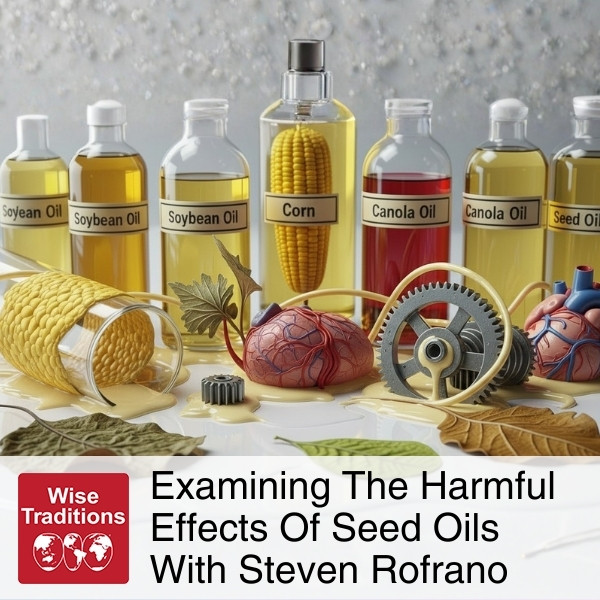
You may have heard the buzz that seed oils are bad for you. But why are they so damaging, exactly? What do they do to the body? And what are the results of their effects? Steven Rofrano of Ancient Crunch goes over the specifics, along with sharing stories about his own health wake-up call and why he is so eager to invite us to go back to ancient, nourishing foods.
Visit Steven’s website: masachips.com
Become a member of the Weston A. Price Foundation at westonaprice.org
Check out our sponsors: New Biology and Paleovalley
—
Watch the episode here
Listen to the podcast here
Episode Transcript
Within the below transcript the bolded text is Hilda
Seed oils are making us more inflamed and sicker than ever. It’s 2026. The time has come to examine carefully what seed oils are and what they do to the body. This is episode 561, and our guest is Steven Rofrano. He is the founder of Ancient Crunch, the company behind MASA chips and Vandy crisps.
Steven explains in simple terms why seed oils exist, their purpose in nature, and why they really aren’t meant for human consumption. He also goes over in detail the damage that they do to us and why it’s high time to return to traditional foods and fats that nourish us best, the very ones that Dr. Price came across on his travels. Before we get into the conversation, I want to invite you to become a member of the Weston A. Price Foundation.
It is only $30 for the year when you use the code POD10, and you support our work of education, which includes things like this podcast, research, and activism. All you have to do is go to Weston A. Price, click on the Become a Member button, and join hands with us. It would mean so much. Let’s start the new year right together. Thank you in advance, and welcome to the family.
—
Welcome to the show, Steven.
Thanks. It is great to be here.
Steak & Shake Switches To Tallow: The Tipping Point For Traditional Fats
I want to talk to you about the traction we are making in paying attention to what is in our food. At Steak and Shake, I understand that they recently switched from vegetable oil or “seed oils” to tallow for their fries. Is that true? Are you excited about this?
Yes. It is pretty cool. I had not actually heard about them until they were on Twitter announcing this transition. As everyone else, I was skeptical about where tallow comes from. Does it have this additive, or is it actually pure? It seems pretty clear. There was a little bit of confusion, but it seems like they have very good tallow, and that is very exciting.
Obviously, the deep fryer is responsible for a majority of the fats that one might eat at any fast food restaurant. The fact that they switched that is a pretty big deal. People talk about seed oils a lot and talk about tallow a lot. Seed oils are very important and a big deal when it comes to unhealthy foods that are in our diets, but they are not the only thing. It will be encouraging to see them in other restaurants try to completely clean up the supply chains and all the ingredients that they use.
Seed oils are very important and a big deal when it comes to unhealthy foods that are in our diets, but they are not the only thing.
Although it is very difficult. We had the same thing when we were trying to source all the ingredients for our tortilla potato chips. It is just not like you can just go to the agricultural commodity companies and buy large quantities of very high-quality things. It is very difficult. Of course, expensive. We will see how that pans out over the next couple of years, but very exciting.
Healthy Calories Per Acre: Can Sustainable Farming Meet The Demand?
I have actually heard Sally say that she is concerned that the supply will not be able to meet demand if these shifts happen. What do you think of that?
The market responds very well to incentives. The reason why the supply does not exist is that there are no customers for it. It’s very simple. There is plenty of land in America and the world in general. The US alone is just unbelievable, how large a country we have, and how much farmland we have, and how much of it is either not utilized at all, underutilized, or incorrectly utilized.
If you think about what is available today, certain acreages for seed oils and certain acres for soybeans, and certain acreages for this, and other acreages not being used at all for anything useful. In short, there is a big difference between what we could theoretically grow in this country with our resources and what is being grown. Some combination of, for example, switching soybean plantations into pasture for cattle, is an obvious thing using regenerative farming and permaculture to increase the total yield of land.
That is another thing people do not necessarily understand. The current method of farming is not the most productive use of that acreage. It is perhaps the most profitable for the people who run it today under the current system, but it is not the most productive in terms of healthy calories per acre, which is how I personally think we should think about farmland.

That is interesting. Healthy calories per acre. I had never heard anyone use that phrase.
I do not think anyone has. It is a concept that regenerative farmers certainly have. To give an example of this, I was at the Rogue Food Conference hosted by John Moody a few years ago, and this happened to be in Northern Florida. After the conference, we went to one of the farms that was local and was helping sponsor the conference. This guy had this cattle, all the classic stuff. He had this valley that was a little bit like wind would come through there, and he did not like that.
It was disrupting something. He decided to plant chestnut trees in this valley. In this valley, he passed through with his cattle. It is let us call it ten acres. In order to break up the wind, he planted chestnut trees. The crazy thing is if you think about what you get out of the land, if it is just ten acres for cattle, you get your certain amount of beef because there is a certain amount of grass. If you plant these 50 trees, the actual surface area occupied by the trunk of each tree is very small.
It does not actually take away any meaningful amount of grass that the cattle could be grazing on, but it does add tons of chestnuts, like literal tons, on an annual basis. That is just by stacking these two types of agricultural products in the same area, the total amount of healthy calories you get per year has massively increased. A lot of farming is not set up to do this.
You have acreage and you have a certain crop that goes there and it is the only thing that is there, but you do not have this vertical in the philosophical sense of you are adding things above, stacking products out of a certain piece of land and you get way more out of it without giving anything up, which is cool that earth works that way.
To take it a step further, and this is a bigger regenerative agriculture thing, imagine you have your chestnuts, you have your cattle, and they graze through. After the cattle graze, you send your pigs through that field, and they can eat the cow poop and whatever bugs and graze and they eat rotten chestnuts that fell from the tree. Now you can get pork out of that land. You can also throw chickens, run them through there.
You have a chicken pasture for a few weeks. You get chickens or eggs. All of that farming requires a lot of care and attention to do this, but that method of farming actually gets you the most out of the land. In short, I do not believe that we have any fundamental issue with the amount of land we have in the country in terms of a shortage. Just the market needs to show that there is demand for it in order for more farmers to be financially incentivized to then grow and produce food in this way.
Again, I have never thought about it as healthy calories per acre, but I have thought about it in terms of biodiversity. What you are describing is instead of a monocrop scenario, which is not good for the soil, and these monocrops are often used for seed oils, as you pointed out, corn and soy being the biggest in the US, that you have a scenario where many animals and many things can be harvested and enjoyed. It is great for the land, it is great for the animals, and it is great for the consumer.
Conventional farming optimizes more or less net income, profit per acre. That is what their job is. Their calculation of what to do with the land is going to be very different. If farming were optimized by healthy calories per acre, then you would get way more out of the land. The only thing is, obviously, farmers or businesses are like anyone else, and they have to operate based on economic incentive. If the economic incentive, if their ability to maximize their profit per acre happens to also be aligned with the idea of healthy calories per acre, then you get the incentive alignment. That is how you get the transition, and everyone wins.
Conventional farming optimizes more or less net income, profit per acre.
Tallow, Lard, And Coconut Oil: Why Saturated Fats Are Making A Comeback
Speaking of everyone winning, the demand is going up. The demand is going up for more natural fats, and the kind that the Weston A. Price Foundation has been promoting for decades. The lard, the tallow, the coconut oil, the saturated fats. Talk to me about what you know about these and what got you interested in them, Steven.
The thing that got me interested in tallow specifically actually happened before I started caring about health. I was in Belgium doing a little study abroad thing as a freshman in college. If anyone does not think about Belgium, one of their most famous foods is Belgian fries. In fact, French fries do come from Belgium, not France.
Their fries are, in layman’s terms, French fries. It’s world-renowned, and that recipe is, of course, inspired by the American fast food culture, all of that stuff. Belgium fries are fried in beef tallow. Traditionally, that is what they are fried in. That is one of the reasons why they are so good. Evidence of the fact that this matters is that even after McDonald’s switched away from using beef tallow, which they did from the ‘50s through the ‘90s, they still added beef extract into their soybean oil to give it a sort of beefy flavor that was associated with their delicious French fry recipe.
That was one of the first factoids about food that was just in my head. A few months later, I started getting into health for reasons that are not necessarily as important to this question. I always remember the fact that good French fries are fried in beef tallow. When the idea came up, I was hanging out with a few friends. One of them was eating the seed oil Tostitos chips, and I was making fun of him.
We were talking about what you could have instead. Could you have a healthy chip? I remembered that whole beef tallow fried thing and was like, “Sure. You just fry the chips in beef tallow, and then you are good.” That turned into MASA Chips, which we have been selling for about three years at this point. Beef tallow is simply the best fat for frying.
It makes the food taste the best. It is the wisest available healthy fat, particularly in the US. It is the most locally available. You do not have coconut oil, maybe fine, but you have to ship it all the way from the Philippines, or Palm oil, you have to ship it from Indonesia. If we are thinking about local food and local farmers, and environmental sustainability, what is better?
The beef fat that I get from the ranch down the road, or the coconut oil that I get from the deforested jungle of the Philippines, shipped on a boat halfway across the world? I am personally partial to tallow. Lard is good too, but at the same time, lard is very hard to find high-quality pigs in the US. Pig farming does not scale as cattle farming does. You are not able to find it as easily. There are plenty of pigs, but they are very unhealthy, and it is very hard for farmers to raise healthy pigs. Beef tallow is the best.
Interesting to think about that. Some of us just eat whatever meat comes our way, and we do not think about the health of this animal, whether and is affecting my own?
Pigs eat different stuff. Not only is the biology of the pig an issue. For example, the fat that the pigs eat becomes the fat that the pig has in their bodies. Same thing as humans. People have measured the amount of polyunsaturated fats, which are the type of fats in seed oils, as a percentage of the human body fat. It used to be basically negligible, maybe one percent, which corresponded to our diet 100 years ago.
Nowadays, people’s body fat proportion of unsaturated fats is like 20% and rising because 20%, 25%, 30% of the average American’s calories come from seed oils. Our body fat is changing based on the fat that we eat. Pigs have a similar digestive system and metabolic physiology to humans. The fat that they eat becomes their fat.
If you feed the pig seeds and seed oils, which is commonly done. Soybean is the most common pig feed in the US. If you feed them that, their fat becomes a seed oil, basically. Modern lard has a higher proportion of polyunsaturated fats than lard might have been like your grandma’s lard. That is not true of cattle.
Cows do not eat fat. They eat grass. They make their own fat from the grass. The fat that they make is pretty much always saturated, regardless of what they eat. That alone means that tallow is more reliably high in saturated fat. The other thing is that the cow’s diet is simple. It is just grass. It is everywhere. Easy to find.
The natural diet of pigs is much more complex. They eat root vegetables and little critters and rodents sometimes. They are omnivores. They are not herbivores. In nature, they do not have occasion to eat a ton of seeds and grain, which is their common diet in an agricultural setting. Mimicking the paleo diet for the pig on a farm is very hard. The paleo diet of a cow is very easy.
I want to go back to the percentage of polyunsaturated fat in the human body now. What percentage did you give?
It is like twenty percent.
The Danger Of Seed Oils: What Your Body Fat Is Telling You
Why is this problematic for the person who is new to the issue of seed oils, or maybe they have heard of seed oils, but they are like, “So what? I am eating Tostitos made in seed oils,” or “I am having fries that are fried up in soybean oil.” Tell us about some of the dangers of those oils or why they are unhealthy for us?
The big issue with the seed oils is, I’ll get into this in a second, assuming they are bad for you, which they are. It is not like, “I ate this bad thing, and then I went to the bathroom the next day, and it is gone.” Your body fat, which is a persistent storage of calories and nutrients and anti-nutrients, and other toxins in your body, is shaped by what you eat.
You could be an average American and decide to stop eating seed oils. You could decide tomorrow to stop eating seed oils, and you still cannot escape them. You can stop eating them, but they are still in you. They are in your body fat, and it could take years for them to fully get out as your body cycles through the actual fatty acids in its tissues. Why are they toxic? One easy way of understanding this is that it is a completely novel ingredient.
This is not a thing that humans ever ate. There are many completely synthetic ingredients, but seed oils are arguably the first one. They are the oldest processed food ingredient. Every other thing that humans ate up until the invention of seed oils was largely something you could obtain from a farm. Seed oils were the first “This came from a factory,” thing that you ate. Later on, we have the artificial food dyes and preservatives, and all these other things that are common today.
Seed oils were the first and still are the largest. Red 40 is bad. These food dyes are bad. All these additives. If you are a normal American and you eat the foods that contain them, you are going to have a few milligrams of red 40 in a year. You are going to have a few micrograms of a certain preservative or something. The amount of seed oils that is present in food means that if you eat an average diet, the single largest source of calories comes from seed oils.
You will eat 30% of your calories from them. It is not only that this is a novel ingredient. It is also consumed in such high amounts. There are more calories from seed oils in the average diet than from anything else. Thirty percent seed oils. People eat 20%, 25% of their calories from meat. Grains are a big one. There’s a whole bunch of others after them. Seed oils are huge, and they are a single source.
The fundamental reason why they are bad for you is simply that they are meant for seeds, which are more or less cold-blooded organisms. Seed oils degrade in heat and in oxygen. They oxidize and are essentially a part of this. That means they break down, and the resulting molecule is inflammatory in the sense that it pulls electrons away from other molecules and cells. They are damaging. It is like some guy driving down the street with a baseball bat, hitting the mailboxes.
That is what seed oils are doing to all your cells. The reason why seeds have them is that they are self-contained in this little seed pod, where there is no oxygen. There is also vitamin E in most seeds naturally, but it is removed when seeds are processed into seed oils, and that is an antioxidant that keeps them stable.
They are cold. Seeds are stored underground. No 98.6 degree metabolism is heating them up on the inside. They are helpful in that environment. Similarly, cold-water fish have polyunsaturated fats, just like seed oils, and they can get away with it because they are in the cold water underneath the ocean in a relatively oxygen-deprived environment. If a tuna’s fat were beef tallow or more similar to beef tallow, it would freeze.
It would not be able to swim because tallow solidifies at that temperature. Seed oils do not. It allows them to have body fat, which is important, but also be flexible in the cold environment in which they operate. Humans, even if you live in the cold, you live inside in a heated house, and even if you do not live in a heated house, your body is heated.
Your body is the greenhouse.
There is not really any reason for humans to be eating this thing, especially if you live in the types of climates that most humans find themselves in today, either in a warm area or with indoor heating. There is a complete incompatibility between the types of fats in seed oils and humans. Seed oils have a purpose in nature, but humans do not fit that purpose, and hence the difficulty.
Steven Rofrano’s ‘Wake-Up Call’: The Book That Changed His Life
I love your illustration of the baseball bat and the seed oil that was going around and doing this to our cells. I’m never going to forget that. Thank you for that. Now, I want to ask you because you’re not a farmer, you’re not a nutritionist, to my knowledge. How did you get into this field? Tell me a little bit about your health wake-up call, Steven.
My health wake-up call was about ten years ago. I was in Belgium, same trip. That was the first time in my life that I had to cook for myself because at the universities in Europe, they do not have dining halls. I had been in an American university with this dining hall. My mom cooked everything I ate before that. I had to cook for myself for the first time.
In so doing, I was able to observe the relationship between what I ate and the health effects that I had. That is obvious to pretty much anyone, but to me, the nineteen-year-old, it was not. It is like, “You just eat food, and how you feel is a completely separate thing.” It was not, and I could see that because I was going to the grocery store, buying ingredients, cooking them, eating them, and then observing how I felt.
I had all the data, if you will, for the first time. I was like, “If I can feel better or worse when I eat certain things, how do I eat such that I feel the best?” That is when I started figuring this stuff out. Very early on, I discovered the book Nutrition and Physical Degeneration by Weston Price. I read the book, and my mind was completely blown. It was one of the most influential, important books I had ever read up until that point. I was Googling Weston Price, and I found the Weston Price Foundation. I actually went to a conference in 2015.
2015 was Anaheim.
I know where I was, I think it was in Dallas. When was that?
I have to say I do not know that one off at the top of my head, but 2015, but yeah, we’ve been in Dallas a bunch.
I had no reason to be there. I had no social media account and no business. I was still in college, and I just showed up. I remember being very enthralled, and the food was very good. I was like, “This is very cool.” Weston Price is the first health book I ever actually read. That was just a personal interest of mine. Some years later, after I graduated, I was working, and I was bored with my job.
I started making TikToks about Weston Price. The videos that did the best were when I talked about Weston Price. In the summer of 2021, I had a bunch of TikToks in a green screen format where I clipped the pictures from the book of people with teeth. I would make a video of “Why did these people in Peru have such good teeth and why is everyone sick today?” The first video I did in that style got several million views.
I just kept doing them. I went through all the chapters of all the different tribes and showed the pictures, narrated, and talked about all this stuff. That was literally the first viral content I ever did. I totally forgot about that. It was Weston Price content. The pictures alone are just how can anyone look at that and go about their business like a normal person anymore? You read the text, and the text is interesting. There are a ton of fun tidbits that still stick out in my mind.
For example, we’ve been talking about the home birth, I have a baby still eleven years old, and we gave birth at home in a pool in the living room. I remember reading the part with Eskimos where this dude’s Eskimo wife was pregnant, and then he was asleep in their igloo, and then he woke up the next day, and there was a baby. In the middle of the night by herself, she just goes outside of the igloo in the cold in Alaska, pops the baby out, comes back, and does not even wake him up. He wakes up at his normal time, like, “There is a baby.”
How To Live The Weston A. Price Lifestyle In A Modern World
The resilience, strength, and health of these people were vibrant. That book is life-changing. I suggest people pick it up, too. It is Nutrition and Physical Degeneration by Dr. Weston A. Price. Now, as you said, you are a father and an entrepreneur. You have started the MASA chip company and some other related products. How do you and Mia live this out in your home? How do you make the best choices for your baby and for yourselves?
Do you mean how we learn about it, or what specific things do you do?
What specific things do you do?
90% of our food comes from the farmers’ market. We go once a week, and there are a few other farm market stores if we need additional stuff. With the exception of things like olive oil, we live in New Jersey. Olives do not grow here. Exceptional things like olive oil, huge chocolate, and the MASA chips, everything comes from a farm close to us. We go drive here and there, stop at the farmer’s stores, and go to the farmer’s markets. All the food is unbranded and from some dude who grew it or from a lady who grew it.
In our current apartment, we get Mountain Valley water delivered in giant glass jugs. It is very good. We just got a house, and we are in the process of moving, so now I can install a whole-house water filter, which I am excited to do. We have water filters on all the faucets and the showers. I have my red light panel that you can see, and we have certain red light bulbs that we keep around at night. I have my red light glasses. I have my air filters. All our kitchen equipment is stainless steel or wood, or glass.
Let me interrupt you just to say my mind is still blown because you were a college kid and you got interested. You read Dr. Price’s book. You came to the conference. You did not have a huge pressing health crisis that I know of. Yet you still made all these shifts. Mia did too. Now you are raising your son this way. Why? What did you learn that made you think we have to do this?
I did not have any pressing health concerns. One of the main things that was very striking and obvious when I went to the first Weston Price Conference was how sick some of the people were. Somebody with vaccine injuries or other mostly injuries, to be honest, and other similar health problems. Horrible things that they had to deal with. Fortunately, I never had any such things, but when I was a kid, I was not as healthy as a normal child growing up.
For example, when I was in eighth grade, I got the swine flu. I got the regular flu two years later. At one point, when I was a kid, I got pancreatitis. No one gets that. What even is that? Not appendicitis. We checked, and they were like, “You have pancreatitis.” I could barely walk. My stomach hurt so much.
It is a thing that only very rare among certain alcoholics who are old, like, “What even is that?” I was raised gluten-free because my mom discovered early on that I stopped growing when she fed me normal food. She did an elimination diet and figured out that the ingredient in question that caused my growth to pause was bread and bread products.
We were Italian and never ate pasta because I was gluten intolerant, or at least so we thought. We got me tested for celiac. I remember going to all sorts of doctors. I never had celiac itself, but I had a gluten intolerance. In retrospect, we know it is gut inflammation, and bread products exacerbated it because of the folic acid and the glyphosate, and other pesticides that it contains.
I eat bread now, presuming it is organic, ancient grain, sourdough, etc. I grew up with all these things, like horrible allergies. I would play baseball or soccer, and I would have my nose running down my face. Because of that, I never really liked playing outside. I would spend all my time indoors with my books and my Legos. I would not have had a normal kid’s health situation growing up.
The prospect that I could breathe through my nose as a nineteen-year-old was after eating well and cooking for myself for a few months. I woke up one day, and I could breathe through my nose. I was like, “What? That’s possible. How is it possible?” I would not say I had a particularly aggrieved childhood, but I definitely did not have normal health conditions. People do not ever care about health until they become sick.
It seems like it.
People, unfortunately, are getting sicker and sicker. More and more people are starting to care about health. Even then, this is like maybe nine years ago, the Weston A Price Conference that I was talking about?
People, unfortunately, are getting sicker and sicker. More and more people are starting to care about health.
Yeah.
Really sick people discover this kind of thing back then. Now it is much more common. Now, everybody and their brother has some practice in relation to health. I think that is great, but it is also sad because in order to have gotten this far, it meant that everyone’s health had gotten so bad.
I have seen on some of your social media feeds, you have shown people from the 1970s who are not doing the red light therapy. They are not even exercising. They look great, and they are healthy. Health is a second thought. They are just pursuing their lives. Now we have to hyper hack it. It feels like we have to be hyper vigilant because our whole world is so toxic.
Nike was started in the mid to late ‘60s. It did not really become popular until the late ‘70s and ‘80s. People think of sports and exercise as a natural thing that everyone does. Sports in the ‘50s were relegated to high school and college academic amateur sports and did not make any money. It was like a hobby for a very obscure group of a small number of people. Obviously, certain sports are more popular than others.
Professional sports like baseball were a thing that people attended, but you did not, if you were a normal person who was an adult, do sports. Even in school, most schools, the prep schools, and the fancy private schools did more athletics than public schools. It was not really a thing. If you were running down the street in the ‘50s, going on a run, your neighbors would have liked to call the cops.
Like, “This is the weirdest thing I have ever seen.” That did not exist. Nike, that’s in the sportswear industry, and sports culture has increased to promote this type of thing. I am not saying this is bad by any sense, but the point is that no one needed to do that stuff. Yet they were still healthy and fit, and no one was obese. A lot of people get confused, and they are like, “You are fat because you have no willpower.”
It is not exactly true, right? If you think about your grandparents, who, pretty much everyone’s grandparents, were fit and relatively healthy and skinny. Acne was not a big problem. All the things that we know of today were not problems that affected people back then. Did they go to the gym? No. Did they go on runs? No. Did they buy fancy food? No. Did they do any of this? Did they have a red light, as you said?
No. All this comes down to, it is not like you acknowledge, it is willpower because people say, “You are fat because you just cannot stop stuffing your face.” No, those people did not count calories or have Weight Watchers or try to do that either. It is not like they were paragons of virtue with strong willpower. They just happened to occupy and live in a world that enabled them to be healthy easily.
The standard things that you did also happened to be healthy. You go to the diner, and you split a milkshake and fries. The French fries are fried in tallow. The beef was not soy-fed. I do not even think soy was grown in America at the time in appreciable quantities. The milkshake is like local milk, high-quality dairy. All these additives did not exist.
They just eat this stuff. They are not thinking, “Is this burger at the diner good for me?” No, they ate it, and they were fine. That is what you have to expect with people. Why should normal people have to spend years reading arcane books of nutritional anthropology? Not that I do not like Weston Price, but why do we need to study this? We should not have to.
People did not have to, and they were able to be healthy. You go to the food store and buy the food that is sold by the food store, and the doctors tell you to eat, and it is good for you. Nowadays, you go to the food store and buy the food the doctors tell you to, and it is bad for you. Obviously, people are going to be unhealthy because they just live their lives normally, and normal is unhealthy.
The Normalization Of Sickness: The Health Advice Doctors Get Wrong
Wait, I want to go back to something you said. Sorry to interrupt, but you said doctors tell us to eat certain foods, and when we eat that we are unhealthy. Is that because doctors are still saying like, “Eat low-fat and recommending all these processed foods?”
You just need to look a little further than the standard hospital diet in any hospital in the country. Go look at the labels of what they feed patients in hospitals. It is disgusting. I am sure you see all these pictures on Instagram of hospitals with the rooftop lounges where all the hospital beds were up on the roof so that people could get sunlight because they knew the sun was healing. Nowadays, they keep it under fluorescent lights.
If society is pushing you into doing a certain set of things, most people are just going to go do them, and they will reap the consequences. If those things happened to be healthy, like they were, people think we are so innovative. We have DoorDash, the app, for delivery. My dad had a milk delivery. It was cheap. Fresh milk would show up at your front door every other day. You are telling me we have innovation. What is this innovation?
I do not want it. If that is what innovation is, we already have this. The milk they delivered was, of course, good. It was not like skim milk with a bunch of synthetic fake vitamins added. They had it every single day. When society tells you to do certain things, you do them. That is just called being normal. There is nothing wrong with people.
They just listen to what the authorities tell them. The problem is that people that we put in positions of authority, in my view, have an obligation to use their authority in the right way to actually benefit the people that they serve. This is not like the government. There are several doctors, lawyers, and businesspeople. It is your job. You are the expert. You are the food manufacturer, or you are the farmer.
People that we put in positions of authority have an obligation to use their authority in the right way to actually benefit the people that they serve.
You should know what good food is. You should know how to make it. You should sell it. You should not expect the average customer who has their own problems to worry about to know what is right and what is wrong, in a sense. How is the normal person who goes to work? Let us say you are a mechanic or a plumber.
You have to learn about drains and faucets and engines and things, just like the farmer does not know about this stuff, or the doctors know about this stuff. People specialize. We have to trust that the other people that we interact with and who make the rules and generate culture have our back. That is important. If we do not have that, which we do not today, then we get all the consequences that we see.
It is interesting. Several times, you have used the word normal. I realized when college kid, I was going to say they seem to eat with impunity. It is like pizza late at night, all the food in the dining hall that is not organic or local, and they seem fine. No, they actually do not. They are struggling with things that older people used to have. As you pointed out. Arthritis, joint pain, back pain, and acne. We have just normalized that. Everyone is like, “That is just common.” They are not making that connection that you made so many years ago, Steven, that what I am eating is affecting my health, because they just think it is normal. After all, it is common.
College kids, also, many of them just by virtue of youth, are able to resist the worst effects of these things better than elderly people. It is getting really bad. I remember freshman year of college. I started in 2013, and I could count on one hand the number of fat people in my class. This is nothing against fat people or sick people. As I said, you live in a world that makes you sick. Is it your fault? No.
Although I do think if you want to fix it, which you should, because you should want to be healthy, it is up to you to do so, because no one is coming to save you. That being said, there were five, let us call them overweight people, when I was a freshman in college. I took six years to graduate. By the time I left, that number had ballooned, and it was like probably a significant portion. In six years, it was closer to maybe twenty percent.
People were overweight. Skin problems, too. Many college kids have acne, and it is like, “Your diet of beer and pizza full of glyphosate, folic acid, and cheese.” Not that cheese is bad, but some people actually are more lactose intolerant. Yes, that is not going to serve you very well. The kids are not okay. If you look at young people, you see malformed jaws everywhere.
You see skin problems, you see acne, you see just bloating and puffiness. It is a big problem too because a lot of people want to be skinny and look good, but it is not just that they have high body fat. It is just that they are bloated and puffy from cortisol and other issues. They are just inflamed. Especially, you have these young women who are starving themselves. You are literally not even fat.
You are inflamed, and no amount of starving yourself is going to fix it because the problem is not body fat. After all, you do not have any. It is all these other issues. It is a huge shame. There were some comments I went to. There was a significant number of college-age kids, and a lot of them just looked really bad. No offense to them.
Again, this thing you said about the normalization of it, if everyone looks a certain way, everyone has a certain thing that becomes normal. That was the eye-opening thing with Weston Price, and his book is like teeth problems are not normal. The need for braces is not normal. Overcrowding, malformed jaw, all this stuff is not normal, but because it is so common, people think it is.
Because we do not ever see pictures like this, or people like this, in our daily life, and we never learn about it, when you open the book, and you look at the pictures, and you are like, “It looks like a different species of people. It looks like a different creature.” The other thing, of course, is that they are so happy, which is a separate situation.
The Two-Question Challenge: What To Tell A Seed Oil Skeptic
Dr. Price noticed that, too. He was like, “These people are not only strong and fertile and healthy, but they are optimistic.” He noted that too, as a consequence of the diet. I only have two more questions for you. Steven, one is that of the skeptic. The person who has yet to notice any consequences. They are like, “I am having all the seed oils that I care to have. I do not care that a certain percentage of my body fat is polyunsaturated. This guy is just a geek and too into this stuff.” What would you say to a skeptic like that?
I would just stop eating them for a month and then see how you feel. If you do not feel any different, go eat them again and then tell me how you feel.
I love that. Just test it out.
To be fair, some people just have unnatural levels of resilience to environmental toxins. President Trump is a good example. It was funny when he was elected, people were saying RFK can get rid of the seed oils and all the food, but he cannot touch Trump’s diet. It is honestly fair. The man has more energy than I or anyone I know who is my age, and his diet consists of McDonald’s, Coke, and candy. It is just like, “Go ahead. If that is you, if that is your experience of life eating the standard American diet, go right ahead.” For most people listening, that is not the case. All they need to do is try to do something else, and then they will quickly see the difference.
I want to pose to you the question I always pose at the end, Steven. If the audience could just do one thing, just take one step in the direction of improving their health, what would you recommend that they do?
I would say stop eating seed oils. The reason for this is not only that they are the single largest source of unhealthy thing that you ingest, again, 20, 30% of your calories, but also the dishes in which you find seed oils or the foods that you buy at the grocery store, the things in which you find them are also likely to have a lot of other unhealthy stuff as well.
There is plenty of stuff that does not have seed oils that is also bad for you, but a majority of the bad things that you are eating are from seed oils themselves and seed oil-containing foods. If you stop that, you will like that. That is a very big impact. I do not think food is everything, certainly, but that is definitely a big one. Possibly the first one.
A great place to start. Thank you again on behalf of the Weston A. Price Foundation. It has been a pleasure, Steven.
Thanks, Hilda.
—
Our guest was Steven Rofrano. Go to his website, MASA Chips, to learn more. For the transcript for our episode, visit our website, Weston A. Price, and click on the podcast page. Now for a recent review from Apple Podcasts. Robin Kim had this to say, “Game changer. This podcast is such a game-changer in my journey to health.”
“Thank you so much for everything you are doing and fighting for. Our right to live happy and well.” Robin, Kim, thank you so much for your review. It really means a lot. You too can rate and review the show. Just go to Apple Podcasts, give us a bunch of stars, and tell the world why they should listen or why you are thankful that you do. Thank you so much for tuning in, my friend. Stay well, and remember to keep your feet on the ground and your face to the sun.
About Steven Rofrano
Steven Rofrano grew up in New Jersey in an Italian-American family that instilled a deep respect for food quality and old-world traditions. Steven struggled with chronic health issues growing up, until he discovered that eliminating seed oils and processed foods made him feel truly healthy for the first time.
Fueled by years of obsessive research, Steven became convinced that classic American foods can be both healthy and delicious—if made without toxic ingredients. Determined to prove this, he quit his big tech software job in 2022 to launch Ancient Crunch, starting with MASA Chips, the first nixtamalized tortilla chips cooked in grass-fed beef tallow.
Next came Vandy Crisps, tallow-cooked potato chips that restore the ‘Great American Snack’ to its original seed oil-free glory.Today, Steven remains on a mission to rebuild America’s pantry with real, nourishing ingredients—and, of course, to spread a little anti-seed oil “propaganda” along the way.
Important Links
- MASA Chips
- Ancient Crunch
- Ancient Crunch on Instagram
- Nutrition and Physical Degeneration
- Weston A. Price
- Wise Traditions on Apple Podcast
Episode Sponsors
🖨️ Print post

Leave a Reply