

 🖨️ Print post
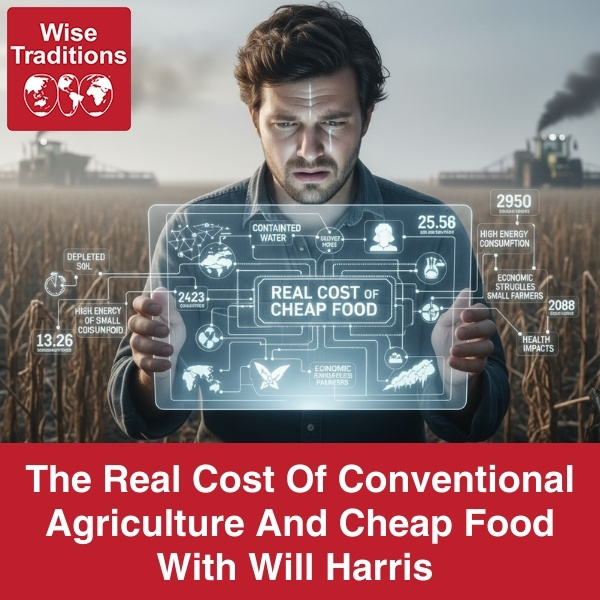
We all love a bargain when it comes to food. But what if it’s not a good deal in the long run? Cheap food comes at a high cost, according to farmer Will Harris from White Oak Pastures. Will is a fourth-generation cattle rancher who once farmed conventionally. Now, Will, is an author and a strong advocate for regenerative agriculture. Why did he make the switch?
Today, Will opens up about his story. He sheds light on the problems with the conventional/industrial model of agriculture along the way – pointing out its drawbacks on the environment, animal welfare, and on our the health of humanity. Will also highlights the benefits and changes he’s seen on the land he grew up on, since changing to a more holistic/natural approach to farming and ranching.
Visit Will Harris’ website: whiteoakpastures.com
Get the Weston A. Price Foundation’s FREE info pack at westonaprice.org
Check out our sponsors: Nutrition Therapy Institute and MASA Chips
—
Watch the episode here
Listen to the podcast here
Episode Transcript
Within the below transcript the bolded text is Hilda
Cheap food isn’t actually cheap. Industrial agriculture makes it more affordable, but its cost is the proverbial can kicked down the road, paid for by repercussions to the environment, to animal welfare, and even our own health. This is episode 560, and our guest is Will Harris. Will is a fourth-generation cattle rancher at White Oak Pastures. He’s an author and an advocate for regenerative agriculture. He once followed the industrial model until he realized he simply couldn’t do it anymore.
In this episode, Will shares his personal a-ha moment. He also talks about what the transition to farming regeneratively has looked like to the land that he grew up on and the difference it has made in his community, in his own life, and in that of his family. Will also invites us to wake up and concern ourselves once again with the cost of the choices that we make related to agriculture, animals, and the welfare of humanity.
Before we get into the conversation, let’s start the new year right. We have a free information pack that we would love to send to you via snail mail. It offers our premier brochure called the Timeless Principles of Healthy Traditional Diets. It will give you ideas on how to stop toxins from coming into your life and what good stuff to include in your diet and lifestyle based on the eleven dietary principles of the Weston A. Price Foundation. All you have to do is go to The Weston A. Price Foundation, click on Request Free Info Pack, give us your information, and we will mail it to you right away. That’s The Weston A. Price Foundation for the free info pack. Start the new year off right. You’re welcome in advance.
‐‐‐
Will Harris, welcome to the show.
Thank you for coming.
Moving From Conventional To Regenerative Farming
It’s my pleasure. I love being on this farm. What did you say the other morning when we saw the birds flying over? You said, “That’s synergy. That’s the beauty of what’s happening here.”
The bounty of life. It’s symbiosis, everything working together. It’s amazing to me. I used to cut that off. I didn’t let that happen. That was a mistake, but that’s the way I learned to do it. I did it that way for years.
This farm used to be run on a conventional farming model, right?
It was very conventional. My great-grandfather and grandfather ran the farm. They ran it as a cyclical, vertically integrated operation. My dad took over after World War II, and he changed it dramatically. On his watch, it became a monocultural cattle operation. It was very industrial and linear. We weren’t a line. We were a widget in the line of beef production. We didn’t produce beef. We produced calves. They were shipped to the West, and then we fed them out. It changed so completely.
With my great-grandfather and grandfather, it was a cyclical food production farm. It’s a little bigger than most farms. Every day before the day, they and their employees got up and slaughtered something. They might kill a cow. They might kill 2 or 3 hogs. They might kill 100 chickens. They killed something and dressed it. They loaded it into a mule-drawn wagon, brought it to Bluffton, since we’re in the middle of Bluffton, and paddled the meat.
There was a boarding house and a hotel right over there. The more affluent people in town who didn’t have animals sold the meat. This is before. There was no refrigeration. There was no internal combustion engine. There was no USDA inspection. There was sell it or smell it. They fed and bluffed them, and they were successful and made a living.
My dad was born in 1920. He took over the farm after World War II. He’d been about 24 or 25 years old. He is the first generation to industrialize it. On his watch, it went from a multi-species to purely cattle, from being vertically integrated to just finishing calves for the system. He was successful. It was timely. I’m glad he did it. I know it was the right thing to do ecologically, but it’s what he had to do economically.
For survival.
He was proud of it. He was a cowboy, and I was a cowboy, so we didn’t talk much. I think that he was proud of the fact that he was an expert cattleman. He didn’t have to know about pigs, sheep, goats, slaughter, selling them, and collecting the money. He was a professional cattleman. He knew more than anybody that I knew about the cattle business. I grew up under him, and that’s all I wanted to do. I wanted to be like him.
I went to the University of Georgia and majored in animal science. That had been animal husbandry. They had become animal science. Husbandry is cyclical. Science is linear. I graduated in animal science, came home, and worked for my dad. I wanted to do the same thing he did, and I did. I ran the operation for twenty years as a monocultural cattle operation and made money.
Husbandry is cyclical. Science is linear.
I went back and looked, and I didn’t make a lot of money, but I made money every year. It was consistently profitable. It wasn’t a great profit-maker, but it was consistently profitable. I reached a point in my life that I didn’t want to do that anymore, and I changed the way I ran the farm. For 25 years, I’ve continued to change it. It is evolving.
You were on this show before. You told me about that a-ha moment when you were like, “Something’s got to change. I can’t keep doing this,” but I don’t remember what your answer was. What was that thing that made you change?
It was many years ago. We loaded a semi truckload of calves to be shipped to Nebraska. It was 500-pound calves on a double-decker truck. The ones on top were urinating and defecating on the ones on the bottom. They’ve been in that truck for 30 hours without food or water or rest. It’s wrong.
You knew it.
It had always been fine. I’ve done it for a long time, but I didn’t want to do it anymore.
I’m so touched by the symbiosis that I saw. I want to ask you. Now that you’ve made that change and now that you’ve made that shift from a more conventional model to the regenerative, let’s talk about cattle and the contrast in those two systems. Let’s start by talking about, for example, the environment in which the cattle are raised.
We can care for them at about 8 or 9 months of age. You can wean them at 5 or 6 months of age. That’s what I used to do. From birth to weaning, not much difference in some, but not much difference in what I used to do and what I do now. We don’t use chemical fertilizer. We don’t use pesticides. We don’t use hormonal implants. We don’t use subtherapeutic antibiotics.
Generally, it’s a lot alike. It changes after weaning. Weaning is when I would load on the truck and ship them out to where the corn was cheap. Corn was what they ate. Now, they stay in the pasture. We do wean them from their mama. My cattle won’t wean themselves. We have bred so much maternal instinct into those cows that mama will have a baby, weighing 70 pounds, with a 500-pound yearling competing at the teat. That doesn’t end well for the calves.
That’s the problem with putting too much maternal instinct into the animal. A deer or buffalo will kick the yearling away to feed the baby. My cows won’t. We wean the calves, and then they are their own herd. We put them in another herd. They rotate through my pastures, through the paddocks, until slaughter. I built my own slaughter plant on the farm. I struggled with custom slaughter. We treat them humanely. It wasn’t so good at the slaughter plant, so we built our own.
In other words, they had a good life, and then their ending was not the way you would have wanted.
They had a bad death, so we built our own. We control that now. We also have a slaughter plant for poultry, pigs, sheep, goats, and other species.
I want to go back to something you said earlier about the cattle rotating from paddock to paddock. Animals raised, cattle in particular, in controlled animal feeding operations don’t have that luxury. They don’t have that ability, do they?
They don’t eat grass either. They’re eating out of the trough.
I’ve heard that they sometimes feed them grass in that trough. They can say they’re grass-fed.
I’m sure that happens, but the whole cattle feeding industry is something that is unpleasant to me. Everything we do here is an attempt to emulate nature. It’s an imperfect emulation. None of it is as good as I want it to be. It’s an attempt to emulate nature. This farm that we’re on is about 3,200 acres. It’s divided up into 150 paddocks. It’s a 20, 30, 40-acre pasture. We can get water, shade, and grass together to make a form of paddock. We move the animals every day from one paddock to the next. It’s an attempt to emulate herds of, let’s say, buffalo from Mexico to Canada.

They’re crossing the plains.
The paddocks would keep them tight. They would stay tight. They would move constantly, grazing as they went. That land would have a great animal impact, a lot of eating the grass, urinating, defecating, and those cloven hoofs pushing the ground. It may be a year before they come back through that. That is so different from what I used to do. Now, it’s what I try to emulate. My emulation is imperfect. We move the animals every day from one paddock to the next, and we get much the same effect as when they were migrating as great herds of ruminants. Is it as good? Probably not. Is it good? Yeah, it is.
The organic in my land, my soil, has gone from 0.5% to 5.5% percent. It’s because of the way we graze the land. When we let them indiscriminately walk around and eat what they wanted, the undesirable species would get big, and the desirable species would get eaten to death. It was too imperfect an emulation of nature.
Why Do Regenerative Farming Despite Intensive Labor
Some people would say, “It’s good for the land, but it’s a lot of labor. It’s very intensive. Why don’t you keep them in those confined feeding operations so that they fatten up easily and you get more profit?”
It is more labor in doing it the way we do it. It’s much better for the land to do it the way we do it. It’s better for the animal from an animal welfare perspective. We know it’s probably better for the people who eat it. The industrial agricultural model that we use makes cheap food. It does so by casting off costs to other areas. When my dad and I operated this farm, my dad and then I operated this farm industrially. That organic model went from whatever it was, probably 5, 6, 7, down to a half. That had a cost. It wasn’t a direct cost, but it had a cost.
There still was a cost. I see what you’re saying.
All the chemicals, pesticides, and fertilizers that we put out here, and my neighbors put out. We get 50-something inches of rain. It goes into the groundwater, into the flowing water, to the Gulf of Mexico. It goes from Devil’s Ranch to Spring Creek to the Chattahoochee River to the Gulf of Mexico. There’s a dead zone in the Gulf of Mexico. It’s bigger than the state of Massachusetts. It used to be a thriving oyster ground, but they don’t oyster the animal. It’s because it’s a dead spot. We’ve killed it. That’s a cost. Those of us who incurred that cost won’t pay for it. We all pay for it.
It’s cheap food at a high price.
That’s exactly right. I think a lot about the extension of species. I believe that every species of plant, animal, or microbe in an ecosystem has a role. We all talk about how great it is when bees pollinate flowers. They do, and it is great. That’s one thing we can see. Every indigenous species, plant, animal, and microbe has a role in that ecosystem of producing a bounty.
Every species of plant, animal, or microbe in the ecosystem has a role.
We drive species into extinction or near extinction constantly with the way we manage the land and use pesticides. In pesticide, cide means kill. Homicide means killing people. Pesticides kill pests, but it doesn’t just kill the pest. We put pesticides on our crops, animals, or whatever to kill a target pest, and it is highly efficacious. It does a great job. It kills a lot more stuff, too. That causes the ecosystem to be out of balance, so we need another pesticide. It’s highly efficacious on what it would do after the target, but it kills other things, too. It’s never-ending. I believe that the first pesticides that were used came from the war effort.
World War II, right?
World War II. After the war, scientists realized that it was highly efficacious in getting rid of this pest. People like my dad used it, and it worked well. We didn’t see the unintended consequence that it killed other things in the ecosystem, so it required another one. I believe that it was all very serendipitous, and it happened, but now, it’s very well understood. Pesticide companies know that when they bring a technical chemical to the market to destroy a pest, it’s going to destroy something else and require another one. It’s never-ending. That’s what I got out of that. I wasn’t going to do that anymore.
Speaking of costs, you save money on some level because you’re not buying this pesticide and then the stronger one after that, and so forth. You’re out of that system.
There’s that savings, but then you bear more of your own costs than you do in the industrial system, where you’re casting it off.
As we were saying, it’s more labor-intensive, the kind of agriculture that you’re doing, but I imagine it’s more satisfying for the workers.
It’s far more satisfying. I never recruit anyone to do this kind of farming by telling them, “You’ll make a lot more money,” because they won’t. It won’t take them long to realize it doesn’t. It is a lot more satisfying, and it is a lot more attractive. I got a fourth generation to run this farm. I have two daughters and their spouses who came back. They wouldn’t have come back and do what I used to do, but they’re back here, and they love it. They have babies, so maybe they’ll be a sixth generation.
Repairing What We Have Broken
That would be so gratifying. I also wanted to ask you about this. In your book, A Bold Return to Giving a Damn, you say that part of your mission is to repair what you broke. What do you mean by that?
I was very much part of that industrial system. I contributed to causing this land to be less fertile. Endangering so many species of plants, animals, and microbes, I was part of that. I did it. I was part of the financial impoverishment of this community. All the things that modern industrial, monocultural agriculture caused, I did my share of it. I don’t do it anymore.
You’re done with that. It’s not just for your family, but it’s to have this ripple effect, right?
Yeah, that sounds good. I do what I do for my family. When I say my family, I mean my employees. There is a ripple effect. What we have done, are doing, and will do here can be replicated over and over again. What we do here is not highly scalable. We may be at the top of the scale in terms of what we ought to do in terms of volume, but it’s highly replicable. If it can be done by White Oak Pastures in Bluffton, Georgia, it can be done by the Smiths family in Arkansas, the Jones family in Minnesota, and so on and so forth.
Getting People On Board With Regenerative Agriculture
You say you’re doing it for your family. You told me yourself that you’ve seen Bluffton grow because of the economic success of White Oak Pastures. It’s been so cool that you’ve been able to bring more people on board as employees. That’s had a ripple effect on your community and the town itself.
It has, and I’m very proud of it. I tell people that I ceased to operate industrially because of what I didn’t like about the impact on the land and the animals. The community had nothing to do with it. Bluffton, Georgia, where we’re sitting, had over 500 people in 1900. That’s misleading because that was the era of 40 acres on a mule.
Every 40 acres around Bluffton would have had a family with 6, 8, or 10 people living on that. It was a highly populated, productive area compared to now. The town, like so many other agricultural towns, declined all my life. I was born in 1954, and it was already in decline. I watched it decline all my life. I didn’t think I could do anything about that. I wasn’t focused on it.
You were like, “That’s the way it’s going to be.”
That’s the way it is. When I changed the way I farm, I went from having 4 minimum wage employees to having 170 employees who make above the county average. I’m not proud of what I pay my people, but it’s way above the county average. People started coming here to go to work, and the town started changing. I tell the story that I was so not focused on it that I didn’t notice it.
I had a salesman come see me one day. I didn’t buy what he was selling, but before he left, he said, “This is a nice little town.” I was waiting for the punchline. He was serious. He thought it was a nice little town. I said, “Do you know what? It is.” That became an area of focus for me. Animals, land, the town, and the community. I’m proud of it. It’s tiny, but it’s nice.
There’s something very satisfying and rewarding about this kind of work. I’ve met people who came to intern on your farm who were like, “I stayed on. I’ve been here for twelve years. I’ve been here for fifteen years. I’m like, “What?” These people are not leaving because you’re doing something that’s gratifying on a deep level.
We have an internship program. We bring in 6 interns 4 times a year for 3 months. Three months is not long enough to learn how to farm, but it’s an exposure. We tell them, “You get exposed.” The benefit to me is that these are great people. We only take six. We get twenty applications, so we really pick them. We fall in love with them.
I don’t want to hire all of them because some of them don’t fit. Usually, it’ll be half of them I’m going to hire. I’ll make them a job offer. They don’t all take it, but a lot of them do. Many of my managers are former interns who stayed on. The benefit for them is that it’s very difficult to get started farming this way. If you don’t inherit land or inherit money to buy land, it’s hard to find that. It enables these people to come here and farm the way they want without having to come up with an investment.
They don’t have to start from scratch.
Correct.
How To Maintain A Zero-Waste Farm
That’s wonderful. One more aspect. I want to go back to this. Comparing the industrial ag model and regenerative agriculture has to do with waste. Talk to me about how they differ in terms of the relationship to waste.
We refer to this as a zero-waste farm. I realize that’s probably not exactly right. There’s probably some plastic and stuff that we don’t recover. We try to. For the most part, it is near zero waste. Probably the best example is we slaughter the animals that we raise here, and it generates about nine tons of what the USDA calls packing plant waste per day. That’s a visceral gut fill. Non-marketable bones, hooves, horns, feathers, and whatever, we compost that. It is one of the best things I ever done. It’s beautiful compost. It takes this material that has a negative value. You have to pay somebody to come get it, and it turns it into this beautiful humus. It’s great. I’ll take you and show you.
The very thing that some people would think should be discarded, you’re using to enrich the soil and bring it back to life.
We compost it all with peanut shells or wood chips that we get locally. It takes about six weeks to compost, and then we let it sit for a year. If you let it sit for a year, I’m told that it’s more fungal and less bacterial. Fungal is better. I guess that’s right. That’s what they told me. I’ll tell you what it did when I started letting it sit for a year. The bones become more porous. When I would spread it after six weeks, the bones were still sharp, and they punctured tires. It’s great. When you ride through my passage, you’ll see bones.
Praying Hard For More Hard Work
I have. I have a couple more questions to ask you. I’ve heard you say, and it’s in your book, too, that you pray for hard work to do and the strength to do it. Why? Why are you choosing hard work? Wouldn’t there be an easier life or an easier way?
In Bluffton, this is where the Bible was built. Everybody goes to church. Some people go to the Methodist church. Some people go to the Baptist church. I pray for plenty of good hard work to do and the strength to do it.
You’ve got it. It’s been answered. You say you feel so lucky.
I’m fortunate and blessed.
The Danger Of Going Outside The Natural System
That’s beautiful. One more question, or a couple more. You know I like to talk.
That’s good. I like talking to you.
You entitled your book, A Bold Return to Giving a Damn, so to speak. What are we not giving a darn about that we should?
In modern food production, it’s all about breaking the cycles of nature. The abundance of nature comes from the cycles of nature operating optimally. In the era of the dinosaurs, things were rocking and rolling optimally in nature. The energy cycle from the sun, the microbial cycle from microbes in the soil, the mineral cycle, the water cycle, and all the cycles of nature were operating optimally, and the ecosystem was thriving. All that oil, gas, and coal in the ground come from the thriving ecosystem that was going on in the era of the dinosaurs.
Huge abundance.
I can’t imagine all that abundance. We have gone from that cyclical abundance to our focus for a long time, since World War II, in a very linear, reductionist way of breaking those cycles of nature. That is having an incredible cost to the environment, to rural America, to the welfare of the island, on and on. Abundance is not there anymore.
We, humans, are doing incredible damage to the ecosystem, but don’t you worry. The ecosystem will be fine. We’re not going to be so fine. When we do enough damage to the ecosystem, then things will go the other way. We will pay for that. What we’re trying to do here is return to working in cooperation with the cycles of nature so that we won’t have that terrible consequence that I think can happen.
I’ve heard Allan Savory talk about our need to do things for team humanity. In our short-sightedness of mistreating the land, we forget that it affects us, too, and that we’re interconnected.
A lot of problems that we endure are because we have gone so far outside the natural system.
Instead of cooperating with nature, we’re cutting through it. In the short-term, maybe it’ll seem to be working okay, but not for the long-term.
There’s profit in it. The technologies that break the cycles of nature offer the opportunity for a lot of profit to some people. I don’t begrudge them that, but I do begrudge the harm and damage that’s done.
I don’t know that I’ve met many farmers with your kind of environmental ethos.
When we do enough damage to the ecosystem, things will go the other way and we will pay for it.
There’s a reason for that. Over the years, we have made farming into a very linear science. We talk about it that way. We think about it that way. The land grant universities teach it that way. The corporate extension administers it that way. Much of it is driven by the big tech companies. They have taught us how to think about things. The drug companies, pharmaceutical companies, fertilizer companies, and pesticide companies have taught us how to do it, and it worked. People were able to make a living doing it, but the amount of profitability that’s left for the farmer continues to wane.
I’m a cow guy, first and foremost. I think four companies control something like 85% of the cattle beef in this country. Those companies are squeezing more and more, so the farm is making less and less. It’s still working for those who do it, but there’s not much support for those who choose to do it differently. When I made up my mind to change the way I farm, and this was back in the 90s, we didn’t have the internet in Boston, Georgia. I’d go to the library in Blakely and read. I thought wrongly that I was the only person on the planet who was doing that. I didn’t know anybody else.
You thought, “I’m the only one still looking this up and trying to figure it out.”
I didn’t feel like I was special, but I felt like I was lonesome in that way. Gabe Brown is a dear friend of mine. We’re about the same age. He was doing the same thing in Bismarck, North Dakota, that I was doing in Bluffton, Georgia, during the same window. We didn’t know each other.
I feel like there’s this resurgence. Thanks to the connectivity that we have, people are learning, and they’re desirous. That’s why you have the interns coming to you. People want to get back to a simpler and more natural way of farming and living.
There are people who want to do that. I have to tell you that there have been times I thought of myself as an early innovator in how we produce food. I like the way that sounds. More commonly, I feel like I’m a niche marketer who is raising food different from the industry and found a group that will buy it from me. I can make it work, and I can live with either one. I’d rather be an early innovator and help other people do it. Failing that, I will be a niche marketer, and then me, my family, and my employees will continue to make a living here, but I don’t get to decide that.
You keep your head down, do the things you do, and see how it plays out.
I am pleased that there seems to be increasing interest in this. I hope that works out. In my lifetime, I’ll always be pretty much a niche producer. There will be another generation and then another one, and we will see how that works out.
Finding A Farmer Close To Where You Live
I’ll come around, and your grandkids will be running the farm. I’m sure you’ll still be here, too. Let me ask you the last question I love to pose on the show. I know you’re a farmer and not a doctor or anything. I’m just asking. If the reader could do one thing to improve their health, what would you recommend that they do?
From my perspective, what I would want them to do is find a farmer, hopefully, as close to where they live as possible. There’s farming as much as the way you think is proper. You may not be able to find a guy next door that’s operating beautifully, but you may be able to find somebody in the next state that is operating pretty much like you want to see it.
There is no perfect way to farm. We do a little bit better job every year. We’ve been doing a little bit better job every year for 25 years, but it’s still imperfect. I can show you things on our farm. I don’t try to hide it. It’s imperfect. You can do better. The farmer can’t do better if he doesn’t have somebody buying his product.
That’s a good point.
There needs to be a relationship between the consumer and the farmer.
You make me want to move to Bluffton, but I’ll find somebody near me.
There is somebody near you.
I know there is.
We ship online to 48 states, and I don’t want to. I have to sell as much stuff as I produce to financially keep my business going. I don’t want to ship it to 48 states. I want to sell it, and I know I can’t sell it in Bluffton, Georgia. Atlanta is three hours that way, and Orlando is three hours that way. I shouldn’t have to ship it to 48 states.
If more people find their local farmers. That’s the way in which the world can be fed. It is locally where we’re at.
To be honest, and we discussed it with the family, we feel bad about shipping food to 48 states. I feel like I’m impugning somebody’s ability to do it well, but we have made investments, we have costs, and we produce a certain amount of stuff, and I have to sell it. It’s unfortunate. I have to sell it over such a large geography.
I’m still happy when I go to the grocery store, and I see White Oak Pastures when I didn’t get something from my local farmer. I’m like, “I know them.” On behalf of the Weston A. Price Foundation, thank you for your time.
Thank you for being here.
It’s been a pleasure.
‐‐‐
Our guest was Will Harris of White Oak Pastures. Visit his website, White Oak Pastures, for more information. Here is a letter to the editor from our Fall 2025 Wise Traditions Journal. It’s called Boron to the Rescue. “I am writing about the suggestion to use boron that was published in the fall 2024 journal. I started doing this about a month ago due to a knee injury, and I am now pain-free. Who knew something so simple would have had such a dramatic result?
I have also started adding a teaspoon of the boron solution to my mom’s water every day without her knowing because she rejects everything that I say. I have not heard her complain about pain since I’ve been doing this. Doctors say that my pain is related to arthritis and nothing about loss of cartilage. They have no answers for me that work. I highly suggest that everyone check out that little infographic in the Fall 2024 Journal and try it for themselves. Thank you, Weston A. Price Foundation, for excellent articles in the journal.” This is a letter from Katrina from Michigan.
Katrina, it is our pleasure. Those journals are nutrient-dense in and of themselves. If you want to get your hands on one, become a member. Go to WestonAPrice.org. Click on the Join Now button. It’s only $30 for the year when you use the code Pod10. I said that right. $30 for the entire year. You will get the quarterly journal, along with supporting our mission of education, research, and activism. If you’ve benefited from our content or even this show, please join hands with us in 2026. Thank you so much for tuning in. Stay well, and remember to keep your feet on the ground and your face to the sun.
About Will Harris
Will Harris is a fourth-generation cattleman, who tends the same land that his great-grandfather settled in 1866. Born and raised at White Oak Pastures, Will left home to attend the University of Georgia’s School of Agriculture, where he was trained in the industrial farming methods that had taken hold after World War II. Will graduated in 1976 and returned to Bluffton where he and his father continued to raise cattle using pesticides, herbicides, hormones, and antibiotics. They also fed their herd a high-carbohydrate diet of corn and soy.
These tools did a fantastic job of taking the cost out of the system, but in the mid-1990s Will became disenchanted with the excesses of these industrialized methods. They had created a monoculture for their cattle, and, as Will says, “nature abhors a monoculture.” In 1995, Will made the audacious decision to return to the farming methods his great-grandfather had used 130 years before.
Since Will has successfully implemented these changes, he has been recognized all over the world as a leader in humane animal husbandry and environmental sustainability. Will is the immediate past President of the Board of Directors of Georgia Organics. He is the Beef Director of the American Grassfed Association and was selected 2011 Business Person of the year for Georgia by the Small Business Administration. He is also the author of “A Bold Return to Giving a Damn”.
Will lives in his family home on the property with his wife Yvonne. He is the proud father of three daughters, Jessi, Jenni, and Jodi. His favorite place in the world to be is out in pastures, where he likes to have a big coffee at sunrise and a 750ml glass of wine at sunset.
Important Links
- White Oak Pastures
- A Bold Return to Giving a Damn
- Request a Free Info Pack from the Weston A. Price Foundation
- Become a Member of the Weston A. Price Foundation
Episode Sponsors
🖨️ Print post

Leave a Reply