



 🖨️ Print post
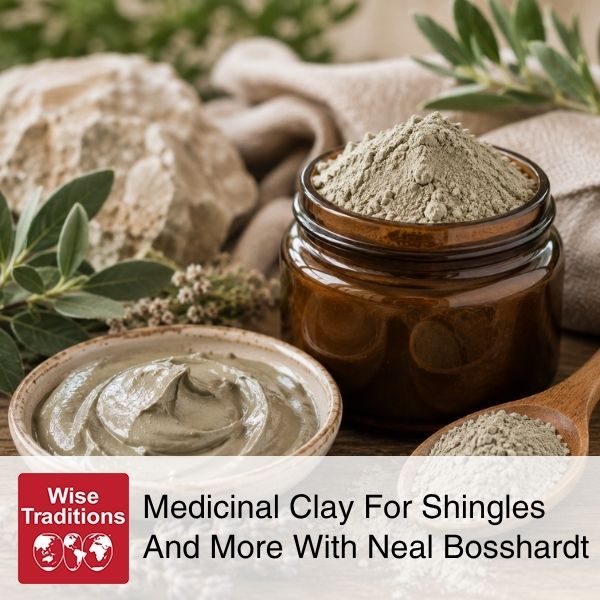
For generations, people have turned to natural clay for everything from wounds and burns to digestive troubles and detoxification. But could something as simple as clay also offer relief when shingles strikes?
Neal Bosshardt has been using natural bentonite clay for more than 50 years. His connection to it began with his grandfather’s Utah farm, which happened to sit alongside a remarkable deposit of mineral-rich clay. Over the decades, Neal and his family began exploring the traditional medicinal uses of clay for a wide variety of ailments.
In this episode, Neal shares stories of people who have turned to clay during painful shingles outbreaks, including his own wife. He explains how to prepare and apply a clay poultice, why he recommends keeping the clay in place for hours at a time, and how clay baths may help soothe the intense itching associated with shingles.
But the conversation goes well beyond shingles. Neal discusses the many ways his family has used clay over the years, from cuts, burns, and other everyday injuries to digestive issues. He also talks about drinking clay, using it for detoxification and remineralization, and what he believes may explain its effects.
Neal offers practical guidance for preparing and storing clay so it is ready when needed—and explains why this simple substance has earned a permanent place in his family’s medicine cabinet.
WAPF Ad- Membership: Visit https://www.westonaprice.org/why-join/. Use code pod10 to join for $30 for the year.
To learn more about Neal Bosshardt, visit https://weeatclay.com/
Join the Nourishing Our Children closed Facebook group
Check out our sponsors:
Paleo Valley: Receive 15% off your first order
Optimal Carnivore: use code WESTON10 for 10% off.
—
Watch the episode here
Listen to the podcast here
Episode Transcript
Within the below transcript the bolded text is Kendall Nelson
For generations, people around the world have turned to the earth for healing using natural clay to soothe wounds, calm irritation, and support the body in ways modern medicine may not fully understand. Could medicinal clay also help relieve the intense pain and blistering associated with shingles? This is episode 594, and our guest is Neal Bosshardt. Neal’s connection to medicinal clay began with his grandfather, who purchased a farm in Utah in the 1930s.
Beneath the farm was a rich deposit of natural mineral salt and along its edge was an unusual white bentonite clay. Decades later, Neal’s family began learning about the traditional medicinal uses of clay and experimenting with themselves. Neal has been using medicinal clay for approximately 50 years. He teaches others how to prepare and use it both internally and externally and is the author of the booklet We Eat Clay & Wear It, Too!.
Neal joined Hilda Labrada Gore on the show to introduce our readers to medicinal clay. The two had planned a second conversation, specifically about shingles but never had the opportunity to record it. In this episode, Neal returns to share what he has learned about using clay for shingles. He explains how to prepare a clay poultice, how thickly it should be applied, how long it can remain on the skin and why he believes beginning treatment as soon as symptoms appear may make an important difference.
We also discuss clay baths, foot soaks, drinking clay water, and lingering nerve pain following shingles and some of the experiences Neal has witnessed within his own family and among others who have turned to clay for relief. Before we get into the conversation, I want to remind you that the Weston A. Price Foundation is a member-supported group.
In other words, we can only do research, education, and activism with your help. There’s no other way. Please become a Weston A. Price Foundation member. Go to the Weston A. Price Foundation website and click on the Member Yet button. Use the code POD10 to join for just $30 for the year. Thanks in advance, and welcome to the family. Now, let’s welcome Neal Bosshardt.
—
Neal, welcome to the show.
Thank you. I’m so glad to be with you.
Me, too. You joined Hilda and introduced our audience to medicinal clay. The two of you had planned a follow-up episode that was going to be specifically focused on using clay for shingles but you never had a chance to record it. Here you are with me, which is wonderful. Before we dive into our topic on shingles, I wanted to remind readers that your grandfather purchased a farm in Utah in the 1930s. It happened to sit above one of the world’s richest mineral deposits of salt and also of bentonite clay. Can you remind us a little bit about the history of your family lineage with the clay?
Pioneering Natural Clay Discovery
You’ve nailed it. My grandfather did buy a farm back in the 1930s, and under the farm was this vein of natural mineral salt. On the edge of the farm was this outcropping of this white mineral substance. The geologists say that it’s a bentonite. Now there’s as many kinds of bentonites as there are breeds of dogs. This is bentonite clay, but that doesn’t mean you should go out and dig up your garden and start to try to use it medicinally.
Discover how a 1930s Utah farm unveiled a rich deposit of natural bentonite clay that changed family health for decades.
In the 1970s, the health food people came to us with a book called Our Earth, Our Cure, written by a French homeopath. In that book, he talks of the wonders of clay. One of those he mentions is shingles. From the 1970s on, little by little, we began using the clay as he directed and including for shingles. I’ve just heard so many people who painfully suffered with shingles that I thought, and I mentioned to Hilda that we need to help people benefit from this.
When we did the episode, we mentioned shingles. Not using the clay for shingles but there was a lady who had shingles earlier in her life that had left a lot of nerve damage. Now, in her later years, she was in pain all day and pain all night. She used the clay to detoxify, to get rid of the heavy metals and toxins in her body. She’s getting rid of those by using clay, then she feels ten years younger. She was sleeping through the night. It changed her life.
Again, she didn’t use the clay for the shingles that she had. It was many years later, she used the clay to detoxify. I want to have people know about clay and how to use clay for shingles for the people who are going to have shingles next week or next month or next year so that they’ve got the clay on hand and know how to use it before they get shingles.
Before we get too far along, let’s define what shingles is. Can you help explain what it is and why it’s so important to try to find some relief for people who are experiencing shingles?
I’ll tell you what Western medicine says. Conventional medicine says that shingles is due to a virus. It’s the same virus that causes chickenpox. It’s called varicella zoster virus. It’s the virus that causes chickenpox. When someone has chickenpox, after they heal from chickenpox, that virus remains in their body inactive. It can be there for years, decades even.
At some point in their life, and again, this is Western medicine’s explanation. Due to certain conditions, usually a weakened immune system, then that virus can become active. That’s what results in shingles. Those situations that can make it active are stress, age, and medications. Those are some of the issues that can cause this virus to become active. When it does, people can suffer.
What are some of the symptoms of having shingles?
Usually, there’s some watery blisters and pain. A lot of times it happens just on one side of the body. A lot of times, it’s in the back. Either the shoulders or down to the middle of the back. It’s usually on one side of the body. Why does that happen? I don’t know. Unfortunately, sometimes people will get these watery blisters, this pain in their face, in the head, and it’s serious. If it’s in the eyes, there are some serious consequences. It’s not something that we can just ignore.
There are medications that conventional medicine will give that doesn’t get rid of the shingles, unfortunately. Generally, it’s to manage the pain. They generally say that shingles go away on their own. Our first experience with shingles was a guy from Phoenix who had learned of the clay. He had driven up from Phoenix. He came down with a case of shingles. In transit, he stopped at a hospital in southern Utah, and they said, “You’ve got shingles.”

Easing Painful Shingles Outbreaks
He said it felt like a red-hot poker being shoved through the small of his back. He said, “Give me something to make it go away.” They said, “There’s nothing. They go away on their own but here’s some medication or some pain until they do go away.” The next day he learned of clay. He packed his back in a clay gel, and we’ll talk about that. Maybe even show it to the people who are watching it. He’s packing his back in the clay gel three days later. He didn’t have any evidence of shingles.
I believe that you’ve written that the duration of the outbreak of shingles can be directly affected by applying clay. Can you explain what your experience has been with that?
Generally, as many days as people have had the shingles until they use clay. That’s how long they will have the shingles. The funniest story, but it wasn’t funny to the people. A guy in Las Vegas, his sister called him and said that she had just come home from the doctor, and she was diagnosed with shingles. He said, “Sis, come on over. I’ve got something that will help that.” She said, “You’re my brother, not my doctor. No thanks.”
She didn’t come over. Three days later, she called in tears. Bawling her eyes out and saying, “Please tell me what that was. I didn’t know it could hurt this bad. Tell me. Please tell me what it was.” He was tempted to say, “I’m your brother. Not your doctor,” but because she was in pain and crying so hard, he relented. She said, “Come on over, sis. I’ll help you.” They packed her back in clay. Three days later, they were gone.
It was the same number of days that she had experienced the blistering pain, then she packs the clay, and then three days later, the pain goes away. You mentioned the hospital in both of these stories, and it’s so sad that the pain is so severe. I’ve heard it described as an electrical shock. It’s burning, tingling, and itching, just an aching pain. After the physical symptoms go away, they can still, for years, experience nerve pain. Have you had anybody describe a relief from the nerve pain by using the clay?
I should say, too. People are individuals. People are different. A couple of years ago, my wife came down with shingles and I thought, “Great. Here’s another opportunity to show what clay can do.” We packed her back in the clay gel. We started the day the shingles showed up. I expected them to be gone in a day or two. They weren’t with my wife. They lasted four days. Even though we started to use the clay on day one or two, her pain level never got above a four.
That’s the blessing that we count. It’s not that they went away immediately, but the fact that her pain level never went above four. It wasn’t the excruciating pain that some mentioned. Unfortunately, the shingles can leave nerve damage that can persist for years. As you mentioned, excruciating pain. My friend described it as a red-hot poker going through. For others, it’s an unbearable itch. The electrical shock is a good explanation as well. You’re right.
That’s why it’s so nice to know about clay. For people who know about clay, they can help their family. It’s interesting. I have a friend who went to church, which is a good idea to show the Lord that we love Him and appreciate Him. In church that day, the blessing that she or the information that was so good didn’t come from the sermon at the pulpit.
It came from the lady she was sitting next to who mentioned to my friend how wonderful clay was for shingles. My friend’s husband was dealing with shingles at that time. They left that meeting afterwards and got clay and it resolved his shingles. Hopefully, people who read this will be able to not only help themselves, but their friends and neighbors.
Soaking feet in mineral-rich clay water allows the body to pull out heavy metals and environmental toxins through the skin.
Back to the nerve pain, to the post-herpetic neuralgia. I don’t have the medical expertise to know. Is it something that you think can be prevented somehow by lessening the duration of the shingles and the pain of the shingles? Is it something that just happens and then when that happens, a month, 2 months, 6 months, or a year later, the pain can be eased by applying the clay?
I don’t know that I’ve got the medical background to give you all the details of that, but all the people who I’ve worked with who have used clay to shorten and lessen their experience with shingles. None of them have ever talked of residual pain. The lady who had shingles earlier in her life that didn’t use clay, didn’t know about clay. For her, decades later in her older years, that’s when the nerve pain that was resulting from the shingles came back with a vengeance.
In her situation, she felt like she could detoxify, get rid of the heavy metals and the toxins that she felt or knew that she had in her body. I don’t know exactly how she knew she had toxins and heavy metals, but she said she did. She felt if she got rid of those, that would help. She then used the clay to detoxify from the toxins and heavy metals that she had. That eliminated her nerve pain that was there because of the earlier case of shingles.
How would this particular woman detoxify with clay? Would she be drinking the clay? Is that what she would do or was she still just applying it to her body?
Detoxifying Toxins Through Foot Baths
It’s because the shingles were gone and it was just a matter of detoxifying. What we talked about was doing a clay bath to detoxify, but she didn’t have a bathtub. She soaked her feet in a foot soak of clay water and did that every night for a week. I believe it was a week. When she called me back a few days after starting to soak her feet in a clay bath, she called back as excited as a kid on Christmas morning, saying that she was sleeping through the night. She was pain-free, and she attributed it to the fact that the clay had detoxified her through that foot bath.
That was all the good news. The bad news is she used the water from soaking her feet to water her houseplants, not realizing that water contained the heavy metals and toxins that it pulled out of her. She killed every plant in her house with the water from soaking her feet. That’s how she knew that the clay had pulled the toxins out of her.
That’s an amazing story, that it killed the houseplants?
Yes, of hers and also a friend of hers. She had told a friend how wonderful doing a foot soak to detoxify is. The friend did the same thing. She used the water on her houseplants and killed her houseplants. A guy in Hawaii killed a section of his lawn from the water soaking his feet. Now, clay itself is not toxic. You can use clay water to mineralize houseplants. You can use it as a fertilizer. It’s wonderful. Clay is wonderful for plants, but not after you’ve soaked your feet in that water and that it’s pulled toxins and heavy metals out of the body.
We’ve mentioned packing the clay on the skin. You’ve mentioned taking clay baths. What are the other ways that you can use clay?
Mastering Clay Poultice Preparation
There’s one other way, and that is to drink it. I want to share how to use the clay. I’ll try to describe it in enough detail for all of those people who are not watching so that people know how to use the clay for shingles or other extra applications. You want to make a gel like mayonnaise or mustard. The clay comes as a fine dry powder, and you mix it with water. You want to gel thick enough where when you apply it, it doesn’t drip on the carpet. You want it to be thin enough to where it spreads easily.
You don’t want a thick paste that you have to conform to the flesh. Mayonnaise or mustard is the perfect consistency. If somebody wants to see how to do it, I have a YouTube channel. It’s my name, Neal Bosshardt. It’s titled, Medicinal Uses of Natural Bentonite Clay. It’s an hour-long YouTube class. People can see what we’re going to talk about. You start out with a gel, about like mayonnaise or mustard. You want to put it on the area of the body, as a poultice, about a half-inch thick.
You can put it right on the skin, right on the affected area, half-inch thick. It’s not a cream or a lotion. We’re talking about shooting for a half-inch thick, then covering it. Some people will cover it with fabric and some with plastic. Again, people are individuals. Try and see which works best for you. Now, a good way to make it even easier rather than putting the clay gel right on the skin. You can make what we call a poultice or a burrito.
I was taking a piece of cheesecloth or a thin layer of gauze about 10-12 inches square and put the gel, that mustard-like gel, right on that piece of gauze or cheesecloth. Make it about like a hamburger patty, about 4 or 5 inches in diameter, and a good half inch thick. Again, it’s one thin layer of gauze or cheesecloth, then you fold the extra cheesecloth, the edges, on top. Now you have a patty of clay wrapped in gauze or cheesecloth that’s about a half inch thick.
It looks like a hamburger patty wrapped in gauze, and then you put that on the body. Secure it in place either with more gauze or a nice bandage. Again, some people will use plastic wrap to secure it on the body, then you leave it there in place for several hours, even overnight. Since this was on my wife’s back and because it covered about maybe eight inches.
I made two of these little patties and hamburger-sized patties, and I put two of them on her back, on those watery blisters. It was right above her bra strap. With her bra strap and her underclothing, they held those patties in place. She got dressed and went about her life. We changed those patties twice a day. We put a patty on in the morning, and she’d worn it all day. We refreshed it with a new clay patty at night, and she slept on it through the night. By keeping those clay gel patties on those watery blisters, again, pain level never above a four, and they were gone in like four days.
How does the clay work? What’s the theory behind what is happening when you either soak in it, apply it, or ingest it? What’s happening?
Understanding Clay’s Negative Charge
You’re giving me lots of credit. You’re assuming that I know how. I do know some things. Now, the guy who wrote the original book on clay was a French homeopath. He said, “Mankind is not smart enough to know how clay can do all the things it can do,” because he said clay responds to an organism. It does one thing for you, something else for me. Some of the things that we know that clay has that maybe partially explains how it can work, the clay has a negative electronic charge.
Most free radicals, heavy metals, toxins, and poisons have a positive charge. Since opposites attract, the clay can pull out toxins, poisons, heavy metals, and free radicals. That negative charge is one of the explanations as to why clay can do what it does. Now, another thing. The clay is very alkaline. Most of us, unfortunately, because of lifestyle, environment, and diet, most of us are too acidic. The clay being very alkaline helps us become more alkaline. That’s another reason.
Because clay carries a negative ionic charge, it naturally attracts positively charged toxins, free radicals, and heavy metals.
Remineralizing The Body Internally
The third is that clay has a broad mineral spectrum. There’s over 70 trace minerals in the clay. By using the clay, either taking it internally, and we’ll talk of that in a minute. Using the clay, it re-mineralizes the body. Exactly which of those elements it is that enables the clay to help relieve the issues of shingles? I don’t know. My personal feeling, it’s a combination of all of them. There may be other issues of which we’re not even aware that enable the clay to do what it does. Again, the clay is a gift from our Creator. He put it here for us to benefit from. Exactly how it works, I’ll admit, I don’t know. I’m just grateful it does.
As you said, maybe it’s a combination of all three of those things. I’m curious. Is there anything that we need to pay attention to safety-wise? Is there anything about the medicinal clay that you wouldn’t do? What should a person be aware of?
Again, there’s as many kinds of clays as there are breeds of dogs. I’m talking about the clay that I’ve used for 50 years. It is clay. It is volcanic ash. It’s a specific clay. It’s volcanic ash that fell in seawater. It is called a bentonite-type clay. It is the clay I’ve ingested for 50 years. In 50 years of using it, we have never seen an allergic reaction. We have never seen a negative side effect. The worst thing that we have seen happen using the clay is nothing.
It may not help, but never have we seen it make anything worse or cause problems. Let’s come back to the shingles issue. If I had shingles, I would do three things. I would apply it topically as a poultice, the way we’ve been talking. I would do a clay bath. A full-body clay bath. People who have shingles say that relieves a lot of the itch of shingles. Topically, as a mud poultice, bathing in it, and I would also drink it. Drinking the clay, I feel, helps detoxify the body from the inside out. If the shingles are due to some stress, then drinking the clay can help that.
You said, can there be problems? Yes. If you drink too much clay, it can cause constipation. Which is ironic because people who are constipated they’ll drink clay to activate their bowels and to eliminate the constipation. By drinking the clay, it can get rid of constipation. It can get rid of diarrhea, and that’s by taking the right amount. The right amount is 1 or 2 teaspoons a day. Certainly, if you took too much clay and are not drinking enough water, the clay could cause constipation.
Are some people drinking clay on a regular basis, even if they don’t have shingles or if they’re not experiencing a certain type of pain? Are people doing it as just a medicinal, like a well-being thing where they’re taking a teaspoon of clay and putting it in their water every day and drinking it?
There are some people who take it every day as a mineral supplement. Again, there’s some 70 minerals. Taking it every day as a mineral supplement is good. Other people take it every day as a detoxifier if they feel like they’ve got toxins or they feel like their environment, the air they breathe, the food they eat are being subjected to toxins. Some people will take it daily as a detoxifier. Other people, as I say, have mineral supplements. Other people will take the clay internally when they have issues like food poisoning, heartburn, acid indigestion, or any intestinal discomfort. Also, diarrhea or colitis or diverticulitis. Any issues or ongoing issues like IBS. People will take it daily for that.
Is it safe to use on children or even babies?
Absolutely. I could tell you some fun stories, but we don’t have the time, but yes. We have eight children, and they all got clay as needed as they were babies. Now, usually we didn’t have problems when they were just tiny infants. Certainly, as young children, they did. We did have a grandson. When he was only two months old, his mother was no longer able to nurse him. He was put on a formula, and the side effect of that formula was constipation.
Medicinal Bentonite Clay: Drinking clay water delivers over 70 essential trace minerals to help rebalance your internal ecosystem and soothe digestion.
Very bad that his parents were shoving suppositories up his little bottoms because of this constipation. When we heard that, we said, “You can’t do that to our grandkids.” We said, “Mix the clay as if you were going to drink it.” To drink the clay, it’s a teaspoon of clay in a glass of water. After you mix the clay in the water, it will be quite murky. If you set it aside, then the minerals will dissolve into the water.
The sediment drops to the bottom, and you can drink the clear water off the top, and throw the sediment away, and get the same benefit as drinking the whole thing. His parents used the clear water off the top to mix the formula. As soon as our grandson got formula made with the clay water, his little bowels kicked in and he filled diapers every day, just like a baby should. He was two months old.
It sounds like the medicinal clay is something that everyone should have in their medicine cabinet. Is there a particular brand that you recommend?
I can’t recommend a brand because if I tell people what clay does medicinally and if I tie it to a company’s product, that’s considered making drug claims, practicing medicine without a license. I could be in big trouble. I don’t sell clay. Now, the clay I use is from a company called Redmond. Redmond Life in Heber City, Utah. I don’t work for them. I don’t represent them, but that’s the clay I’ve used for 50 years. I teach how to use clay, then people have to go out and find their own.
The Redmond company does support a nonprofit organization that I like, which is called WHOlives. If people order from Redmond and use the promotion code cleanwater. If they use that as a promotion code, Redmond gives them a 15% discount. Redmond makes a donation to WHOlives to help people in third-world countries get clean, safe water.
That’s wonderful. I do have one question for you, though. Is the Redmond clay the same clay that came off of the farm that your grandparents bought in the ‘30s?
It is. It is. Now, on the edge of grandfather’s farm, this clay deposit covers about 40 acres. In that huge deposit, there’s different qualities of clay in that deposit. The human-grade clay that Redmond sells is from one specific vein in that 40-acre deposit. Yes, that’s the same deposit that grandpa was using to line ponds.
Got it. You don’t have a stake in the company anymore, but it is the same physical clay that you grew up with.
Essential Medicine Cabinet Staple
Yes, same clay. Now, I am emotionally attached. You’d mentioned, should people have clay at their houses? Yes. I tell people, don’t have kids or grandkids on your property until you’ve got the clay and you know how to use it because it is useful for so many things. I am holding up a quart jar of clay gel that lives in our kitchen cupboard 24/7, 365 days a year. It lives in our cupboard so that if one of our kids or grandkids takes a nosedive in the driveway, comes up all skinned and bloody, we run in the house and we scoop that gel out and apply it to the wounds.
Keeping a pre-mixed jar or tube of clay gel on hand ensures immediate natural first aid for burns, cuts, and sudden skin ailments.
That jar was there when my wife had shingles. We scooped it out of that jar and put it on her shingles. It lives in our cupboard. When that jar gets less than a third full, I add more clay and water at the ratio of 3 to 1. To make the gel, the ratio is 3 parts water, 1 part clay. I add that to the jar so my jar never runs empty.
It sounds like maybe the jar never expires, too. Would that make sense because it’s clay?
There is no shelf life. That jar will live there, as I say, until I use it. Every 5 or 10 years, I’ll wash the jar out just for fun. You don’t even have to keep it in the kitchen cupboard. I keep a tube of the gel in my vehicle. It will roll around in the trunk of my car or under the seat of my pickup truck 365 days a year, through the heat of summer, through the freezing of winter. A plastic tube of clay gel is in my vehicle traveling with us. If somebody gets cut, burned, bruised, or comes down with shingles when we’re away from the house, we’ve got clay gel in the vehicle that we can apply immediately. We get home and continue to apply it.
I am learning so much. I’m fascinated by this subject. As we begin to wrap up, I do want to let people know that you are going to be speaking at the Weston A. Price Foundation Conference, the Wise Traditions Conference that’s happening in DC in October. It’s October 16th-18th. You were at the conference in 2025, and you had a popular talk. In 2026, you’ve been invited back. People will be able to come to the conference. They’ll be able to meet you and learn a lot more about clay. Anyways, I’m curious. Is there anything that I haven’t asked you that you’d like to say?
There is one thing I’d like to mention. I am excited about coming to the conference in October. I’m looking forward to that experience again. In the meantime, though, there may be people who want more information on clay before October. I want to tell people I have a website. The website is We Eat Clay. On the website, people can get a copy of this little book. It’s called We Eat Clay & Wear It, Too! It’s my story of how we got into the clay and then how to use the clay for both internal and external applications.
I would encourage people, if you want information before October, go to the website. You can get a PDF of this book for $6.00 or if you want a hard copy, there at the website, there’s information on how to get a hard copy. I mail those out directly myself, but this would be very useful. Another thing, if you want to see how to use the clay, how to do what we’ve talked about here, the YouTube channel is my name, Neal Bosshardt, titled Medicinal Uses of Natural Bentonite Clay. People can see how to make the clay. How to prepare it for internal use, and how to prepare it for external use. Check things out. Don’t let your family be in pain and misery due to shingles or other issues that this natural clay can help.
I can attest to your booklet. I have it right here, too, in front of me. Everybody should go and order it. I appreciate you being on the show so much. I want to ask you just one final thing that I like to pose at the end of each interview. That is, if the reader could do one thing to improve their health, what would you suggest it be? It doesn’t have to be clay. It can be anything.
As important as clay is, it’s a tiny piece of the puzzle. I would say there’s three issues that affect our health. One is genes. Unfortunately, there’s not a lot we can do about those. Although, maybe some, but let’s not go into that. Diet, what we eat, is so important. I would say avoid processed foods. Eat as close to the way your grandparents ate as possible. It’s so important. Diet, clean food, unprocessed, as much as practical. Also, exercise. Our bodies need to move. Have an active lifestyle.
That’s wonderful advice, Neal. Thank you so much for being with us here. I appreciate your time.
I appreciate this and I look forward to seeing you in October.
It sounds good. Thank you.
About Neal Bosshardt
Neal Bosshardt was born and raised in Redmond, Utah. After graduating from Snow College in Ephraim, Utah, he earned a degree in Business Management from Brigham Young University.
In 1974, Neal returned to Redmond to join his family’s business, which at the time had just six employees—five of them family members. Over the next four decades, he worked in nearly every aspect of the company, from mining and packaging to marketing. He helped grow markets for products ranging from table salt and livestock salt to de-icing salt, expanding the company’s reach from the western United States throughout the country and into Canada, New Zealand, and Japan. He retired in 2018.
Today, Neal’s passion is teaching others about the traditional and medicinal uses of unrefined salt and natural clay. He says his own family’s experience is what motivates him to continue teaching after retirement: “Natural clay and unrefined salt kept us out of the emergency room, the doctor’s office, and the drug store so many times over the years that I feel badly for parents and grandparents who don’t have these natural products or know how to use them.”
His advice is simple: Don’t have children or grandchildren on your property until you have natural clay on hand and know how to use it.
When he isn’t teaching about natural salt and clay, Neal enjoys making sauerkraut and compost, working in the garden, and spending time with his family. He and his wife, Marcia, have eight children and 28 grandchildren who, as Neal likes to say, all “eat clay and wear it, too”—using it internally as well as applying it topically when needed.
Important Links
- Neal Bosshardt on YouTube
- Neal Bosshardt on Instagram
- Neal Bosshardt on Facebook
- We Eat Clay & Wear It, Too!
- Our Earth, Our Cure
- Medicinal Clay Heals You Inside And Out With Neal Bosshardt – Previous Episode
- Medicinal Uses of Natural Bentonite Clay
- Redmond Life
- WHOlives
- We Eat Clay
- Nourishing Our Children
Episode Sponsors
🖨️ Print post
Leave a Reply